- 242 pages
- English
- ePUB (mobile friendly)
- Available on iOS & Android
eBook - ePub
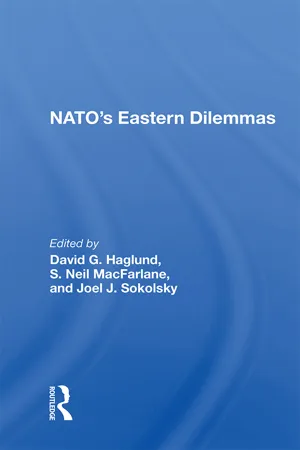
Nato's Eastern Dilemmas
About this book
The contributors to this book set out to show that NATO's post-Cold War troubles are largely self-generated and almost exclusively "eastern". They focus in particular on the issue of what to do with the former Yugoslavia.
Information
Part One
Eastern Challenges
1
NATO and the Quest for Ongoing Viability
David G. Haglund, S. Neil MacFarlane, and Joel J. Sokolsky
Introduction
The collapse of the Soviet Union, the consequent disappearance of the bipolar structure of European security, and the emergence of new foci of insecurity and instability in Central, Eastern, and Southeastern Europe all raise questions about the appropriate role of the North Atlantic Treaty Organization (NATO) as an institution of regional security in Europe. The questions are all the more urgent, since NATO has served as an institutional cement tying the United States and Canada to European security. Unless the organization has a clearly defined mission in Europe relevant to the interests of the transatlantic partners, their engagement in Europe may be subject to question. Moreover, in the post-Cold War environment, a number of other organizations also claim roles related to security, raising questions about how these various institutions relate one to another in coping with emerging issues of regional security, such as ethnic conflict, migration and refugees, and nonproliferation.
In this chapter, we examine the prospects for NATO in dealing with its new security environment. We begin by focusing on collective defense (as NATO's traditional mission) and collective security as a possible alternative in the new environment. We then discuss the possibility that, failing an embrace of collective security, the less ambitious agenda of peacekeeping might provide a viable role for the organization.
The Obsolescence of Collective Defense
The initial rationale of NATO was collective defense against a perceived shared Soviet threat. In this respect, NATO was a typical alliance. It is no secret that the Soviet threat no longer exists. The basis of NATO in collective defense is, consequently, under question. Alliances generally do not long survive the demise of the threat that brought them into being. Nonetheless, a shared threat might reemerge. There is significant military capability remaining in the former Soviet Union. The current phase of positive relations between the Russian Federation and the NATO powers could deteriorate over time. The process of economic reform has not produced particularly promising results. Levels of popular dissatisfaction with the current political system are rising. Polls show increasing lack of interest in democratic development and a growing stress on the restoration of order, even if this means a return to authoritarianism.1 Changes in Boris Yeltsin's cabinet and the slowing of the reform process suggest a rightward drift in Russian domestic politics—a drift that may have been halted, but not eliminated, by the crushing of the parliamentarians' revolt in early October 1993.2
In foreign policy, this has translated into increasing disillusion with the West, increasing resentment of Western policy, and a reassertion of Russian nationalism. In the former Soviet Union, the apparent rightward drift of Russian politics has already translated into greater assertiveness in relations with the non-Russian republics.3 It is to be expected that the Russian government will attempt to reestablish a degree of hegemony within the boundaries of the former union. This has involved, and will continue to involve, Russian efforts to limit the sovereignty of these newly independent states and to secure their compliance with Russian approaches to economic and security cooperation.4 Outside the former USSR, Russian behavior with respect to both the Gulf and the Yugoslav crises in late 1992 and 1993 suggested that it is becoming more difficult for the West to define the nature of collective international action in regional crises that impinge on Russian interests.
Although the dissolution of the Supreme Soviet in Moscow and an outcome of the crisis that ensued strongly favoring Yeltsin may allay concerns about a reassertion of Russian imperial aspirations, a return to the halcyon days of Western orientation in Russian foreign-policy seems unlikely. In the first place, Yeltsin prepared the ground for his victory by coopting large portions of the moderately nationalist center and by adopting much of the substance of their foreign policy preferences. To the extent that he remains dependent on the Russian military and moderately conservative and nationalist centrists, he is unlikely to reverse course now. For these reasons, it might be prudent to sustain the commitment to collective defense.
However, one can take such concerns too far. First, Russia itself remains in a state of near chaos, with inflation running at 2000 percent, give or take a decile or two, and industrial output continuing to drop by around 20 percent.5 The center's control over the republic has more or less collapsed, with real power in the system shifting to regional and local authorities. The Russian Federation faces a number of deepening challenges from within to its sovereignty. These difficulties are sufficient to ensure that any regime in Russia is likely to be preoccupied with the internal crises for many years to come.
There are also serious problems relating to the Russian capacity to deploy and use force. Command and control over the armed forces remains problematic. The logistical system of Russian forces is in chaos. Commanders spend their time worrying about food and housing rather than strategy and tactics. The officer corps appears to be deeply divided on the question of reform and democratization. In the meantime, the Russian armed forces continue to shrink reasonably rapidly, as a result of deliberate national policy, but also owing to the failure of the regime to enforce its laws on conscription and to feed and properly house its troops.6
None of these problems is permanent. However, apart from the extreme "red-brown" fringe of the Russian political spectrum, no one seriously questions the post-Cold War settlement in Central Europe or entertains the possibility of the resumption of Cold War confrontation with the West. Those critical of what they take to be an excessively supine approach to the West by the Yeltsin-Kozyrev team argue not for a return to systemic confrontation, but for a recognition that Russia, like any other great power, has distinct interests, that these in part coincide with and in part depart from those of the Western alliance, and that, therefore, Russia should be more independent in its foreign policy behavior.7
This is a far cry from the resurrection of a post-Soviet Russian threat that might justify the maintenance of an alliance such as NATO in its traditional configuration. In such conditions, it is difficult to see how a continuing commitment to collective defense is necessary and, consequently, how NATO as a collective-defense organization could be maintained.
The Collective-Security Alternative
This brings us to the issue of collective security in Europe. Many associated with the alliance see NATO's post-Cold War role to lie in participation in an evolving structure of collective security in Europe. Collective security involves the construction of a structure of security cooperation among a group of states whereby the group as a whole is committed to respond collectively to an act of aggression by any of its members against any other member.8
Two conceptual problems are worth noting. First, the concept of collective security pertains specifically to the actions of states and relations among them. It involves the collective security of a group of states to an act of aggression committed against one of them. Collective security is not obviously relevant to matters of domestic jurisdiction. Given the nature of security problems in the former Soviet Union and East-Central Europe, it is difficult to see how a traditional collective-security system could be effective. Most of the serious security issues faced by the region are not pure interstate issues where it could be unambiguously determined when aggression was or was not occurring.
The case of Bosnia-Herzegovina is illustrative. Is this a civil war, which is a matter of domestic jurisdiction? Or is it a question of aggression by one state against another? If the former, then it is hard to see how a collective-security system could respond. If the latter, then collective security comes into play. The case in question lies in between. Civil conflict is fuelled in important ways by external intervention, both by Serbia and Croatia.
This raises the question of the level at which intervention by an external party becomes aggression. Are arms transfers sufficient? Is the cutoff at the point at which armed volunteers from the other state involve themselves? How does one reliably identify such individuals? Or is it when organized units of the other state's armed forces insert themselves? The Eastern European landscape is littered with actual or potential cases where these questions complicate the definition of a collective international response (e.g., Georgia, Azerbaidzhan, Slovakia, Transylvania, Macedonia, Kosovo).
This may seem like nit-picking. One could argue that the matter of deciding when aggression has occurred is an essentially political one and that such distinctions are at best irrelevant and at worst obstructionist. The actions of a state elicit a collective-security response when the other states in the community decide that it has committed aggression. However, states within the North Atlantic system are highly attentive to issues of risk and cost, and are consequently predisposed by their domestic politics not to use force to maintain order in the eastern part of the European region. They can be expected, therefore, to approach the definitional issues considered here conservatively.
The other side of the decision process is perceived gain or interest from participation in collective action. A collective-security response is most likely to be forthcoming when the vital interests of a large number of members of the society of states are threatened by the aggressive actions of a rogue state. States are unlikely to contemplate the combat deployment of their forces where such interests are not perceived to be at stake. The contrast between the Gulf War and the former Yugoslavia is compelling.
Second, the effective operation of a collective-security system presumes the existence not merely of a community of states, but a community of values and a community of trust. Arguably there is such a community in Western Europe, but it is not universal. There seems to be little agreement beyond the boundaries of NATO Europe on the legitimacy of the Eastern territorial settlement, on the nonuse of force in the resolution of disputes, and on the limitation of the influence of national chauvinism over state policy in the East. In this sense, there is arguably an operating de facto collective-security system in the West (where it is not necessary) already, while there is not one and probably cannot be one in the East, where it is necessary.
Turning to prospects for collective security in Europe, structures of collective security may be either global or regional. There are serious problems in eliciting a global response to threats to regional security, since the interests of many of those involved in a decision to act are not obviously affected by the issue in question. There is consequently little obvious payoff for them in acting, and normal risk aversion will dictate evasion of responsibility. One saw this in the behavior of the United States toward Yugoslavia during the Serb-Croat crisis and in the early phases of Bosnia-Herzegovina. The United States—and for that matter the United Nations—preferred that Europe handle its own problems. Similar preferences were evident in the early American response to Somalia and in the attitude of the developed states toward the Liberian civil war.
These problems are matched at the regional level. Recent experience with efforts by regional organizations to manage security in their own regions are not encouraging. On the face of it, regional approaches to collective security have considerable merit. It is the states in a region affected by conflict that have the greatest stake in its resolution. They bear the refugee burden, the economic costs, and the risk of spillover.
But it is also the states within a region that are most likely to disagree on its politics. States within a region are likely to have a high interest in conflict occurring there, but there is no guarantee that their interests will coincide. Generally, the shared interest of states contiguous to a conflict in its management and resolution is accompanied by an array of unilateral competitive interests that these states will pursue at the expense of the community interest, either because they are selfish, or because they cannot be confident that other involved parties will behave in a disinterested fashion. The former Yugoslav cases are again full of examples.
Second, regions tend to contain asymmetries of power that impede cooperation in the realm of security. Larger states tend to have a larger say in the policies of regional organizations. Smaller ones tend to be nervous about large-state aspirations to hegemony. One reason for the serious disagreement between France and Germany on the breakup of Yugoslavia was a French concern about the rise of influence of the newly united Germany in Central and Eastern Europe. This limits prospects for cooperation in the management of regional security.9
For all of these reasons, the ground is not well-suited to the development of elaborate systems and structures of collective security. If NATO's Eastern dilemmas are dealt with at all (and frequently they may not be), it is likely to be through less ambitious and more ad hoc approaches (e.g., peacekeeping) or through rather traditional approaches to maintaining order, such as the recognition of spheres of influence, where particular states exercise a degree of responsibility for keeping the peace in return for recognized primacy.
Peacekeeping: The Future Is Not What It Used to Be
The alliance has identified peacekeeping, including ...
Table of contents
- Cover
- Half Title
- Title
- Dedication
- Copyright
- Contents
- List of Tables
- Preface and Acknowledgments
- Introduction
- PART ONE Eastern Challenges
- PART TWO Western Interests
- PART THREE Institutional Adaptation
- PART FOUR Conclusion
- About the Contributors
- Index
Trusted by 375,005 students
Access to over 1.5 million titles for a fair monthly price.
Study more efficiently using our study tools.
Frequently asked questions
Yes, you can cancel anytime from the Subscription tab in your account settings on the Perlego website. Your subscription will stay active until the end of your current billing period. Learn how to cancel your subscription
No, books cannot be downloaded as external files, such as PDFs, for use outside of Perlego. However, you can download books within the Perlego app for offline reading on mobile or tablet. Learn how to download books offline
We are an online textbook subscription service, where you can get access to an entire online library for less than the price of a single book per month. With over 1.5 million books across 990+ topics, we’ve got you covered! Learn about our mission
Look out for the read-aloud symbol on your next book to see if you can listen to it. The read-aloud tool reads text aloud for you, highlighting the text as it is being read. You can pause it, speed it up and slow it down. Learn more about Read Aloud
Yes! You can use the Perlego app on both iOS and Android devices to read anytime, anywhere — even offline. Perfect for commutes or when you’re on the go.
Please note we cannot support devices running on iOS 13 and Android 7 or earlier. Learn more about using the app
Please note we cannot support devices running on iOS 13 and Android 7 or earlier. Learn more about using the app
Yes, you can access Nato's Eastern Dilemmas by David G. Haglund in PDF and/or ePUB format, as well as other popular books in Politics & International Relations & Eastern European History. We have over 1.5 million books available in our catalogue for you to explore.