- 656 pages
- English
- ePUB (mobile friendly)
- Available on iOS & Android
eBook - ePub
About this book
This resource discusses all aspects of food poisoning and its sources such as bacteria, plant, and fungus - presenting the pathogens and food toxins in detail. Featuring contributions from over 30 leading authorities in the field, Food Poisoning ...: describes bacterial food contaminants including staphylococcal, salmonellae, E. coli, Clostridium perfringens, Bacillus cereus, cholera, and botulism; covers the prevention and treatment of mushroom and other poisonings from grains and plant-type foods; explains how to aid allergic reactions resulting from eating certain foods; identifies which kinds of seafood may cause severe poisoning; explores teratogenic aspects of food poisoning, outlining which foods pregnant women should avoid; and shows how those sensitive to nitrosamines can avoid such food poisoning.;Extensively referenced with more than 2200 literature citations, Volume 7: Food Poisoning serves as essential reading for toxicologists, microbiologists, dietitians and nutritionists, public health officials, food scientists and technologists, agricultural chemists and biochemists, bacteriologists, and graduate-level students in food science and toxicology.
Information
I
PUBLIC HEALTH PROBLEMS
1
Public Health Problems of Foodborne Diseases and Their Prevention
I. INTRODUCTION
II. STATUS OF FOODBORNE DISEASES
A. Incidence
B. Place of Mishandling
C. Implicated Foods
D. Factors That Contribute to Causation of Outbreaks
E. Economic Impact
III. APPROACHES FOR PREVENTION AND CONTROL
A. Surveillance of Diseases
B. Surveillance of Food-Establishment Workers
C. Surveillance of Foods
D. Surveillance of Food-Processing and -Preparation Environments
E. Surveillance of Food-Processing and -Preparation Operations
F. Training of Persons Who Handle Foods and Supervise Its Safety and Quality
G. Education of the Public About Food Safety
References
I. INTRODUCTION
Foodborne diseases are syndromes that are acquired as a result of ingesting foods that contain either an infectious or a toxigenic microorganism or a poisonous substance. For convenience they are classified into three categories. These are (1) infections, (2) toxin-mediated infections, and (3) poisonings or intoxications. The infections occur when microorganisms (e.g., pathogenic bacteria, viruses, parasites) invade and multiply in the intestinal mucosa or other tissues. The toxin-mediated infections are caused by certain pathogenic bacteria that produce enterotoxins (substances that affect water, glucose, and electrolyte transfer) during their colonization and growth in the intestine tract. The poisonings or intoxications follow ingestion of either poisonous chemicals, radionuclides, or toxins produced by microorganisms (e.g., marine plankton, bacteria). Hence, food poisoning is a misnomer, because illnesses result from mechanisms other than poisonings. The term, however, is often used in a general way to refer to illness resulting from the ingestion of foods or otherwise foodborne diseases.
This chapter introduces the foodborne disease problem by giving examples of the status of foodborne diseases in the United States. It also describes means by which these diseases can be prevented and controlled. The following chapters describe specific foodborne diseases and the measures for their control in more detail.
II. STATUS OF FOODBORNE DISEASES
Foodborne diseases are a continuing and nagging problem in all countries. Reports of foodborne diseases in the developed countries where surveillance is practiced are usually sporadic and quite incomplete. Yet, the sparse data suggests that the problem causes considerable morbidity and economic consequences. In developing countries, a significant proportion of deaths and illnesses attributed to gastroenteritis are foodborne, but the specific amount is unknown because of lack of investigations and surveillance records.
A foodborne disease outbreak is defined (with exceptions) as an incident in which two or more persons experience a similar illness, usually gastrointestinal, after ingestion of a common food, and epidemiological analysis indicates that food is the source of the etiological agents. The exceptions are a single case of botulism, a plant or chemical poisoning where ingestion is the mode of transmission, or any situation where ingestion of a food invariably leads to illness. A case is a person who shows signs or feels symptoms as a result of eating a contaminated food.
A. Incidence
Table 1 illustrates trends of annual reported outbreaks and cases of foodborne diseases over a period of 50 years. These indicate that there is no decline in the reported incidence despite improvements in sanitation, physical facilities where foods are processed and prepared, standards of living, and education of the populace. From 400 to 600 outbreaks of usually between 10,000 and 30,000 cases are reported annually. Large decreases in the reported number of outbreaks usually indicate a change in responsibility for foodborne disease surveillance or a gap in summarizing the data and a corresponding loss of reporting by state health agencies. Major changes are noted by footnotes. Variation in annual reported cases relate to whether large outbreaks were detected.
Table 1 Foodborne Outbreaks and Cases Reported in the United States, 1938–1987
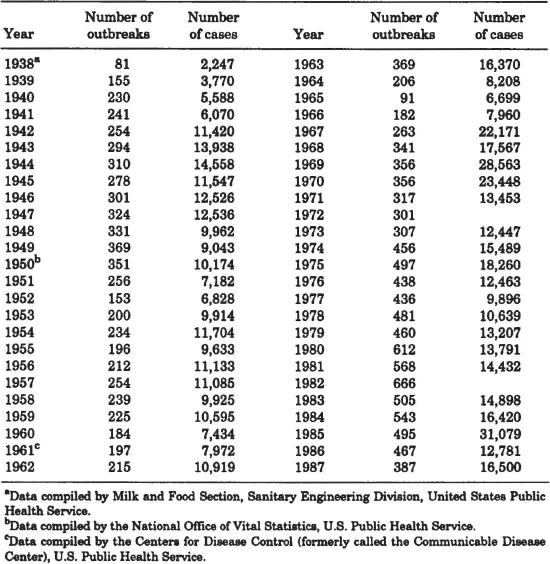
Source: Based on Bryan, 1972, adjusted through 1970; updated with surveillance reports from the CDC without adjustments.
It does not take much experience with surveillance of foodborne diseases to realize that the reports are woefully inadequate. Some of the reasons are that some persons have gastroenteritis and never realize that food was the vehicle (“It’s the flu or something.”) and others suffer their syndrome without seeking medical attention or complaining to health authorities. They may not, however, return to the place or eat the same type of food they f...
Table of contents
- Cover
- Half Title
- Title Page
- Copyright Page
- Preface to the Handbook
- Preface to Volume 7
- Table of Contents
- Contributors
- Contents of Previous Volumes
- Part I. Public Health Problems
- Part II. Bacterial Origin
- Part III. Plant and Fungal Origin
- Part IV. Allergy
- Part V. Seafood
- Part VI. Goiter
- Part VII. Teratogeny
- Part VIII. Antibiotics
- Part IX. Others
- Index
Trusted by 375,005 students
Access to over 1.5 million titles for a fair monthly price.
Study more efficiently using our study tools.
Frequently asked questions
Yes, you can cancel anytime from the Subscription tab in your account settings on the Perlego website. Your subscription will stay active until the end of your current billing period. Learn how to cancel your subscription
No, books cannot be downloaded as external files, such as PDFs, for use outside of Perlego. However, you can download books within the Perlego app for offline reading on mobile or tablet. Learn how to download books offline
Perlego offers two plans: Essential and Complete
- Essential is ideal for learners and professionals who enjoy exploring a wide range of subjects. Access the Essential Library with 800,000+ trusted titles and best-sellers across business, personal growth, and the humanities. Includes unlimited reading time and Standard Read Aloud voice.
- Complete: Perfect for advanced learners and researchers needing full, unrestricted access. Unlock 1.5M+ books across hundreds of subjects, including academic and specialized titles. The Complete Plan also includes advanced features like Premium Read Aloud and Research Assistant.
We are an online textbook subscription service, where you can get access to an entire online library for less than the price of a single book per month. With over 1.5 million books across 990+ topics, we’ve got you covered! Learn about our mission
Look out for the read-aloud symbol on your next book to see if you can listen to it. The read-aloud tool reads text aloud for you, highlighting the text as it is being read. You can pause it, speed it up and slow it down. Learn more about Read Aloud
Yes! You can use the Perlego app on both iOS and Android devices to read anytime, anywhere — even offline. Perfect for commutes or when you’re on the go.
Please note we cannot support devices running on iOS 13 and Android 7 or earlier. Learn more about using the app
Please note we cannot support devices running on iOS 13 and Android 7 or earlier. Learn more about using the app
Yes, you can access Handbook of Natural Toxins by Anthony Tu in PDF and/or ePUB format, as well as other popular books in Tecnología e ingeniería & Nutrición, dietética y bariatría. We have over 1.5 million books available in our catalogue for you to explore.