eBook - ePub
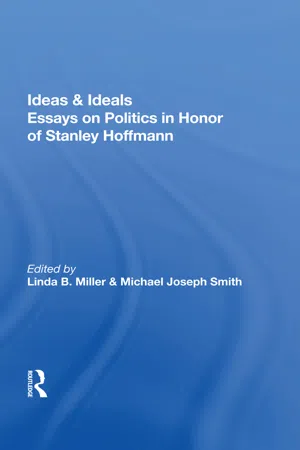
Ideas And Ideals
Essays On Politics In Honor Of Stanley Hoffmann
- 448 pages
- English
- ePUB (mobile friendly)
- Available on iOS & Android
eBook - ePub
Ideas And Ideals
Essays On Politics In Honor Of Stanley Hoffmann
About this book
This rich collection of original essays pays tribute to Stanley Hoffmann, a preeminent scholar of international relations and French politics who has inspired former students to explore the links between domestic society and foreign policy and between theory and practice. In two autobiographical chapters, Hoffmann traces his personal odyssey from F
Trusted by 375,005 students
Access to over 1.5 million titles for a fair monthly price.
Study more efficiently using our study tools.
Information
Part One
Perspectives on Teaching and Scholarship
1
A Retrospective on World Politics
It wasn’t I who chose to study world politics. World politics forced themselves on me at a very early age. I was born in Vienna at the end of 1928. However, as I explain in the next essay, I was brought up in France, in the 1930s, by an Austrian mother who disliked her native country (although not to the point of ever giving up her nationality!) and, like so many Central Europeans, preferred the South of France (Nice). But her brothers and their families had remained in Vienna; and they were Jews (converted or not). My first political memory is quite vivid. My mother and I (age 5) were in the garden of a lovely hotel in Vence—a hotel that later became a convent, a garden that now shelters Matisse’s ethereal chapel. She opened the newspaper and found out about the assassination of Austria’s Chancellor Dollfuss by the Nazis (July 1934). She turned to me and said that this was the beginning of the end for Austria—and for her family.
Two years later, after we left Nice and its sunshine for Paris and its grim lycée, I remember standing in a Paris bus and seeing a huge headline in a newspaper someone was reading: “La guerre pour demain?” (War for tomorrow?). It was the Rhinelandcrisis. The following year, I was a constant visitor to the huge International Exhibit along the Seine, where the German and the Soviet buildings faced one another, as if getting ready for battle. My lycée, in the bourgeois and reactionary suburb of Neuilly, where we lived, was filled with adolescents who shared their parents’ antisemitic and xenophobic prejudices; but I was introduced to a most endearing form of French cognitive dissonance. I had skipped a grade between Nice and Neuilly, and in order to adjust to the tougher Parisian schoolfare, I took some private lessons with my principal lycée teacher. She and her husband (who taught in a higher grade) were ardent readers of Maurras’ dreadful Action Française, the organ of “integral nationalism” (still battling the French Revolution, the Republic, and Dreyfus). Yet she couldn’t have been kinder and warmer toward the little Austrian, partly Jewish, rootless pupil, with whom she remained in touch as long as she lived.
In 1938, Hitler annexed Austria, and four of my mother’s brothers came as refugees with their families—one en route to Australia, two to England, and one to stay with us. I remember listening with horror to Hitler’s raucous voice on the radio at the time of Munich. I recount my story of the war years in the following essay; here I will simply say that on May 10, 1940, my unquiet world collapsed: the Germans invaded the Low Countries and France—and I had an emergency operation for appendicitis! Barely convalescent, I fled with my mother, and ten million other people, just two days before the Germans entered Paris. It took three days—in someone else’s car—to travel the 100 miles from Paris to Tours. We reached Bordeaux in time to hear Marshal Pétain’s call for an armistice.
The sinister years of the Vichy regime, followed by Italian and later German occupation, I spent back in Nice—sustained by the BBC broadcasts that gave one hope. The last nine months before the liberation, my mother and I hibernated in a small spa, a village of the Languedoc, away from the Gestapo and the anxieties of Nazi-infested Nice, but in the presence of about a thousand German soldiers barely older than I. In the fall of 1945, we returned to liberated but exhausted and freezing Paris, and to my Neuilly lycée. When, after my final baccalauréat exams of 1945, I had to choose a course in higher education, I settled on the Institut d’Etudes Politiques (Sciences Po) and the Law School: the latter because it was deemed practical, the former because, I thought, it would help me understand a world that had treated me reasonably well—I had survived—yet roughly.
Even though the curriculum at Sciences Po (an exciting school that was both rigorous and, by French standards, reasonably informal and free) was heavily centered on French affairs, I was attracted to international ones: diplomatic history, foreign policies and international law and organization. At the Law School—a grim and anonymous place, where economics was also taught (badly)—French and comparative public law, and international law, were the only subjects that interested me. When, after graduating from Sciences Po, in 1948, I decided to go for a doctorate in Law, I had to study private law, public law and economics in greater depth (Keynes was taught only for doctoral students, by the histrionic François Perroux). I chose as a thesis topic an issue that had come out of a question I had had to answer in an oral exam in Professor Suzanne Bastid’s demanding course on International Law at Sciences Po. The question was about the great powers’ right of veto in the U.N. The issue became the effect of international organizations on the political powers of states, 1815–1952: the European Concert, the League of Nations and the U.N. Obviously, I suffered from grandiosity! “Political powers” was my way of avoiding that eel-like concept of sovereignty, and of indicating that I was concerned not just with law but with politics.
My thesis, supervised by the formidable Mme. Bastid, didn’t please law professors, but it ended up being published by the Fondation Nationale des Sciences Politiques, the research branch of Sciences Po. It is quite unreadable (I’ve tried) but it has a first part I’m still pleased with: a study of the Concert of Europe as an embryonic international organization. (In those days, the concept of a regime still belonged to the lawyers.1)
While I worked on my thesis, I decided to renew my interest in political science—and to escape from law school—by applying for a fellowship for a year of study as a visiting graduate student in the Government Department at Harvard. I had seen Harvard in the summer of 1948 when I visited relatives who had settled in Boston after the Anschluss. I was attracted to the United States ever since an exciting summer spent at the Salzburg Seminar in American Studies, in 1950. There, I discovered the main issues in American history, contemporary society and culture, and I was especially fascinated by two men who became my friends, the great historian Richard Hofstadter, who died far too young, and the sociologist Howard Higman from Boulder. I came to Harvard in the fall of 1951, with my thesis still left to write. I discovered something I had never heard of in France: international politics as a legitimate and largely autonomous branch of political science. Hans Morgenthau’s ideas were all the rage—even if the rage took the form of sharp criticism. “Idealism,” legalism, moralism, were out, power was definitively in. The two men who served as my intellectual guides were Rupert Emerson, the gentle and learned scholar of imperialism and nationalism, who was the adviser, the shield, I was going to say the father, of foreign students, and one of the young stars of the Department, McGeorge Bundy, who asked me to assist him in his subtle and elegant course on American foreign policy (the head section man was my late friend, Robert Osgood). I was dazzled not only by the Department’s brilliant faculty but by my fellow graduate students (Judith Shklar, already the best, Zbigniew Brzezinski, the most competitive, Sam Huntington, Harvey Mansfield, Lloyd and Sue Rudolph, Paul Sigmund, Nicholas Wahl, Al Mavrinac, and many others—including my future wife Inge Schneier; Henry Kissinger was also among them, but he wasn’t around that year).
When I returned to France in July 1952, my thesis showed all the marks of a late, shotgun marriage between the “science” of international politics and the more French approach to international law and organization. But my time at Harvard convinced me that I wanted to become a professor, not (like many of my friends in Paris) a civil servant; a political scientist, not a professor of law. This effectively meant giving up a career in France. The Harvard Department of Government, thanks to my teachers of 1951–52—Bundy (now Dean of the Faculty of Arts and Sciences), Emerson, Sam Beer, Carl Friedrich—offered me an instructorship, and after 16 months of military service in France, in 1955, I returned to Harvard, where I still am.
II
When I look back at my work, I find a whole series of dualities (they often translate as ambivalences). The most obvious is that I am French and American. Perhaps because I was not born French or in France, I identified passionately with the French, and am undoubtedly an example of France’s own art of the “melting pot”—of France’s power of cultural assimilation, largely through its educational system. And yet, as I try to explain below, the latter’s rigidities, and various aspects of the French style of authority, I found hard to bear. My father (whom I had barely known) had been American; atavism as well as chance and choice led me to this country and gave me the blessing and burden of being able to observe each of my two nations as a partial outsider (i.e. to be marginal in each) and to try to interpret each one for the other.
I have, partly as a result, divided my scholarly career between work on France and work on world affairs. As a teacher, I have also worked on modern political ideologies. My interest in world politics came first. I started writing about France while at Harvard in 1951–52. My immersion in French political and intellectual history led to my fascination with the ways in which domestic experiences and traditions shape foreign policy, and affect thereby the international system; at the same time, this system often affects and shapes domestic politics by provoking a whole range of divergent responses. For years, the link behind my two “fields” was a leader whom I had deeply admired since June 1940, Charles de Gaulle.
The study of de Gaulle (or of any other great statesman) is the best cure against “structural” models of international relations that present the system, and particularly the distribution of power in it, as the decisive determinant of state behavior, and reduce nations to the condition of abstract units endowed only with one significant property: measurable—i.e. mainly military—power. To be sure, anarchy creates the security dilemma, but there are more ways of coping with the latter than in the constricted universe of game theory, and even states that are not among the greatest powers can respond in a variety of ways to the constraints—not to mention the opportunities—created by the system. My interest in France had led me, early on, to look at French foreign policy in Europe, often an attempt at escaping from or at finding external solutions for French internal problems.2 For post-war France, “the system” often took the form of … the United States. I was thus led to examine American policy toward France, and this in turn strengthened my interest in U.S. foreign policy in general, sparked by my studies at Harvard in 1951–52 (where I had, in particular, examined the role of Congress in American foreign policy in 1948–50).
I remain convinced that the most fruitful way of investigating world affairs is to do it from the unit level. World politics is, largely, the clash and convergence of state strategies; how these strategies are set and changed can best be understood by looking within the unit. At that level, few studies are more rewarding than those of statecraft (a field that is more art than science). The conflicts, the compromises, the rules and the institutions of world politics result from the moves of statesmen; and therefore the study of their character, of their ideas and of their style is essential.
A third duality results from my two sets of studies: law and political science. The study of politics has, inevitably, helped me undestand how people, and particularly political leaders, behave, how political forces get organized, how political issues get framed. But the years I spent on the study of law I have never regretted. First, law is a splendid technique for sharpening the mind, forcing clarity into concepts (or—in the case of sovereignty—forcing one to see clearly why the concept is unmanageable) and order and logic into arguments. Secondly, it draws attention to the importance of norms for behavior in human affairs, even when behavior itself often departs from these norms, as is the case in international relations. And it focuses the study of politics on institutions, which embody and enforce norms, corset behavior, serve as the channels and targets of political action. As a student of public and international law, I have always been interested by the way in which legal battles, and especially cases, mold and express the quintessence of broad political issues. In the 1950s, I wrote several articles dealing with U.S. constitutional law (on such issues as race, and the powers of the various branches of the government in foreign affairs) for French legal journals. I also began to explore the functions of international law in foreign policy.3 Later, I found that teaching international law for undergraduates was a good way of introducing them both to some of the fundamental issues of world politics and to some of the most important theoretical debates about the nature of international relations.
A fourth duality is related to the previous one—and to my own experiences. I find in my work a kind of schizophrenia. On the one hand there is a permanent demand for realism (not the doctrine, just the outlook!). It is partly a reaction against idealistic illusions in and mis-interpretations of world affairs (I am thinking of the legal constructions of Hans Kelsen and Georges Scelle). It also results from the influence of positivistic teachers of law, and from my own observations about political behavior. It comes from the luminous, relentless, never cynical but thoroughly anti-utopian analyses and dissections of social and international reality by Raymond Aron, the great French intellectual, scholar and journalist who had never been formally my teacher but whose works I had read as a student and who, after a chance meeting in a train late in 1952, became my mentor and friend. He had a razor- and laser-sharp mind. His phenomenal range, his articulateness, his ironic lucidity, his art of getting to the heart of every issue, of submitting it to rigorous, rational analysis and of reaching enlightened, reasonable conclusions filled me with admiration and awe.
The realist in me has been suspicious of theories that can too easily be interpreted as offering to the actors on the world stage ways out of their predicament (for instance in the form of supranational integration, or of international regimes); I am hostile to radical cures (such as disarmament or world government), and dubious about readings of the international system that predict pacification through nuclear wisdom or through economic interdependence. It is the realist who was attracted to the tough-mindedness of my Harvard colleague, Henry Kissinger. It is also the realist who deplored the flaws and limitations of Morgenthau’s Realism (with its fuzzy concepts and its unsatisfactory treatment of the normative aspects of international life) and of Waltzian neo-Realism, with its sterilizing effect on the study of world politics, a result of its anemic view of change in and skeletal conception of the dynamics of international affairs; for neo-Realism is a coarse sieve that eliminates most of what provides food for thought in the discipline: domestic realities and interstate or transnational processes, for instance. The realist in me is distrustful as well of all doctrines and theories that assume perfectly rational behavior and choices on the part of the actors. Reality, to me, was far too diverse and full of surprises to be contained in any such straitjacket.
On the other hand, there was in me an idealist, or utopian, who refused to give up, and whose values had been shaped by the horrors of the Second World War, by revulsion against totalitarianism, and by the conviction that humanity had to will a better future and could create it if it so willed. The realist was conscious of the power—the dangerous power—of leaders; the moralist was convinced that the common man was capable of sound judgment and decent behavior—if the circumstances allowed. Aron’s influence was mitigated by Camus’ seductive appeal, the call for justice and happiness in the very midst of an absurd universe, the claim that all action, and especially political action, had to respect limits, and especially the dignity of others. Aron himself was a coolly fervent Liberal, even if he tried to keep his ethics from distorting his analyses. The idealist in me found Realism too forgetful of the role of ideals and beliefs in decisions, too morosely convinced that the perpetual struggle for power, even in moderated forms, was our only possible horizon. My unfortunate thesis juxtaposed a realist analysis of state behavior (within and as a reaction to international organizations), and a wild call for overcoming sovereignty. I tamed the romantic urge, but remained concerned with a better future—with what I once called moving from a vicious circle to an ascending spiral. Hence my appeal for “relevant utopias,” my continuing conviction of the necessity of international institutions, my attempts to discover what kinds of ethical norms are both desirable and practical in international politics. Like Aron, I tend naturally to “think against.” Utopians tempt me into demonstrating (gleefully) that their recipes are worthless. Crass realists provoke me into trying to show that they have overlooked some exits.
III
My career as what my irreplaceable friend Hedley Bull called an international relationist appears to me as both simple and diverse. It has been simple insofar as I have repeated the same themes for more than thirty years, regardless of fads and fashions, and also because I have never left academia. It has been diverse, because my interests have been widely scattered. I’ve had the intellectual romps of a fox, and the convictions of a hedgehog.
Unlike many of my colleagues at Harvard, I have never been tempted by “Washington.” I have neither the temper of, nor the desire to be, a bureaucrat or policy adviser. I value my independence above anything else; working for others, shaping my ideas so that they can be conveniently used by statesmen or so that they can float in a muddy mainstream, simply never appealed to me. I remained too French to be a convincing American policymaker (this was not Kissinger’s or Brzezinski’s problem). Moreover, unlike theirs, my reaction to power is more dread than desire. I study power ...
Table of contents
- Cover
- Half Title
- Title
- Copyright
- Dedication
- Contents
- Preface
- PART ONE PERSPECTIVES ON TEACHING AND SCHOLARSHIP
- PART TWO MANAGING THE UNMANAGEABLE: CHOICES IN AN ANARCHIC MILIEU
- PART THREE STATE AND SOCIETY: CHANGE AND CONSTRAINTS
- PART FOUR RECAPTURING THE PAST: BELIEFS AND BELIEVERS
- PART FIVE IMAGINING ALTERNATIVE FUTURES
- About the Book
- About the Editors and Contributors
- Index
Frequently asked questions
Yes, you can cancel anytime from the Subscription tab in your account settings on the Perlego website. Your subscription will stay active until the end of your current billing period. Learn how to cancel your subscription
No, books cannot be downloaded as external files, such as PDFs, for use outside of Perlego. However, you can download books within the Perlego app for offline reading on mobile or tablet. Learn how to download books offline
Perlego offers two plans: Essential and Complete
- Essential is ideal for learners and professionals who enjoy exploring a wide range of subjects. Access the Essential Library with 800,000+ trusted titles and best-sellers across business, personal growth, and the humanities. Includes unlimited reading time and Standard Read Aloud voice.
- Complete: Perfect for advanced learners and researchers needing full, unrestricted access. Unlock 1.5M+ books across hundreds of subjects, including academic and specialized titles. The Complete Plan also includes advanced features like Premium Read Aloud and Research Assistant.
We are an online textbook subscription service, where you can get access to an entire online library for less than the price of a single book per month. With over 1.5 million books across 990+ topics, we’ve got you covered! Learn about our mission
Look out for the read-aloud symbol on your next book to see if you can listen to it. The read-aloud tool reads text aloud for you, highlighting the text as it is being read. You can pause it, speed it up and slow it down. Learn more about Read Aloud
Yes! You can use the Perlego app on both iOS and Android devices to read anytime, anywhere — even offline. Perfect for commutes or when you’re on the go.
Please note we cannot support devices running on iOS 13 and Android 7 or earlier. Learn more about using the app
Please note we cannot support devices running on iOS 13 and Android 7 or earlier. Learn more about using the app
Yes, you can access Ideas And Ideals by Stanley Hoffmann, Linda B. Miller,Michael Joseph Smith in PDF and/or ePUB format, as well as other popular books in Politics & International Relations & Political Ideologies. We have over 1.5 million books available in our catalogue for you to explore.