- 200 pages
- English
- ePUB (mobile friendly)
- Available on iOS & Android
eBook - ePub
About this book
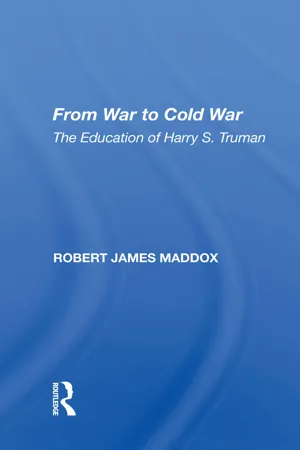
This book reviews the strains between the United States and Great Britain that led to the Cold War as the result of personal characteristics of the leaders of the United States, the Soviet Union, and Great Britain as well as of historical and ideological forces.
Chapter One
Introduction: The Grand Alliance
The United States and the Soviet Union became allies when Adolf Hitler declared war against the United States four days after the Japanese attack on Pearl Harbor. As allies, they dominated the anti-German coalition, along with Great Britain, and later bludgeoned Japan into surrender. The Grand Alliance was a strange partnership because the two Western nations had little in common with the Soviet Union beyond the necessity to defeat their enemies, and many Soviet wartime aims conflicted with those of its allies. That strains should have developed within such a relationship was inevitable; they existed already between the United States and Great Britain. That these strains led to the condition known as the Cold War was the result of personal characteristics of the leaders of the three nations as well as of historical and ideological forces.
Past U.S. relations with the Soviet Union provided an inauspicious foundation for collaboration. In 1917, President Woodrow Wilson had refused to recognize the revolutionary Bolshevik government on the grounds that it had seized power illegally and did not represent the will of the Russian people. In the early summer of 1918, he authorized a military intervention in Siberia through which he hoped to unseat the Bolsheviks. He did not intend the operation to accomplish this task directly. Rather, he wanted to secure the trans-Siberian railway for use as a pipeline to supply and equip anti-Bolshevik groups in the interior. He hoped that, nourished and trained, they would become strong enough to overthrow the radicals and establish a "responsible" government. His primary motive was to reopen the Eastern front, deactivated by the Brest-Litovsk Treaty in March 1918, but his dislike of bolshevism caused him to continue the operation for more than a year after the armistice of November 1918. Josef Stalin alluded to the intervention several times during World War II conferences; it no doubt strengthened the suspicions of a naturally suspicious man.1
Wilson contributed to U.S. distrust of the Soviet Union with his anti-Bolshevik rhetoric during the fight over the League of Nations and his toleration of witch-hunting subordinates, both of which helped create the "Red Scare." His nonrecognition policy was continued by Republican presidents, who periodically issued condemnations of Soviet activities within Russia and abroad.
As Democratic candidate for the presidency in 1932, Franklin Delano Roosevelt indicated he meant to reverse this policy. Nonrecognition had failed to produce any discernible changes in the Soviet regime, as its supporters had claimed it would, and many saw it as contrary to U.S. interests. Further, Soviet-U.S. rapprochement might curb Japanese aspirations in the Far East and might provide new markets for a U.S. economy mired in depression. Roosevelt began negotiations during his first months in office, but the benefits expected from recognition proved illusory. Disputes over Soviet payment of debts contracted during the war, legislation prohibiting loans to nations defaulting on such debts, and Comintern activity within the United States ruined chances of a working relationship.
During the depression years, Americans on the left generally regarded the Soviet government favorably. Many shared journalist Lincoln Steffens's frequently quoted view that the Soviet Union represented the future and "it works." The Soviet image was enhanced during the Popular Front period of the mid-1930s, when Communist parties in the West cooperated with liberals, because the USSR seemed an ally against fascism. Later, however, revelations of Stalin's purges convinced previous admirers that the Soviet government was a tyranny scarcely less onerous than Nazi Germany.
Events of 1939-1940 made matters worse. The USSR's antiaggression pact with Germany in August 1939 shocked even the remaining faithful, as did its occupation of eastern Poland two weeks after the Nazi invasion in September. Its invasion of Finland later that year made it appear that the Soviet Union was Hitler's partner in crime. Arguments in behalf of Soviet security needs did little to alter depictions of the struggle as one between tiny, brave Finland and the insatiable Russian bear. Soviet conduct after Hitler invaded the West did not change U.S. perceptions. As France collapsed and Great Britain struggled on alone, the USSR lived up to its commitments by providing foodstuffs and raw materials for the Nazi war machine. While doing so, it seized the three Baltic states of Latvia, Lithuania, and Estonia.
Germany's invasion of the USSR in June 1941 radically altered the situation. The then relatively unknown Sen. Harry S. Truman stated a popular view when he said that the United States should let the dictatorships fight it out and only help whichever side was losing. President Roosevelt understood, however, that the fate of Europe hinged on the outcome. If Russia collapsed, Hitler would have at his disposal virtually all the resources of the continent to use against the British. Roosevelt extended Lend-Lease Act benefits to provide war materials to the Soviets despite predictions that they could hold out only a few months at most. Attitudes changed later in the year when they not only slowed the Nazi onslaught, but fought it to a standstill before Moscow and Leningrad.2
The enormous struggle on the Eastern front led to two conclusions after the United States entered the war. The USSR would have to bear the brunt against Germany until Anglo-American power could be mobilized and, if victory were achieved, would play a major role in postwar Europe. These assumptions in turn posed two interrelated tasks for the United States, in Roosevelt's view. The first was to do everything possible to sustain Russia by providing badly needed supplies and equipment. The second was to convince Soviet leaders that past enmity and distrust must be put behind to create a lasting peace. FDR pushed his subordinates to fulfill the first obligation; the second he took upon himself.3
Having been assistant secretary of the Navy during World War I and president through most of the 1930s, Roosevelt understood Soviet suspicion of the Western powers. He sought to overcome it by convincing Stalin that the United States wanted cooperation to continue into the postwar world. To Roosevelt, success was necessary to maintain peace because, although he endorsed an international organization, he believed only a large power condominium would be effective. Finally, Soviet-U.S. collaboration during the war would make the American people more receptive to playing an active part in world affairs during peacetime.
FDR damaged his cause only a few months after Pearl Harbor. He approved a plan, drawn up by General George C. Marshall's staff, for a 1943 invasion of France across the English Channel. But the plan also contained provisions for an emergency assault in 1942 if that appeared necessary to stave off Soviet collapse. FDR became so enamored of the latter proposal that he cabled Stalin, asking him to send Foreign Minister V. M. Molotov to Washington to discuss a "very important military proposal involving the utilization of our armed forces in a manner to relieve your critical western front." Molotov arrived in Washington during late May after talks with the British in London. Responding to his direct question, Roosevelt assured him he could "inform Mr. Stalin that we expect the formation of a second front this year."4
It was a major blunder. British leaders regarded the plan as folly, and Winston Churchill hurried to Washington to persuade Roosevelt that North Africa was the only feasible place to open a second front. This was not what FDR had led the Soviets to expect, but he agreed because it would divert some German forces and because he believed it critical for American morale to take the offensive against Germany. In this instance, the British surely were right. Troops lacked training in amphibious operations, landing craft were in short supply, and long-range fighters to provide air cover were not yet operational. Considering the difficulties encountered when the cross-channel invasion did take place, landings in 1942 almost certainly would have led to disaster and prolonged the war. It is ironic that Roosevelt's zeal to encourage the Soviets and show them he was a good ally led him to make a promise he could not keep, thereby feeding their mistrust.5
The Soviets were disappointed again by the Casablanca Conference of January 1943. Stalin declined to attend, saying he was needed at home to direct the war effort. At the conference, Roosevelt and Churchill agreed to the invasion of Sicily. Although preparations for a cross channel invasion were stepped up, it was put off for another year. The decision was made within the context of conflicting views between the United States and Britain over strategy, but it must have seemed to Stalin that his Western allies were leaving the Soviet Union to bear the burden while they waited to pick up the pieces.
At Casablanca, Roosevelt proclaimed one of the most controversial policies of the war: the doctrine of "unconditional surrender." He said the idea simply popped into his mind at the time, and Churchill later wrote that FDR's statement astonished and appalled him. Neither told the truth. Roosevelt had decided on unconditional surrender weeks earlier and secured Churchill's assent before making the announcement. Critics have charged that the policy prolonged the war because Nazi and Japanese propagandists used it as proof that the Allies meant to destroy their nations. FDR adopted the doctrine to avoid what he regarded as a mistake of the last war, when a negotiated peace permitted extremists to claim that Germany had not been defeated in the field, but had been "stabbed in the back" at home. He also wanted to compensate for failure to open a second front by assuring Stalin that his Western partners would not negotiate separately with the enemy. In so doing, he hoped to dispel any notion the Soviets might have of making terms with Hitler.6
Roosevelt had a chance to win over Stalin in person at the Teheran Conference, which met in late November 1943. Convinced of his persuasiveness, the president believed he could convince the Soviet leader of American goodwill. The fabled Roosevelt charm does not translate well in conference notes. It consisted largely of jokes and quips, often at Churchill's expense. Stalin responded indulgently, thereby leading Roosevelt to think he had succeeded. He later told an aide that the more he teased the prime minister the more Stalin warmed up, until at last he "broke into a deep, heavy guffaw. . . . The ice was broken and we talked like men and brothers." That FDR accomplished anything more than encourage Stalin to exploit Anglo-American differences is unlikely. Yet Churchill shared Roosevelt's illusion. "If only I could dine with Stalin once a week," he boasted shortly after Teheran, "there would be no trouble at all. We get on like a house on fire."7
Aside from an Anglo-American promise to launch the long-delayed cross-channel invasion by late spring of 1944, most of the discussions at Teheran were exploratory. They established positions on issues that would provide the basis for negotiation at Yalta. Postwar treatment of Germany was an exception. Both Stalin and Roosevelt inclined toward radical dismemberment of Germany to prevent repetition of what had happened after the last war. FDR offered a plan for dividing Germany into five parts and for establishing a trusteeship over the Ruhr and Saar region. Even Churchill, who opposed such a drastic approach as likely to produce chaos, recommended that Prussia be detached from the rest of Germany. All three leaders, for reasons of their own, retreated from this concept in the months following and showed little enthusiasm for it at Yalta.
Talks about Poland revealed a dilemma that would plague Roosevelt. The Atlantic Charter he and Churchill had issued in August 1941 condemned territorial changes imposed by force and endorsed the right of all peoples to choose their form of government. Although Stalin had given a hedged endorsement of the charter, Roosevelt understood he was adamant about retaining Polish territory occupied in 1939— roughly corresponding to the Curzon Line—and also meant to establish a "friendly" government.8 How could FDR agree without incurring the criticism, particularly from voters of Polish extraction, that he had betrayed the charter to placate Stalin?
Roosevelt took refuge in silence. He said little in discussions during which Churchill and Stalin agreed that Poland should be compensated for losses in the east by gaining German territory up to the Oder River. They were far apart on who would govern Poland. Churchill hoped to work out an arrangement between the London-based Polish government in exile and the Soviets, but their relations had been poisoned six months earlier when the former publicly accused the USSR of murdering nearly 5,000 Polish officers in the Katyn Forest in 1940. FDR told Stalin privately that he was sympathetic to Soviet desires, but that he could not be a party to any agreements until after the 1944 elections because he was afraid of alienating the Polish vote. Stalin said he understood.9
Roosevelt's success in trying to resolve the contradictions between idealistic wartime statements and his realistic assessment of Soviet goals depended on Stalin's cooperation in Eastern Europe. It helps explain why he so ardently courted the Soviet leader's trust. If Stalin were convinced of America's goodwill, FDR reasoned, his apprehension about security might be sufficiently eased to permit him to treat this area with a light hand. If he valued partnership, furthermore, he would spare Roosevelt domestic embarrassment by at least going through the motions of holding plebiscites and relatively free elections. FDR was a bit cynical perhaps, but what was the alternative? If he pressed matters over which he had no control, he would justify Stalin's fears and probably cause him to choke occupied nations into submission. No one would benefit.
Roosevelt explained to Stalin his ideas about a United Nations. He saw it as a three-tiered affair: an assembly of all nations, limited to debate; a council composed of the Big Four (the United States, Great Britain, the USSR, and China, which FDR included despite its weakness and internal divisions) and six regional representatives, which could decide nonmilitary issues; and finally, what he called the "four policemen." Only the latter, he said, had power to enforce peace. When Stalin suggested separate organizations for Europe and Asia, to be dominated by the United States, Great Britain, and the Soviet Union, Roosevelt said he doubted Congress would approve an arrangement that might involve sending U.S. troops to Europe. As one scholar has written, Stalin "must have been delighted to learn that Roosevelt planned to permit the Russian and British armies to dominate the continent after the war."10 Roosevelt said he wanted to study the issue further, so it was not discussed in formal session nor mentioned in the communiqué. He later abandoned the phrase "four policemen" as too blatant, but they would dominate the Security Council as permanent members with veto power.
Asian affairs were discussed briefly at Teheran. Although the United States had taken the offensive in the Pacific more than a year earlier, it was assumed that many months of fighting lay ahead and that an invasion of the Japanese home islands would be necessary. The atomic bomb was only a possibility that could not figure in military calculations. Roosevelt believed it crucial that the Soviets engage Japanese forces on the mainland so they could not be employed against U.S. landings. Stalin repeated a promise he had made to Secretary of State Cordell Hull in Moscow a few weeks before the conference: The USSR would declare war on Japan two or three months after Germany's defeat. When he said he expected compensation f...
Table of contents
- Cover
- Half Title
- Title
- Copyright
- Contents
- Acknowledgments
- 1 Introduction: The Grand Alliance
- 2 Yalta
- 3 After Yalta: The Rifts Begin
- 4 From V-E Day to Potsdam
- 5 The Potsdam Conference
- 6 The Far East
- 7 The Atomic Bomb: A New Dimension
- 8 The Coalition Unravels
- 9 The Adversaries
- Selected Bibliography
- Index
Trusted by 375,005 students
Access to over 1.5 million titles for a fair monthly price.
Study more efficiently using our study tools.
Frequently asked questions
Yes, you can cancel anytime from the Subscription tab in your account settings on the Perlego website. Your subscription will stay active until the end of your current billing period. Learn how to cancel your subscription
No, books cannot be downloaded as external files, such as PDFs, for use outside of Perlego. However, you can download books within the Perlego app for offline reading on mobile or tablet. Learn how to download books offline
Perlego offers two plans: Essential and Complete
- Essential is ideal for learners and professionals who enjoy exploring a wide range of subjects. Access the Essential Library with 800,000+ trusted titles and best-sellers across business, personal growth, and the humanities. Includes unlimited reading time and Standard Read Aloud voice.
- Complete: Perfect for advanced learners and researchers needing full, unrestricted access. Unlock 1.5M+ books across hundreds of subjects, including academic and specialized titles. The Complete Plan also includes advanced features like Premium Read Aloud and Research Assistant.
We are an online textbook subscription service, where you can get access to an entire online library for less than the price of a single book per month. With over 1.5 million books across 990+ topics, we’ve got you covered! Learn about our mission
Look out for the read-aloud symbol on your next book to see if you can listen to it. The read-aloud tool reads text aloud for you, highlighting the text as it is being read. You can pause it, speed it up and slow it down. Learn more about Read Aloud
Yes! You can use the Perlego app on both iOS and Android devices to read anytime, anywhere — even offline. Perfect for commutes or when you’re on the go.
Please note we cannot support devices running on iOS 13 and Android 7 or earlier. Learn more about using the app
Please note we cannot support devices running on iOS 13 and Android 7 or earlier. Learn more about using the app
Yes, you can access From War to Cold War by Robert James Maddox in PDF and/or ePUB format, as well as other popular books in History & Military & Maritime History. We have over 1.5 million books available in our catalogue for you to explore.