eBook - ePub
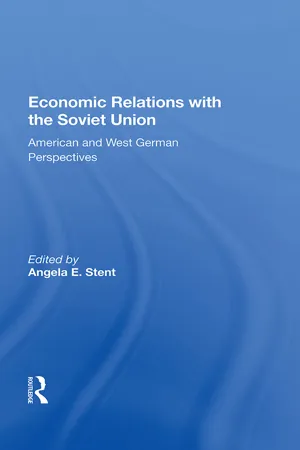
Economic Relations with the Soviet Union
American and West German Perspectives
- 200 pages
- English
- ePUB (mobile friendly)
- Available on iOS & Android
eBook - ePub
About this book
In recent years, the United States and the Federal Republic of Germany have disagreed sharply over the politics and economics of East-West relations. This book examines the political and economic premises behind American and West German approaches toward East-West commerce and analyzes the degree to which views differ. The contributors, a mix of Ge
Information
Part One
The Political Dimension
1
US-Soviet Relations: Detente or Cold War?
Any examination of economic relationships involving the United States, the Federal Republic of Germany and the Soviet Union must inevitably consider the broader context of East-West politics. For each of these states, trade relations with members of the opposing alliance system have always been intimately linked with political strategy. Indeed, trade has often been consciously subordinated to the pursuit of distinctly political goals by foreign policy decision makers in Washington, Bonn and Moscow. In some instances this has led to a deliberate contraction in East-West economic cooperation and, in others, to its promotion. To be sure, economic considerations have at times exercised an important influence of their own on political decisions affecting relations among these countries, as policymakers and important interest groups at home have come to perceive the beneficial effects of East-West trade for the domestic economy. In general, however, it has been the primacy of politics over economics that has usually prevailed in these three countries, with diplomatic, military and at times ideological considerations generally taking precedence over purely economic calculations in the formulation of foreign policy towards the opposing side.1
It is therefore imperative, when examining American and West German attitudes on economic ties with the USSR and its allies, to keep this wider political canvas prominently in focus. Many of the conflicts and misunderstandings that have occurred in recent years between Washington and Bonn on various issues relating to trade with the Soviet bloc reflect political differences in their respective perceptions of, and policies towards, the USSR and Eastern Europe. By the same token, disagreements on economic matters between these two leading NATO allies in their policies toward the Soviet alliance tend to assume a less severe character when viewed against the backdrop of enduring political (and above all security) interests which serve to unite them and to keep disputes on other issues from getting out of hand. It is the main purpose of this essay to help provide this wider political perspective.
More precisely, the object of the ensuing analysis is to situate West Germanyfs Ostpolitik within the broader framework of US-Soviet relations. Recently, much attention has been given to the question of whether West Germany can succeed in isolating the more positive aspects of its relations with the East (particularly its ties with the German Democratic Republic, but also its trade agreements with the Soviets) from the disturbing effects of increased tension between the United States and the Soviet Union. TTiis question is particularly appropriate in the light of the Carter administration’s sharp reaction to the Soviet invasion of Afghanistan in December 1979, and to the harsh anti-Soviet rhetoric and vigorous military build-up pursued by the Reagan administration upon assuming office in 1981. Since the beginning of the present decade, an observable contrast has arisen between the conflictuel nature of US-Soviet relations and the attempts by successive West German governments, first under Helmut Schmidt and subsequently under Helmut Kohl, to keep a measure of East-West cooperation alive.
While this contrast is indeed real, it conceals a fundamental irony. Despite their continuing global rivalry and deep-seated hostility, the United States and the Soviet Union have traditionally had more in common with each other than with West Germany in defining the broad contours of East-West relations. Washington and Moscow have come to share roughly similar views about both the persistence of East-West conflict and the limits of East-West cooperation in the postwar world. They have also shared a vested mutual interest in maintaining the political status quo in Europe. The Federal Republic, by contrast, has never fully accepted the postwar division of Germany as permanent and, at least since the second half of the 1960s, has sought to widen the margins of cooperation with the East in hopes of someday overturning Europe’s (or in any event Germany’s) bifurcation.
These contrasts between American and Soviet conceptions of the realities of East-West relations, on the one hand, and West Germany’s views about the ultimate direction these relations should take, on the other hand, are perhaps nowhere more visible than in the alternative conceptions of detente elaborated by these three governments in the 1970s. It is the principal argument of this chapter that—in spite of all claims and disclaimers to the contrary put forward by official spokesmen—both Washington and Moscow conceived of detente essentially as a new phase in their on-going Cold War, not as a radical break from the basic patterns of their relationship as it had evolved over the course of the 1950s and 1960s. “Cold War” and “detente,” in other words, should not be viewed as antithetical notions when applied to American and Soviet policy in the postwar international system.
For West Germany, however, detente was viewed as the onset of a long-term transformation of East-West relations, particularly in Europe. As articulated and practiced above all by Willy Brandt, detente implied an eventual end to the Cold War and a gradual but decisive rupture in the long spiral of conflict between the capitalist world and the communist regimes.
Obviously, this interpretation rests to a considerable extent on the way one defines such politically charged terms as Cold War and detente. To be sure, these labels defy easy translation into succinct, dictionary-style definitions. But any effort to elucidate their political implications requires us to be as clear as possible about what they mean.
Let me therefore begin by defining the Cold War as the state of political conflict short of direct war between the capitalist democracies and the states governed by communist parties—above all, of course, the United States and the Soviet Union. TTifs conflict rests upon antithetical political ideologies and geopolitical rivalries, and is characterized by arms races and occasional indirect wars involving clients of the superpowers, among other forms of conflict.
To this skeletal definition several features of what is usually thought of as the period of the Cold War (the late 1940s to the early or mid-1960s) must be added. First, the intensity of this conflict varied over the course of this period. At times, the two superpowers appeared to be on the brink of war (for instance, the Berlin blockade, the Cuban missile crisis), at other times there was a distinct thaw in the general chill (“the spirit of Geneva,” “the spirit of Camp David”). Second, the scope of the US-Soviet rivalry in these years underwent a shift from Stalin’s emphasis on Europe and the Far East to the more globalized conflict extended under Khrushchev to the Third World. Third, the intensity of invective also oscillated noticeably, from bullying threats (“rollback,” “We will bury you”) to competitive boasting over reputedly peaceful intentions (“peaceful coexistence,” “peaceful competition”). Fourth, there were variations in the military power balance between the two main adversaries, and especially in their perceptions of the military balance (for instance, the US monopoly of the atomic bomb followed by the USSR’s success in testing the first H-bomb; US strategic superiority over the Soviet Union versus Soviet manpower superiority in Europe; Sputnik and the American reaction to it; the “missile gap,” followed by the enhancement of US strategic superiority, etc.). Finally, at no time during these decades were agreements or mutual compromises ruled out as a matter of principle. Confrontation did not preclude negotiation. Accord was reached on a number of outstanding issues, either by formal agreement (for instance, the Austrian State Treaty, the Geneva agreement on French withdrawal from Vietnam, the Nuclear Test Ban Treaty) or by tacit consent not to challenge the status quo (for instance, in Western and Eastern Europe; in the Middle East during the Suez crisis).
What is perhaps most striking about these decades is the relative swiftness with which the superpowers could swing from intense confrontation to at least a modicum of understanding (and, all too often, back again). With two quick strokes, the Soviets in May 1955 signed the Austrian State Treaty on one day and the treaty establishing the Warsaw Pact on the next. The “spirit of Camp David” took wing in the midst of a gathering crisis over Germany, which culminated in the construction of the Berlin Wall in 1961. And in perhaps the sharpest reversal of all, Moscow linked eyeballs with the United States over missiles in Cuba in October 1962, only to join in signing the Test Ban Treaty a scant ten months later.
The Cold War years, in short, were not a period of unrelieved hostility between the two superpowers. Similarly, detente, at least as formulated in Washington and Moscow, was by no means intended to end the fundamental US-Soviet hostility itself. And yet, in both capitals, the architects of detente policy went to great rhetorical lengths to announce the advent of a whole new epoch in East-West relations. The Nixon administration declared in 1969 that the superpowers would now pass from the “era of confrontation” to the “era of negotiation.” Soviet leaders, in slightly less cosmological terms, also ascribed to detente all the attributes of a major turning point in East-West relations. For their part, many West Germans professed to see in detente the opportunity for major initiatives aimed at overcoming the division of the continent.
Scarcely a dozen years later, these lofty ambitions for the most part lay in shambles. The United States and the Soviet Union confronted each other in a virulent arms race, in a host of Third World conflicts, and in Europe itself. This intensified superpower conflict cut directly across Germany, where the remains of detente hung by the slender threads of the inter-German relationship. Meanwhile, the rhetoric of US-Soviet relations reverted to the Maniehean excesses of the 1950s, with imputations of evil and prophecies of war ringing from both sides. These events have led many to conclude that detente is dead, and that a “new Cold War” has begun. But is (or was) detente really as distinct from Cold War politics as it practitioners indicate?
Since detente has meant different things to different people, the need to define the term with some precision is inescapable. One way of doing this is to distinguish between detente as a principle and detente as a policy (or set of policies). As a political principle, detente means a “relaxation of tensions.” (The Russian term for detente is literally that.) Much of the confusion engendered by the term derives in large part from the overwhelmingly positive connotations of this dictionary definition. As a political principle, detente contains barely a hint of conflict; the emphasis is entirely on the element of “relaxation,” while the continuing tensions are assumed to be fading into insignificance. The fact that, strictly speaking, the “relaxation” of tensions does not signify their elimination tends to get overlooked. By itself, detente inspires images of peace, not struggle.
Detente as a policy (or, more precisely, as the designation given to a policy) can indeed reflect these positive connotations, and thus aim almost exclusively at reducing political tensions to zero, or close to it. But detente as a policy can also involve a predisposition towards conflict as one of its constituent elements. Despite their occasionally roseate portrayals of detente, policy-makers in Washington and Moscow in fact never abandoned the fundamental premise of Cold War polities—that the East-West relationship was fundamentally conflictuel in nature and would remain so indefinitely. For both of these governments, detente was conceived as a policy for managing an essentially irreconcilable conflict, albeit under new conditions and with somewhat altered means. Both American and Soviet leaders in the 1970s continued to pursue many of the same objectives that had guided the US-Soviet relationship since the 1950s.
This stood in marked contrast to West German conceptions of detente, especially those espoused by figures such as Willy Brandt and his chief foreign policy adviser, Egon Bahr. At least in their initial formulations of detente policy in the late 1960s and early 1970s, Brandt, Bahr and other like-minded West Germans came closer to the notion of detente as a principle than to the actual policy implications of the term as understood by Nixon, Kissinger and Brezhnev. What the West German advocates of detente looked forward to was the implementation of a process designed to break down the barriers—both figuratively and literally—of East-West conflict, at least as far as Europe was concerned. Moscow and its allies were to be drawn into a steadily expanding web of political, economic, cultural and military agreements aimed at deepening trust and amity among the peoples and governments of both halves of Europe. In this design, the gradual but persistent development of reciprocal political concessions, growing economic interdependence and, ultimately, mutual military disengagement by both alliances would, over time, surmount traditional animosities toward West Germany among the Soviets and East Europeans. This, in turn, would set the stage at some point in the distant future for the culminating goal of the detente process—the reunification of Germany.2
Of course, not everyone in the FRG shared this conception in the early 1970s, especially in the ranks of the Christian Democratic parties. Since that time, even some Social Democratic leaders have backed away from certain ideas and preconceptions that underlay the early variant of Brandt’s Ostpolitik. Nevertheless, by the 1980s all the major West German political parties were more committed to promoting political and economic cooperation with the Soviet Union, the GDR and other Warsaw Pact states than either the Carter or Reagan administrations. Even Helmut Kohl’s scaled-down version of Ostpolitik is rooted, like Brandts more ambitious design, in German interests, based on priorities that are not necessarily shared by either Washington or Moscow.
It is to the evolution of American and Soviet perspectives on East-West relations that we now turn, starting with their perceptions of the world scene at the start of the detente period.
The Seminal Years of Detente: 1969–1975
As American leaders surveyed the international scene at the start of the new decade, their gaze fell only rarely on Europe. All eyes were turned instead to the quicksands of Vietnam. American self-absorption with the Vietnam conflict had by now become all-consuming, and the search for a way out of the debacle was unavoidably the new administration’s highest priority. More importantly, the US foreign policy elite had already begun to “draw the lessons” of the exasperating Vietnam experience, and a national consensus was developing around the idea that every effort must be made in the future to avoid a repetition of the disaster. With the evident failure of overwhelming military power to vanquish a primitively armed adversary, many now questioned the utility of force in the pursuit of American foreign policy goals, and called for a scaling down of the vast US military machine. For the first time in decades, Congress effectively challenged Pentagon budget requests.
Although both President Nixon and his National Security Adviser, Henry Kissinger, were determined to get out of Vietnam “honorably,” they were nonetheless determined to get out. Their chief differences with their more dovish critics were over the pace and conditions of withdrawal, not over its desirability. And although they never shared the deepening distrust expressed by some Americans concerning the utility of military force as an effective (or even morally legitimate) instrument of foreign policy, Nixon and Kissinger were compelled to draw the appropriate conclusions from popular—and Congressional—sentiment. Accordingly, as “Vietnamization” progressed and American soldiers were brought home, the rate of military spending gradually tapered off, certain defense programs were put on hold, and the draft was abolished. The reponse to fears of over-commitment was the Nixon Doctrine.
Thus, as America took its pulse at the turn of the new decade, its mood reflected the cautious attitudes of non-interventionism, anti-militarism, and, at the extreme edge, neo-isolationism. While neither the President nor his chief advisers sympathized with these attitudes in principle, they fully recognized that US foreign policy was going to be subject to a series of new constraints for an indefinite period of time. The United States had embarked on a period of retrenchment.3
The mood in Moscow was very different. In contrast to America’s “crisis of confidence,” Kremlin leaders by the early 1970s had reason to congratulate themselves on a decade of proven successes. They had only to look at how far they had come, both domestically and internationally, since the humiliation of the Cuban missile crisis to find justification for their growing self-assurance. In the early 1960s, the United States had possessed an overwhelming strategic advantage over Soviet defense forces; the Kremlin’s public polemics with China were assuming an embarrassingly vitriolic character; America’s popularity in Western Europe had risen to new heights (especially in West Germany, ...
Table of contents
- Cover
- Half Title
- Series Page
- Title
- Copyright
- Contents
- List of Tables
- Foreword
- Preface: Transatlantic Divide?
- PART ONE THE POLITICAL DIMENSION
- PART TWO THE ECONOMIC DIMENSION
- PART THREE THE SECURITY DIMENSION
- PART FOUR TOWARD A NEW GERMAN-AMERICAN CONSENSUS
- Afterword
- Abbreviations
- About the Contributors
- Index
Trusted by 375,005 students
Access to over 1.5 million titles for a fair monthly price.
Study more efficiently using our study tools.
Frequently asked questions
Yes, you can cancel anytime from the Subscription tab in your account settings on the Perlego website. Your subscription will stay active until the end of your current billing period. Learn how to cancel your subscription
No, books cannot be downloaded as external files, such as PDFs, for use outside of Perlego. However, you can download books within the Perlego app for offline reading on mobile or tablet. Learn how to download books offline
Perlego offers two plans: Essential and Complete
- Essential is ideal for learners and professionals who enjoy exploring a wide range of subjects. Access the Essential Library with 800,000+ trusted titles and best-sellers across business, personal growth, and the humanities. Includes unlimited reading time and Standard Read Aloud voice.
- Complete: Perfect for advanced learners and researchers needing full, unrestricted access. Unlock 1.5M+ books across hundreds of subjects, including academic and specialized titles. The Complete Plan also includes advanced features like Premium Read Aloud and Research Assistant.
We are an online textbook subscription service, where you can get access to an entire online library for less than the price of a single book per month. With over 1.5 million books across 990+ topics, we’ve got you covered! Learn about our mission
Look out for the read-aloud symbol on your next book to see if you can listen to it. The read-aloud tool reads text aloud for you, highlighting the text as it is being read. You can pause it, speed it up and slow it down. Learn more about Read Aloud
Yes! You can use the Perlego app on both iOS and Android devices to read anytime, anywhere — even offline. Perfect for commutes or when you’re on the go.
Please note we cannot support devices running on iOS 13 and Android 7 or earlier. Learn more about using the app
Please note we cannot support devices running on iOS 13 and Android 7 or earlier. Learn more about using the app
Yes, you can access Economic Relations with the Soviet Union by Angela E. Stent in PDF and/or ePUB format, as well as other popular books in Économie & Commerce Général. We have over 1.5 million books available in our catalogue for you to explore.