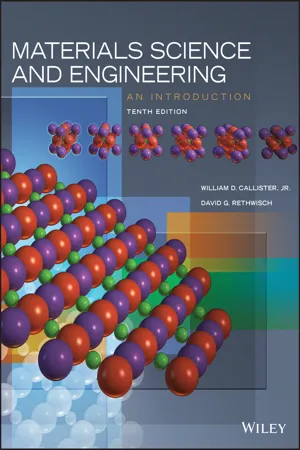
Materials Science and Engineering: An Introduction promotes student understanding of the three primary types of materials (metals, ceramics, and polymers) and composites, as well as the relationships that exist between the structural elements of materials and their properties. The 10 th edition provides new or updated coverage on a number of topics, including: the Materials Paradigm and Materials Selection Charts, 3D printing and additive manufacturing, biomaterials, recycling issues and the Hall effect.
eBook - PDF
Materials Science and Engineering
An Introduction
- 984 pages
- English
- PDF
- Available on iOS & Android
eBook - PDF
About this book
Key takeaways
AI-Generated Insights
Insight 1
Analyze the fundamental atomic and crystalline structures of metals, ceramics, and polymers, and correlate these structures with their resulting mechanical, electrical, thermal, magnetic, and optical properties.
Insight 2
Differentiate the primary classes of engineering materials—metals, ceramics, polymers, and composites—by their characteristic structures, processing methods, and typical applications, including advanced manufacturing techniques such as 3D printing.
Insight 3
Apply principles of phase transformations, mechanical behavior, and degradation to evaluate material performance and select appropriate materials for specific engineering applications. This includes considering environmental and societal impacts such as recycling.
Information
Table of contents
- Cover
- Title Page
- Copyright
- Dedication
- Preface
- Acknowledgments
- Contents
- List of Symbols
- 1. Introduction
- 2. Atomic Structure and Interatomic Bonding
- 3. The Structure of Crystalline Solids
- 4. Imperfections in Solids
- 5. Diffusion
- 6. Mechanical Properties of Metals
- 7. Dislocations and Strengthening Mechanisms
- 8. Failure
- 9. Phase Diagrams
- 10. Phase Transformations: Development of Microstructure and Alteration of Mechanical Properties
- 11. Applications and Processing of Metal Alloys
- 12. Structures and Properties of Ceramics
- 13. Applications and Processing of Ceramics
- 14. Polymer Structures
- 15. Characteristics, Applications, and Processing of Polymers
- 16. Composites
- 17. Corrosion and Degradation of Materials
- 18. Electrical Properties
- 19. Thermal Properties
- 20. Magnetic Properties
- 21. Optical Properties
- 22. Environmental, and Societal Issues in Materials Science and Engineering
- Questions and Problems
- Appendix A The International System of Units (SI)
- Appendix B Properties of Selected Engineering Materials
- Appendix C Costs and Relative Costs for Selected Engineering Materials
- Appendix D Repeat Unit Structures for Common Polymers
- Appendix E Glass Transition and Melting Temperatures for Common Polymeric Materials
- Appendix F Characteristics of Selected Elements
- Appendix G Values of Selected Physical Constants, Unit Abbreviations, SI Multiple and Submultiple Prefixes
- Appendix H Unit Conversion Factors, Periodic Table of the Elements
- Glossary
- Index
- EULA
Trusted by 375,005 students
Access to over 1.5 million titles for a fair monthly price.
Study more efficiently using our study tools.
Frequently asked questions
Yes, you can cancel anytime from the Subscription tab in your account settings on the Perlego website. Your subscription will stay active until the end of your current billing period. Learn how to cancel your subscription
No, books cannot be downloaded as external files, such as PDFs, for use outside of Perlego. However, you can download books within the Perlego app for offline reading on mobile or tablet. Learn how to download books offline
We are an online textbook subscription service, where you can get access to an entire online library for less than the price of a single book per month. With over 1.5 million books across 990+ topics, we’ve got you covered! Learn about our mission
Look out for the read-aloud symbol on your next book to see if you can listen to it. The read-aloud tool reads text aloud for you, highlighting the text as it is being read. You can pause it, speed it up and slow it down. Learn more about Read Aloud
Yes! You can use the Perlego app on both iOS and Android devices to read anytime, anywhere — even offline. Perfect for commutes or when you’re on the go.
Please note we cannot support devices running on iOS 13 and Android 7 or earlier. Learn more about using the app
Please note we cannot support devices running on iOS 13 and Android 7 or earlier. Learn more about using the app
Yes, you can access Materials Science and Engineering by William D. Callister, Jr.,David G. Rethwisch in PDF and/or ePUB format, as well as other popular books in Technology & Engineering & Materials Science. We have over 1.5 million books available in our catalogue for you to explore.