For a majority of filmgoers, the names most usually associated with classic Japanese cinema are those of Kurosawa and Ozu. Yet during the early 1950s, at the same time that Kurosawa was becoming known to the public through the release of classics like Rashomon and The Seven Samurai, another Japanese director, Kenji Mizoguchi, quietly came out with a trilogy of films - The Life of Oharu, Ugetsu Monogatari and Sansho the Bailiff - that are the equal of Kurosawa's in mastery, and which by any account rank among the greatest and most enduring masterpieces of world cinema.
As a storyteller, Mizoguchi was drawn to the plight and oppression of women throughout the ages - it was, for him, the 'subject of subjects'. So in addition to the movies just mentioned, he is remembered for a string of masterly contemporary films that examined, with unprecedented candour and ferocity, the conditions of life in Japanese brothels and geisha houses. Yet, as well as being a moralist. Mizoguchi was a stylist. His films are considered by critics to be among the most beautiful ever made, from a purely pictorial point of view. Filmgoers who have responded enthusiastically in recent years to Chinese classics like Farewell My Concubine or to the colourful works of Zhang Yimou will be delighted to discover 'pre-echoes' of this cinema in such late films by this Japanese master as The Empress Yang Kwei Fei and Tales of the Taira Clan (both released in 1955) works in which colour, costume and decor are deployed with compelling refinement.
Despite his extraordinary qualities as a film-maker, Mizoguchi and Japan is the first full -length study in English for over 20 years of a director whose work is as vibrant now as it ever was in its heyday, and whom the French film review Cahiers du Cinema recently hailed 'the greatest of all cineastes.'
Mark Le Fanu's preface to the new ebook edition - https://media.bloomsbury.com/rep/files/revised-mizoguchi-and-japan-preface.docx
A Retrospective to the 2008 edition - https://media.bloomsbury.com/rep/files/mizoguchi-and-japan-retrospect.doc
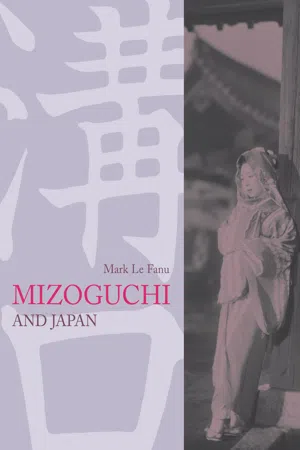
- 224 pages
- English
- ePUB (mobile friendly)
- Available on iOS & Android
eBook - ePub
Mizoguchi and Japan
About this book
Information
Edition
11 | Why Mizoguchi?
A true appreciation of art is always to some extent pluralistic. It would be as odd to come across a connoisseur of paintings who only and exclusively loved Picasso (for example) as it would be to come across a lover of music whose knowledge and appreciation began and ended with Wagner. It's almost a prerequisite of knowing such artists deeply for there to be other artists in the mind's eye - predecessors and contemporaries - with whom to compare them. So it is with cinema. Everyone, of course, is entitled to have their favourites, but we know from experience that such preferences shift around radically at different stages of life. The plausible contestants for the title 'greatest film director of all time' probably amount to no more than a dozen names (and maybe even this is being generous). But I think - or I hope - that it's possible to love all these great artists in different ways. So it might be that in attending a season of Bergman films at a national cinematheque, it becomes obvious, subjectively, that no one has ever grasped human psychology with such wit and penetration and intelligence as this (still living) Nordic master has; which will not stop the true film buff from changing his allegiance to the no less wonderful films of Satyajit Ray (or John Ford or Jean Renoir) when they in turn are showcased in well-mounted retrospectives.
It's never been contested that Kenji Mizoguchi (1898-1956) is among the greatest masters that the medium has ever known; but if this is so, he belongs nonetheless - along with directors like Bresson, Murnau, Dreyer and Ophuls - to the obscurer shadows of the inner sanctum. People know about him more than they know his actual work. Indeed, he is almost certainly less well known than his fellow countrymen Kurosawa and Ozu, about whom well-researched studies and biographies have long existed in print. By contrast, there has not been an English-language study of Mizoguchi's cinema taken as a whole since the monograph written by Keiko McDonald twenty years ago - which is as good a reason as any, I hope, for approaching him now.
Despite this relative obscurity, there is a feeling in the air that Mizoguchi is alive and relevant. The season of Mizoguchi's films curated by James Quandt of the Ontario Cinemathèque in 1996 during the run-up to his centenary had an unprecedented success in North America, touring twelve cities with sell-out screenings in each of them; while Mizoguchi's centenary itself (1998) was celebrated in England by a correspondingly record-breaking retrospective at the National Film Theatre that sold over 15,000 tickets. Nearly fifty years after his death, it appears that his cinema still has something to teach us. Partly this is a spiritual apprehension (as it also is with Ozu, surely): his films have an extraordinary force and purity. They shake and move the viewer by the power, refinement and compassion with which they confront human suffering. Thus there is a subject there - to which this book in different ways (and with different degrees of explicitness) will attempt to do justice. But there is also the matter of Mizoguchi's style: a specific way of setting up his scenes that speaks forcibly and directly over the gap of years to the modern viewer: the serious modern viewer, that is, who takes world cinema, and not just Hollywood, as the object of his interest and curiosity. So I think it is worth making the claim right at the beginning of this book that Mizoguchi is perhaps the greatest master ever of the method of shooting known as extended sequence or long-take composition - the very method, coincidentally, that is the signature of many of the most interesting contemporary film directors; in different ways of course (everyone's signature is at least slightly different), as well as for different reasons, and towards different ends: but united in opposition to that other mode of contemporary film-making which relies for its effects on multiple alternation of camera angles, rapid-fire editing and unremitting pace of delivery.
Is this perhaps the contrast itself between art-house cinema and commercial or entertainment-based programming? It is tempting to think so. For the time being, however, I would like simply to take note of the opposition, without drawing anything-like-polemical conclusions.1 The comparable artists on Mizoguchi's side of the fence are directors like Chantal Akerman and Theo Angelopoulos, Peter Greenaway and Raul Ruiz, Victor Erice and Arturo Ripstein: virtuosi both of the extended 'still life' (that is, the camera held motionless on a scene for an extended timespan, without changing to different focal setups) and also of the choreographed tracking arabesque. Before them came Tarkovsky, and Jancsó, and Rainer Werner Fassbinder and Frederick Wiseman; and back in the 1950s and 60s there were others (Dreyer, Antonioni, Kazan, Preminger, Cassavetes). There has always been a tradition in France for this kind of patient, elaborate and concentrated 'one-scene-one-take' mise en scène: Jacques Rivette, Jacques Doillon, Maurice Pialat, Catherine Breillat, Raymond Depardon, Gaspar Noé and Bruno Dumont spring to mind; from Russia, there are contemporary directors such as Alexandr Sokurov (Russian Ark was shot entirely in a single take lasting ninety minutes); also the wonderful documentarists Victor Kossakovsky and Sergei Dvortsevoy; from Iran, Abbas Kiarostami, Mohsen Makhmalbaf, Jafar Panahi; from the Far East, Hou Hsiao-hsien, Tsai Ming-liang, Edward Yang. From Austria, Michael Haneke, Ulrich Seidl. And 'one-offs' as well: from Palestine, Elia Suleiman; from Georgia (via Paris), Otar losselliani; from Hungary, Bela Tarr; from England, Mike Grigsby (another documentarist). A whole raft of names in short, all of them - in one way or another - resplendent.
It goes without saying that the cinema which emerges in its different ways from this preference for the long take makes heavy demands on the viewer: minimalism, in any form, can be uncomfortable. There are times when such a mode of directing seems to simply slip into arid formalism. When it does not work it can be boring and aggravating. One can feel sympathetic to the oft-voiced verdict: 'Watching X is like watching paint dry.' Yet, conversely, when such methods really do work, there is simply nothing to compare to them.2
Sometimes, it's almost as if patience with the long take - a sense of its sombre existence (even if the director isn't actually using it the whole time) - is the precondition for cinema saying anything powerful at all. I mean by this last, slightly paradoxical, parenthesis to make an important distinction: there are film-makers whose use of the long take is categorical and puristic: that is their style, that is what they always do (Angelopoulos and Jancsó are examples); and there are filmmakers (Godard, Welles, Kiarostami, Wong Kar-wai perhaps) whose liking for the device goes hand in hand with a complementary skill in editing, montage, concision itself. Mizoguchi himself in different films and at different stages of his career utilised the long take puristically (for example, in The Story of Late Chrysanthemums/Zangiku Monogatari [1939] and The Loyal 47 Ronin/Genroku Chushingura) and less puristically (throughout the post-war masterpieces - Oharu, Ugetsu, Sansho); and as far as I am concerned, there is no issue of quality in the preference. One way of deploying the mode is not necessarily better than the other. In short, stylistic consistency across a single movie is undoubtedly a value, but it is not the only value; as I have just said, reliance on the long take has to be balanced against the dangers of formalism. Yet whether the long take is deployed consistently throughout a film, or whether it is used sparingly but intelligently, it seems able to bring something to the possibility of cinema of which other forms of mise en scène are incapable.
So what are these magic properties denied to rapid-cutting MTV-style films? In brief, the long take draws us into the scene in question with a particular dramatic force and intimacy. Delivering the audience over, as it does, to real time, it delivers us over to the suspense and awkwardness that present-tense drama entails: the sense that the outcome of the scene hasn't yet been settled, that it is still in the air, and that we are somehow complicit in making it land rightly.
Take an example, from Jacques Becker's famous prison drama Le Trou (1961). The five men in the cell are making their first bid for freedom: a concrete floor has to be smashed through in order to link up with a passage leading to the underground sewers. The men have managed to fashion a crowbar of sorts from one of their bedsteads, and Becker holds the camera in close-up on the little patch of floor as the first blows of this improvised hammer rain down on the grimly resisting concrete. No editing or elision is desirable or possible here, since the point of the scene is to emphasise the brute difficulty - actually, the rank impossibility - of the task the desperate men have set themselves. We watch as the crowbar gouges the first thin chips of concrete out of the shining flat surface, gradually indenting it until it begins to form, in front of our eyes, the existential 'hole' of the film's title. I can't believe I am the only admirer of Becker to believe that the scene which emerges here is one of the most exciting and philosophical sequences in the whole of French cinema; indeed (it is tempting to put it extravagantly) in the whole of cinema tout court.
The agonising suspense that informs this scene and others in Becker's film is the same suspense, mutatis mutandis, that Catherine Breillat makes use of in order to underline the unbearableness of first love in such remarkable studies of adolescent sexuality as 36 Fillette (1987) and A nos amours (2000). In each of these films, the central scene involves an extraordinarily powerfully imagined seduction of a teenage girl by an older man, played out in real time, with all the myriad silent changes of mood that such encounters entail in real life (on either side, but particularly on the part of the young girl of course). It is as if, in such sequences, we were watching, or being made to watch, some documentary transcript of the soul. Breillat in these scenes takes her audience to the brink of what may legitimately be imagined in cinema - as cinema: a freedom, it has sometimes been objected, that is perilously close to pornography. (It may be worth underlining the obvious, that pornography itself relies for its impact on the sustained gaze of the film-maker manipulating photographed rituals in not dissimilar slices of real time.)
Sometimes it is possible to feel that the existence of only one such sequence in a whole movie is enough to make the drama come alive. If the director can do this, we can usually justifiably infer that he (or she) can do all the other important things as well. Thus (to take a contemporary instance) the populist facility of a successful film like Y tu mamá también (Alfonso Cuarón, 2001) seems to me tamed and tempered - converted into something that really does approach art - by the film's miraculously controlled penultimate sequence, in which the three main characters, slumped round a table, at nightfall, in some godforsaken estaminet, drunkenly open up their hearts to each other with a candour and depth whose authenticity absolutely depends upon the fact that we are continually in their presence for seven and a half minutes without a single camera cut. Similarly, a run-of-the-mill police and legal procedural like Sidney Lumet's Q & A (1990) seems to me to be completely transformed - elevated into a fascinatingly complex piece of psycho-theatre - by just two or three confrontations (that is, arranged meetings, with lawyers present) where the combined acting talents of Armand Assante (playing a Latino gangster), Timothy Hutton (a straight cop, in deep water) and Nick Nolte (a 'bent' cop, and the latter's nemesis) are given full scope and measure by nothing less than the imperturbable authority of the camera's motionless, inquisitorial gravity. That particular film, I would guess, is not widely known - not even available on DVD - but the inclusion in it of these few episodes is enough by itself to 'fast-track' the movie into the top tier of the director's filmography.
Among modern movies, it is interesting to compare in this context Kubrick's Eyes Wide Shut (1999) with Michael Haneke's controversial study of sado-masochism, The Piano Teacher (2001). Both these films are 'difficult', in conventional parlance. Both have had their detractors (as well as their strong supporters): neither film was universally praised when it appeared. What is not controversial, I suppose, is that they are serious dramas (rich in cameo and in incidental detail), and that in their different ways they make a sophisticated shot at dealing with the phenomenology of a woman's inner sexual demons. Needless to say, Nicole Kidman and Isabelle Huppert are actresses of the very highest quality. Yet if Haneke's film gives the impression of going further than Kubrick's, of mining depths which, in this instance, Kubrick does not plumb, it is at least partly because Haneke's one-scene-one-take mise en scène (in contrast to Kubrick's preference for edited montage) gives him the decisive edge, enabling him not just to talk about that terror which is at the basis of all drama, but to find it, and present it to us with unforgettable brilliance.
Bazin, Mizoguchi and Japanese Cinema
Earlier, I stated more or less openly that Mizoguchi's cinema gives us some of the most perfect instances of this method that have ever been committed to celluloid. The reader may wonder whether, or how, such a contention can ever be proven. The historical dimension of the argument has already been touched upon. Cinema itself was born with the long take, in the sense that editing wasn't developed until the late 1890s, some five years after the invention of the kinetoscope itself. The very earliest films, issued by Edison and the Lumières dating from the mid-1890s, are each less than sixty seconds long, but because they are shot and presented without cuts, they have a concentrated purity about them, a resplendence, that has survived intact to the present day. Starting from Griffith's move to Biograph in 1908, and the American public's subsequent perceived desire to 'have the story told faster', the whole history of the refinement and development of editing techniques can be seen, from one point of view, as a graduated assault on the rigidity and static-ness of the original bare, stagey, theatrical long take, in its Edisonian or Lumière-like incarnation. Yet even while these developments were taking place (it...
Table of contents
- Cover
- Title Page
- Dedication
- Contents
- Preface and Acknowledgments
- Chronology
- Mizoguchi's Extant Films
- 1 Why Mizoguchi?
- 2 The Japanese Context
- 3 Mizoguchi at Work
- 4 The Great Triptych
- 5 Geisha, Prostitution and the Street
- 6 Visions of History
- 7 Respectable Women
- 8 Alive or Dead?
- Appendix 1 Mizoguchi and French Film Criticism
- Appendix 2 Mizoguchi's Attitude Towards Geisha
- Appendix 3 Mizoguchi, The Loyal 47 Ronin and the War Years
- Filmography
- Further Reading
- Index
- eCopyright
Trusted by 375,005 students
Access to over 1.5 million titles for a fair monthly price.
Study more efficiently using our study tools.
Frequently asked questions
Yes, you can cancel anytime from the Subscription tab in your account settings on the Perlego website. Your subscription will stay active until the end of your current billing period. Learn how to cancel your subscription
No, books cannot be downloaded as external files, such as PDFs, for use outside of Perlego. However, you can download books within the Perlego app for offline reading on mobile or tablet. Learn how to download books offline
Perlego offers two plans: Essential and Complete
- Essential is ideal for learners and professionals who enjoy exploring a wide range of subjects. Access the Essential Library with 800,000+ trusted titles and best-sellers across business, personal growth, and the humanities. Includes unlimited reading time and Standard Read Aloud voice.
- Complete: Perfect for advanced learners and researchers needing full, unrestricted access. Unlock 1.5M+ books across hundreds of subjects, including academic and specialized titles. The Complete Plan also includes advanced features like Premium Read Aloud and Research Assistant.
We are an online textbook subscription service, where you can get access to an entire online library for less than the price of a single book per month. With over 1.5 million books across 990+ topics, we’ve got you covered! Learn about our mission
Look out for the read-aloud symbol on your next book to see if you can listen to it. The read-aloud tool reads text aloud for you, highlighting the text as it is being read. You can pause it, speed it up and slow it down. Learn more about Read Aloud
Yes! You can use the Perlego app on both iOS and Android devices to read anytime, anywhere — even offline. Perfect for commutes or when you’re on the go.
Please note we cannot support devices running on iOS 13 and Android 7 or earlier. Learn more about using the app
Please note we cannot support devices running on iOS 13 and Android 7 or earlier. Learn more about using the app
Yes, you can access Mizoguchi and Japan by Mark Le Fanu in PDF and/or ePUB format. We have over 1.5 million books available in our catalogue for you to explore.