The definitive guide to the birdlife of Kazakhstan, Kirghizstan, Turkmenistan, Uzbekistan, Tajikistan and Afghanistan.
Central Asia includes a diverse variety of habitats with a rich avifauna that includes some truly mouthwatering specialities, from sandgrouse, ground jays and larks on the vast steppe and semi-desert to woodland species such as warblers and rosefinches and a suite of montane species including snowcocks, accentors and snowfinches. Ornithologically, Central Asia is very hard to beat.
This book represents the only comprehensive guide to the region. It includes 141 high-quality plates, covering every species (and all distinctive subspecies) that occur in the six countries covered, along with concise text focusing on identification, and accurate colour maps. Important introductory sections introduce the land and its birds.
Birds of Central Asia is a must-read for any birder or traveller visiting this region, and an essential addition to the backpack.
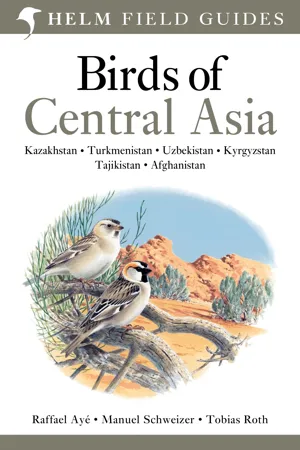
- 336 pages
- English
- ePUB (mobile friendly)
- Available on iOS & Android
eBook - ePub
Field Guide to Birds of Central Asia
About this book
Information
APPENDIX 1
OLD VAGRANTS, UNDOCUMENTED RECORDS AND DOUBTFULLY RECORDED SPECIES
This list comprises species recorded as vagrants prior to 1950, doubtfully recorded species, and vagrants whose future occurrence is considered unlikely in the region.
| Snow Partridge Lerwa lerwa | doubtfully recorded Afg |
| Grey Francolin Francolinus pondicerianus | Afg |
| Spot-billed Duck Anas poecilorhyncha | doubtfully recorded |
| Lesser Flamingo Phoeniconaias minor | Afg |
| Cinnamon Bittern Ixobrychus cinnamomeus | Afg |
| Little Cormorant Phalacrocorax niger | Afg |
| Oriental Darter Anhinga melanogaster | recently reliably recorded in Uzb, further occurrence unlikely |
| Lesser Spotted Eagle Aquila pomarina/ Indian Spotted Eagle A. hastata | reports from Afg, Tkm |
| Indian Vulture Gyps indicus | doubtfully recorded Afg |
| Ruddy-breasted Crake Porzana fusca | Afg |
| Hooded Crane Grus monacha | Kaz |
| White-naped Crane Grus vipio | Kaz |
| Oriental Plover Charadrius veredus | Kaz/Uzb |
| Purple Sandpiper Calidris maritima | doubtfully recorded |
| Sooty Gull Larus hemprichii | doubtfully recorded Afg |
| Red Turtle Dove Streptopelia tranquebarica | doubtfully recorded Afg |
| Common Koel Eudynamys scolopaceus | Afg |
| Great Spotted Cuckoo Clamator glandarius | doubtfully recorded |
| Grey Nightjar Caprimulgus indicus | Afg |
| House Crow Corvus splendens | might occur Afg |
| Long-billed Bush Warbler Bradypterus major | Tjk |
| Bank Myna Acridotheres ginginianus | Afg |
| Indian Robin Saxicoloides fulicatus | Afg |
| Hodgson’s Bushchat Saxicola insignis | Kaz |
| Upland Pipit Anthus sylvanus | Afg |
| Arctic Redpoll Carduelis hornemanni | Kaz |
| Cinereous Bunting Emberiza cineracea | Tkm |
| Chestnut-eared Bunting Emberiza fucata | Uzb |
| Black-faced Bunting Emberiza spodocephala | Kaz, Uzb |
| Chestnut Bunting Emberiza rutila | Kgz, Tjk |
APPENDIX 2
MOULT AND AGEING OF LARGE RAPTORS
For many species of large raptors, at least an approximate knowledge of the age of a bird is important for correct identification. Some ageing criteria are valid for many large raptors and are described below. Observers are encouraged to familiarise themselves with these and to train on the ageing of large raptors on some of the commoner species in their usual birding sites.
Moult strategies
Large raptors often cannot replace their whole plumage in one year and have developed special moult strategies. Their moult proceeds in waves that may overlap. Primary moult starts from the innermost primary and proceeds outwards. The sequence of secondary moult is much more variable. Secondary moult usually starts from several points: the outermost secondary, close-to-innermost secondary and one or more secondaries in between. In most eagles and other large raptors, new waves of moult are started every year, even if the previous wave(s) has not yet been completed. Correspondingly, often three (sometimes four) generations of remiges can be found on one bird. Typically, the outermost primary is among the last juvenile feathers that are retained. It is then heavily bleached and abraded due to exposure to sunlight and physical abrasion over sometimes several years. Under favourable conditions, differences in bleaching and abrasion can be detected between each generation of remiges. The moult strategy of all these species leads to common ageing criteria. All remiges are of the same generation in juveniles, but not usually at later ages. In immature and adult birds, there are usually two or more generations of remiges present at the same time. Later generations of remiges often differ in length from juvenile remiges (see below).
Trailing edge of wing in juveniles, immatures and adults
Fresh juveniles have a very regular trailing edge to the wing, because all remiges are of the same length (and age). However, single juvenile feathers are more pointed than later generations and thus the trailing edge is saw-toothed when seen at close range. Later generations of remiges often differ in length from juvenile remiges, leading to a very irregular trailing edge of the wing in immature birds. The trailing edge becomes again slightly more regular and smooth in most adult birds with broader-tipped remiges of equal length. However, it is o...
Table of contents
- Cover
- Title Page
- Authors’ note
- CONTENTS
- MAP OF THE REGION
- ACKNOWLEDGEMENTS
- INTRODUCTION
- HOW TO USE THIS BOOK
- GEOGRAPHY AND BIOGEOGRAPHY
- ORGANISATIONS AND WEBSITES
- SPECIES ACCOUNTS
- Grouse, partridges and pheasants PHASIANIDAE
- Geese, swans and ducks ANATIDAE
- Divers GAVIIDAE
- Grebes PODICIPEDIDAE
- Flamingos PHOENICOPTERIDAE
- Storks CICONIIDAE
- Bitterns, herons and egrets ARDEIDAE
- Pelicans PELECANIDAE
- Cormorants PHALACROCORACIDAE
- Hawks, buzzards and eagles ACCIPITRIDAE
- Bustards OTIDIDAE
- Rails, crakes and gallinules RALLIDAE
- Jacanas JACANIDAE
- Stilts and avocets RECURVIROSTRIDAE
- Lapwings and plovers CHARADRIIDAE
- Sandpipers and allies SCOLOPACIDAE
- Coursers and pratincoles GLAREOLIDAE
- Gulls LARIDAE
- Skuas STERCORARIIDAE
- Terns STERNIDAE
- Sandgrouse PTEROCLIDAE
- Pigeons and doves COLUMBIDAE
- Parakeets PSITTACIDAE
- Owls STRIGIDAE
- Nightjars CAPRIMULGIDAE
- Swifts APODIDAE
- Rollers CORACIIDAE
- Kingfishers ALCEDINIDAE
- Woodpeckers and wrynecks PICIDAE
- Shrikes LANIIDAE
- Bulbuls PYCNONOTIDAE
- Crows and jays CORVIDAE
- Orioles ORIOLIDAE
- Hypocolius HYPOCOLIIDAE
- Tits PARIDAE
- Penduline-tits REMIZIDAE
- Long-tailed tits AEGITHALIDAE
- Swallows and martins HIRUNDINIDAE
- Larks ALAUDIDAE
- Cisticolas and prinias CISTICOLIDAE
- Bush warblers CETTIIDAE
- Grasshopper warblers MEGALURIDAE
- Reed warblers ACROCEPHALIDAE
- Leaf warblers PHYLLOSCOPIDAE
- Sylvia warblers SYLVIIDAE
- Babblers TIMALIIDAE
- Nuthatches SITTIDAE
- Wrens troglodytidae
- Starlings and mynas STURNIDAE
- Thrushes TURDIDAE
- Robins, chats and flycatchers MUSCICAPIDAE
- Sparrows and snowfinches PASSERIDAE
- Accentors PRUNELLIDAE
- Sunbirds NECTARINIIDAE
- Wagtails and pipits MOTACILLIDAE
- Waxbills ESTRILDIDAE
- Buntings EMBERIZIDAE
- APPENDIX 1 Old vagrants, undocumented records and doubtfully recorded species
- APPENDIX 2 Moult and ageing of large raptors
- APPENDIX 3 Identifying gulls
- REFERENCES
- INDEX
- eCopyright
Trusted by 375,005 students
Access to over 1.5 million titles for a fair monthly price.
Study more efficiently using our study tools.
Frequently asked questions
Yes, you can cancel anytime from the Subscription tab in your account settings on the Perlego website. Your subscription will stay active until the end of your current billing period. Learn how to cancel your subscription
No, books cannot be downloaded as external files, such as PDFs, for use outside of Perlego. However, you can download books within the Perlego app for offline reading on mobile or tablet. Learn how to download books offline
Perlego offers two plans: Essential and Complete
- Essential is ideal for learners and professionals who enjoy exploring a wide range of subjects. Access the Essential Library with 800,000+ trusted titles and best-sellers across business, personal growth, and the humanities. Includes unlimited reading time and Standard Read Aloud voice.
- Complete: Perfect for advanced learners and researchers needing full, unrestricted access. Unlock 1.5M+ books across hundreds of subjects, including academic and specialized titles. The Complete Plan also includes advanced features like Premium Read Aloud and Research Assistant.
We are an online textbook subscription service, where you can get access to an entire online library for less than the price of a single book per month. With over 1.5 million books across 990+ topics, we’ve got you covered! Learn about our mission
Look out for the read-aloud symbol on your next book to see if you can listen to it. The read-aloud tool reads text aloud for you, highlighting the text as it is being read. You can pause it, speed it up and slow it down. Learn more about Read Aloud
Yes! You can use the Perlego app on both iOS and Android devices to read anytime, anywhere — even offline. Perfect for commutes or when you’re on the go.
Please note we cannot support devices running on iOS 13 and Android 7 or earlier. Learn more about using the app
Please note we cannot support devices running on iOS 13 and Android 7 or earlier. Learn more about using the app
Yes, you can access Field Guide to Birds of Central Asia by Raffael Ayé,Manuel Schweizer,Tobias Roth in PDF and/or ePUB format, as well as other popular books in Biowissenschaften & Zoologie. We have over 1.5 million books available in our catalogue for you to explore.