Few phenomena embody the notion of time as well as fashion. Fast-moving and rooted in the 'now', it's constantly creating its own past through the process of rapid style change. Uniquely poised between the past and the future, fashion's relationship with time is unorthodox. Rather than considering time in the conventional sense, this anthology explores three alternative ways to think about fashion and time: the first identifies the seasonal nature of fashion as an industry, and shows how this has impacted on workers and wearers alike. The second looks at fashion design as a ceaseless process of adaptation, reconstruction and recombination of motifs, in which nostalgia and revivals play their part. The third construes fashion's 'imaginary', with its capacity for fantasy and myth-making, as a form of alternate history that asks 'what if?'
Within this framework, key classic texts are juxtaposed with lesser known ones, in an interdisciplinary approach that includes philosophy, history, literature, media and fashion design, ranging from the 18th century to the present. It will be of interest to anyone wishing to understand one of the most complex yet inescapable aspects of fashion, its relationship to time, and will be a critical resource for undergraduate and postgraduate students in the humanities and all those interested in fashion in all its creative, commercial and cultural aspects.
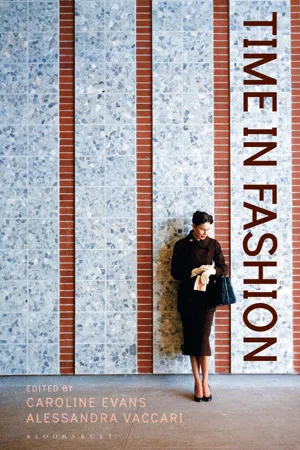
eBook - ePub
Time in Fashion
Industrial, Antilinear and Uchronic Temporalities
- 200 pages
- English
- ePUB (mobile friendly)
- Available on iOS & Android
eBook - ePub
Time in Fashion
Industrial, Antilinear and Uchronic Temporalities
About this book
Information
Section 1
Industrial Time
The Murderous, Meaningless Caprices of Fashion
Karl Marx
Karl Marx, Capital Volume I [1867] trans. Ben Fowkes (Harmondsworth: Penguin 1976), 364–65 and 608–9.
These two passages, both from Marx’s Capital (1867), adumbrate the devastating impact of the social season on workers in the fashion and textiles industries. In the first paragraph, taken from chapter 10 on ‘The Working Day’, Marx describes the death in 1863 ‘from simple overwork’ of the London milliner Mary Anne Walkley. The next two paragraphs come from chapter 15, where Marx writes at greater length about the working conditions of women and children employed in the production of ‘wearing apparel’ in unregulated factories. At the end of this passage, in a famous phrase, he excoriates ‘the murderous, meaningless caprices of fashion’.
The nineteenth-century social season set the pace for a biannual cycle of production that existed at all levels of the garment industry, from home dressmaking to large-scale factories. As a result of the season, Marx wrote, workers were cruelly over-worked for half the year, and equally cruelly unemployed for the other half. This biannual cycle of fashion production dominated Western, especially European, fashion for over 150 years, and still prevails today, though it has recently been challenged by the retail forms of ‘fast fashion’ and ‘see now, buy now’.
In the last week of June 1863, all the London daily papers published a paragraph with the ‘sensational’ heading, ‘Death from simple over-work’. It dealt with the death of the milliner, Mary Anne Walkley, 20 years old, employed in a highly respectable dressmaking establishment, exploited by a lady with the pleasant name of Elise. The old, often-told story was now revealed once again.1 These girls work, on an average, 16½ hours without a break, during the season often 30 hours, and the flow of their failing ‘labour-power’ is maintained by occasional supplies of sherry, port or coffee. It was the height of the season. It was necessary, in the twinkling of an eye, to conjure up magnificent dresses for the noble ladies invited to the ball in honour of the newly imported Princess of Wales. Mary Anne Walkley had worked uninterruptedly for 26½ hours, with sixty other girls, thirty in each room. The rooms provided only ⅓ of the necessary quantity of air, measured in cubic feet. At night the girls slept in pairs in the stifling holes into which a bedroom was divided by wooden partitions.2 And this was one of the better millinery establishments in London. Mary Anne Walkley fell ill on the Friday and died on Sunday, without, to the astonishment of Madame Elise, having finished off the bit of finery she was working on. The doctor, a Mr Keys, called too late to the girl’s deathbed, made his deposition to the coroner’s jury in plain language: ‘Mary Anne Walkley died from long hours of work in an overcrowded work-room, and a too small and badly ventilated bedroom.’ In order to give the doctor a lesson in good manners, the coroner’s jury thereupon brought in the verdict that ‘the deceased had died of apoplexy, but there was reason to fear that her death had been accelerated by over-work in an overcrowded work-room, etc.’. […]
In factories and places of manufacture which are not yet subject to the Factory Acts, the most fearful over-work prevails periodically during what is called the season, as a result of sudden orders. In the outside departments of factory, workshop and warehouse, the so-called domestic workers, whose employment is at best irregular, are entirely dependent for their raw material and their orders on the caprice of the capitalist, who, in this industry, is not hampered by any regard for depreciation of his buildings and machinery, and risks nothing by a stoppage of work but the skin of the worker himself. Here then he sets himself systematically to work to form an industrial reserve force that shall be ready at a moment’s notice; during one part of the year he decimates this force by the most inhuman toil, during the other part he lets it starve for lack of work. ‘Employers … avail themselves of the habitual irregularity [in work at home] when any extra work is wanted at a push, so that work goes on till 11 and 12 p.m., or 2 a.m., or as the usual phrase is, “all hours”,’ and in places where ‘the stench is enough to knock you down; you go to the door, perhaps, and open it, but shudder to go further’.3 ‘They are curious men,’ said one of the witnesses, a shoemaker, speaking of the masters, ‘and think it does a boy no harm to work too hard for half the year, if he is nearly idle for the other half.’4
Like the technical impediments, these ‘usages which have grown with the growth of trade’, or business customs, were also proclaimed by interested capitalists (and still are proclaimed) to be ‘natural barriers’ inherent in production. This was a favourite cry of the cotton lords at the time when they were first threatened with the Factory Acts. Although their industry depends, more than any other, on the world market, and therefore on shipping, experience showed they were lying. Since then, every pretended ‘obstruction to business’ has been treated by the Factory Inspectors as a mere sham.5 The thoroughly conscientious investigations of the Children’s Employment Commission prove that the effect of the regulation of the hours of work, in some industries, was to spread the mass of labour previously employed more evenly over the whole year;6 that this regulation was the first rational bridle on the murderous, meaningless caprices of fashion,7 caprices which fit in very badly with the system under which large-scale industry operates.
The Acceleration of Fashion Change in The Eighteenth Century
Kimberly Chrisman-Campbell
Kimberly Chrisman-Campbell, Fashion Victims: Dress at the Court of Louis XVI and Marie-Antoinette (New Haven and London: Yale University Press, 2015), 10–11 and 14–17.
The voracious appetite for fashion that Marx criticized so fiercely in the nineteenth century was not new, however, and the phenomenon of the fashion season long predated industrialization. The dress historian Kimberly Chrisman-Campbell outlines the advent of seasonal fashion that began in the seventeenth century, and describes the accelerated rate of fashion change in the late eighteenth, when ‘it was not enough for fashion to change with the seasons: it changed every day, and sometimes several times a day, or so it was said’. Suddenly, the season required not only new clothes, but also novelty in design. Hair arrangements like the pouf were designed to change frequently, and to go out of fashion quickly. A bride’s trousseau was intended to last a season, not a lifetime. Chrisman-Campbell outlines how this rapid style change was both created by, and reflected in, the first fashion magazines and almanacs of the 1770s.
During the eighteenth century there was a dramatic increase in the speed with which fashions were emulated, and a corresponding increase in the speed with which fashions changed. These changes were often perceived as the result of chance or female caprice rather than deliberate (if sometimes unconscious) emulation. For example, the Magasin des modes nouvelles declared:
When you see a fashion beginning to go over the top, you will say: Its end is approaching, and in a little while it will be undone. As there should be constant variety in fabrics, in colors, in the distribution of these colors, in their combination, to satisfy our taste, from the instant that this variety can no longer be felt in comparison to some other fabric, color, or combination of colors … it is indispensably necessary to change one’s fabric, o...
Table of contents
- Cover
- Half-Title Page
- Title Page
- Contents
- List of Figures
- Acknowledgements
- Introduction
- 1 Industrial Time
- 2 Antilinear Time
- 3 Uchronic Time
- Bibliography
- Index
- Copyright
Trusted by 375,005 students
Access to over 1.5 million titles for a fair monthly price.
Study more efficiently using our study tools.
Frequently asked questions
Yes, you can cancel anytime from the Subscription tab in your account settings on the Perlego website. Your subscription will stay active until the end of your current billing period. Learn how to cancel your subscription
No, books cannot be downloaded as external files, such as PDFs, for use outside of Perlego. However, you can download books within the Perlego app for offline reading on mobile or tablet. Learn how to download books offline
Perlego offers two plans: Essential and Complete
- Essential is ideal for learners and professionals who enjoy exploring a wide range of subjects. Access the Essential Library with 800,000+ trusted titles and best-sellers across business, personal growth, and the humanities. Includes unlimited reading time and Standard Read Aloud voice.
- Complete: Perfect for advanced learners and researchers needing full, unrestricted access. Unlock 1.5M+ books across hundreds of subjects, including academic and specialized titles. The Complete Plan also includes advanced features like Premium Read Aloud and Research Assistant.
We are an online textbook subscription service, where you can get access to an entire online library for less than the price of a single book per month. With over 1.5 million books across 990+ topics, we’ve got you covered! Learn about our mission
Look out for the read-aloud symbol on your next book to see if you can listen to it. The read-aloud tool reads text aloud for you, highlighting the text as it is being read. You can pause it, speed it up and slow it down. Learn more about Read Aloud
Yes! You can use the Perlego app on both iOS and Android devices to read anytime, anywhere — even offline. Perfect for commutes or when you’re on the go.
Please note we cannot support devices running on iOS 13 and Android 7 or earlier. Learn more about using the app
Please note we cannot support devices running on iOS 13 and Android 7 or earlier. Learn more about using the app
Yes, you can access Time in Fashion by Caroline Evans, Alessandra Vaccari, Caroline Evans,Alessandra Vaccari in PDF and/or ePUB format, as well as other popular books in Design & Fashion Design. We have over 1.5 million books available in our catalogue for you to explore.