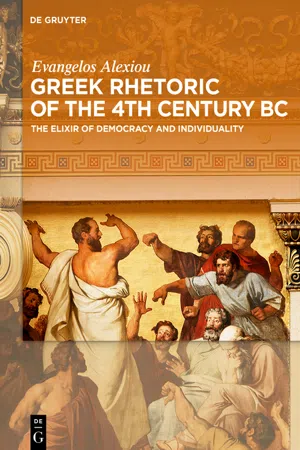
The interaction between orator and audience, the passions and distrust held by many concerning the predominance of one individual, but also the individual's struggle as an advisor and political leader, these are the quintessential elements of 4th century rhetoric. As an individual personality, the orator draws strength from his audience, while the rhetorical texts mirror his own thoughts and those of his audience as part of a two-way relationship, in which individuality meets, opposes, and identifies with the masses. For the first time, this volume systematically compares minor orators with the major figures of rhetoric, Demosthenes and Isocrates, taking into account other findings as well, such as extracts of Hyperides from the Archimedes Palimpsest. Moreover, this book provides insight into the controversy surrounding the art of discourse in the rhetorical texts of Anaximenes, Aristotle, and especially of Isocrates who took up a clear stance against the philosophy of the 4th century.
eBook - ePub
Greek Rhetoric of the 4th Century BC
The Elixir of Democracy and Individuality
- 377 pages
- English
- ePUB (mobile friendly)
- Available on iOS & Android
eBook - ePub
Greek Rhetoric of the 4th Century BC
The Elixir of Democracy and Individuality
About this book
Information
1 The Development of Rhetoric
1.1 The Origins of Rhetoric and the “Mirror Effect”
I should begin this study with an apt statement by M. Gagarin (2007, 9): “Oratory lies at the heart of Greek culture from its beginning”. Rhetoric is one of the key aspects of Greek culture, and skilled orators appear throughout every period of Ancient Greek literature.1 References are already found in the Homeric era to natural eloquence, the impression this caused on the audience, as well as the social recognition of those who handled the spoken word well. The natural gift of speaking well was considered a virtue. In the Iliad, the phrase uttered by Phoenix, the tutor of Achilles, μύθων τε ῥητῆρ’ ἔμεναι πρηκτῆρά τε ἔργων (10.443), reflects the ancient ideal of being skilled in both words and deeds. The silver-tongued Nestor, with words sweeter than honey (1.248–249), and the comparison between the rhetorical ability of Menelaus and Odysseus (3.212–214), with the former appearing as a man of few words in contrast to the verbose Odysseus, with words like snowflakes, are characteristic examples. The three speeches addressed to Achilles in order to convince him to return to battle are considered examples of rhetorical eloquence (10.225 ff.).2 In Hesiod, the deity Peitho is the daughter of Ocean (Theog. 349; cf. Op. 73); furthermore, in the beginning of the Theogony, the gift of speaking well is described as a wonderful gift of the Muses (81–84).3
The turning point in the development of rhetoric is the transition from natural talent to a systematic art, consisting of theory and practice, teaching and cultivation of rhetorical techniques and methods. There are no scientifically documented dates due to a paucity of testimonies. The terminus technicus technē rhētorikē is first encountered in Plato (Gorg. 449c; Phaedr. 260c).4 Should one, due to this fact, seriously object to the early categorisation of rhetoric as an art, as expressed by T. Cole (1991) and E. Schiappa (1999),5 and attribute the “independence” of rhetoric to Plato and Aristotle for succeeding in distinguishing it from other cognitive areas? Furthermore, is modern scholarship legitimately entitled to diametrically opposed extreme views, where, on one hand, rhetoric existed as an art long before the authoring of rhetorical handbooks6 and, on the other that it had not achieved independence even in the age of Plato, but was still in rather a twilight stage?7 This is precarious ground, allowing for a number of conjectures, but the fact that technē rhētorikē is not encountered as a terminus technicus prior to Plato does not mean it was discovered by Plato.
Contradictory ancient testimonies on the views of Aristotle name Empedocles of Acragas8 and the Sicelians Corax and Tisias9 as the inventors of rhetoric. Although Empedocles must have been a formidable orator, his role was aggrandized in antiquity as he was Gorgias’ teacher and it was only natural that this new art be attributed to him. His poetical and philosophical style gave credence to the effort to identify the potential philosophical origins of rhetoric.10 However, the Syracusan Corax and his pupil Tisias (likely the same person) are alleged to have authored the first handbook of rhetoric.11 Precisely what this handbook contained is not certain; in all likelihood, this was not a systematic handbook such as those of the 4th century, but mainly models of speeches in various judicial cases. This is by no means odd, given that the fall of monarchy in Syracuse and the establishment of democracy in 467 BC were accompanied by several trials where the importance of the new art began emerging.12 Interest is primarily focused on teaching the eikos (“that which is reasonable or likely”). However, the attachment to the central role played by ek tou eikotos arguments in early rhetoric dictates a cautious approach, as our information mainly stems from opponents of rhetoric, such as Plato.13 Interest in such arguments is unquestionable, but their importance was inflated by opponents of rhetoric in order to support the criticism that orators were exclusively concerned with what was likely and not necessarily with what was true. Plato provides us with a typical example of the technique of teaching that which is likely in relation to early Sicilian rhetoric (Phaedrus 273b-c; cf. Aristotle Rhetoric 1402a 17–20):
The case is as follows: a feeble (asthenēs) yet brave (andrikos) man assaulted a strong (ischyros) yet cowardly (deilos) man and robbed him. Both appear in court. Neither must speak the truth. On the one hand, the coward must prove that the brave man had accomplices, so as not to admit his cowardice, while on the other the brave man must refuse this and assert that, being feeble, he could not have committed the offence. In this example, the parties in the case are presenting arguments not on the basis of actuality but on the basis of the “likelihood” of one version of events or another.14 This is where one might find the roots of sophistic argumentation for which orators often gave the impression of lacking in integrity. The tradition around the court dispute between Corax and Tisias concerning the non-payment of the teacher by the pupil, which led to the expulsion of both parties from the court, strengthens this very contention.15
However, the fact that rhetoric and its origins were at the centre of theoretical discussions in the 4th century BC, in contrast to the silence of the past, acquires particular value: irrespective of whether or not the various assertions concerning the origins of rhetoric are correct, they bear indisputable witness to the importance placed by intellectuals – both sophists and philosophers – on rhetorical theory and practice in the 4th century BC. This century cannot be considered the originator of the rhetorical art, but does serve as its main field of action: it contributed so decisively to its growth that the art of speaking achieved a remarkable triumph, especially during this period and despite philosophical criticism. In short, the 4th century is permeated by rhetoric both as a form of political and judicial dispute and as a key literary genre.16
This context also includes an important function of rhetorical texts, which I define as the “mirror effect” of Athenian society.17 This means that rhetoric, as a psychagogic art, i.e. the art of “leading the souls through speech”, has a tremendous effect on listeners and also redefines itself, reflecting and reverberating the “soul” of the public to the point where it is often difficult to tell apart the orator and the audience.18 Orators exist through their audience, and rhetorical texts depict the relationship between orator and audience. Gorgias gained renown for the meticulous aesthetics of his speech and his stirring of passions. The sophist stresses the psychological, wholly passionate effect of speech, both poetic and prosaic, on listeners in his Encomium of Helen (82 Β11.9; 11.14 D.-K.).19 Additionally, Plato, who was opposed to his contemporaneous sophistical rhetoric and only accepted philosophical rhetoric based on logic and scientific knowledge, defines rhetoric, under the effect of the Gorgianic psychagogic power of speech, as the art of “leading the souls through speech” (Phaedrus 261a: ψυχαγωγία διὰ λόγων; cf. 271c).20 Aristotle, too, subjected the psychology of passions and emotions to strictly scientific analysis (Rhetoric 1378a 19 ff.) and insisted on their categorisation using scientific criteria. Stirring passions dominates judicial and deliberative speeches: the judgments of judges and listeners are decisively impacted by shifting passions (cf. Rhetoric 1354b 8–13; 1356a 14–16).21
From this perspective, a close connection between rhetorical texts and everyday morality is vital. Research into popular morality, such as the classic study by K. Dover (1974),22 has helped us better perceive the limits of this non-theoretical morality. A number of passions, such as orgē, eleos, hybris, phthonos, etc. permeate rhetorical texts that focus on political reality.23 Further semantic fields are those of polypragmosynē and pleonexia,24 or, on the contrary, those of sōphrosynē and apragmosynē.25 Moreover, euphemistic phrases appear, which in rhetorical texts almost stereotypically accompany the defeat of the Athenians at Aegospotamoi (405 BC), a decisive event for the outcome of the Peloponnesian War.26 Following the various oligarchic conspiracies of the late 5th century BC, the frequent use of adjectives such as misopolis or misodēmos (“he who hates the polis or the demos”), philopolis or philodēmos (“he who loves the polis or the demos”) supports the view that placing emphasis on virtues and categorically condemning vices was considered a basic component of political life. W.R. Connor (1971, 106) is justified in maintaining that “these developments of language mark the emergence of a new hierarchy of values in the Greek city, one that emphasizes civic virtues and devotion to the well-being of the whole city”.27 Additionally, the vocabulary of orators, such as Isocrates, is less removed from everyday language than that of Plato and Aristotle.
The adjectives misodēmos (“he who hates the demos”), misanthrōpos (“he who hates people, particularly human communication”) and hyperēphanos (“arrogant, insolent”) are negatively assessed as anti-democratic characterisations (Isocr. 15.131). Oligarchikos and misodēmos are used together ([Andoc.] 4.16), as are ponēros, adikos and misodēmos (Din. 3.22) or misodēmos and misathēnaios (Lycurg. Leocr. 39). Demosthenes (45.68) gives an example of misanthrōpia as the behaviour of a man walking along a wall with a sullen face to whom no one speaks (cf. the misanthrōpia of a law in Demosth. 18.112). How strongly hyperēphania leads to arrogance is indicated in Demosthenes’ speech Against Meidias (21.198–199): Meidias’ self-importance, which extends not only to his fortunes but also to his rhetorical abilities, makes him insufferable to others: all others are social outcasts, beggars, not even human (Roisman 2005, 92–94).28 If one considers the importance of approachability for a democratic politician, then misanthrōpia and hyperēphania are undemocratic concepts.On the other hand, philanthrōpia proves the extent to which conceptual shifts adapt to the political ideals of the city-state. The concept initially denotes the “man-loving ways” of the gods (Aesch. Prom. 11: φιλανθρώπoυ δὲ παύεσθαι τρόπoυ; cf. Aristoph. Peace 392; Plat. Symp. 189c– d). Over time, the concept underwent a process of democratisation: it defines universal hum...
Table of contents
- Title Page
- Copyright
- Contents
- 1 The Development of Rhetoric
- 2 Theoretical Debate concerning Rhetoric
- 3 Rhetorical Handbooks
- 4 The Canon of Attic Orators and Other Orators
- 5 Isocrates
- 6 Demosthenes
- 7 Aeschines
- 8 Isaeus
- 9 Lycurgus
- 10 Hyperides
- 11 Dinarchus
- 12 Summary - Conclusions
- General Index
Trusted by 375,005 students
Access to over 1.5 million titles for a fair monthly price.
Study more efficiently using our study tools.
Frequently asked questions
Yes, you can cancel anytime from the Subscription tab in your account settings on the Perlego website. Your subscription will stay active until the end of your current billing period. Learn how to cancel your subscription
No, books cannot be downloaded as external files, such as PDFs, for use outside of Perlego. However, you can download books within the Perlego app for offline reading on mobile or tablet. Learn how to download books offline
Perlego offers two plans: Essential and Complete
- Essential is ideal for learners and professionals who enjoy exploring a wide range of subjects. Access the Essential Library with 800,000+ trusted titles and best-sellers across business, personal growth, and the humanities. Includes unlimited reading time and Standard Read Aloud voice.
- Complete: Perfect for advanced learners and researchers needing full, unrestricted access. Unlock 1.5M+ books across hundreds of subjects, including academic and specialized titles. The Complete Plan also includes advanced features like Premium Read Aloud and Research Assistant.
We are an online textbook subscription service, where you can get access to an entire online library for less than the price of a single book per month. With over 1.5 million books across 990+ topics, we’ve got you covered! Learn about our mission
Look out for the read-aloud symbol on your next book to see if you can listen to it. The read-aloud tool reads text aloud for you, highlighting the text as it is being read. You can pause it, speed it up and slow it down. Learn more about Read Aloud
Yes! You can use the Perlego app on both iOS and Android devices to read anytime, anywhere — even offline. Perfect for commutes or when you’re on the go.
Please note we cannot support devices running on iOS 13 and Android 7 or earlier. Learn more about using the app
Please note we cannot support devices running on iOS 13 and Android 7 or earlier. Learn more about using the app
Yes, you can access Greek Rhetoric of the 4th Century BC by Evangelos Alexiou, Daniel Webber in PDF and/or ePUB format, as well as other popular books in Literature & Languages. We have over 1.5 million books available in our catalogue for you to explore.