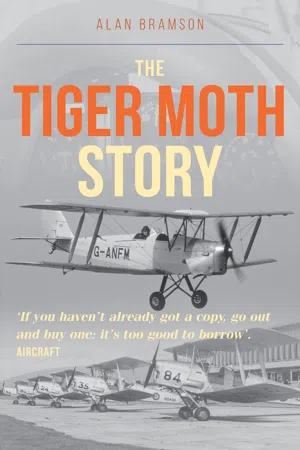
The Tiger Moth is one of the major aviation success stories in the history of British aviation. Developed by Geoffrey de Havilland and flown for the first time on October 26 1931, the biplane became the most important elementary trainer used by Commonwealth forces. More than 1, 000 Tiger Moths were delivered before WWII, and subsequently around 4, 000 were built in the UK with an extra 2, 000 being manufactured in Canada, Australia and New Zealand. Following the end of WWII, pilots could buy and modify a Tiger Moth for recreational use or agricultural crop spraying and use it relatively cheaply. This, combined with its popularity within the aero club movement, provided employment for the Tiger Moths until the late fifties when the more modern closed cockpit aircraft began to force them into retirement. This new edition provides a comprehensive account of the aircraft's origins and its development as a trainer of Commonwealth pilots in times of peace and war. It also looks at some of the other roles which this versatile little aeroplane performed such as a crop duster, glider tug, aerial advertiser, bomber, coastal patrol plane and aerial ambulance. Technical narrative and drawings, handling ability and performance as seen through the eyes of the pilots combine to make The Tiger Moth Story the most comprehensive book of the aircraft.
- 248 pages
- English
- ePUB (mobile friendly)
- Available on iOS & Android
eBook - ePub
The Tiger Moth Story
About this book
Information
Subtopic
British HistoryIndex
HistoryCHAPTER ONE
The Family Tree
IT was one of those sunny days that, years later, provokes us to complain that our summers are not as pleasant as they used to be. Such is the behaviour of human memory that we tend to forget the discomforts of the past and only recall the good experiences such as those glorious summer days of years ago. Yet this one was real enough and, thus encouraged, a number of us were picnicking on the lawn outside one of the well-known flying clubs in the Home Counties. Every now and then a visiting aircraft would arrive or a local plane would depart to another club. A Cessna landed and taxied up to the club followed by a sleek fighter-like Piper painted in some exotic colour scheme of doubtful taste but undisputed brilliance. Suddenly our attention was diverted by a sound alien among the modern light planes. It was the unmistakable ‘pop, pop, pop’ of a throttled back Gipsy engine, and sure enough a Tiger Moth swept in to land but a few yards away from the line of parked aircraft.
It was just another visiting Tiger so far as the younger club members were concerned, but to those connected with flying and old enough to remember the year 1931 it represented something quite different. Like vintage motorcars, famous elderly aeroplanes have a habit of bringing back memories, and as the little Tiger parked between a diminutive Turbulent and the sleek Comanche one couldn’t help but notice the pensive look of those who would never see 50 again. Some thought of the hotted-up versions so skilfully flown by the spirited Tiger Club, and the many Tigers, some good and others not so good, still flying in many parts of the world, while others recalled their immediate post-war years with the RAFVR. One of the gathering thought back to the 1939–45 period and wondered what had happened to Dizzy Bearsby and Dusty Miller and all the others at Shellingford and similar Elementary Flying Schools. Then there were the pre-war days at Brooklands – Geoffrey Tyson and his superb performances on the Tiger at Sir Alan Cobham’s Air Displays – and Hubert Broad, who flew the first ever Tiger Moth.
One or two of the members had by now walked over to greet the visiting pilot who was extracting himself from the rear cockpit. How old was this Tiger? Was it made by de Havillands or Morris Motors? Did it see service in this country or was it stationed in Australia or Southern Rhodesia? Perhaps it was an old pre-war club machine… If only it could talk! Perhaps it is as well that planes are mute because this one could undoubtedly recall hard years at the hands of student pilots in two shades of blue and others in khaki, followed by a still longer period of hammering at a flying club. It would instance the day that X dropped it from the height of a hangar while practising landings – treatment that would wreck a less robust aeroplane.
But to be really familiar with the sequence of events that gave us the evergreen Tiger, chatting about past experiences on the club lawn is not enough; we shall have to put the clock back still further and review the 1920s, or perhaps even earlier times.
There is an old saying to the effect that, were it not for unreasonable men, nothing would ever be accomplished in this world of ours. It is certainly the case that these who are in the forefront of progress often push their own security to the background. And so it was with the young Geoffrey de Havilland. With little or no knowledge of aerodynamics and only half-promises of financial assistance, he gave up a steady position with an acceptable future and turned his thoughts to the building of his No 1 Biplane. Like the Wright Brothers, he was soon to realise that the key to successful flight was power, and that meant finding a suitable engine. Fortunately his training as an engineer enabled him to design his own aero engine, and have it built by the old Iris Car Company. It seems that his grandfather was not only understanding but uncommonly far-sighted, for the old gentlemen advanced £500 to Geoffrey de Havilland so that he might relinquish his job with a reputable firm of automobile engineers and set about building an aeroplane – this in the days when they were looked upon as newfangled contraptions fit only for madmen.
The frail machine was assembled in a small shed (bought from the famous holder of UK pilot certificate No 1, Moore-Brabazon). It stood in a field named Seven Barrows, which at the time was open grassland and part of Lord Carnarvon’s estate. Nearby is the village of Crux Easton, where Geoffrey’s father was Rector. Working on the project with Geoffrey de Havilland was his friend Frank Hearle. It was May 1909 when DH Biplane No 1 made a brief hop only to break up in the air. Fortunately de Havilland was uninjured save for a damaged wrist occasioned when he signalled his well-being from the wreckage and collected a sharp blow from the still rotating propeller. Later, when de Havilland had a flourishing aircraft manufacturing concern, he would fly in for the weekend and visit his family in a Gipsy Moth and, later, a Puss Moth. To this day it is still referred to as ‘de Havilland Field’. Cattle love the taste of doped fabric and the locals would erect a fence to protect the light planes when they came to Seven Barrows. Geoffrey became Sir Geoffrey, and when he died in 1965 his ashes were scattered over the field from a de Havilland Trident passenger jet flown by John Cunningham. The following year a memorial stone was laid on that historic site by Lord Porchester, the present owner of the land.
Looking back it is perhaps not surprising that so many of the early attempts to fly should have ended in failure, for there were no flying schools in existence and, indeed, hardly any previous experience of flight to call upon. The designer had to teach himself to pilot by trial and error. A famous pioneer aviator, the late Otto Lilienthal of pre-Wright brothers time, would often say, ‘To design a flying machine is nothing; to build is something; to test it is everything.’ These words were certainly true, for little was known at the time about stability and most of the early wire-andstick machines were capricious in the extreme.
If de Havilland was undaunted by his early failure, grandfather at least matched him in spirit, for on hearing of the setback he announced that since he intended leaving his grandson £1,000 he might as well have the other £500 immediately.
Backed by this additional money, Geoffrey de Havilland designed and built Biplane No 2, and on 10 September 1910 his tenacity was rewarded by a successful first flight. His achievements soon came to the notice of the aviation authorities at Farnborough who bought his aeroplane for £400 and gave him a job as an aircraft designer.
A brief period in the Royal Flying Corps during the early days of the Great War led to his being seconded to the Aircraft Manufacturing Co Ltd at Hendon, where he produced some of the most successful designs of that period. It is not generally realised that during the First World War a very considerable part of the American Air Force was equipped with the DH 4 of his design, and that many of the 4,800 built in the USA were in use until 1929.
With the winding down of production that inevitably followed the Armistice, the Aircraft Manufacturing Company rapidly ceased its activities. de Havilland’s reputation as a brilliant aircraft designer, coupled with the combined qualities of quiet confidence and far-sightedness that had always distinguished him, enabled him to raise £20,000 and form the de Havilland Aircraft Company Ltd at Stag Lane aerodrome, Edgware, an old airfield that had been the home of a flying school for some years.
Activity was confined to ‘civilianising’ old wartime aeroplanes, and many of the early passenger services were flown with somewhat grotesque-looking converted DH 4s. Life at Stag Lane was very hand-to-mouth in those days, with work coming through the shops in dribs and drabs. Private aeroplanes and private pilots were practically non-existent, and anyone wealthy enough to consider an aeroplane for his own use would have little or no ready-made market at his disposal, so that it was very much like buying a new suit – the aeroplane was tailor-made for the customer. It was just such a transaction that was to have the most profound effect on the destiny of the still young de Havilland Company. A wealthy sporting pilot by the name of Alan S. Butler approached de Havillands with an inquiry for a private touring aeroplane. A design was prepared and the result emerged as the DH 37, a handsome-looking biplane powered by a Rolls-Royce Falcon engine of 275hp. Butler took delivery of his aeroplane and became one of the first private owners in the country. So pleased was he with his new mount that he inquired, quite casually, if de Havillands would like any additional finance, since he was prepared to invest in the company. It was an opportune request, for the enterprise was faced with the need to purchase the freehold of Stag Lane aerodrome – the offer was readily accepted.
The DH 37 as bought by Butler was a typical ‘small’ aeroplane of the period, with its massive engine originating from the Great War. In effect the aeroplane was as large and powerful as the RAF fighters of the day, and as such hardly likely to popularise flying in the eyes of the general public.
Many minds were turned to the engaging thought of providing an aeroplane inexpensive to buy and run, so that the ‘man in the street’ could contemplate private ownership. With this object in view the Lympne Trials were arranged in 1923, and de Havillands rose to the occasion with the DH 53 Humming Bird, a tiny single-seater aeroplane powered by a Douglas motorcycle engine. The Air Ministry placed a small order for the type and used it for communication duties. One even took part in some rather frightening experiments when it was suspended underneath an airship and released in flight, later to re-attach itself to the mother ship. Nevertheless de Havillands had little faith in the Humming Bird as a serious means of transport, nor for that matter could they see it as the answer to their quest for ‘everyman’s aeroplane’.
Somewhat reluctantly a certain Mr Alan Cobham agreed to fly one over to the Continent so that it might take its place on the de Havilland stand at an aeronautical exhibition in company with a notice to the effect that it had actually flown the Channel!
With so little power, fuel and, in consequence, range was strictly limited and it was necessary to refuel the diminutive machine at Lympne airport before leaving the coast. It was a somewhat embarrassed Cobham who asked the petrol crew to fill his fuel tank – all 2 gallons of it – but worse was to come, for, battling against a headwind on the return journey, the Humming Bird was overtaken by, of all things, a Belgian goods train. On landing back at Stag Lane, Cobham is said to have expressed his opinion of the aeroplane in somewhat forthright terms, but then de Havillands themselves had little affection for this product of the Lympne Trials.
In the following year a competition was arranged by the Air Ministry for two-seater designs with engines limited to a maximum capacity of 1,150cc. Such an engine is little bigger than that to be found in a modern miniature car, and it should be remembered that in 1924 engines were developing less power for a given size than they do now. Many of the modern materials that we now take for granted were non-existent at the time. The modern designer saves weight in the interest of added range or payload, but during the 1924 competition a few pounds here and there, using an engine of such low power as that stipulated by the Air Ministry, could actually mean the difference between flying and remaining on the ground. Because of these problems, and remembering the not very satisfactory outcome of the Lympne Trails, de Havilland himself decided not to take part in the Air Ministry competition. Instead he devoted his energies to a design that was the company’s first serious attempt to build an inexpensive aeroplane suitable for private ownership and with practical touring capabilities.
In many ways this aeroplane may be regarded as the great grandfather of the Tiger Moth. Certainly the DH 51, as it was called, was unmistakably Moth-like in appearance, and it set the fashion in small aeroplanes for many years to come.
Some ingenious features were incorporated in the DH 51. In appearance it was a conventional enough two-bay biplane in its original form, although later machines had the wingspan reduced by 5 feet and single pairs of inter-plane struts. The fuselage was plywood-covered, and two cockpits were provided, the rear one with a single seat for the pilot. Two passengers could be accommodated tandem fashion in the larger front cockpit, and it was possible to make the opening smaller by pulling back the windscreen, which was attached to a sliding portion of the fuselage top decking. In this way draughts were minimised when only one passenger was carried. A Tiger Moth-type, spring-loaded trimmer was used.
Determined efforts were made to keep down the price of the aeroplane so that it might appeal to a large section of the public. Vast quantities of war surplus aero engines were on the market at the time, and de Havillands were able to purchase a number of RAF 1a engines at the incredible price of 72p each! The RAF 1a developed 90hp and was an air-cooled V8 engine. On the prototype it drove an enormous four-bladed propeller 8ft 9in in diameter. In these days, when the V8 engine is considered as something of an achievement in motorcars, it is perhaps surprising to realise that such power units existed in aeroplanes during the 1914–18 war.
Although the engine had been designed and built by the Royal Aircraft Establishment, the authorities confined the DH 51 to flying within the vicinity of Stag Lane Aerodrome because by this time dual ignition was considered necessary for civil aeroplanes and the RAF 1a had only one magneto and one set of plugs. Rather than face the cost of modifying the engine and obtaining type approval, de Havillands re-engined the DH 51 with an Airdisco motor of 120hp, which was in reality a much improved version of the wartime 80hp Renault design. If the Airdisco engine vastly enhanced the performance of the DH 51, it shattered de Havillands’ vision of an inexpensive private aeroplane. Disappointing as this must have been to the manufacturers, the aeroplane deserves its place in aeronautical history as the link between the heavy military-type biplane of the 1920s and the private light plane of today.
The first Airdisco-engined DH 51 took part in the 1925 King’s Cup Race, although fog prevented the course being completed. Later it became the first aeroplane to land on the cliff top at John O’Groats. A later version, known as the DH 51a, even sported automatic camber-changing flaps – a very advanced refinement in those days.
The fifth and last of the DH 51 aeroplanes to be built was purchased by a Mr Carberry of Mombasa, who named it ‘Miss Kenya’. In more recent years this fine old aircraft has returned to its country of birth, where it is now part of the Shuttleworth Collection. It may be seen flying in immaculate condition at the regular flying displays of vintage aircraft performed at Old Warden airfield, Bedfordshire, England. As such it is believed to be the oldest de Havilland aeroplane still flying – the great-grandfather of all the Moths!
Looking back there is little doubt that were it not for the difficulties that arose with the authorities over the use of war surplus engines at 72p a time, many more DH 51s would have been sold and the resultant chain of events may have led to an aeroplane quite different from the Tiger Moth.
By now de Havillands had reached the conclusion that, while the little Humming Bird had been too small to be practical, the DH 51 with the 120hp Airdisco engine represented the other extreme and was too large for the private owner. Nevertheless the experience gained from these two designs was to prove invaluable to Geoffrey de Havilland and his colleagues, enabling them to draw up a clear set of requirements for the ideal private aeroplane. They commenced the design with these thoughts in mind:
1 The engine must not weigh more than 350lb and it should develop 60hp
2 It must be a two-seater with dual control.
3 There must be a space for weekend luggage.
4 It must be easy to fly and capable of operating from relatively small fields.
5 It must have a genuine 80mph cruising speed.
6 It must carry sufficient fuel for 3 hours flying.
7 The wings should fold to facilitate hangarage in small sheds and towing behind a car.
8 It must be inexpensive both in first and running costs.
A problem that had existed since the earliest attempts to fly was immediately apparent to the de Havilland Company – no suitable engine existed.
Before relating the fascinating sequence of events that led to the development of what was possibly the first purpose-designed light aeroplane engine, the name of Frank Halford must be introduced, a man who was to play a most important part in the development of the de Havilland enterprise and without whose activities this story may never have been told.
As a young man Major Halford graduated from Nottingham University. He learned to fly with the Bristol Aeroplane School at Brooklands and in the far-away days of 1912 became one of their Assistant Flying Instructors. Shortly afterwards he joined the Aeronautical Inspection Department at the Air Ministry as Engine Examiner, and it was in this capacity that he amassed the valuable knowledge that was to place him amongst the foremost of the world’s aero engine designers.
On the outbreak of the First World War in 1914 he went to France as a sergeant in the RFC and was commissioned the following year. Such was his reputation that in 1916 he was returned home to design new engines. His first engine unit, the famous 230hp ‘BHP’, eventually developed into the Siddeley Puma, which was fitted to thousands of DH 4s and DH 9s.
He worked with the eminent Ricardo, maestro of the internal combustion engine, and together they produced the first inverted motor. It was Halford who modified the original wartime Renault engine and raised its power from 80 to 120hp. In its improved form it was manufactured during the Great War by the Aircraft Disposal Compa...
Table of contents
- Cover
- Title
- Copyright
- Contents
- Foreword by Sir Alan J. Cobham KBE AFC
- Author’s Preface
- Acknowledgements
- 1 The Family Tree
- 2 Birth of the Tiger
- 3 The Colourful Thirties
- 4 Growing Up
- 5 The Fighting Tigers
- 6 Tigers in Training
- 7 The Post-War Tiger
- 8 The Tiger Changes its Stripes
- I Leading particulars of DH 82a Tiger Moth
- II Tiger Moth-equipped Service and Reserve Flying Schools 1937–1954
- III Summary of Production of New Tiger Moths DH 82b Queen Bee Production
- IV List of registrations of DH 82 and 82a Tiger Moths constructed by the de Havilland Company in Great Britain and other factories abroad
- V Pilot’s Notes for World War II Tiger Moth
- Plate Section
Trusted by 375,005 students
Access to over 1.5 million titles for a fair monthly price.
Study more efficiently using our study tools.
Frequently asked questions
Yes, you can cancel anytime from the Subscription tab in your account settings on the Perlego website. Your subscription will stay active until the end of your current billing period. Learn how to cancel your subscription
No, books cannot be downloaded as external files, such as PDFs, for use outside of Perlego. However, you can download books within the Perlego app for offline reading on mobile or tablet. Learn how to download books offline
Perlego offers two plans: Essential and Complete
- Essential is ideal for learners and professionals who enjoy exploring a wide range of subjects. Access the Essential Library with 800,000+ trusted titles and best-sellers across business, personal growth, and the humanities. Includes unlimited reading time and Standard Read Aloud voice.
- Complete: Perfect for advanced learners and researchers needing full, unrestricted access. Unlock 1.5M+ books across hundreds of subjects, including academic and specialized titles. The Complete Plan also includes advanced features like Premium Read Aloud and Research Assistant.
We are an online textbook subscription service, where you can get access to an entire online library for less than the price of a single book per month. With over 1.5 million books across 990+ topics, we’ve got you covered! Learn about our mission
Look out for the read-aloud symbol on your next book to see if you can listen to it. The read-aloud tool reads text aloud for you, highlighting the text as it is being read. You can pause it, speed it up and slow it down. Learn more about Read Aloud
Yes! You can use the Perlego app on both iOS and Android devices to read anytime, anywhere — even offline. Perfect for commutes or when you’re on the go.
Please note we cannot support devices running on iOS 13 and Android 7 or earlier. Learn more about using the app
Please note we cannot support devices running on iOS 13 and Android 7 or earlier. Learn more about using the app
Yes, you can access The Tiger Moth Story by Alan Bramson in PDF and/or ePUB format, as well as other popular books in History & British History. We have over 1.5 million books available in our catalogue for you to explore.