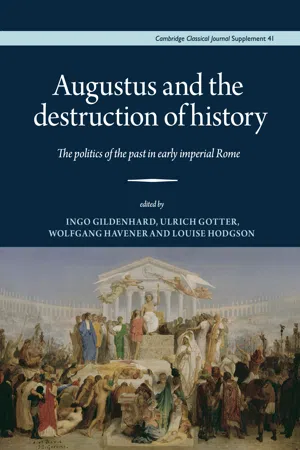
Augustus and the Destruction of History explores the intense controversies over the meaning and profile of the past that accompanied the violent transformation of the Roman Republic into the Augustan principate. The ten case studies collected here analyse how different authors and agents (individual and collective) developed specific conceptions of history and articulated them in a wide variety of textual and visual media to position themselves within the emergent (and evolving) new Augustan normal. The chapters consider both hegemonic and subaltern endeavours to reconfigure Roman memoria and pay special attention to power and polemics, chaos, crisis and contingency – not least to challenge some long-standing habits of thought about Augustus and his principate and its representation in historiographical discourse, ancient and modern. Some of the most iconic texts and monuments from ancient Rome receive fresh discussion here, including the Forum Romanum and the Forum of Augustus, Virgil’s Aeneid and the Fasti Capitolini.
eBook - ePub
Augustus and the destruction of history
The politics of the past in early imperial Rome
- 376 pages
- English
- ePUB (mobile friendly)
- Available on iOS & Android
eBook - ePub
Augustus and the destruction of history
The politics of the past in early imperial Rome
About this book
Information
Subtopic
Ancient HistoryIndex
HistoryD.
HISTORICAL PALIMPSESTS
CHAPTER 8
Flooding the Roman Forum
Hannah Price
The Roman Forum lies in a valley at the centre of a famously hilly city, tucked into the area between the Capitoline and Palatine Hills. For the Romans of the late republic, this civic space monumentalised the res publica of the senatus populusque Romanus: at one end stood the Curia, the senate’s meeting place, and temples looking down on the open area and rostra. This was the place from which an empire was governed, where political dreams were made and broken. Fergus Millar (provocatively) distilled the Republican constitution as ‘an orator addressing a crowd in the Forum’.1 In 66 BCE, Marcus Tullius Cicero, ambitious junior politician from Arpinum, began his first address from the rostra with the following words (Man. 1):
… mihi semper frequens conspectus uester multo iucundissimus, hic autem locus ad agendum amplissimus, ad dicendum ornatissimus est uisus, Quirites …
[…it has always been by far my greatest joy to watch your crowded assembly, and this place in particular has seemed the most authoritative for conducting business and the most distinguished for speaking, fellow citizens…]
The Commentariolum Petitionis likewise hails the Forum as the very centre of Rome and its political life (Q. Cic. Pet. 2):2
prope cottidie tibi hoc ad forum descendenti meditandum est: ‘nouus sum, consulatum peto, Roma est.’
[virtually every day when you go down to the Forum you ought to say to yourself: ‘I am a new man. I seek the consulship. This is Rome.’]
Because it was central to the city’s daily workings, the Forum was cluttered with legends and memories: it was perhaps the place where Rome’s collective memory was most concentrated.3 History was monumentalised in the temples and civic buildings crammed around the edges of the open space and the shrines dotted over its pavement. Marble heroes glowered down from every available vantage point. This past was enacted by those who wrote about the place, by the rituals that were performed there, and by the orators who spoke in the law courts and from the rostra.4 When they climbed the speaker’s platform – as Cicero did, above – they stood above the ancient beaks of long-destroyed enemy ships, and shared the stage with a thicket of statues.5
The physical monuments were, arguably, ‘the most eloquent texts about the origins of the city available to the Romans of the middle and late Republic.’6 It would have been possible for Cicero, as he stood on the rostra in 66 BCE, to ‘read’ a history of Rome from the Forum, from Romulus to the present day. Some of the monuments told of a time when Rome was ruled by kings. Behind him, in the Comitium, was a black marble pavement, beneath which, some legends had it, lay the grave of Romulus himself. The Senate House above it took its name from Tullus Hostilius, the third of Rome’s ancient kings. Others recalled the expulsion of those kings, and the history of the early republic. From the rostra, Cicero could see across the Forum to the Temple of Castor and Pollux, dedicated to the gods who had brought the good news that the Roman monarchy had been defeated forever. Throughout his career, Cicero would frequently draw on the authority of the monuments in his speeches to the assembly.7 As Amy Russell writes, ‘the sheer variety of meanings and messages attached to the Forum’s monuments gave any viewer the opportunity to create his (or even her) own narrative.’8 The Forum narrative woven by Cicero and many of his contemporaries was of the government of Rome by the senate and Roman people. The Forum acted not just as a monument to the republic but a physical manifestation of it. It was an open, shared, ‘neutral’ space, inimical to oneman rule: the place ‘most authoritative for conducting business and most distinguished for speaking’.
Augustus did his best to put his stamp on this part of Rome as well – but the Forum proved a more intractable space than his own Forum Augustum, which he was able to design from scratch in his own image: the area invited the construal of alternative histories, potentially problematic for the first princeps, and in this chapter I want to trace the dynamics of memory and oblivion that the historical layers of the Roman Forum enabled during the late republic and early imperial period. My starting point are the rivers of blood that flooded the Forum in the late 40s at a time when the Forum itself resembled a construction site, with various building projects initiated by Caesar yet incomplete. While architects buried the republican Forum beneath the bright marble of the imperial city, poets and historians looked beyond the Forum’s republican history into mythical prehistory, ‘burying’ the republican Forum in a pastoral landscape or the waters of a primitive swamp. And just as the architectural Forum was transformed from an irregular space to an ordered precinct, we can trace a movement from a diffusion of different and even contradictory traditions about sites and monuments to a single authoritative version. The Augustan version of the Forum ideally required everyone to respond to the site in the same way, thereby eliminating subversive ‘readings’. At its root, this is about historical authority. The process is particularly raw here because the Forum was traditionally the place of free speech. Now the princeps assumed ultimate authority over its history. He required the collaboration of writers, historians and viewers on the project to commemorate recent tragedy and to refine and redirect old traditions; and at times, as we will see, some were reluctant.
Cicero’s Head
In 43 BCE, the head and hands of Marcus Tullius Cicero, Father of His Country, former consul, senator, philosopher and sometime poet, were fixed to the rostra. They joined a heap of rotting body parts, gory trophies claimed by Rome’s new masters, the ‘Three Men for Confirming the Republic’. The horror of the sight was hard to articulate, even a few decades later – though authors of the triumviral and early imperial period developed something of an obsession with the death of Cicero, neatly archived and thereby amplified by Seneca the Elder, who put together an anthology of accounts of Cicero’s death from Livy, Gaius Asinius Pollio, Aufidius Bassus, Aulus Cremutius Cordus, Bruttedius Niger and a poem by Cornelius Severus.9 According to Livy (Sen. Suas. 6.17),
uix attollentes lacrimis oculos humentes intueri truncata membra ciues poterant.
[The citizens could scarcely bear to lift their tearful eyes to look upon his butchered limbs.]
And Bruttedius Niger proclaimed that there was no part of the Forum not marked with some trace of his distinguished speaking (Sen. Suas. 6.21: nulla non pars fori aliquo actionis inclutae signata uestigio erat…). Cicero was one of more than two thousand citizens who lost their lives in the slaughter following Julius Caesar’s assassination.10 The dictator’s closest allies, Mark Antony, Marcus Lepidus and his recently adopted son Gaius Julius Caesar (Octavian), had initiated their triumvirate with a wave of proscriptions. Whitened boards were set up in the Forum, displaying the names of political enemies, those with tempting riches and even some of their own relatives. Such a wholesale butchering of citizens had not been seen since Sulla’s day.11 The triumvirs portrayed this measure as just revenge for Caesar’s murder.
With Caesar’s assassins and their followers eliminated, and the empire divided among them, the triumvirs inevitably turned on each other. By 30 BCE Octavian was the last man standing. If the republican system of government can be encapsulated, in Millar’s phrase, by ‘the orator addressing the crowd in the Forum’, then there can be no more potent symbol of its end than Cicero’s downfall – which accounts for Seneca the Elder’s colle...
Table of contents
- Cover
- Title Page
- Copyright
- Contents
- Preface and Acknowledgements
- Contributors
- Abbreviations
- Introduction
- A. (One Possible) Order out of Chaos
- B. Augustan Plots
- C. The Histories of Empowered Subalterns
- D. Historical Palimpsests
- E. Epilogue
- Bibliography
Trusted by 375,005 students
Access to over 1.5 million titles for a fair monthly price.
Study more efficiently using our study tools.
Frequently asked questions
Yes, you can cancel anytime from the Subscription tab in your account settings on the Perlego website. Your subscription will stay active until the end of your current billing period. Learn how to cancel your subscription
No, books cannot be downloaded as external files, such as PDFs, for use outside of Perlego. However, you can download books within the Perlego app for offline reading on mobile or tablet. Learn how to download books offline
Perlego offers two plans: Essential and Complete
- Essential is ideal for learners and professionals who enjoy exploring a wide range of subjects. Access the Essential Library with 800,000+ trusted titles and best-sellers across business, personal growth, and the humanities. Includes unlimited reading time and Standard Read Aloud voice.
- Complete: Perfect for advanced learners and researchers needing full, unrestricted access. Unlock 1.5M+ books across hundreds of subjects, including academic and specialized titles. The Complete Plan also includes advanced features like Premium Read Aloud and Research Assistant.
We are an online textbook subscription service, where you can get access to an entire online library for less than the price of a single book per month. With over 1.5 million books across 990+ topics, we’ve got you covered! Learn about our mission
Look out for the read-aloud symbol on your next book to see if you can listen to it. The read-aloud tool reads text aloud for you, highlighting the text as it is being read. You can pause it, speed it up and slow it down. Learn more about Read Aloud
Yes! You can use the Perlego app on both iOS and Android devices to read anytime, anywhere — even offline. Perfect for commutes or when you’re on the go.
Please note we cannot support devices running on iOS 13 and Android 7 or earlier. Learn more about using the app
Please note we cannot support devices running on iOS 13 and Android 7 or earlier. Learn more about using the app
Yes, you can access Augustus and the destruction of history by Ingo Gildenhard,Ulrich Gotter,Wolfgang Havener,Louise Hodgson, Ingo Gildenhard, Ulrich Gotter, Wolfgang Havener, Louise Hodgson in PDF and/or ePUB format, as well as other popular books in History & Ancient History. We have over 1.5 million books available in our catalogue for you to explore.