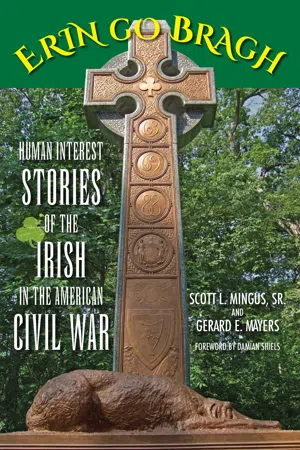
Tens of thousands of Irish-Americans fought in the Civil War, with "Sons of Erin" playing a vital role in both Union and Confederate armies. Award-winning author Scott L. Mingus, Sr., has teamed with living historian Gerard E. Mayers to present more than 150 of their most memorable personal stories. In this unique collection, readers will find tales of courage, boldness, and humor. Many have rarely been seen in print since their original publication more than a century ago. Stories have been adapted for the modern reader, with original sources cited. The anthology also includes brief biographies of leading Irish soldiers and personalities such as Patrick Cleburne, Father William Corby, James Shields, Michael Corcoran, and the incomparable Thomas Francis Meagher of the famed Irish Brigade and its battle cry, "Ireland Forever."
eBook - ePub
Erin Go Bragh
Human Interest Stories of the Irish in the American Civil War
- 120 pages
- English
- ePUB (mobile friendly)
- Available on iOS & Android
eBook - ePub
Erin Go Bragh
Human Interest Stories of the Irish in the American Civil War
About this book
Information
CHAPTER ONE: 1861
Native-born Americans of Irish descent and those residents born in Ireland had divided loyalties as war loomed. While the majority openly supported the Union, thousands of others supported the fledgling Confederacy, formed after the elections of 1860 when seven slave-holding states in the Deep South seceded from the established Union and formed their own new government. President-elect Abraham Lincoln of Illinois and the Republican Party openly opposed the western expansion of slavery, a controversial issue that, coupled with years of sectional strife and general distrust of the Federal government in much of the South, led to the long-feared dissolution. Anxiety and un-certainty were high, especially in the military. Many U. S. Regular Army officers from these breakaway states resigned their commissions and went home; other Southerners took a “wait-and-see” attitude in case their own states also departed. Some U.S. Regular Army officers from the South chose to remain with the Stars and Stripes rather than support the breakaway government.
Patrick Fletcher had served in the pre-war 2nd U. S. Cavalry under Colonel Jefferson Davis, who now was the Confederate president. A story circulated in several Northern newspapers in early 1861 about a Private Fletcher and a Texas lieutenant. The two men were at Fort Bliss (near El Paso, Texas) discussing the prospects of engaging in battle with fellow Irishmen should war erupt. The duo had enlisted together a few years ago. Fletcher had decided to honor his five-year enlistment term and stay in the U. S. Army, unlike several comrades who were leaving to join the Rebel forces.
“Do you know that you will have to fire on green Irish colors in the Southern ranks?” inquired the lieutenant, who had resigned his commission in the “abolition army.” “And won’t you have to fire on them colors…?” Fletcher pointed at the Stars and Stripes flying above the fort and retorted, “Sure it isn’t a greater shame for an Irishman to fire upon Irish colors, than for an American to fire on American colors.” He reminded his friend that the oath of allegiance they had taken to the United States still held true, “And th’ oath’ll be on my side, you know, Lieutenant.” He also had another point, one of great personal importance, “What would my mother say if I deserted my colors?”
Not long afterward, on March 31, Fort Bliss peacefully surrendered to the Confederates.
Joliet (IL) Signal, June 11, 1861.
**
Tensions remained quite high between the North and South throughout the early spring. Abraham Lincoln was inaugurated as president on Monday, March 4, in a well-attended ceremony in front of the U. S. Capitol. Many in the Confederacy feared hostile Federal intervention to force them back into the Union. Within days, newspapers reflected the growing uncertainty. “Are we to have war?” a Rebel soldier encamped near Charleston, South Carolina, asked in a letter to his hometown paper on March 11. “Upon this point opinions are as conflicting as ever… At present the indications are decidedly pacific, but to-morrow’s advices may overthrow the well constructed fabric of our hopes. Ten days at farthest, we think, will decide the all absorbing question.”
Finally, on April 12, secessionists manning land-based fortifications near Charleston opened fire with long-range artillery on Federal-held Fort Sumter in the harbor. An Irishman from Galway, Private James Gibbons of Company E, 1st U. S. Artillery, is often credited with firing the first Federal shot in defense of the Stars and Stripes. More than 40% of the garrison had Irish blood, including 38 men born on the Emerald Isle.
After an intense 34-hour bombardment, Union Major Robert Anderson finally surrendered the battered masonry fort. He ordered his men to fire a 100-gun salute before leaving Sumter. The 47th shot prematurely exploded, tearing off the right arm of Private Daniel Hough and killing the native of Tipperary, Ireland. He holds the dubious distinction of being the first soldier to die in the Civil War. Another Irishman soon followed him. Edward Galloway, one of five men who had suffered serious injuries in the blast, died five days later in a hospital in Charleston.
Abbeville, SC, Press and Banner, March 15, 1861; Samuel W. Crawford, The Genesis of the Civil War: The Story of Sumter, 1860-1861 (New York: C. L. Webster & Company, 1881).
**
Reaction to the stunning surrender of Fort Sumter was swift, with most Southern newspapers hailing the results and many in the North expressing outrage and condemnation. On April 15, President Lincoln immediately called for 75,000 volunteers for three months to suppress the Confederate rebellion and “to cause the laws to be duly executed.” That proclamation further angered much of the Southern populace, although pockets of East Tennessee, northwestern Virginia, the hill country of northern Texas, and scattered other areas remained loyal to the U. S. government. Four additional states, Virginia, Tennessee, North Carolina, and Arkansas, formally seceded and joined the Confederacy. A few slave states in the Upper South that directly bordered free states chose not to secede. These included Missouri, Kentucky, Maryland, and Delaware.
Many Northerners quickly embraced the idea of fighting to preserve the Union. “The enthusiasm of the people of Massachusetts was of the first order,” Michael H. Macnamara later wrote. “Flags were flung to the breeze from public buildings and private dwellings in every part of the capital of Massachusetts; recruiting offices were opened, and large handbills posted in every place of prominence in Boston. The excitement and enthusiasm throughout the city were intense, and enlistments rapidly progressed. Such was the state of affairs when, early in the month of April, Captain [Thomas] Cass, then commanding the Columbian Association, proposed to the Governor of Massachusetts to raise an Irish regiment for three years, under the call of the President of the United States, or for a longer period if they were required.”
That new infantry regiment eventually became the 9th Massachusetts, a predominantly Irish outfit. Many of the recruits were recent immigrants from the Emerald Isle; others were second or third generation Irish-Americans. “Many of our best soldiers were men of family and position,” Macnamara later proudly recounted, “comfortably situated, who entered the service from feelings of pure patriotism and warm affection for a government under which they had long lived and their children had been born. To them the stars and stripes was a beautiful emblem; and if they could not love it as dearly as their own native green, they could fight for it as bravely, and shed their blood for it as freely, as any ‘to the manor born.’
Michael H. Macnamara, The Irish Ninth in Bivouac and Battle (Boston: Lee and Shepard, 1867).
**
Thomas Francis Meagher, an immigrant from Waterford who became one of the best-known Irish-born Civil War generals, later remarked as to the reasons why Irishmen preferred to enlist en masse and serve in the same regiments together: “The Irishman never fights so well as when he has an Irishman for his comrade. An Irishman going into the field in this cause, has this as the strongest impulse and his richest reward, that his conduct in the field will reflect honour on the old land he will see no more. He therefore wishes that if he falls, it will be into the arms of one of the same nativity, that all may hear that he died in a manner worthy of the cause in which he fell, and the country which gave him birth.”
In late April, the fiery Meagher, an outspoken Irish nationalist who resented British control, quickly raised a full 100-man Zouave company of fellow Irishmen. They became attached to the 69th New York State Militia under Colonel Michael Corcoran.
John Francis Maguire, The Irish in America (London: Longmans, Green, and Co., 1868).
**
Abraham Lincoln’s urgent call to arms sparked newspaper editorials, political speeches, patriotic rallies, and fiery sermons from pulpits across the North. The Catholic Church (the denomination of most of the Irish in America) did not officially endorse either the Union or the Confederate cause. It remained neutral.
“The Catholic Church of America, regarding war as a great calamity, and civil war—of State against State, citizen against citizen, even brother against brother—as the direst of all evils,” John Francis Maguire, an Irish member of the British Parliament, stated, “scrupulously abstained from uttering one word that could have a tendency to inflame or exasperate the passions which others were doing their utmost to excite to uncontrollable fury. The mission of the Church was to proclaim glad tidings of peace to man, not to preach strife and hatred amongst brethren. Thus those who visited the Catholic churches of the United States from the Spring of 1861 to the Autumn of that year, would never have supposed, from anything heard within their walls, that the trumpet had sounded through the land; that armies were gathering, and camps were forming; that foundries were at full blast, forging implements of death; that artificers were hard at work, fashioning the rifle and the revolver, sharpening the sword, and pointing the bayonet; that dockyards rang with the clang of hammers, and resounded with the cries of myriads of busy men—that America was in the first throes of desperate strife.”
There were several individual exceptions. Michael Creedon headed the Church of the Holy Family on Chapel Street in Auburn, New York. On Sunday, April 21, the talented, eloquent Roman Catholic priest and several other local clergymen urged their congregants to support the fledgling war effort. “I wish every man who can leave his family, to enlist,” the 37-year-old Creedon pleaded. “This is the first country the Irishman ever had that he could call his own country. The flag of stars and stripes, the only flag he can fight under and defend as his own flag. Now is the time of a nation’s peril. Let every Irishman show that he is worthy to be a part of a great and glorious nationality. Now, when the American flag is bombarded and struck down by traitors, let every Irishman show he is true to the flag which always protects him. I want every Irishman who hears me to enlist if he can. There are two classes whom I most despise—cowards and traitors—and those who can enlist and do not, are either one or the other.”
Father Creedon’s impassioned sermon inspired 65 of his faithful listeners to rise and march as a body from the church across town to the armory. There they, along with another large group of volunteers from the nearby Presbyterian church, were sworn into Company C, 19th New York Infantry, under Irish-born Captain Owen Gavigan.
John Francis Maguire, The Irish in America (London: Longmans, Green, and Co., 1868); Frank Moore, ed., The Rebellion Record: A Diary of American Events, with Documents, Narratives, Illustrative Incidents, Poetry, etc., 7 vols. (New York: G. P. Putnam, 1861-68); Henry Hall and James Hall, Cayuga in the Field, a Record of the 19th N.Y. Volunteers (Auburn, NY: 1873); Pomeroy, Ohio, Weekly Telegraph, July 12, 1861.
**
States’ rights, particularly over the complex issue of Federal interference in the economically important Southern institution of slavery, were critical to many who supported the new Confederacy and flocked to its service. Longstanding sectional differences over tariffs, banking, Federal authority, and many other controversial issues had created rifts between the states for decades, but the fulcrum to many in the South was the Republican Party’s rejection of the westward expansion of slavery into the territories. Other planks in the platform that also alienated Southerners included import tariffs that supported Northern industry, the proposed development of a transcontinental railroad, and plans to offer free farmland to settlers in the West through a Homestead Act.
Now that civil war was a reality, President Lincoln’s stated immediate goal was to preserve the previous Union of the states. The Irish in America tended to follow sectional partisan lines. “The Northern Irishman went into the war for the preservation of the Union— the Southern Irishman for the independence of his State,” so wrote Parliamentarian John Francis Maguire, “And each, in his own mind, was as thoroughly justified, both as to right and duty, principle and patriotism, as the other.”
John Francis Maguire, The Irish in America (London: Longmans, Green, and Co., 1868).
**
In New Orleans, many pro-Confederate men of Irish descent enlisted in what was to become the 6th Louisiana Infantry. So many enlisted, in fact, that the unit took on the name Irish Brigade. Starting on April 29, Captain Samuel L. James posted notices in a leading newspaper stating that, “Company A, Irish Brigade, will meet for company drill at 64 St, Charles street, EVERY EVENING, at 7½ o’clock.” Concurrently, William M. Monaghan was running a notice to form another company: “The roll for the formation of Company B, Irish Brigade, will be opened on Monday, the 29th inst., at 10 o’clock A. M. at the Olive Branch Coffeehouse, corner of Erato and Tchoupitoulas streets. The undersigned will be present every day and evening until the roll shall be filled up, when the member will elect their officers. Prompt action is now expected of every Irishman in the present crisis.”
New Orleans Times-Picayune, April 30, 1861.
**
Several leading Southern newspapers soon caught wind of the religious and political fervor which pervaded the North as men flocked to take up arms against the fledgling Confederacy. Their editors were quick to respond. “The reign of terrorism still prevails in New York…,” a Nashville newspaper proclaimed on Sunday, May 5, “The fanatical churches are all praying for war and bloodshed. Members of that beautiful abolition organization in New York known as ‘The Young Men’s Christian Association’ have volunteered to butcher American citizens of the Southern States for daring to assert their rights, and who, no doubt, would put up unctuous prayers of thanksgiving if they could hear that a negro insurrection had broken out, that Southern men’s wives and daughters had been violated, their children slain, the men’s throats cut and their dwellings destroyed by fire.”
The “warlike fury” permeating New York extended to the impassioned calls for Irish volunteers. “One Irishman just returned is made to tell...
Table of contents
- COVER
- TITLE
- COPYRIGHT
- TABLE OF CONTENTS
- INTRODUCTION
- FOREWORD
- CHAPTER ONE: 1861
- CHAPTER TWO: 1862
- CHAPTER THREE: 1863
- CHAPTER FOUR: 1864
- CHAPTER FIVE: 1865
- SUGGESTED FURTHER READING
- ABOUT THE AUTHORS
Trusted by 375,005 students
Access to over 1.5 million titles for a fair monthly price.
Study more efficiently using our study tools.
Frequently asked questions
Yes, you can cancel anytime from the Subscription tab in your account settings on the Perlego website. Your subscription will stay active until the end of your current billing period. Learn how to cancel your subscription
No, books cannot be downloaded as external files, such as PDFs, for use outside of Perlego. However, you can download books within the Perlego app for offline reading on mobile or tablet. Learn how to download books offline
Perlego offers two plans: Essential and Complete
- Essential is ideal for learners and professionals who enjoy exploring a wide range of subjects. Access the Essential Library with 800,000+ trusted titles and best-sellers across business, personal growth, and the humanities. Includes unlimited reading time and Standard Read Aloud voice.
- Complete: Perfect for advanced learners and researchers needing full, unrestricted access. Unlock 1.5M+ books across hundreds of subjects, including academic and specialized titles. The Complete Plan also includes advanced features like Premium Read Aloud and Research Assistant.
We are an online textbook subscription service, where you can get access to an entire online library for less than the price of a single book per month. With over 1.5 million books across 990+ topics, we’ve got you covered! Learn about our mission
Look out for the read-aloud symbol on your next book to see if you can listen to it. The read-aloud tool reads text aloud for you, highlighting the text as it is being read. You can pause it, speed it up and slow it down. Learn more about Read Aloud
Yes! You can use the Perlego app on both iOS and Android devices to read anytime, anywhere — even offline. Perfect for commutes or when you’re on the go.
Please note we cannot support devices running on iOS 13 and Android 7 or earlier. Learn more about using the app
Please note we cannot support devices running on iOS 13 and Android 7 or earlier. Learn more about using the app
Yes, you can access Erin Go Bragh by Scott L. Mingus,Gerard E. Mayers in PDF and/or ePUB format, as well as other popular books in History & Military Biographies. We have over 1.5 million books available in our catalogue for you to explore.