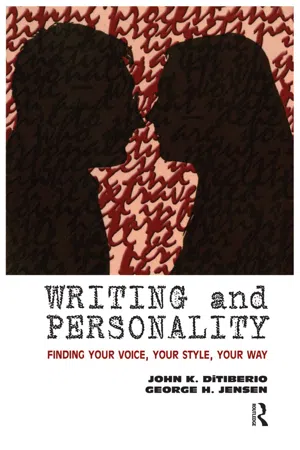
'We cannot separate the writer from the writing. Nor should we try. Both our writing process and our writing products need to carry our unique signature, a bit of our personality.' - From Writing and Personality How you write - what works for you and what makes sense to you - depends on who you are, your personality, your preferences, your style of thinking and feeling. If you're extraverted and grounded in your senses, your natural writing style will be far different from the person who tends to be introverted and intuitive. Not only that, how you learn to write will be different as well. Here's a book that taps into the natural strengths of your personality and helps you use those strengths in your writing. Whether you're a student, businessperson, or professional writer, this book will help you: engage your natural writing voice; adapt to styles that are less natural; overcome writer's block; and find the right words for communicating effectively, whatever your assignment.
eBook - ePub
Writing and Personality
Finding Your Voice, Your Style, Your Way
- 248 pages
- English
- ePUB (mobile friendly)
- Available on iOS & Android
eBook - ePub
About this book
Information
Part I
How Writing Works For You
Both our past and present experiences with writing color how we view ourselves as writers. In the two chapters in this first part of the book, we will ask you to look back at your beginnings as a writer and then examine how you currently go about writing.
Both here and throughout the book we encourage you to keep a notebook and a pen close by as you read. This is because these first two chapters, and several others that follow, include writing exercises designed to help you relate in an active way to the questions we will be raising. Although some of these exercises might seem a little odd at first, we encourage you to give them a chance to tell you about your beginnings as a writer, about your present as a writer, and, in later chapters of the book, about your personality and how it relates to writing.
1
Your Beginnings as a Writer
We cannot separate the writer from the writing. Nor should we try. Both our writing process and our writing products need to carry our unique signature, a bit of our personality. In our earliest development as writers, however, many of us treated writing as something quite separate from who we were as growing individuals. The exercises in this first chapter will help you to establish what your beginnings as a writer were like. This will be the starting point for your discovery of natural ways to go about writing that work for you.
How You Learned to Write
We’d like you to take a moment now to think about your first attempts at writing and to write about your earliest memory as a writer. But we would like for you to write in a special way. We want you to write for about ten or fifteen minutes in one continuous word. What we mean by “one continuous word” is that once you begin to write, you should not lift your pen at the end of a word, but continue writing. For example, you might write:

Do not lift your pen from the page except to move on to the next line. This will help you to get in touch with the physical act of writing—the feel of a pen in your hand and the extended feel of that pen rubbing across paper.
In Writing Down the Bones: Freeing the Writer Within, Natalie Goldberg spoke about the physical act of writing in this way:
Handwriting is more connected to the movement of the heart…. Consider the pen you write with. It should be a fast-writing pen because your thoughts are always faster than your hand. You don’t want to slow up your hand even more with a slow pen.
This physical sense of writing, which can tell us so much about how we experience the process of putting words to paper, is often pushed from our consciousness when we concentrate on the meaning we want to convey.
As you write in your continuous word, it is best to leave your t’s uncrossed and your i’s undotted. That way you can concentrate on the immediate process of forming your letters and constructing words. If you feel a compelling need to cross your t’s and dot your i’s, try at least to hold off until you reach the end of a line.
What you have done, albeit in a limited way, is to reexperience the process of learning to write. Below is an example of what one adult writer produced as he followed this exercise:

Before this recaptured memory begins to slip away, take some time to reflect on it in another piece of writing. The questions below will help you to think about what this experience has meant to you.
- How did it feel to hold the pen in your hand and form the letters?
- What surprised you about this earliest recollection of writing?
- What were your emotional reactions to writing about this early experience?
- Do you think that this experience was typical of your early attempts at learning to write, or was it in some way unique?
- What else do you remember about your early experiences with writing?
The following answers were written by the person who wrote the paragraph for the previous exercise.
- It felt awkward. The self-consciousness I was writing about when I was in the first grade was duplicated when I couldn’t easily cross my t’s or dot my i’e or add commas where they were supposed to be.
- It surprised me how quickly I felt like I must have felt in the first grade and how I free associated to the social atmosphere of being in that classroom of classmates and teachers.
- I felt a little embarrassed to discover that in some ways I feel punished inside even today when I start to write.
- I really am not sure if this experience was typical, but I suspect it was.
- I mainly am aware of how important it was to feel connected and supported by people around me when learning a new skill.
With this exercise, you have begun to reconstruct what learning to write was like for you. It is now time to move from elementary school to high school or college. You will move from how you learned to hold a pen and form letters to how you learned to write book reports, essays, and term papers.
How You See Yourself as a Writer
In order to explore how you began to form your concept of yourself as a writer, we’d like you to try another exercise. We want you to record a simple list of all the feedback, both positive and negative, that you received about your writing in any writing course, whether in high school or college. For example:
- “Well-written.”
- “Unclear pronouns—not clear what or who they refer to.”
- “Too much information and not enough personal integration.”
- “Too much use of passive voice.”
- “You need to vary words (use a thesaurus).”
- “You need to discuss implications of topic.”
- “Your writing has vigor.”
- “Too many misspelled words.”
- “Too wordy.”
- “Very thorough.”
If you are the type of person who saves old school papers, you might want to review these to refresh your memory.
After you have made your list of comments that teachers or others have made about your writing, spend ten to fifteen minutes exploring your reactions to these comments. You may go on to explore some of your most vivid memories about writing in high school or college. The following sample shows one writer’s reactions to their comments.
I was still very mindful of the personal reactions of teachers and of wanting to do what I could to meet their expectations and to feel both respected and liked by them. Unlike my first-grade memory, I remember feeling somewhat annoyed at teachers who reacted with criticism, some of it feeling nitpicky to me.
How you see yourself as a writer may or may not have been affected by teacher comments as strongly as was true for this writer. But we hope you were able to recall memories of your early writing and how you reacted to it.
If, after you have finished these exercises, you feel that there is much more in your memory that you have not yet explored, continue to write in your notebook until you believe your memories are somewhat complete. Although it might seem as if you have just taken a step backwards, you have just made an important move that will allow you to develop a new vision of yourself as a writer, as you will see later in the book.
2
Your Present as a Writer
Before we begin to make some suggestions about how your writing process can become more effective, we would like for you to examine what your writing is like right now. What follows is a series of questions about your writing process. Read these questions over and determine your answers to them.
- Do you like to write at all?
- What kinds of writing do you prefer?
- What kinds of subjects do you find it difficult to write about?
- What do you do before you begin to write?
- Do you use an outline?
- How long do you think about a topic before you begin to write?
- How do you organize your ideas or data?
- What kind of difficulties do you tend to get into?
- What kind of writer’s blocks do you experience?
- What kind of environment do you prefer to write in? For example, do you like to write at a desk, or would you prefer to write while lying in bed?
- What kind of writing rituals do you follow? Do you have to sharpen pencils before you begin? listen to music? take a bath? or wear a certain kind of clothing?
- What are your rough drafts like?
- How many drafts do you like to write?
- Do you develop your best ideas when alone or when talking with someone?
- Are your ideas clear before you start to write? Or do they become clear as you write?
- What kind of feedback helps you to revise better?
- When you revise your drafts, what do you tend to change?
- When you revise, do you tend to expand or cut your rough draft?
- What are your strengths as a writer?
- What are your weaknesses as a writer?
- What are some of your best experiences as a writer?
- What are some of your worst experiences as a writer?
The responses of two very different types of writers follow. You might want to compare your answers to theirs.
Writer Number One
- Writing is a real pain.
- If I have to write, it’s better when it’s about what I know about a subject—facts and information. But I’d really rather tell you about it face to face.
- I have trouble with “compare and contrast” essays.
- Before I write, I get all the materials together—note cards, books, thesaurus, dictionary, sharpened pencils, pad of paper, coffee pot.
- I always write an outline. How else can you know what comes next?
- I only think about a topic long enough to know what I’m going to write about. Then I’ve got to get the ideas out of my head and tell somebody.
- If I can talk to a colleague, the ideas start to take shape and get organized. Then I outline.
- I have a problem when there’s no choice about a deadline and there’s not enough time to get organized.
- I have problems when there’s no one around to talk out ideas with.
- I always write at a big table with all the necessary resources within arm’s reach.
- I never write on an empty stomach or without a good supply of caffeine ready. Also, I never start until everything needed is on the table in front of me.
- I prefer a first draft to be not very rough, but to be a solid product. If there was a way to do it all in one sitting, that would be best. Revising is a struggle.
- I only write one draft, if I can get away with it (I rarely can).
- I definitely get my best ideas from talking with someone.
- I prefer my ideas to be clear before I write.
- The best feedback needs to be clear and to the point and give specific suggestions on rewording.
- When I revise, I change mechanics (sentence structure, verb tense) because words don’t come easily on the page. (They come a lot easier when I speak them.)
- Teachers always told me to say more, to...
Table of contents
- Cover
- Half Title
- Title
- Copyright
- Dedication
- Contents
- Prologue
- Part I How Writing Works for You
- Part II Writing Through Personality
- Part III Sixteen Approaches to Writing
- Part IV Practical Applications
- Epilogue
- Appendix
- Bibliography
- Credits
- Index
Trusted by 375,005 students
Access to over 1.5 million titles for a fair monthly price.
Study more efficiently using our study tools.
Frequently asked questions
Yes, you can cancel anytime from the Subscription tab in your account settings on the Perlego website. Your subscription will stay active until the end of your current billing period. Learn how to cancel your subscription
No, books cannot be downloaded as external files, such as PDFs, for use outside of Perlego. However, you can download books within the Perlego app for offline reading on mobile or tablet. Learn how to download books offline
Perlego offers two plans: Essential and Complete
- Essential is ideal for learners and professionals who enjoy exploring a wide range of subjects. Access the Essential Library with 800,000+ trusted titles and best-sellers across business, personal growth, and the humanities. Includes unlimited reading time and Standard Read Aloud voice.
- Complete: Perfect for advanced learners and researchers needing full, unrestricted access. Unlock 1.5M+ books across hundreds of subjects, including academic and specialized titles. The Complete Plan also includes advanced features like Premium Read Aloud and Research Assistant.
We are an online textbook subscription service, where you can get access to an entire online library for less than the price of a single book per month. With over 1.5 million books across 990+ topics, we’ve got you covered! Learn about our mission
Look out for the read-aloud symbol on your next book to see if you can listen to it. The read-aloud tool reads text aloud for you, highlighting the text as it is being read. You can pause it, speed it up and slow it down. Learn more about Read Aloud
Yes! You can use the Perlego app on both iOS and Android devices to read anytime, anywhere — even offline. Perfect for commutes or when you’re on the go.
Please note we cannot support devices running on iOS 13 and Android 7 or earlier. Learn more about using the app
Please note we cannot support devices running on iOS 13 and Android 7 or earlier. Learn more about using the app
Yes, you can access Writing and Personality by John K. DiTiberio,George H. Jensen in PDF and/or ePUB format, as well as other popular books in Languages & Linguistics & Authorship. We have over 1.5 million books available in our catalogue for you to explore.