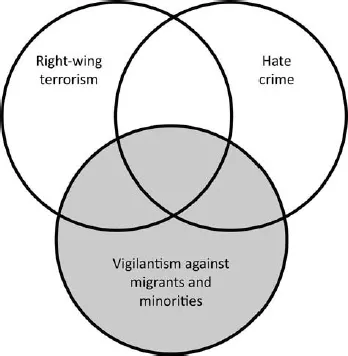
Various authors in the field are defining vigilantism rather differently, emphasising diverse aspects and criteria. The etymological root of the word “vigilantism” is in the Latin word “vigil”, which means “watchful” or “alert” (Osborne 2005: 39). Vigiles (“Cohortes Vigilum”) served as firemen patrols and also as municipal police during night hours in the ancient Rome. They belonged under the governmental structures at that time (Cartwright 2016). The current use of the terms vigilante or vigilantism has its roots in the Spanish word “vigilante”. It means “watchman”, “guard”, “guardian” or “regulator” (Kirschner 2011: 572). The modern term “vigilantism” – in contrast to the ancient historical legacy – is dominantly connected with non-governmental actors. These actors are active in the enforcement of subjectively perceived “law and order” and they act autonomously from governmental power. Eduardo Moncanda defines vigilantism as “the collective use or threat of extra-legal violence in response to an alleged criminal act” (Moncanda 2017: 408). However, the exact concept and definition of vigilantism is still being discussed among various scholars. For example, this above-mentioned Moncanda’s definition does not include the element of non-state actors (the extra-legal police violence can then be subsumed under this definition). Moncanda also understands vigilantism as a group activity (Moncanda 2017: 408). However, some individuals can do vigilante activities without engagement in an organizational structure. Although we do not have any examples of that in our volume, some lone actor terrorists do have a dimension of vigilantism behind their violent activities.2
The frequently used criteria of vigilantism were elaborated by Les Johnston (1996). He identified six main elements of this phenomenon. According to Johnston:
- it involves planning and premeditation by those engaging in it;
- its participants are private citizens whose engagement is voluntary;
- it is a form of ‘autonomous citizenship’ and, as such, constitutes a social movement;
- it uses or threatens the use of force;
- it arises when an established order is under threat from the transgression, the potential transgression, or the imputed transgression of institutionalized norms;
- it aims to control crime or other social infractions by offering assurances (or ‘guarantees’) of security both to participants and to others
(Johnston 1996: 220)
The condition of using extra-legal force – or at least an explicit or implicit threat of the use of such force – is a challenge to researching extreme right vigilantism in the modern world. Due to legal conditions in democratic countries the official goals of vigilante groupings are usually declared to be within the borders of legality, despite the fact that the real intention of vigilante activists might well be to make use of extra-legal force. Many recent groups that we consider as vigilante in our volume do not act against the law of the countries in which they operate, and they avoid the actual use of violence (although they do display a capacity for violence). Some of them even declare readiness to cooperate with law enforcement agencies, rescue services or military forces. On the other hand, they were established autonomously with the intention to demonstrate their capability to act besides the present governmental agencies. Even if they sometimes declare that they want to be part of the governmental security systems, they do not want to lose their organizational independence. In fact, they understand themselves as a challenge to present security policy and they often struggle to use their capability in the security field for propagandist and other political issues (mobilization of new supporters, strengthening of recent ties in their collective, to show their capability to act for domestic or foreign allies etc.). The identification of real goals can be difficult; however, it’s an important part of the current research.
Our re-conceptualization of vigilantism also requires dropping the criterion of clear extra-legal activity by vigilantes (despite the fact that in many cases also current vigilantes break the law). We substitute this condition with the element of public performance of their own capabilities for violence to counter activities and groups of people that are perceived as social anomalies by vigilantes. They want to win sympathy and support from the part of the public who are inclined to share their opinions and attitudes. The fifth of Johnson’s element is related to the threat from transgression is not necessary in some cases of vigilantism. The threat may not be real, but to a certain category of people it is perceived or constructed as a threat to the social order. However, how broadly the group is perceived in the community as a threat seems to be an important variable for the growth and success of vigilante groups.
Our re-conceptualization of vigilantism is also generally still based on Johnson’s definition and criteria discussed above, however, with some significant changes. Our core definition of vigilantism refers to organized civilians acting in a policing role without any legal authorization, using or displaying a capacity for violence, claiming that the police (or other homeland security agencies) are either unable or unwilling to handle a perceived crime problem.
However, there are several border cases that may stretch or challenge the definition, such as unorganized mobs and lynchings, or individual vigilantism and lone actor terrorists. There are also some vigilante groups that are tacitly tolerated by the police or other authorities. Some organizations (in particular militias) are doing vigilante patrols or other crime-fighting activities as a minor side task. Moreover, some citizen patrol groups are declaring themselves as non-violent but may still appear rather intimidating. However, vigilantism is not a black or white phenomenon. With a core definition of vigilantism, it is to be expected that there will be a number of cases in the grey area.
Specific vigilante activities should be analysed within a time and context related framework. The use of vigilantism can be temporarily limited, real goals of some groups can be hidden (they can declare only goals without threat of the use of force, but they can intend to use it), or a mixed form of activities can be found (for example, an interconnection between vigilante groupings and private security companies in some countries). Vigilantism can also be understood as an instrument to weaken the enemies in civic and ethnic conflicts and it can serve as a training activity for paramilitary groups. Moreover, in some cases it can be supported by external actors (including hostile states) with the goal to weaken the state authorities. In this sense can it be subsumed under hybrid campaigns or hybrid warfare (Mareš 2017b).
There are several theories for explaining vigilantism. David Kowalewski identified two main theories – the “frontier” theory (represented by Richard Brown and Roger McGrath) and the “counter-movement” theory (represented by Kowalewski himself). The frontier theory is inspired by the experience of the “Wild West” and it tries to explain vigilantism as a reaction to the lack of “law and order” governmental authorities. The “counter-movement” theory explains vigilantism as a reaction to the rise of deviancy (mostly growing crime or perception of crime) in society. Vigilantes struggle to keep their life environment and life-style (Kowalewski 2002: 427–429).
We also want to explore the various reasons, drivers or goals behind vigilante activities – from an actor-oriented point of view. We suggest the following types:
- External justifications present the official mission of the group towards the public, the media and authorities: to protect the community against certain crime threats that the police and other authorities do not have the capacity (or will) to handle alone. These justifications are tailored to resonate with widely held concerns in society (e.g. on crime or migration) and issues high on the news media’s agenda. Vigilante groups claim to represent the interests of society in order to control crime or other social anomies.
- Group strategies are the internal reasoning for why leaders believe it will serve the interests of the group to engage in vigilante activities, typically to attract media attention and public support, promote the organization and mobilize new members, to maintain group cohesion, or to undermine the legitimacy of the government. It can also serve as a training activity for paramilitary groups. These reasons are not meant for public consumption.
- Individual motivations are the drivers behind individual participation in vigilante activities and groups. Such motivations may have to do with a desire to improve one’s personal identity and status, in particular by individuals who have a tarnished reputation as trouble-makers or criminals. Others may be attracted by the militarism or belonging to a strong group. These individual motivations are usually not fit to be publicized, as they may undermine the official justification. However, some participants may also be driven by motives that are congruent with the official mission of the group.
In the concluding chapter we will discuss to what extent these three types of reasons are matching our empirical cases.
In our volume we are dealing with vigilantism against migrants and minorities. This is a specific segment of vigilantism (besides religious vigilantism against deviants in their communities, antifascist vigilantism against fascist groups etc.). We have a broad range of cases from Western and Eastern Europe, North America, Israel/Palestine and India.
In all cases included in this book we can identify the declared goal of protecting society or the community against groups and behaviour that are – at least from the point of view of vigilantes – considered unacceptable. An anomic behaviour (mostly crime or breaking the moral norms of majority) is usually connected with specific groups of people – immigrants, ethnic or religious minorities etc. Usually vigilantes claim to protect the traditional societal order (as exemplified by the cases of Hindu vigilantes in India and anti-homosexual vigilantes in Russia, see chapters by Ahuja and Laryš, both in this volume). However, some contemporary vigilantes imagine themselves as protectors of certain liberal Western values as well (mostly in protection of women’s rights against Muslims). A specific case is Jewish vigilantes on the occupied territories who defend the territory to which they claim national ownership (see Gazit in this volume).
The protected community is usually the traditional major nation state (see Koehler’s chapter on Germany in this volume), however, it can also be only a local community or a region. The protected object is often used in the name of some groups, as in the case of Britain First! (see Ralph-Morrow in this volume). The pan-national and “civilization” arguments are also used, as an example of the “Defend Europe” by a multinational crew of European Identitarian shows.
Even if vigilantes do not consider the whole target group as “criminal” or “problematic”, they use racial, ethnic or religious profiling in their activities. In many cases they want to protect their “own” community not only against “extraneous” entities, but also against their supporters, for example, Russian vigilante terrorists targeted also officials who helped migrants from Caucasus and Central Asia (see chapter by Martin Laryš). These “extraneous entities” are mostly accused of criminal behaviour (for example, the frequently used term “Gypsy crime” in Central Europe by local vigilantes), which is sometimes specified (“against the rape culture”), or o...