Introduction to Experimental Biophysics
eBook - ePub

Introduction to Experimental Biophysics

Biological Methods for Physical Scientists

  1. 764 pages
  2. English
  3. ePUB (mobile friendly)
  4. Available on iOS & Android
eBook - ePub

Introduction to Experimental Biophysics

Biological Methods for Physical Scientists

About this book

Praise for the First Edition

"essential reading for any physical scientist who is interested in performing biological research." ?Contemporary Physics

"an ambitious text…. Each chapter contains protocols and the conceptual reasoning behind them, which is often useful to physicists performing biological experiments for the first time." –Physics Today

This fully updated and expanded text is the best starting point for any student or researcher in the physical sciences to gain firm grounding in the techniques employed in molecular biophysics and quantitative biology. It includes brand new chapters on gene expression techniques, advanced techniques in biological light microscopy (super-resolution, two-photon, and fluorescence lifetime imaging), holography, and gold nanoparticles used in medicine. The author shares invaluable practical tips and insider's knowledge to simplify potentially confusing techniques. The reader is guided through easy-to-follow examples carried out from start to finish with practical tips and insider's knowledge. The emphasis is on building comfort with getting hands "wet" with basic methods and finally understanding when and how to apply or adapt them to address different questions.

Jay L. Nadeau is a scientific researcher and head of the Biomedical Engineering in Advanced Applications of Quantum, Oscillatory, and Nanotechnological Systems (BEAAQONS) lab at Caltech and was previously associate professor of biomedical engineering and physics at McGill University.

Frequently asked questions

Yes, you can cancel anytime from the Subscription tab in your account settings on the Perlego website. Your subscription will stay active until the end of your current billing period. Learn how to cancel your subscription.
No, books cannot be downloaded as external files, such as PDFs, for use outside of Perlego. However, you can download books within the Perlego app for offline reading on mobile or tablet. Learn more here.
Perlego offers two plans: Essential and Complete
  • Essential is ideal for learners and professionals who enjoy exploring a wide range of subjects. Access the Essential Library with 800,000+ trusted titles and best-sellers across business, personal growth, and the humanities. Includes unlimited reading time and Standard Read Aloud voice.
  • Complete: Perfect for advanced learners and researchers needing full, unrestricted access. Unlock 1.4M+ books across hundreds of subjects, including academic and specialized titles. The Complete Plan also includes advanced features like Premium Read Aloud and Research Assistant.
Both plans are available with monthly, semester, or annual billing cycles.
We are an online textbook subscription service, where you can get access to an entire online library for less than the price of a single book per month. With over 1 million books across 1000+ topics, we’ve got you covered! Learn more here.
Look out for the read-aloud symbol on your next book to see if you can listen to it. The read-aloud tool reads text aloud for you, highlighting the text as it is being read. You can pause it, speed it up and slow it down. Learn more here.
Yes! You can use the Perlego app on both iOS or Android devices to read anytime, anywhere — even offline. Perfect for commutes or when you’re on the go.
Please note we cannot support devices running on iOS 13 and Android 7 or earlier. Learn more about using the app.
Yes, you can access Introduction to Experimental Biophysics by Jay L. Nadeau in PDF and/or ePUB format, as well as other popular books in Medicine & Biotechnology in Medicine. We have over one million books available in our catalogue for you to explore.

Information

1Introduction and Background

1.1Basic Biochemistry

Molecules important to molecular biophysics

The chemicals of life are organic compounds, or compounds that contain carbon. Carbon (C, atomic number 6) is one of the few tetravalent atoms, meaning that it has four valence electrons available to form bonds with other atoms. Each of the four atoms to which it bonds can be different and can include other carbons. Carbon is thus central to the formation of complex, three-dimensional molecules, and it makes up about 10.7% of the atomic ratio of living matter. Other molecules necessary for the building blocks of life are hydrogen (H, atomic number 1, monovalent, 60.5%); oxygen (O, atomic number 8, divalent, 25.7%); nitrogen (atomic number 7, trivalent, 2.4%); phosphorus (P, atomic number 15, trivalent up to hexavalent, 0.17%); and sulfur (S, atomic number 16, divalent, tetravalent, or hexavalent, 0.13%).
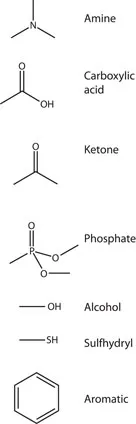
The valence of the key elements forms the basis of the structural model of organic chemistry that permits us to predict which combinations of atoms will combine to form stable molecules. Figure 1.1 shows the classes of organic molecules that are most important in biochemistry and their functional groups. If the letter R is used to designate any chemical moiety besides hydrogen, then an amine has the general formula RNH2 (for a primary amine), R2NH (for a secondary amine), or R3N (for a tertiary amine). A carboxylic acid is RCOOH; at physiological pH, it will usually dissociate into a free proton (H+) and a negatively charged ion RCOO (called a carboxylate). A ketone is RCOR where the second R is not an OH group. Phosphates in biology have the form RPO32
inline.math1_1
; when R is OH, this is referred to as inorganic phosphate or Pi. Alcohols are ROH where R can be nearly anything; any biomolecule with a name ending in -ol terminates in an OH group. A sulfhydryl, also known as a thiol group, is RSH. Thiols are also known as mercaptans. Finally, an aromatic group is a planar ring that may be made of carbon only or of carbon plus oxygen, nitrogen, or sulfur (called heterocyclic compounds). The simplest example is the six-carbon benzene ring.
image fig1_1.webp
Figure 1.1Functional groups seen in biochemistry.
The structural and functional makeup of a cell results from combinations of four basic molecular types, each of which falls into one or more of the categories in Figure 1.1; these molecules join end to end (polymerize) to achieve their final active form:
  • Amino acids (polymerize to form peptides and proteins). There are twenty naturally occurring amino acids, whose structure consists of a central carbon atom with a carboxylic acid on one end and a primary amine on the other, and a side chain that branches off the first carbon after the amine. The side chain determines the amino acid’s identity and ranges from a hydrogen (glycine) to complex charged or aromatic groups (Figure 1.2). Short chains of amino acids are called peptides and may be synthesized by organisms like fungi in order to kill bacteria. The example shown is bacitracin, which is a cyclic peptide active against many bacteria; it is often found in first-aid creams. Some peptides are available from biological suppliers, and custom peptides are also available, though costly. Full-length proteins are encoded genetically and synthesized as a long polypeptide chain. They then fold to form their final tertiary structure; the example shown is green fluorescent protein, or GFP, which has 238 amino acids. The physics of protein folding still remains largely a mystery. Proteins usually cannot be purchased but must be expressed and...
Table of contents

  1. Cover
  2. Half Title Page
  3. Series Page
  4. Title Page
  5. Copyright Page
  6. Contents
  7. Series Preface
  8. Preface
  9. Acknowledgments
  10. Author
  11. Contributors
  12. Chapter 1 Introduction and Background
  13. Chapter 2 Basic Molecular Cloning of DNA and RNA
  14. Chapter 3 Expression of Genes in Bacteria, Yeast, and Cultured Mammalian Cells
  15. Chapter 4 Advanced Topics in Molecular Biology
  16. Chapter 5 Protein Expression Methods
  17. Chapter 6 Protein Crystallization
  18. Chapter 7 Introduction to Biological Light Microscopy
  19. Chapter 8 Advanced Light Microscopy Techniques
  20. Chapter 9 Advanced Topics in Microscopy II: Holographic Microscopy
  21. Chapter 10 Quantitative Cell Culture Techniques
  22. Chapter 11 Semiconductor Nanoparticles (Quantum Dots)
  23. Chapter 12 Gold Nanoparticles
  24. Chapter 13 Advanced Topics in Gold Nanoparticles: Biomedical Applications
  25. Chapter 14 Surface Functionalization Techniques
  26. Chapter 15 Electrophysiology
  27. Chapter 16 Spectroscopy Tools and Techniques
  28. Chapter 17 Introduction to Nanofabrication
  29. Glossary
  30. Appendix A Common Solutions
  31. Appendix B Common Media
  32. Appendix C Restriction Endonucleases
  33. Appendix D Common Enzymes
  34. Appendix E Fluorescent Dyes and Quenchers
  35. Appendix F Fluorescent Proteins
  36. Index