Book Award Finalist for Urban Design Group Awards 2020
Human settlements are the result of a mix of self-organisation and planning. Planners are fighting a losing battle to impose order on chaotic systems. Connections between the process of urban growth and the fields of complexity theory are of increasing importance to planners and urbanists alike; the idea that cities are emergent structures created not by design but from the interplay of relatively simple rules and forces over time. From the the small Tuscan hill town to the megacities of Asia: the struggle between the planned and the unplanned is universal.
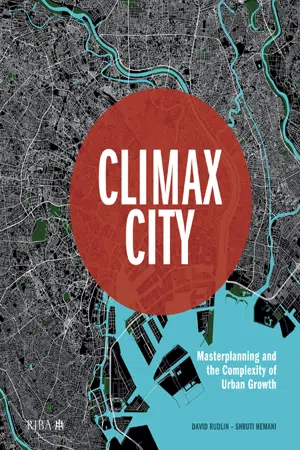
Based on years of international research, Climax City is a critical exploration of the growth of cities and masterplanning. Challenging the idea that the city can be entirely planned on paper, this book implores you to work with chaos when planning cities. Beautifully illustrated with striking hand-drawn plans of global cities, this is a vital and accessible contribution to urban theory and planning. It's the perfect title for practitioners and academics across planning and urban design looking to make sense out of chaos.
Venice Venice is a unique unplanned city that was founded by refugees fleeing the fall of the Roman Empire. The city is a complex web of streets and canals, and the only part to be planned is the Piazza San Marco, which was remodelled on the orders of Napoleon I around 1810.
1. Cities without Plans
The Walled City, Hong Kong:
A 14-storey vertical village topped with a sea of television aerials, the Walled City was an ungoverned enclave in Hong Kong that until its demolition in 1993 represented one particular vision of what the unplanned city might become.
Once upon a time (well, up until 1993), there existed a city called Hak Nam. Within its tangled alleys could be found shops and factories, dental clinics and pharmacies, schools, abattoirs, drug dens and brothels. Within its 14 storeys lived 35,000 people, and its buildings were packed so tightly that they formed a continuous mass. The ‘streets’ of this city had been encroached upon to such an extent that many were less than two metres wide, and pedestrians were forced to stoop below the tangle of dripping wires and pipe work carrying the city’s unofficial services. There was indeed water, drains and electricity (stolen from the surrounding mains) and even a postal system, but no law and order, no taxation or regulation, no building controls or planning permissions and certainly no health and safety. At the heart of the city could be found the original Tin Hu Temple around which the city had been built. The temple was now dappled by light filtering through the rubbish-strewn netting that had been strung across the space to protect it from items thrown from the surrounding blocks. This was a city beyond law and planning, a place that we know better by its English name: the Kowloon Walled City.
The journalist Peter Popham, a foreign correspondent at The Independent newspaper, toured the Walled City prior to its demolition in 1993. He wrote: ‘all this intensity of random human effort and activity, vice and sloth and industry, exempted from all of the controls we take for granted, resulted in an environment as richly varied and as sensual as the heart of the tropical rainforest’.8 Just as the majesty and diversity of the rainforest is the climax vegetation in the tropics, so perhaps the Walled City is the climax city state of human civilisation, or would be if we removed all controls. The only problem, as Popham points out, is that ‘it was so obviously toxic’.
The Walled City had been a Chinese fort for centuries. In 1899, it was excluded from the lease that signed Hong Kong and the New Territories over to the English for 99 years. However, within a few years the Chinese garrison had been expelled and the former fort fell into a legal limbo. The English asserted jurisdiction, but their legal advice was that this would be hard to enforce when, for example, prosecuting a criminal act that took place on the disputed territory in the Hong Kong courts. As a result of this, the city became a refuge for all manner of illegal activity, from the Triad gangs and drug dealers to the unlicensed doctors, dentists and pharmacies for which it became known.
By the 1950s, the Walled City had grown into a dense concentration of two- and three-storey shacks within the walls of the old fort. It was just one of many squatter settlements that characterised large parts of Hong Kong. The authorities instigated a programme to demolish these informal settlements and to rehouse their residents in new modern housing blocks. The Tung Tau Resettlement scheme had been built adjacent to the Walled City to rehouse its residents, and by 1960 most residents had signed up for rehousing. Nevertheless, the businesses were much less compliant since most of them wouldn’t have been allowed to trade outside the Walled City, or at least depended on the lack of regulation for their profit margin. In 1962, the businesses set up an anti-demolition committee and appealed directly to the Chinese authorities. The China News Agency proclaimed that the demolition plans were a gross violation of Chinese sovereign territory, and formal representations were made by the Mao government. In the midst of the Cold War, the British decided it was prudent to back down and quietly shelve the demolition.
It was from this point that the denizens of the Walled City were emboldened to turn it into something very different to the shanty town that had existed up until then. The anti-demolition committee evolved into the Kai Fong Association and became the de facto government for the enclave. Confident that their futures were secure, developers started rebuilding, using reinforced concrete and blockwork to expand upwards. The buildings rose and merged together until the whole 2.6 ha coalesced into a single complex mass, topped with a forest of TV aerials. The upwards expansion was only stopped because any higher than 14 storeys would have interfered with the flight path of the planes coming in to land at Hong Kong airport. Like plants stretching towards the light, the upper floors became the most desirable places to live, and the children played on the roof among piles of rubbish and pigeon lofts. Meanwhile, the gloomy damp lower floors were home to opium dens, heroin refineries, dog meat shops and strip joints. The authorities were increasingly unwilling to tolerate the lawlessness, and by the 1970s there was a crackdown and police started to patrol the area. However, far from subduing the area, the thin layer of law and order freed it from the gangs and allowed it to thrive even more. It never became salubrious or wholesome, but it did achieve a stability and developed a strong community. As Popham wrote, ‘despite its crazy appearance and its defiance of every rule of urbanism, the Walled City attained a sort of steady state, a degree of throbbing stability’.
This is as good a description as we are likely to find of the climax city as a steady state of human settlement. We are not suggesting that the Walled City was any sort of model for the way that we should build human settlements. It was an aberration, as bad as any of the slums that characterised the industrial city and led to the birth of modern town planning. Nonetheless, it is an extreme example of the underlying process by which cities are built. Planners may think that they have replaced this messy business with their own rational will. Our contention is that they are very far from having achieved this (and that it would be very bad if they ever did). Planners struggle under the delusion that it is they who are designing the city on their plans and in their reports. At the end of these plans, there is always an implementation section describing how the plan will be put into practice. It is just that this almost never happens. Much to the frustration of the planners, their plan is undermined often before it has even been approved. The city is not an artefact that can be designed but a complex system that may be influenced by a planning system but never entirely controlled by it.
The following quote could describe the Walled City:
The point to be taken is that this astonishing and outrageous arrangement cannot fully be understood as the result of a plot, or even a deliberate design, although those in whose interest it works also control it. It is indeed too huge and too complex a state of organised affairs ever to have been thought up in advance, to have been predicted as an idea.
Except this is a quote by the historian Steven Marcus, from his book about Friedrich Engels’ time spent in Manchester.9 Engels believed that the arrangement of the city, with its grand thoroughfares and hidden squalor, was the result of a plot by the merchants of the city to conceal the misery that their business had spawned. The quote is used by Stephen Johnson,10 saying that the Manchester of the mid-1800s was far too complex to have been controlled or created by anyone, however powerful they might be.
Manchester is a city we will return to time and again in this book because, as the first city of the Industrial Revolution, it embodies, for better or worse, many of the issues that we want to explore. At the time when Engels was there, it had grown into a major city without any form of local government, police force, city planners, health authority or even Member of Parliament. The terrible conditions that were created, every bit as bad as the Walled City at its worst, horrified commentators at the time and set in train processes that have shaped cities ever since. The flight of the middle classes to its early suburbs made it one of the first cities in the world to experience sprawl. As its economy eventually faltered (even as it continued to sprawl), it was the first city in the modern age to experience drastic depopulation and collapse. Finally, in the last few decades, it has been part of a worldwide process of re-urbanisation that is known in the UK as the ‘urban renaissance’. Alongside these natural processes of boom, bust and renewal, the city of Manchester has also been a test bed for the often futile attempts of the state to control and shape these trends: from rules dictating the form of bye-law housing to the development of the planning system, the process of slum clearance, and the subsequent attempts at urban regeneration. This book is about the interplay between the natural process of city growth and decline and the administrative process of planning and urban policy.
It is our contention that the modern planning system has become disconnected from this ‘natural’ urban process, or has seen it as a monster to be slain. Our argument is that this is a dangerous delusion and that, while the natural processes of urban growth may generate horrors, they also lie behind all of our most beautiful and successful urban areas. We need to understand the process by which climax urban states develop if we are to hone and shape them. A good analogy for this is a garden. If you leave a garden to its own devices, it will return to a natural state. Gardeners are in a constant battle to prevent this happening, planting, pruning and weeding to create the garden that they have planned. However, it would be a very poor gardener who believed that they had replaced the natural processes of nature with their artificial notion of the ideal garden. In this respect, horticulture is to garden design what urbanism is to planning or urban design. Yet, like bad gardeners, planners have for years been ignoring the underlying forces of urbanism when planning cities. As a result, they have either failed and seen their best-laid plans made irrelevant by the growth of the city, or worse, they have succeeded in implementing their plans and created dull, lifeless urban areas.
The idea that cities are human constructs that can be designed is the very notion on which the professions of planning and urban design are founded. It has a very long history and is closely associated with the utopian tendencies of the ideal city, and with it the perfect society. From ancient cosmic ideologies of perfect celestial order realised on Earth, to modern utopias of driverless cars and smart technology, planners have always had idealistic tendencies. They are forever envisaging a future that is better than the present, cleaner, more efficient and equitable, with happier, more affluent, more productive people. There is nothing wrong with this, and we will return to the positive influence of utopian thinking in Chapter 5. The problem is that planners tend to ignore the messy business of getting from where we are now to where they would like us to be. This is why we need to engage with the notion of cities as complex systems.
What Slime Mould Can Tell Us about City Growth
A complex system is something that has a very specific meaning in the relatively new science of complexity. As Johnson describes in his book Emergence, the field started with the study of the strange behaviour of slime mould.11 This is a primitive organism that exists as a colony of independent single-celled individuals but can act almost as if the colony were a single organism, able to move around, solve problems, find food, and so on. For many years, scientists assumed that among the millions of slime mould cells there were ‘pacemaker’ cells which were somehow sending out instructions to the rest of the colony. Except that, try as they might, they couldn’t find them. Instead, it appeared that the slime mould cells were acting as a swarm, somehow exhibiting an intelligence as a colony far greater than any of its individual members were capable of.
This was a process that had been studied in a number of fields, particularly biology, medicine and economics, but it was only in the 1960s that scientists started to recognise the connections. In all of these areas it seemed that a simple set of variables, if allowed to interact over time, will generate complex patterns. These patterns will often coalesce into a steady state, which will remain stable for a period, but then a small change will cause the pattern to dissolve and reform into something else. This behaviour by which complex systems generate patterns is called ‘emergence’.
This still doesn’t explain the behaviour of the slime mould. To do that, you have to add in the concept of ‘adaptation’ in which, as Johnson explains, emergent systems ‘show the distinctive quality of growing smarter over time, and responding to the specific and changing needs of their environment’. The billions of slime mould colonies across the planet have been interacting for thousands of years to create complex patterns. Certain patterns have been more successful than others, and the colonies that ‘discovered’ these successful patterns have been more successful and so have reproduced. Thus, through the process of evolution, the colony has grown smarter from the bottom up, despite
A village in Mali: A small settlement on the banks of the River Niger in the Mopti province of Mali. A self-organised vil...
Table of contents
Cover
Title
Copyright
Contents
About the Authors
Preface Obsessive Cartography
Introduction
Part 1 THE SPONTANEOUS CITY
Part 2 THE DESIGNED CITY
Part 3 THE UNRULY CITY
Part 4 THE CITY AND THE PLANNER
References
Index
Trusted by 375,005 students
Access to over 1.5 million titles for a fair monthly price.
Study more efficiently using our study tools.
Frequently asked questions
Yes, you can cancel anytime from the Subscription tab in your account settings on the Perlego website. Your subscription will stay active until the end of your current billing period. Learn how to cancel your subscription
No, books cannot be downloaded as external files, such as PDFs, for use outside of Perlego. However, you can download books within the Perlego app for offline reading on mobile or tablet. Learn how to download books offline
Perlego offers two plans: Essential and Complete
Essential is ideal for learners and professionals who enjoy exploring a wide range of subjects. Access the Essential Library with 800,000+ trusted titles and best-sellers across business, personal growth, and the humanities. Includes unlimited reading time and Standard Read Aloud voice.
Complete: Perfect for advanced learners and researchers needing full, unrestricted access. Unlock 1.5M+ books across hundreds of subjects, including academic and specialized titles. The Complete Plan also includes advanced features like Premium Read Aloud and Research Assistant.
Both plans are available with monthly, semester, or annual billing cycles.
We are an online textbook subscription service, where you can get access to an entire online library for less than the price of a single book per month. With over 1.5 million books across 990+ topics, we’ve got you covered! Learn about our mission
Look out for the read-aloud symbol on your next book to see if you can listen to it. The read-aloud tool reads text aloud for you, highlighting the text as it is being read. You can pause it, speed it up and slow it down. Learn more about Read Aloud
Yes! You can use the Perlego app on both iOS and Android devices to read anytime, anywhere — even offline. Perfect for commutes or when you’re on the go. Please note we cannot support devices running on iOS 13 and Android 7 or earlier. Learn more about using the app
Yes, you can access Climax City by David Rudlin,Shruti Hemani in PDF and/or ePUB format, as well as other popular books in Architecture & Architecture General. We have over 1.5 million books available in our catalogue for you to explore.