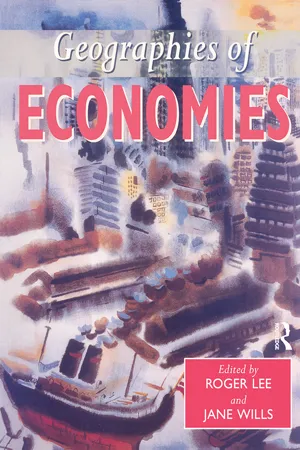
Setting out to explore the intersections of economy and geography, this book brings together contributions from the world's top economic geographers.
Over forty contributors draw upon contemporary theory and experience to explore the cultural and social constitution of economic geographies, processes of globalisation and new forms of political regulation and practice. Although focusing upon 'new' economic geography, the book also illustrates the many connections with previous scholarship as scholars seek to reconstruct the traditions of political economy to understand the contemporary world.
Highlighting and illustrating contemporary developments, the book opens up discussion about the implications of the complex geographies involved. In pointing to new directions of research and debate, this major statement in state of the art economic geography demonstrates the central relevance of economic geography not only in understanding the trajectories of change but in proposing alternatives.
- 424 pages
- English
- ePUB (mobile friendly)
- Available on iOS & Android
eBook - ePub
Geographies of Economies
About this book
Information
SECTION ONE
(RE)CONSTITUTING ECONOMIC GEOGRAPHIES
Cultural Turns and the (Re)Constitution of Economic Geography Introduction to Section One
In their own varying ways, all the chapters in this opening section reflect on the identity of economic geography as an academic subdiscipline. They do so at a moment when that identity is as fluid as it has been at any time since the early 1970s, a period that saw the beginning of the rise to intellectual hegemony of Marxian political-economic approaches. In the mid-1990s, this political-economic tradition is on the defensive. The content, concepts and approaches of (political) economic geography are all being actively reassessed. Content is being rethought in terms of what social and spatial portions of life count as economic, what portions (if any) are therefore non-economic, and how these designated spheres of the economic and non-economic interrelate. Concepts are being reflected on, both in terms of the definitions and utility of key political-economic theoretical constructs such as class, production, labour, capitalism or the economy itself, and in terms of the relevance of theoretical concerns that are conspicuous only by their absence from such a list (identity, representation or meaning for instance). And approaches are being reconsidered through debates over the kinds of theorization and methodology needed to make sense of whatever empirical and conceptual concerns economic geographers decide they are interested in.
The reasons for this uncertainty over the nature of economic geography are multiple. Practically, over the past decade the difficulties of elucidating the complicated geographies of transition in contemporary economies – especially the ‘new’ times and spaces of capitalism proclaimed by a host of mostly ‘post-Marxist’ commentators – have led economic geographers into new areas of substantive interest and, on occasion, into searches for fresh intellectual resources. Conceptually, such resources have been made available as human geography more generally has enagaged with a number of post-structuralist, feminist and ecological literatures. And politically, radical political culture – which in varying degrees of commitment and tokenism has long inspired and legitimated left-leaning political economic geographers – has witnessed a mutation of the emancipatory politics of class struggle into the representational politics of political, cultural and environmental recognition. Add to this mix the institutional dynamics of a field of enquiry in which academic capital was, and is, produced primarily through intellectual innovation rather than loyalty to existing luminaries, and one has a powerful pressure for subdisciplinary reinvention.
The forms of that reinvention have been varied but, as a number of the chapters in this section note, increasingly a particular shorthand has come both to represent and further stimulate economic geography’s self-reconstitution. That shorthand is the ‘cultural turn’ (see Crang, 1994b). Noted more generally within the human sciences (Chaney, 1994) and human geography (Philo, 1991), this turn to culture is apparent in the framing of intellectual gazes both beyond the academy – suddenly culture and the cultural are absolutely everywhere – and within it – particularly through the emergence of cultural studies as a central interdisciplinary field. Indeed, for David Chaney, the turn has been such that ‘culture, and a number of related concepts, have become simultaneously both the dominant topic and most productive intellectual resource in ways that lead us to rewrite our understanding of life in the modern world’ (1994: 1).
Of course, the precise forms of such turns have been multiple and contested. There is no single cultural turn; no single school of ‘new’ cultural geography (Duncan, 1994) upon which a singular ‘new’ economic geography draws; no single understanding of just what culture and the cultural might be. None the less, culture – in a variety of substantive or conceptual guises – is increasingly key to economic geography’s research agendas. As Andrew Sayer suggested in a wonderfully pithy editorial for the journal Society and Space, and as he reiterates later in this section, ‘one of the most striking features of the last decade of radical academic literature has been the shift from economy to culture’ (1994: 635). And the fact that this is so poses particular dilemmas for the subdisci-plinary self-identity of economic geography. For the economic and the cultural have long been cast as ‘self’ and ‘other’, each defined as what the other is not. Consider, for example, one of the most interesting commentaries on the cultural turn within British social geography, a manifesto for ‘delimiting and de-limiting’ social and cultural geography set out by the Committee of the Social and Cultural Geography Study Group of the Institute of British Geographers (1991). In this discussion document, a range of new research areas is outlined under the broad remit of a concern with ‘moral geographies’. And these questions of moral geography are quite explicitly defined in opposition to economic geographies:
Taken as a whole, the above discussion signposts the initiating of a more moral lens on the human geography of the world than has been present before …. Initiating this moral lens is not necessarily to deny the validity of all previous human-geographical work. … Indeed, we would suggest that the lens which has prevailed throughout recent decades – a lens that has been predominantly economic, whether the neo-classical economics of spatial science or the (loosely) Marxist political economy of much radical geography – constitutes ‘the other’ of our moral lens; an other that is indispensable, but which is maybe modified by looking at the world in terms of its moral geographies. (Committee of the Social and Cultural Geography Study Group of the Institute of British Geographers, 1991: 17)
Economic geography is clearly differentiated from social and cultural geography. Whereas it contributes to, say, an understanding of residential segregation through the ‘economic dimensions … of housing, land and labour markets, as keyed into the dynamics of capital accumulation’, it necessarily neglects ‘the moral frameworks underlying group formation and its spatial expression’ (ibid.) that social and cultural geography might analyse. This is a particular construction of the subdisciplin-ary landscape, but it is far from unusual. Its distinction of the moral and the economic has parallels in much more widely used dichotomies of the mental and the material, the ideal and the real, lifeworlds and conditions of life, or symbolic and instrumental interaction. So, if economic geography has established its identity – and had its identity established – through an opposition to the cultural, what happens to that identity through a cultural turn? What becomes of the ‘economic’ in an enculturated economic geography? To what effect does this economic self confront its other?
These are questions that recur throughout this section’s chapters. Sometimes they are addressed head-on (most explicitly in the chapters by Sayer, Peet and Massey). Sometimes they are explored in terms of specific enculturations of the economic (for example, by Gertler, Watts, McDowell, Halford and Savage). In other essays they are approached slightly more tangentially: through an examination of how to conceptualize power in a reconstituted economic geography (Allen); through an analysis of particular keystones of politicaleconomic approaches (for instance, Gibson-Graham on class); or through the parallel question of how the economic and the ‘political’ interrelate (Painter). This Introduction tries to offer a way into these various themes by developing a schematic overview of the responses by economic geographers to their cultural turn. This overview is structured around five options in thinking about the relations between the economic and the cultural: first, that the economic and the cultural continue to be opposed – indeed, if anything, to be reinforced as distinctive entities; second, that the economic is exported to the cultural, as existing economic forms of analysis are applied to cultural life; third, that the economic is understood as contextualized or embedded in the cultural; fourth, that one views the economic as represented through cultural media of symbols, signs and discourses; and fifth, that the cultural is seen as materialized in the economic (i.e. economies are seen as involving the production, circulation and consumption of ‘materials’ that are cultural). As I progress through these alternatives I will be referring to the other chapters in this section of the book, though, to be fair, I should stress that all offer the kinds of textured analysis that show just how schematic my schema is (so I am afraid that reading my annotations of these chapters is no excuse for not tackling the full versions). By way of conclusion, I then try to pull the preceding discussion together in order to reflect on just what should be ‘economic’ about an economic geography engaging with the cultural turn.
The Cultural
How one responds to the so-called cultural turn depends in part, of course, on what exactly is being turned to. I want to begin, therefore, with a brief consideration of how we might define the cultural. In such discussions it is pretty much de rigueur to cite Raymond Williams’ observation that ‘culture is one of the two or three most complicated words in the English language’ (1983: 87), and certainly suggestions for a cultural turn in economic geography have drawn upon a variety of understandings of just what culture is. Broadly these understandings have been of two main types. First, there are those that cast culture as a ‘generic’ facet of human life, bound up with human competencies to make the world meaningful and significant. Here, then, the cultural turn involves economic geographers taking seriously questions of meaning and value. Second, there are those who stress culture as a ‘differential’ quality, marking out and helping to constitute distinctive social groups each with their own meaning and value systems. Here, the cultural turn involves economic geographers analysing the interrelations between these multiple cultures and economic conduct and regulation. Personally, and drawing in particular on Jonathan Friedman’s critical reassessment of the culture concept in anthropology (1994), I am happier with the first of these definitions, but only if culture is cast less as a thing which all human beings possess than as a process that we are all involved in. The cultural, then, concerns the meaningful mapping of the world and one’s positionings within it. It concerns practices of identity, meaning and signification – practices which are not inevitably closed around the assigning of an aesthetic sign value, but which also always, at the same time, have the potential for involving a moral-ethical attribution of significance. In turn, this cultural activity is very much a question of practice, best viewed as it occurs rather than through the lens of some metaphorical end product. So, ‘culture is [and our maps of meaning are] not something out there we seek to grasp, a text or hidden code. It is [they are] a relatively instable product of the practice of meaning, of multiple and socially situated acts of attribution’ (Friedman, 1994: 74; with my additions).
Of course, one potential result of such cultural practice can be the production of seemingly ‘distinct’ cultures and culture areas, each providing a particular piece of a broader human mosaic. In consequence, and as Pam Shurmer-Smith and Kevin Hannam neatly express it, ‘not only is culture a process and not a thing but … it is a process which is often treated as if it were a thing’ (1994: 79). Hence it is precisely this construction of cultural things which needs explaining. Cultures as things are the starting point of analytical endeavour, not the end point. In and of themselves they explain nothing.
Any cultural turn in economic geography therefore requires a careful and critical deployment of culture concepts (see also Gertler later in this section on the dangers of using ideas of national, regional or organizational culture to explain economic performance). But, taking that for granted, we still have to decide whether this careful and critical deployment is a good thing for economic geography, and if it is (at least in some respects), how that deployment should be fashioned.
Opposing the Economic to the Cultural
Of course, one response – both potential and actual – is to resist the cultural turn, defending the purity of existing economic self-identity by continuing to oppose the economic and the cultural. This opposition involves defending and reiterating the existing strengths of political-economic analysis. Such a defence may be developed on the grounds of substantive concerns. Concerns with material realities rather than imaginative geographies. With costs rather than culture. With social action rather than texts. With worlds rather than words (Thrift, 1991). Or it may be mounted in terms of intellectual approach. Following Bryan Palmer’s onslaught in social history, the ‘descent into discourse’ of cultural studies can be deplored (1990). After all, ‘language is not life’, and hence ‘[c]ritical theory is no substitute for historical materialism’ (p. xiv). What is more, too overwhelming a concern with meaning and language can soon lead to a style of analysis and writing that is marked by an ‘obfuscating aestheticism’ (p. 188), a degeneration into ‘an endless and meaningless … playing with words’ (p. 30). Indeed, Palmer argues, at its worst a concern with questions of the discursive constitution of social and economic phenomena has produced ‘[m]uch writing that … is, quite bluntly, crap, a kind of academic wordplaying with no possible link to anything but the pseudo-intellectualized ghettoes of the most self-promotionally avantgarde enclaves of that bastion of protectionism, the University’ (Palmer, 1990: 199). Now, if we agree – even a little – with Palmer’s blunt verdict, then economic geography’s tradition of historicalgeographical materialism should be seen as an important resource. It resists the idea that ‘there is nothing outside of discourse to which it can refer’ (Sayer and Walker, 1992: 12). It keeps awkward issues like determination (see Painter in this section) and, for some at least, reality on the table (a table which, of course, is not only produced through language but is material enough that it hurts if I bang my head on it). It also provides a connection into a political project that has relevance beyond the academy, and into questions of everyday life like job security or poverty that matter to people other than those ‘all in black’, polo-neck wearing intellectuals who like to justify being pointlessly clever by calling it deconstruction.
I am sure you have heard all this before. And in many ways quite rightly so. Some of the social scientific work that covers itself under the rubric of a cultural turn is pretty awful (I should know – the little I’ve ‘contributed’ probably falls into that category). And any major reconstitution of an intellectual field always runs the risk of just abandoning hard-won theoretical insights and important empirical concerns in a quest for novelty and innovation. But although they provide important reminders, I am not sure that blanket defences of the economic against the cultural are a particularly productive response to the cultural turn. They can mistake, as all good realists ought to know, the contingently poor quality of particular bits of intellectual output for a necessary problem with cultural analysis. They can distract us from continuing dilemmas faced by political-economic analysis, whether that be the relations between capitalist and non-capitalist economic practices (for example, between wage economies and non-wage domestic economies) (see Gibson-Graham in this section), the theoretical centrality given to class at the expense of other social divisions and differentiations (Gibson-Graham again and also Massey), the conceptual peripheralization of communicative action, or the productionist emphasis of Marxian thought. And perhaps most importantly, they can end up simply reproducing – and indeed amplifying – some unhelpful dualisms apparent in less interesting cultural studies: such that culture and economy become easy ciphers for further oppositions of the mental and material, the ideal and the real, or rhetoric and reality. This is, I think, a great pity. Just to take the first two of these dichotomies, we have to be open to the possibility, for example, of what the economic anthropologist Maurice Godelier terms ‘ideal realities’. We need to recognize, and conceptually account for, the fact that
no material action of human beings upon nature … can be executed without setting to work mental realities, representations, judgements, principles of thought which can under no circumstances be simply reduced to reflections in thought of material relations originating outside it, prior to and independently of it. (Godelier, 1986: 10–11)
What matters, then, is not the trumpeting of the mental over the material, the text over social action, the signifier over the signified, or vice versa. What is required is a critical reflection on these very dualisms.
Of course, that reflection need not necessarily find them to be illegitimate. It may – and this is another, more subtle way in which we might oppose the economic to the cultural – result in the identification of an analytical distinctiveness between economy and culture. This possibility is intriguingly pursued by Andrew Sayer in his contribution to this section. Sayer argues that the cultural and the economic operate to rather different logics. Cultural practice, he suggests, has a primarily ‘intrinsic’ orientation, operating not as a means to an end but as an end itself. The meanings and normative values that pattern and orientate our social behaviour engage us so that we value them for themselves rather than for what they provide us with. In contrast, ‘economic activities and processes involve a primarily instrumental orientation; they are ultimately a means to an end’ (Sayer, Chapter 1 of this section, p. 17), that end being the reproduction of social life. So, while we need to examine the substantive articulations of the economic and the cultural, we...
Table of contents
- Cover
- Half Title
- Title Page
- Copyright Page
- Table of Contents
- List of Contributors
- Prologue: Economic Geographies: Representations and Interpretations
- Introduction
- Section One: (Re)Constituting Economic Geographies
- Section Two: (Re)Thinking Globalization
- Section Three: New Geographies Of Uneven Development
- Concluding Reflections on Geographies of Economies
- Bibliography
- Index
Trusted by 375,005 students
Access to over 1.5 million titles for a fair monthly price.
Study more efficiently using our study tools.
Frequently asked questions
Yes, you can cancel anytime from the Subscription tab in your account settings on the Perlego website. Your subscription will stay active until the end of your current billing period. Learn how to cancel your subscription
No, books cannot be downloaded as external files, such as PDFs, for use outside of Perlego. However, you can download books within the Perlego app for offline reading on mobile or tablet. Learn how to download books offline
Perlego offers two plans: Essential and Complete
- Essential is ideal for learners and professionals who enjoy exploring a wide range of subjects. Access the Essential Library with 800,000+ trusted titles and best-sellers across business, personal growth, and the humanities. Includes unlimited reading time and Standard Read Aloud voice.
- Complete: Perfect for advanced learners and researchers needing full, unrestricted access. Unlock 1.5M+ books across hundreds of subjects, including academic and specialized titles. The Complete Plan also includes advanced features like Premium Read Aloud and Research Assistant.
We are an online textbook subscription service, where you can get access to an entire online library for less than the price of a single book per month. With over 1.5 million books across 990+ topics, we’ve got you covered! Learn about our mission
Look out for the read-aloud symbol on your next book to see if you can listen to it. The read-aloud tool reads text aloud for you, highlighting the text as it is being read. You can pause it, speed it up and slow it down. Learn more about Read Aloud
Yes! You can use the Perlego app on both iOS and Android devices to read anytime, anywhere — even offline. Perfect for commutes or when you’re on the go.
Please note we cannot support devices running on iOS 13 and Android 7 or earlier. Learn more about using the app
Please note we cannot support devices running on iOS 13 and Android 7 or earlier. Learn more about using the app
Yes, you can access Geographies of Economies by Roger Lee,Jane Wills in PDF and/or ePUB format, as well as other popular books in Ciencias sociales & Economía política. We have over 1.5 million books available in our catalogue for you to explore.