- 272 pages
- English
- ePUB (mobile friendly)
- Available on iOS & Android
eBook - ePub
About this book
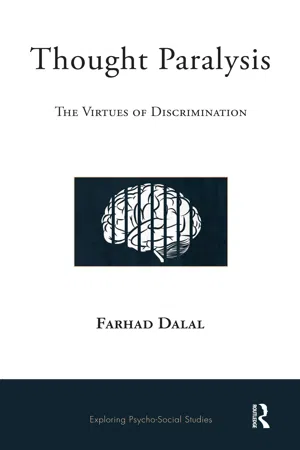
Given the enormous struggles, efforts and money expended on the equalities enterprise, why has more progress not been made? And further, why have things actually become worse in some circumstances? It is argued this has occurred because:- The values of Equality have been bureaucratized, allowing the liberal principle of "live and let live" to be perverted and put in the service of fear and control.- The Diversity discourse has been hijacked by the libertarians and put in the service of increasing profit, under the guise of liberty and inclusivity.- The equality movements have become apolitical, sidetracked into the project of the indiscriminate celebration and preservation of cultures, in lieu of challenging the status quo within cultures as much as between them.- The versions of psychology and sociology that the equality movements have drawn on are over simple
Information
CHAPTER ONE
Introduction: thought paralysis
Over the past few decades there have been many heroic struggles and enormous efforts put into challenging the inequalities and iniquities endemic in our society, specifically in the areas of “race”, gender, class, and disability. And, indeed, a great many positive changes have taken place. For one thing, the struggles have brought about a profound change in social conventions in Britain, so that it is no longer acceptable in polite liberal company to say dismissive or hateful things about women, Blacks, or lesbians; changes in the legislature mean that same sex relationships are granted official recognition—something that was unimaginable fifty years ago. Yet, it is also the case that despite these efforts, despite substantial changes in the legislation and so forth, the statistics tell us that racism and sexism continue to flourish; for example, in the 2010 season of the BBC Proms concerts “only 1.6% of the conductors and 4.1% of the composers [were] women” (Thorpe, 2010). But worse, in some cases the situation has actually deteriorated: two cases in point being the fact that the pay differentials between men and women have actually widened in the last year or two (Hencke, 2009), and the fact that in the five years from 2004–2009 there has been a 70% increase in the numbers of Black and Asians stopped and searched on the streets of the UK in comparison to the previous five years (Travis, 2010). At the same time, these very same institutions make proud claims in their Equal Opportunity statements that they subscribe to the values of inclusivity, fairness, non-discriminatory practice, and so on. They back their claims by pointing to the fact that they require all their employees to participate in “equality and diversity” trainings, in order that they develop more tolerant and inclusive attitudes towards others. Despite these efforts and claims, there remains quite a gap between what institutions say they are doing and what is actually happening.
The contrast between the achievements of the Equality Movements and the road yet to be travelled by them is found in two articles that happened to appear on the same day in the Guardian. A glimpse of the achievements are found in an article describing the return of the “Freedom Riders” to Mississippi, to mark the fifty-year anniversary of the first struggles against segregation. One returning veteran of the early struggles remarked,
There are only two kinds of bathrooms now, men and women. The last time I was here there were eight: white men, coloured men, white women, coloured women, white men employees, white women employees, coloured men employees and coloured women employees. [MacAskill, 2011]
It is a testament to the achievements of the struggle that it is so hard in this day and age to even imagine that strict apartheid was the social norm in parts of the USA (and not so very long ago at that). Meanwhile, in the UK at that time, while there was no formal apartheid, virulent racism and sexism were the prevailing norms.
A glimpse of the road yet to be travelled is provided by the headline, “14,000 British professors – but only 50 are black” (Shepherd, 2011), which computes to just 0.34%. The headline speaks for itself.
So, how is it that, regardless of the enormous amounts of money and effort being poured into equality initiatives, inequality continues to flourish to the extraordinary extent that it still does? One explanation favoured by those on the “right” is that these initiatives go against “human nature” and so are bound to fail; they would say that the paucity of Black professors is simply due to their (lack of) ability or their poor work ethic. The book proceeds in a different direction. It attempts to answer this question by critically reflecting on the assumptions that formed the rationales of the equality enterprise.
And, while acknowledging successes of the equality movements, the work focuses on some of the dead ends that the equality project has found itself in, in order to learn from them. One reason for some of the wrong turns taken by some influential streams of the equality movements (particularly by those that “celebrate diversity”), is that they subscribe to a singularly impoverished version of human psychology as well as sociology.
The book will be arguing that the equalities project has floundered to some degree in part because of the machinations of vested interests, and in part because of the ways that the equality movements (particularly the “celebrators of diversity”), have conceptualized the problem (and the solutions that follow from them). At times these “solutions” have worked in the direction of reinforcing the difficulties rather than of dismantling them. For example, it turns out that both the racists and some proponents of multi-culturalism and diversity buy into the same essentialist premise, to believe that the “difference” each venerates is real and incontrovertible. The category beloved of the racists is that of “race”, while the categories beloved of the multiculturalists and diversity promulgators are those of culture and ethnicity. But, peculiarly, the proponents of diversity utilize their category for the same purposes as the racists: to distance human groupings from each other in order to preserve their “authenticity”. The racists do this by denigrating those who are different, and the diversity promulgators manage this by idealizing and fetishizing difference. Caught between the two, the casualty, often enough, is thought itself.
A part of my developing argument will be that racism and the other processes of marginalization (of which racism is but a subset) are, in many ways, analogous to parasites. Parasites mutate and evolve to mimic the functioning of the host in order to fool the host into thinking that that the parasite is a good and healthy part of itself. This results in the parasite dropping “below the radar” of the defence systems of the host in order to sneak into its body. Once ensconced, the parasite leeches on the resources of the host, depleting and weakening it, and often enough killing it off entirely. In some cases, like that of the cuckoo, the host is sufficiently fooled into actively feeding and nourishing the parasite to the detriment of itself. With regard to equality, this is the kind of situation we currently find ourselves in. My contention is that some of the processes of marginalization have mutated into forms that fool liberalism into fostering them and giving them succour, undermining its own integrity in the process. One of the more successful of the recent forms taken by these processes is the “celebrating diversity” movement. The central belief of the diversity movement, that you must respect difference, looks decent and innocent enough, but it is not. It is insidious, because it has fooled the host (democratic liberal society) into switching off its immune system, this being the capacity to think. How the processes of marginalization have managed this feat is, in part, what the book is about.
An anxiety and a caution
The danger in writing a book critical of aspects of diversity, multiculturalism, and the like is that it might be construed that I am against the emancipatory project per se. Further, the critique could be used to give succour to the racist, or those who cry “political correctness” in order to stifle and undermine challenges to the current order of things. So let me be clear on where I stand: unlike some right-wing pundits, I do think that there are many anomalies with regard to equality in our society. To my mind, there is no question that there are serious and very real issues to be thought about as to how and why only some “kinds” of individuals appear to make the grade and other kinds hit “the glass ceiling”. All of this is beyond question and dispute. There is evidence aplenty that racism, sexism, and the like continue to flourish. For example, in the four-year period from 2005 to 2009, the Metropolitan Police Territorial Support Group (a specialist police unit) has had over 5000 complaints made against them for “oppressive behaviour”. And of these, just 0.18% of the complaints were upheld; the rest were deemed unsubstantiated (by the police themselves). One officer has had thirty-one complaints lodged against him, of which about twenty-six were lodged by Black and Asian men. In other words, not only does racism continue to flourish, there seems to be very little real will to confront it by the authorities, and is, often enough, being perpetrated by the authorities themselves. But it is also an error to talk of the authorities as a “them”, as though they were all of one mind. In this instance, the police force’s watchdog, the Metropolitan Police Authority, is deeply critical of the Territorial Support Group, saying that “it’s time for an ethical audit and thorough overhaul. They desperately need better training” (Lewis & Taylor, 2009).
Why training is not the answer to this sort of situation is something I will address later in the text.
So, while I agree with the equality movements that there are profound issues regarding inequality and injustice that need challenging, I disagree with some of the strategies being proposed as how to solve these problems. Some of my disagreements are at a fundamental level, not just with the solutions proposed, but with the very way in which the problems are being conceptualized in the first place.
I also want to distance this book from the many works emanating from the right of the political spectrum that mock and lampoon some of the suggestions and prescriptions put forward by the equal opportunity movements. Their purpose is destructive, to undermine the entire equalities project and to normalize prejudice, hatred, and bigotry as “natural” phenomena. To this way of thinking, the ones causing difficulties are the equality pundits and their ideologies and the poor victims are beleaguered Whites, embattled in their own land. For example, here is a scaremongering, inflammatory headline in the pages of The Times: “Adoption couples blocked by race barrier”. The article begins:
Thousands of families seeking to adopt a child are being turned away at their first inquiry, with hundreds told that they are simply the wrong race. One family in four was turned down, of which 13 per cent were told it was because their ethnicity did not match the children waiting for a home . . . [Bennett, 2011]
A little later in the article, the hint is made explicit: that it is White families who are being blocked from adopting “ethnic” children. I do not want to take up the issue of whether families of one colour ought to be able to adopt children of another colour. Instead, I want to focus on how mischievously the paragraph is crafted and what it invites the reader to think. At first read it seems as though thousands of (White) families are being blocked from adopting babies. But a second read tells us that one in four were turned down for a multitude of reasons, out of which thirteen per cent were denied because of their ethnicity. The arithmetic is simple: thirteen per cent of twenty-five per cent comes to just over three per cent. In other words just over three out of every hundred applicants were turned down because of their ethnicity—not as exciting as the “thousands” and “hundreds” announced in the initial sentence. It then also turns out that the “thousands” and “hundreds” referred to are not literal, but extrapolations from a research whose “sample is small”. Surely the intention of the article is malicious, in that it seeks to foster and inflame the racist way of thinking.
So, although this book is going to be critical of certain lines pursued by the diversity and equality movements, my intention is not to attack in order to dismantle the equalities agenda per se. Rather, the intention of this work is to strengthen these emancipatory movements by critiquing their weaknesses, anomalies, conceptual confusions, and so forth. To use an arboreal analogy, I consider this work as pruning rather than felling.
To anticipate some of the discussion yet to come, in my view, racism at a systemic level and the like are not caused by “ignorance” or by psychologically malfunctioning individuals, but sustained and produced by power relations. The reasons as to why the situation has not progressed more than it might have are several. The first and foremost reason is, quite simply, that institutions and those in power resist structural change (not necessarily consciously) and find ways of apparently complying with equalities enterprise without actually doing so. The equalities enterprise becomes perverted into a paper exercise, the intention of which is to be seen to be doing good rather than doing actual good; the way that they have managed this is by stripping ethics out of the conversation and replacing it with bureaucratic procedure. Further, the diversity agenda has been hijacked by some corporations who purport to subscribe to the emancipatory project for justice but, in fact, exploit the notion of diversity to further enhance their profit margins. These, I contend, are the main obstacles to real change, but this does not let the equality movements off the hook regarding the ways that they themselves have contributed to this situation. The weaknesses of some of the reasoning from sections of the equality movements have created hostages to fortune that have been opportunistically exploited by vested interests, not only in the service of sustaining the status quo, but also of dismantling the equalities project entirely. Their wish, in contrast to mine, is to fell rather than to prune. For example as the book is going to press, the UK government is “consulting” the general public about whether The Equalities Act of 2010 should be scrapped entirely, or, at the very least, seriously curtailed because of the “red tape” it generates. It does create red tape, but that is its function, which is as an inhibitor of certain kinds of unethical activities, one of which is as follows. Ian Duncan Smith, the Works and Pensions Secretary, wants employers to give priority to British workers over “immigrants” from Eastern Europe. But to do this would be to break the law as found in the Equalities Act. So, it would suit his agenda to have this tiresome bit of red tape removed from the statue books. Once freed of this red tape, companies can get back down to the business of favouring the “us” over the “them”, and, astonishingly, being rewarded by the government for doing so. Duncan Smith’s proposal is extraordinary for its naked advocacy of a return to a version of racism, with the key term changed from “Whites” to “British workers”. It is exactly to prevent this sort of thing that the Equality Act exists. But it is also the case that the real problem is not red tape, but the business mentality that puts profit before any sense of loyalty, commitment, or community.
In sum, the fact that the book consists of a deep critique of aspects of the equality movements is not to suggest that the main difficulties are caused by them. The intention of my critique is to pre-empt the exploitation of conceptual weaknesses for reactionary ends. The argument of this book tries to tread the thin line between the apologists, those who deify otherness and difference (diversity peddlers and liberals of a certain persuasion), and the zealots, those who hate and vilify various kinds of others (racists and right-wing pundits).
Two short (schematic) stories and a moral
When Harry was about thirty years old, his promising life trajectory came to an abrupt halt when he was hit by a series of catastrophes. He became depressed. Unable to sustain an independent life, he moved back into the parental home. He began each day by switching on the television and playing computer games. When Harry’s father, Jim, remarked to his wife, Sue, that he thought that their son beginning each day in this way was not helpful to his recovery, she rebuked him. Sue said that Jim had just made a judgement; she thought it wrong to make judgements about others because judgements impose something on them. In her view, then, the making of judgements about others is unethical and should be avoided at all costs.
Jim was troubled; was it the case that he was wrong to form a judgement about what his son was doing? Ought he instead to stand back and accept Harry on his own terms and rationales? And if so, what was Jim to do with his concerns regarding what he was witnessing? Jim ended up in a state of confusion and paralysis.
* * *
The other day, while taking a walk in the countryside along a river, I passed a woman speaking into her mobile phone. I noticed myself have the fleeting thought: her awareness is not in the present; she is not taking in the beauty of the setting, and instead she is preoccupied with something and someone elsewhere.
* * *
The first episode captures exactly the predicaments generated by the prevailing ethos being promoted by some multi-culturalists and celebrators of diversity. According to their pronouncements, it would appear that to make judgements about others is wrong per se, and instead one always ought to accept and respect what ever it is that “they” are doing because it is their way. This is because one’s disapproval of “their” ways is born of a judgement made on the basis of “our” way, and so it has no legitimacy. If we are to judge them, we must do so on their terms, not ours.
Not only has this way of thinking become a taken-for-granted norm in many quarters of the equality movements, it is also the norm in the day-to-day life of many ordinary citizens (as Jim’s story shows). Citizens with liberal sympathies learn to live lives that have the appearance of being compliant with the diversity ethos; they learn to silence their inner responses in order to be seen to do the right thing. But, as in Jim’s case, they are often left in a state of bewilderment, confusion, and paralysis. The fact that disapproval is ruled ...
Table of contents
- Cover
- Half Title
- Title Page
- Copyright Page
- Dedication Page
- Table of Contents
- Acknowledgements
- About the Author
- Chapter One Introduction: thought paralysis
- Chapter Two The struggle to live and let live: the liberal world view
- Chapter Three Equal strokes for different folks: the legislature
- Chapter Four Manufacturing kinds of people: processes of inclusion and exclusion
- Chapter Five The human condition: psychology
- Chapter Six Counting discriminations
- Chapter Seven Corrupting the liberal ideal: diversity in organizational life
- Chapter Eight Perverting the liberal ideal: fear and control in the Panopticon
- Chapter Nine The difference that dare not speak its name: the lexicon police
- Chapter Ten The vicissitudes of discrimination
- Chapter Eleven Islam: the new black
- Chapter Twelve Tolerating discrimination: discriminatory tolerance
- Chapter Thirteen The road to nowhere: conceptual cul-de-sacs
- References
- Index
Trusted by 375,005 students
Access to over 1.5 million titles for a fair monthly price.
Study more efficiently using our study tools.
Frequently asked questions
Yes, you can cancel anytime from the Subscription tab in your account settings on the Perlego website. Your subscription will stay active until the end of your current billing period. Learn how to cancel your subscription
No, books cannot be downloaded as external files, such as PDFs, for use outside of Perlego. However, you can download books within the Perlego app for offline reading on mobile or tablet. Learn how to download books offline
Perlego offers two plans: Essential and Complete
- Essential is ideal for learners and professionals who enjoy exploring a wide range of subjects. Access the Essential Library with 800,000+ trusted titles and best-sellers across business, personal growth, and the humanities. Includes unlimited reading time and Standard Read Aloud voice.
- Complete: Perfect for advanced learners and researchers needing full, unrestricted access. Unlock 1.5M+ books across hundreds of subjects, including academic and specialized titles. The Complete Plan also includes advanced features like Premium Read Aloud and Research Assistant.
We are an online textbook subscription service, where you can get access to an entire online library for less than the price of a single book per month. With over 1.5 million books across 990+ topics, we’ve got you covered! Learn about our mission
Look out for the read-aloud symbol on your next book to see if you can listen to it. The read-aloud tool reads text aloud for you, highlighting the text as it is being read. You can pause it, speed it up and slow it down. Learn more about Read Aloud
Yes! You can use the Perlego app on both iOS and Android devices to read anytime, anywhere — even offline. Perfect for commutes or when you’re on the go.
Please note we cannot support devices running on iOS 13 and Android 7 or earlier. Learn more about using the app
Please note we cannot support devices running on iOS 13 and Android 7 or earlier. Learn more about using the app
Yes, you can access Thought Paralysis by Farhad Dalal in PDF and/or ePUB format, as well as other popular books in Social Sciences & Mental Health in Psychology. We have over 1.5 million books available in our catalogue for you to explore.