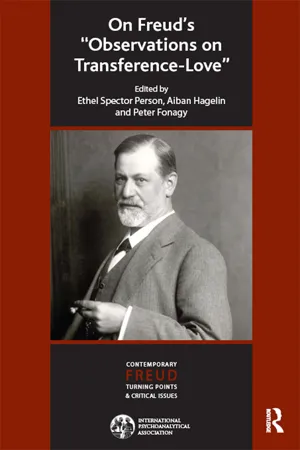
This is the third volume in the series Contemporary Freud: Turning Points and Critical Issues, published for the International Psychoanalytical Association. Each volume presents a classic essay by Freud with commentaries by prominent psychoanalytic teachers and analysts from different theoretical backgrounds and geographical locations."Observations on Transference-Love" may have been inspired, say the contributors, by the unfortunate emotional involvements of two of Freud's colleagues with female patients. In his paper, Freud speaks of the inevitability of "transference-love" in every well-conducted analysis, its important therapeutic functions, and its potential hazards. Transference love is discussed in the larger context of transference in general. The essays illuminate a persistent problem in all modalities of psychotherapy: unfortunate, often tragic, enactments of erotic transference and countertransference.This volume also includes the original essay by Freud.
eBook - ePub
On Freud's Observations On Transference-Love
- 202 pages
- English
- ePUB (mobile friendly)
- Available on iOS & Android
eBook - ePub
On Freud's Observations On Transference-Love
About this book
Information
PART ONE
Observations on Transference-Love (1915)

OBSERVATIONS ON TRANSFERENCE-LOVE
(FURTHER RECOMMENDATIONS ON THE TECHNIQUE OF PSYCHO-ANALYSIS III)
EVERY beginner in psycho-analysis probably feels alarmed at first at the difficulties in store for him when he comes to interpret the patient’s associations and to deal with the reproduction of the repressed. When the time comes, however, he soon learns to look upon these difficulties as insignificant, and instead becomes convinced that the only really serious difficulties he has to meet lie in the management of the transference.
Among the situations which arise in this connection I shall select one which is very sharply circumscribed; and I shall select it, partly because it occurs so often and is so important in its real aspects and partly because of its theoretical interest. What I have in mind is the case in which a woman patient shows by unmistakable indications, or openly declares, that she has fallen in love, as any other mortal woman might, with the doctor who is analysing her. This situation has its distressing and comical aspects, as well as its serious ones. It is also determined by so many and such complicated factors, it is so unavoidable and so difficult to clear up, that a discussion of it to meet a vital need of analytic technique has long been overdue. But since we who laugh at other people’s failings are not always free from them ourselves, we have not so far been precisely in a hurry to fulfil this task. We are constantly coming up against the obligation to professional discretion—a discretion which cannot be dispensed with in real life, but which is of no service in our science. In so far as psycho-analytic publications are a part of real life, too, we have here an insoluble contradiction. I have recently disregarded this matter of discretion at one point,1 and shown how this same transference situation held back the development of psycho-analytic therapy during its first decade.
To a well-educated layman (for that is what the ideal civilized person is in regard to psycho-analysis) things that have to do with love are incommensurable with everything else; they are, as it were, written on a special page on which no other writing is tolerated. If a woman patient has fallen in love with her doctor it seems to such a layman that only two outcomes are possible. One, which happens comparatively rarely, is that all the circumstances allow of a permanent legal union between them; the other, which is more frequent, is that the doctor and the patient part and give up the work they have begun which was to have led to her recovery, as though it had been interrupted by some elemental phenomenon. There is, to be sure, a third conceivable outcome, which even seems compatible with a continuation of the treatment. This is that they should enter into a love-relationship which is illicit and which is not intended to last for ever. But such a course is made impossible by conventional morality and professional standards. Nevertheless, our layman will beg the analyst to reassure him as unambiguously as possible that this third alternative is excluded.
It is clear that a psycho-analyst must look at things from a different point of view.
Let us take the case of the second outcome of the situation we are considering. After the patient has fallen in love with her doctor, they part; the treatment is given up. But soon the patient’s condition necessitates her making a second attempt at analysis, with another doctor. The next thing that happens is that she feels she has fallen in love with this second doctor too; and if she breaks off with him and begins yet again, the same thing will happen with the third doctor, and so on. This phenomenon, which occurs without fail and which is, as we know, one of the foundations of the psycho-analytic theory, may be evaluated from two points of view, that of the doctor who is carrying out the analysis and that of the patient who is in need of it.
For the doctor the phenomenon signifies a valuable piece of enlightenment and a useful warning against any tendency to a counter-transference which may be present in his own mind.1 He must recognize that the patient’s falling in love is induced by the analytic situation and is not to be attributed to the charms of his own person; so that he has no grounds whatever for being proud of such a ‘conquest’, as it would be called outside analysis. And it is always well to be reminded of this. For the patient, however, there are two alternatives: either she must relinquish psycho-analytic treatment or she must accept falling in love with her doctor as an inescapable fate.1
I have no doubt that the patient’s relatives and friends will decide as emphatically for the first of these two alternatives as the analyst will for the second. But I think that here is a case in which the decision cannot be left to the tender—or rather, the egoistic and jealous—concern of her relatives. The welfare of the patient alone should be the touchstone; her relatives’ love cannot cure her neurosis. The analyst need not push himself forward, but he may insist that he is indispensable for the achievement of certain ends. Any relative who adopts Tolstoy’s attitude to this problem can remain in undisturbed possession of his wife or daughter; but he will have to try to put up with the fact that she, for her part, retains her neurosis and the interference with her capacity for love which it involves. The situation, after all, is similar to that in a gynaecological treatment. Moreover, the jealous father or husband is greatly mistaken if he thinks that the patient will escape falling in love with her doctor if he hands her over to some kind of treatment other than analysis for combating her neurosis. The difference, on the contrary, will only be that a love of this kind, which is bound to remain unexpressed and unanalysed, can never make the contribution to the patient’s recovery which analysis would have extracted from it.
It has come to my knowledge that some doctors who practise analysis frequently2 prepare their patients for the emergence of the erotic transference or even urge them to ‘go ahead and fall in love with the doctor so that the treatment may make progress’. I can hardly imagine a more senseless proceeding. In doing so, an analyst robs the phenomenon of the element of spontaneity which is so convincing and lays up obstacles for himself in the future which are hard to overcome.1
At a first glance it certainly does not look as if the patient’s falling in love in the transference could result in any advantage to the treatment. No matter how amenable she has been up till then, she suddenly loses all understanding of the treatment and all interest in it, and will not speak or hear about anything but her love, which she demands to have returned. She gives up her symptoms or pays no attention to them; indeed, she declares that she is well. There is a complete change of scene; it is as though some piece of make-believe had been stopped by the sudden irruption of reality—as when, for instance, a cry of fire is raised during a theatrical performance. No doctor who experiences this for the first time will find it easy to retain his grasp on the analytic situation and to keep clear of the illusion that the treatment is really at an end.
A little reflection enables one to find one’s bearings. First and foremost, one keeps in mind the suspicion that anything that interferes with the continuation of the treatment may be an expression of resistance.2 There can be no doubt that the outbreak of a passionate demand for love is largely the work of resistance. One will have long since noticed in the patient the signs of an affectionate transference, and one will have been able to feel certain that her docility, her acceptance of the analytic explanations, her remarkable comprehension and the high degree of intelligence she showed were to be attributed to this attitude towards her doctor. Now all this is swept away. She has become quite without insight and seems to be swallowed up in her love. Moreover, this change quite regularly occurs precisely at a point of time when one is having to try to bring her to admit or remember some particularly distressing and heavily repressed piece of her life-history. She has been in love, therefore, for a long time; but now the resistance is beginning to make use of her love in order to hinder the continuation of the treatment, to deflect all her interest from the work and to put the analyst in an awkward position.
If one looks into the situation more closely one recognizes the influence of motives which further complicate things—of which some are connected with being in love and others are particular expressions of resistance. Of the first kind are the patient’s endeavour to assure herself of her irresistibility, to destroy the doctor’s authority by bringing him down to the level of a lover and to gain all the other promised advantages incidental to the satisfaction of love. As regards the resistance, we may suspect that on occasion it makes use of a declaration of love on the patient’s part as a means of putting her analyst’s severity to the test, so that, if he should show signs of compliance, he may expect to be taken to task for it. But above all, one gets an impression that the resistance is acting as an agent provocateur; it heightens the patient’s state of being in love and exaggerates her readiness for sexual surrender in order to justify the workings of repression all the more emphatically, by pointing to the dangers of such licentiousness.1 All these accessory motives, which in simpler cases may not be present, have, as we know, been regarded by Adler as the essential part of the whole process.2
But how is the analyst to behave in order not to come to grief over this situation, supposing he is convinced that the treatment should be carried on in spite of this erotic transference and should take it in its stride?
It would be easy for me to lay stress on the universally accepted standards of morality and to insist that the analyst must never under any circumstances accept or return the tender feelings that are offered him: that, instead, he must consider that the time has come for him to put before the woman who is in love with him the demands of social morality and the necessity for renunciation, and to succeed in making her give up her desires, and, having surmounted the animal side of her self, go on with the work of analysis.
I shall not, however, fulfil these expectations—neither the first nor the second of them. Not the first, because I am writing not for patients but for doctors who have serious difficulties to contend with, and also because in this instance I am able to trace the moral prescription back to its source, namely to expediency. I am on this occasion in the happy position of being able to replace the moral embargo by considerations of analytic technique, without any alteration in the outcome.
Even more decidedly, however, do I decline to fulfil the second of the expectations I have mentioned. To urge the patient to suppress, renounce or sublimate her instincts the moment she has admitted her erotic transference would be, not an analytic way of dealing with them, but a senseless one. It would be just as though, after summoning up a spirit from the underworld by cunning spells, one were to send him down again without having asked him a single question. One would have brought the repressed into consciousness, only to repress it once more in a fright. Nor should we deceive ourselves about the success of any such proceeding. As we know, the passions are little affected by sublime speeches. The patient will feel only the humiliation, and she will not fail to take her revenge for it.
Just as little can I advocate a middle course, which would recommend itself to some people as being specially ingenious. This would consist in declaring that one returns the patient’s fond feelings but at the same time in avoiding any physical implementation of this fondness until one is able to guide the relationship into calmer channels and raise it to a higher level. My objection to this expedient is that psycho-analytic treatment is founded on truthfulness. In this fact lies a great part of its educative effect and its ethical value. It is dangerous to depart from this foundation. Anyone who has become saturated in the analytic technique will no longer be able to make use of the lies and pretences which a doctor normally finds unavoidable; and if, with the best intentions, he does attempt to do so, he is very likely to betray himself. Since we demand strict truthfulness from our patients, we jeopardize our whole authority if we let ourselves be caught out by them in a departure from the truth. Besides, the experiment of letting oneself go a little way in tender feelings for the patient is not altogether without danger. Our control over ourselves is not so complete that we may not suddenly one day go further than we had intended. In my opinion, therefore, we ought not to give up the neutrality towards the patient, which we have acquired through keeping the counter-transference in check.
I have already let it be understood that analytic technique requires of the physician that he should deny to the patient who is craving for love the satisfaction she demands. The treatment must be carried out in abstinence. By this I do not mean physical abstinence alone, nor yet the deprivation of everything that the patient desires, for perhaps no sick person could tolerate this. Instead, I shall state it as a fundamental principle that the patient’s need and longing should be allowed to persist in her, in order that they may serve as forces impelling her to do work and to make changes, and that we must beware of appeasing those forces by means of surrogates. And what we could offer would never be anything else than a surrogate, for the patient’s condition is such that, until her repressions are removed, she is incapable of getting real satisfaction.
Let us admit that this fundamental principle of the treatment being carried out in abstinence extends far beyond the single case we are considering here, and that it needs to be thoroughly discussed in order that we may define the limits of its possible application.1 We will not enter into this now, however, but will keep as close as possible to the situation from which we started out. What would happen if the doctor were to behave differently and, supposing both parties were free, if he were to avail himself of that freedom in order to return the patient’s love and to still her need for affection?
If he has been guided by the calculation that this compliance on his part will ensure his domination over his patient and thus enable him to influence her to perform the tasks required by the treatment, and in this way to liberate herself permanently from her neurosis—then experience would inevitably show him that his calculation was wrong. The patient would achieve her aim, but he would never achieve his. What would happen to the doctor and the patient would only be what happened, according to the amusing anecdote, to the pastor and the insurance agent. The insurance agent, a free-thinker, lay at the point of death and his relatives insisted on bringing in a man of God to convert him before he died. The interview lasted so long that those who were waiting outside began to have hopes. At last the door of the sick-chamber opened. The free-thinker had not been converted; but the pastor went away insured.
If the patient’s advances were returned it would be a great triumph for her, but a complete defeat for the treatment. She would have succeeded in what all patients strive for in analysis—she would have succeeded in acting out, in repeating in real life, what she ought only to have remembered, to have reproduced as psychical material and to have kept within the sphere of psychical events.1 In the further course of the love-relationship she would bring out all the inhibitions and pathological reactions of her erotic life, without there being any possibility of correcting them; and the distressing episode would end in remorse and a great strengthening of her propensity to repression. The love-relationship in fact destroys the patient’s susceptibility to influence from analytic treatment. A combination of the two would be an impossibility.
It is, therefore, just as disastrous for the analysis if the patient’s craving for love is gratified as if it is suppressed. The course the analyst must pursue is neither of these; it is one for which there is no model in real life. He must take care not to steer away from the transference-love, or to repulse it or to make it distasteful to the patient; but he must just as resolutely ...
Table of contents
- Cover
- Half Title
- Title Page
- Copyright Page
- Table of Contents
- Preface
- Introduction
- PART ONE OBSERVATIONS ON TRANSFERENCE-LOVE (1915)
- PART TWO DISCUSSION OF “OBSERVATIONS ON TRANSFERENCE-LOVE”
- Contributors
- Index
Trusted by 375,005 students
Access to over 1.5 million titles for a fair monthly price.
Study more efficiently using our study tools.
Frequently asked questions
Yes, you can cancel anytime from the Subscription tab in your account settings on the Perlego website. Your subscription will stay active until the end of your current billing period. Learn how to cancel your subscription
No, books cannot be downloaded as external files, such as PDFs, for use outside of Perlego. However, you can download books within the Perlego app for offline reading on mobile or tablet. Learn how to download books offline
Perlego offers two plans: Essential and Complete
- Essential is ideal for learners and professionals who enjoy exploring a wide range of subjects. Access the Essential Library with 800,000+ trusted titles and best-sellers across business, personal growth, and the humanities. Includes unlimited reading time and Standard Read Aloud voice.
- Complete: Perfect for advanced learners and researchers needing full, unrestricted access. Unlock 1.5M+ books across hundreds of subjects, including academic and specialized titles. The Complete Plan also includes advanced features like Premium Read Aloud and Research Assistant.
We are an online textbook subscription service, where you can get access to an entire online library for less than the price of a single book per month. With over 1.5 million books across 990+ topics, we’ve got you covered! Learn about our mission
Look out for the read-aloud symbol on your next book to see if you can listen to it. The read-aloud tool reads text aloud for you, highlighting the text as it is being read. You can pause it, speed it up and slow it down. Learn more about Read Aloud
Yes! You can use the Perlego app on both iOS and Android devices to read anytime, anywhere — even offline. Perfect for commutes or when you’re on the go.
Please note we cannot support devices running on iOS 13 and Android 7 or earlier. Learn more about using the app
Please note we cannot support devices running on iOS 13 and Android 7 or earlier. Learn more about using the app
Yes, you can access On Freud's Observations On Transference-Love by Ethel S. Person, Aiban Hagelin, Peter Fonagy, Ethel S. Person,Aiban Hagelin,Peter Fonagy in PDF and/or ePUB format, as well as other popular books in Psychology & Mental Health in Psychology. We have over 1.5 million books available in our catalogue for you to explore.