- 140 pages
- English
- ePUB (mobile friendly)
- Available on iOS & Android
eBook - ePub
About this book
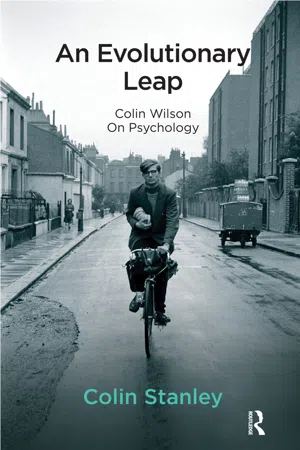
When the existential philosopher Colin Wilson died in December 2013, it was suggested by one perceptive obituary writer that, despite the seemingly diverse subject matter of his books, his true legacy lay in the field of Consciousness Studies. This is particularly apparent when studying his many essays and books on psychology and taking into consideration his close association with the celebrated American psychologist Abraham Maslow whose concept of 'Peak Experiences'(PEs) became, for Wilson, an important link to experiencing enhanced consciousness. Maslow, however, felt that PEs could not be induced at will; Wilson thought otherwise and through his work sought to encourage his readers and students to live more vital and appreciative lives thereby paving the way toward an evolutionary leap for mankind in consciousness-indeed, a change in consciousness that would potentially change everything.In this study, Colin Stanley, Wilson's bibliographer and author of Colin Wilson's 'Outsider Cycle': A Guide for Students and Colin Wilson's 'Occult Trilogy': A Guide for Students, provides an illuminating essay on each of Wilson's nine major books on psychology.
Information
CHAPTER ONE
The Age of Defeat (1959)
In 1957, the publisher Tom Maschler (1933-) edited a volume of essays entitled Declaration—a symposium containing the credos of eight so-called “Angry Young Men”. In his introduction, Maschler wrote:
We have to thank an even lower level of journalism for the phrase “Angry Young Men” which has been employed to group, without so much as an attempt at understanding, all those sharing a certain indignation against the apathy, the complacency, the idealistic bankruptcy of their environment. … To be prejudiced against them purely because they are angry is to imagine that anger is the sole substance of their work. … It is important to note that although most of the contributors to this volume have at some time been termed Angry Young Men they do not belong to a united movement. Far from it; they attack one another directly or indirectly in these pages. Some were even reluctant to appear between the same covers with others whose views they violently oppose.
(Machler, 1957, pp. 7–8)
But three contributors did, at least, have something in common: Colin Wilson, Bill Hopkins, and Stuart Holroyd. They were friends and, at that time, all rented rooms in a kind of writers’ commune at a house in Chepstow Road, London (Upon leaving the premises in 1960, Hopkins commissioned his friend Laurence Bradshaw to sculpt a blue plaque which was fixed to the outside wall near the front door. It read: “In this house lived, 1955–1960, Colin Wilson, John Braine, Stuart Holroyd, Tom Greenwell, Greta Detloff, Bill Hopkins. Hallowed be these precincts.” This was taken down soon afterwards and nothing is now known of its whereabouts).
The Age of Defeat (published as The Stature of Man in the US), the third book in Colin Wilson’s “Outsider Cycle”,1 was published in the UK by Victor Gollancz in September 1959. In his new introduction to the 2001 Paupers’ Press edition, Wilson writes:
The [Age of Defeat] was not originally intended to be published as a separate volume, but as one-third of a kind of symposium that would feature Bill Hopkins, Stuart Holroyd and myself. This came about because the three of us were thoroughly dissatisfied with a book called Declaration, which had appeared in 1957, and in which the three of us had also featured. It was … intended to be a series of “statements of belief” by a number of the so-called “Angry Young Men” … [and] aroused a lot of hostility.
(Wilson, 2001a, p. 11)
He continues:
[The] basic theme [of this new book] would be the “vanishing hero”—that inability of modern writers to create what Bill called “monumental characters”. I would treat the subject from the literary point of view, Stuart from the religious point of view, Bill from the political point of view.
The problem was that Bill and Stuart were slower writers … so I wrote my part of the … book in the first half of 1958 and sent it to my publisher. Gollancz immediately suggested that he should publish it on its own. Bill and Stuart were obviously relieved to be let off the hook, for neither of them had even started their contributions …
(ibid., p. 14)
The book is divided into five parts sandwiched by an introduction and a postscript. The above-mentioned Paupers’ Press edition adds a further introduction in which Wilson writes:
Although I would not count The Age of Defeat as one of my most successful books … it brought me … one important contact: an American professor of psychology called Abraham Maslow. It was Maslow who, after reading the American edition … wrote me a letter in which he told me that he had been preoccupied with the same problem for a long time. He told me how he had said to his students: “Which of you expects to be great?” And when they looked at him blankly, he said “If not you, who then?”
(ibid., p. 21)
An extremely important contact for Wilson, Maslow’s concept of “peak experience” (PE)—that sudden rush of pure happiness that we all experience in moments of delight—subsequently became the cornerstone of his philosophy of optimism. They remained in touch until Maslow’s death in 1970 (the as-yet unpublished correspondence between the two makes for fascinating reading). His widow subsequently supplied Wilson with the tape recordings of her husband that he used as source material for the study New Pathways in Psychology: Maslow and the Post-Freudian Revolution (see Chapter Three).
In the original introduction subtitled “The vanishing hero”, Wilson complains that most contemporary writers concern themselves with the “ordinary man” and his problems and in so doing often just deal with the most ordinary states of mind. He argues that these weak “heroes” often reflect the inadequacies of their creators and criticises James Joyce, William Faulkner, Aldous Huxley, D. H. Lawrence, and avant-garde writers such as Alain Robbe-Grillet:
I decline to accept the view that the world is composed of a mass of self-deceiving fools, and a few impotently honest men who are self-divided and highly intellectual. I believe that strength and an unimpeded vital insight are possible to man. My quarrel with modern writing is based on its unconscious defeatism.
(ibid., p. 21)
He reasons that heroism depends upon a sense of purpose but in a world geared towards “social thinking”, where man’s first duty is to society, this is extremely difficult.
Part one, therefore, concerns itself with “The evidence of sociology” and the problems that arise from increased material security: “Too much security has the effect of slackening the vital tension and weakening the urge to live” (ibid., p. 29). His thesis draws heavily on two American studies: David Riesman’s The Lonely Crowd (1950) and William H. Whyte’s The Organization Man (1956), which argue that Americans are becoming “other-directed” (i.e., orientated towards society) and less “inner-directed” (i.e., self-disciplined pioneers who can drive towards a goal) and increasingly “organization men” (i.e., willing to toe-the-line for a regular wage and secure job).
Wilson asserts that “… the real problem is the attitude of the individual towards himself” (ibid., p. 32). “Other-directed” people tend to divide the world into ordinary and extraordinary people, holding the extraordinary in awe but never aspiring to become one. And “… a life lived on a general level of ‘insignificance’… makes for outbreaks of violence” (ibid., p. 46). “Other-directed” people, longing for the heightened intensity of “inner-direction” search for stimulation in violence. Thus the rise in sex crime (another subject that greatly interests Wilson and which he will write about at length in the future) is seen as a result of a revolt against the taboos imposed by “other-direction”. Examples of sex criminals such as Peter Kürten (1883–1931), the Düsseldorf killer, are cited.
In part two, “The evidence of literature”, James Jones’ From Here to Eternity (1951), Herman Wouk’s The Caine Mutiny (1951), and James Gould Cozzens’ By Love Possessed (1957) are offered as examples of the “organisation man” being presented as hero even when, as in the case of The Caine Mutiny, it is clearly the individual who defies authority (i.e., the mutineer Maryk) that saves the day. The author, however, implies that orders should always be obeyed even if the consequences are disastrous. William Faulkner is attacked as an author who admires unheroic defeated men who somehow “endure”. As for John Dos Passos: “… when society is not the hero (or villain), the hero is defeated” (ibid., p. 85). The plays of Eugene O’Neill “… are full of bewildered characters driven by their passions, and the ending is nearly always despair and defeat” (ibid., p. 85). The same can be said for Tennessee Williams. Arthur Miller “… again reveals the same preoccupation with the individual who is defeated by society, or by his own passions” (ibid., p. 86). Ernest Hemingway’s “… achievement and influence are undeniable but to his younger imitators he must seem a walking declaration that defeat is unavoidable” (ibid., p. 92). And although the Beat Generation “… represent[s] a kind of revolt … it is difficult to discover a great deal more [than] a pure reflex action against ‘other-direction’ …” (ibid., pp. 92–94).
But despite a lack of “inner-directed” characters in modern English literature, Wilson believes that “… the situation in England is, on the whole, more promising than in America” (ibid., p. 104). Whereas “… the revolt of Amis, Wain and Osborne lacks direction …” (ibid., p. 101), John Braine in Room at the Top (1957) and Bill Hopkins in The Divine and the Decay (1957) do provide “inner-directed” heroes.
In the third part, “The anatomy of insignificance”, Wilson decides that “… the hero is … a man who needs to expand, who needs wider fields for his activities. He is the man who cannot ‘accept’ the status quo …” (ibid., p. 113). He then traces the history of heroes in literature from the old physical hero who “… lowered his head and charged like a bull” to the ‘new’ self-divided hero and posits that “… the final hero will be the man who has healed the self-division, and is again prepared to fling himself into the social struggle” (ibid., p. 120).
Romanticism “… for all its sentimentality … never lost sight of the importance of the individual … As soon as the reader opens a book by Hoffmann or Kleist or Brentano, he is transported into a world of greater intensity” (ibid., p. 121). But, Wilson concludes: “All that emerges from consideration of the nineteenth century is that, with occasional exceptions, its writers lost sight of the hero. Society is the true hero of most nineteenth century novels” (ibid., p. 128). An important exception, however, is Nietzsche’s Zarathustra: “But his ‘action’ amounts only to preaching, and the world in which he preaches is an anonymous realm of fantasy … Like Goethe’s Faust, Thus Spake Zarathustra is an attempt to create a new hero, and an admission of failure” (ibid., p. 129).
In the early twentieth century H. G. Wells, G. K. Chesterton, and George Bernard Shaw created a temporary respite from the age of unheroic defeatism. Shaw’s “Julius Caesar in Caesar and Cleopatra is the only serious attempt in twentieth century literature to create an undefeated hero” (ibid., p. 132). Robert Musil’s hero Ulrich in Der Mann ohne Eigen-schaften (The Man without Qualities) (3 vols., 1930, 1942) is given much consideration as Wilson feels “[Musil] had recreated the Faust figure in a typically modern context … and this was a very considerable achievement … when the unheroic premise dominated the literature of Europe and America” (ibid., p. 140).
Part four, “The fallacy of insignificance”, concerns itself mainly with the existentialism of Jean-Paul Sartre (1905–1980) whose “… aim is to emphasise man’s freedom and to explain the workings of that freedom” (ibid., p. 144). However, we can surrender that freedom in a number of ways, most significantly through self-deception (mauvaise foi):
A man is very seldom aware of himself as a person; what he is mainly aware of … is what other people think of him … But there are certain moments in which a man knows himself as a positive reality … The result of this recognition is a knowledge of the dual nature of freedom. Man is free all the time, but he confronts his freedom only at long intervals. Between these occasions, he is free, but does not know it. To be free without knowing it is not to be free. In order to become a reality which “authenticates” existence, freedom must be grasped intuitively.
(ibid., pp. 150–151)
Although Sartre “… analyses every aspect of man’s uncertainty …” (ibid., p. 152) “… his limitations appear when it comes to a question of remedy” (ibid., p. 153). And “… the final index to an author’s insight into ‘inner-direction’ is his ability to create an ‘inner-directed’ man, the hero. For the most part Sartre’s central characters are as negative as those of any American novelist” (ibid., p. 154). Sartre is ultimately “… the dramatist of insignificance …” (ibid., p. 152).
Albert Camus (1913–1960), like Sartre,
… has certain clearly defined limitations … [He] is interested in the position of man in the Universe … his “solution” … will be some individual vision, some reconciling insight into the condition of man … Yet … he seems to lack the temperament that can reach toward mystical insights … [and] although his final final position is one of affirmation, he makes the impression of being a negative writer … There is still a strong element of the “cult of the ordinary chap” in him.
(ibid., pp. 163-164)
(The reader should be aware that Wilson is writing in 1959, one year before Camus’ death.)
Finally, Wilson asks: “Is it possible for existentialism to become something more positive?” (ibid., p. 165). This sets the scene for the introduction of his new existentialism which is outlined in part five, “The stature of man”: “I envisage the new existentialism as a mystical revolt, based upon recognition of the irrational urge that underlies man’s conscious reason. [There is a] need to give life an additional dimension of purpose” (ibid., p. 189). This revolt should, according to Wilson, take place on two levels: philosophical and creative. “On the creative level, it would be a revolt against the unheroic premise, the attempt to create heroes who possess a vision that extends beyond the particularities of environment” (ibid., p. 189). “As a philosophy, existentialism must emphasise the primacy of the will, the importance of the individual, the final unpredictability and freedom of even the most ‘neurotic’ and conditioned human being” (ibid., p. 191).
In this book Wilson sets the benchmark for his own fiction: “The responsibility of literature in the twentieth century becomes appallingly clear: to illuminate man’s freedom” (ibid., p. 2...
Table of contents
- Cover
- Half Title
- Title
- Copyright
- Dedication
- Contents
- ACKNOWLEDGEMENT
- PERMISSIONS
- ABOUT THE AUTHORS
- PREFACE
- CHAPTER ONE The Age of Defeat (1959)
- CHAPTER TWO Origins of the Sexual Impulse (1963)
- CHAPTER THREE New Pathways in Psychology: Maslow and the Post-Freudian Revolution (1972)
- CHAPTER FOUR Frankenstein's Castle: The Right Brain—Door to Wisdom (1980)
- CHAPTER FIVE The Quest for Wilhelm Reich (1981)
- CHAPTER SIX Access to Inner Worlds: The Story of Brad Absetz (1983)
- CHAPTER SEVEN Lord of the Underworld: Jung and the Twentieth Century (1984/1988)
- CHAPTER EIGHT The Misfits: A Study of Sexual Outsiders (1988)
- CHAPTER NINE Super Consciousness: The Quest for the Peak Experience (2007/2009)
- Essays by Colin Wilson on psychology
- APPENDIX 1 Notes on Psychology for George Pransky
- APPENDIX 2 Remembering the outsider: Colin Wilson 1931-2013
- FURTHER READING
- REFERENCES
- INDEX
Trusted by 375,005 students
Access to over 1.5 million titles for a fair monthly price.
Study more efficiently using our study tools.
Frequently asked questions
Yes, you can cancel anytime from the Subscription tab in your account settings on the Perlego website. Your subscription will stay active until the end of your current billing period. Learn how to cancel your subscription
No, books cannot be downloaded as external files, such as PDFs, for use outside of Perlego. However, you can download books within the Perlego app for offline reading on mobile or tablet. Learn how to download books offline
Perlego offers two plans: Essential and Complete
- Essential is ideal for learners and professionals who enjoy exploring a wide range of subjects. Access the Essential Library with 800,000+ trusted titles and best-sellers across business, personal growth, and the humanities. Includes unlimited reading time and Standard Read Aloud voice.
- Complete: Perfect for advanced learners and researchers needing full, unrestricted access. Unlock 1.5M+ books across hundreds of subjects, including academic and specialized titles. The Complete Plan also includes advanced features like Premium Read Aloud and Research Assistant.
We are an online textbook subscription service, where you can get access to an entire online library for less than the price of a single book per month. With over 1.5 million books across 990+ topics, we’ve got you covered! Learn about our mission
Look out for the read-aloud symbol on your next book to see if you can listen to it. The read-aloud tool reads text aloud for you, highlighting the text as it is being read. You can pause it, speed it up and slow it down. Learn more about Read Aloud
Yes! You can use the Perlego app on both iOS and Android devices to read anytime, anywhere — even offline. Perfect for commutes or when you’re on the go.
Please note we cannot support devices running on iOS 13 and Android 7 or earlier. Learn more about using the app
Please note we cannot support devices running on iOS 13 and Android 7 or earlier. Learn more about using the app
Yes, you can access An Evolutionary Leap by Colin Stanley in PDF and/or ePUB format, as well as other popular books in Psicología & Historia y teoría en psicología. We have over 1.5 million books available in our catalogue for you to explore.