eBook - ePub
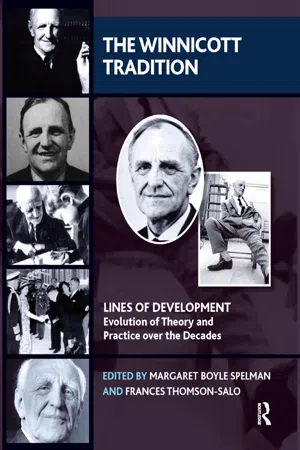
The Winnicott Tradition
Lines of Development-Evolution of Theory and Practice over the Decades
- 432 pages
- English
- ePUB (mobile friendly)
- Available on iOS & Android
eBook - ePub
The Winnicott Tradition
Lines of Development-Evolution of Theory and Practice over the Decades
About this book
This book includes articles that describe how Winnicott's thinking facilitates the building of bridges between the internal and external realities, and, outside the boundaries of psychoanalysis as well as within it, between different schools of thought.
Information
PART I
WINNICOTT: HIS WORK AND LEGACY
SECTION INTRODUCTION
Rather than providing a general overview of Winnicott’s tradition, this section attempts to set Winnicott’s thinking in context. This important exercise of putting his thinking in context was something which Winnicott himself was unable to do and which was an area of regret for him in his later years. It is hoped that in attempting this, that this volume also implicitly reveals something of the origins, significant milestones, contemporary development, and theoretical expansion of the thinking of this man who is the major figure of what was The Middle Group.
Chapter One consists of the transcript of a lecture given by Martin James, Winnicott’s colleague and friend, and board member, along with Clare Winnicott, of the inaugural Winnicott Trust Board. James gives an account of Winnicott, the person and his thinking, and an account of what the board discussed and what they subsequently decided Winnicott would have wanted his financial legacy to be used for.
In Chapter Two, James Anderson draws on his own interviews in the 1980s with a number of people who knew Winnicott. The essay is in two parts. The first part traces Winnicott’s life and struggle to find his true self, emphasising what was solid and dependable in Winnicott’s early childhood environment, leading to his qualities of reliability and trustworthiness as an analyst, and also the considerable discord which Winnicott experienced with both of his parents. Though disappointed with his own two lengthy treatments, psychoanalysis as he encountered it in the 1920s and 1930s fascinated the young Winnicott. He appreciated the opportunity to become deeply acquainted with his inner world, reflecting his personal approach fostering the finding of his true self. The second part of the essay looks at aspects of Winnicott’s personality along with his expression of his true self.
Emma Letley begins in Chapter Three by referring to Caldwell’s and Joyce’s statement in Reading Winnicott that Marion Milner and Donald Woods Winnicott were in “continuing dialogue from the 1940s”. As Milner’s biographer, Letley comments briefly on their ongoing connection and then focuses on the interaction of these two great figures of psychoanalysis through the lens of Milner’s posthumously published text Bothered By Alligators (2012), the last in the newly reissued (with new introductions) series of Milner texts. Letley considers that Bothered by Alligators illuminates and comments directly on Milner’s analysis with Winnicott, highlights shared psychoanalytic and artistic themes and offers new insights into their mutual influence.
In Chapter Four, William Meredith-Owen considers Winnicott’s engagement with Jung. He explores Winnicott’s critique of Jung’s autobiography Memories, Dreams, Reflections which asserts that Jung’s failure to integrate his “primitive destructive impulses” was subsequent to his inadequate early containment, leaving him “handicapped by his own need to search for a self with which to know” (Winnicott, 1964, p. 450). This is juxtaposed to Winnicott’s Jung-inspired “splitting headache” dream of destruction which he claimed had resolved his own “lifelong malady” of dissociation. The enigmatic relationship between destruction and creativity and the way in which this might inform the “unit self”—a central concern of late Winnicott—is then considered within the framework of Matte Blanco’s bi-logic.
R. D. Hinshelwood draws our attention in Chapter Five to the fact that Donald Winnicott and Wilfred Bion were contemporaries who were both significantly influenced by Melanie Klein. Although the two men had a lot in common, Hinshelwood makes sense of the fact that they make almost no reference whatever to each other in their own work. He considers the possibility that each was, in fact, influenced in hidden ways by the other, and suggests that there is merit in our contemporary discussions being well informed by the originating circumstances of the two lines of development, and acknowledges the diverging assumptions (perhaps forged in the rivalry of two peers) behind the ideas of each.
In Chapter Six, Brett Kahr examines Donald Winnicott’s 1949 paper “Hate in the counter-transference” which has an important place in the psychoanalytical literature, both as a feisty critique of mid-twentieth century biological psychiatry, and as a brave statement about the burdens of working psychotherapeutically with very ill patients. He explores the biographical and cultural contexts in which Winnicott developed this crucial clinical concept, providing new archival material and unpublished data which sheds light on Winnicott’s life and work during the 1930s and 1940s. By situating Winnicott’s path-breaking essay in an historical framework, the author hopes that contemporary readers will develop a fuller appreciation of Winnicott’s contribution.
Lewis A. Kirshner explores the historical and conceptual links between Winnicott and Lacan in Chapter Seven. He suggests that Lacan’s unrequited wish for an intellectual and perhaps personal connection with Winnicott makes for an interesting episode in psychoanalytic history or sociology. Kirshner details the deeper affinities between the two men which grew out of their independent efforts to develop a new paradigm for psychoanalysis and to move away from the classic Freudian metapsychology and its revisions by Melanie Klein. He suggests that what André Green has called a bifurcation in psychoanalytic thought between the two contrasting tendencies which these two figures represent, might better be considered a dialectic between intrinsic aspects of the work that each developed in his own style.
For Chapter Eight, Nellie Thompson explores the reciprocal influences between Winnicott and the American analyst Phyllis Greenacre who, like Winnicott, was deeply absorbed by the vicissitudes of the infant’s and the young child’s psychic development. Thompson explores the way in which the clinical observations and theoretical ideas of both figures display striking convergences and demonstates how Greenacre’s account of maturational processes provided an important stimulus to Winnicott’s thinking originating outside of the British Psychoanalytical Society. Detailing also the influence of Winnicott on Greenacre’s writings, Thompson suggests that the unexplored Winnicott/Greenacre relationship is indicative of the need for less insular accounts of the development of psychoanalytic thought on both sides of the Atlantic.
CHAPTER ONE
Has Winnicott become a Winnicottian?*
It’s very nice of you all to come. I thought you’d have to fight the weather but you only had to fight the title, really. I hope it’s not too much an insider’s word, this “Winnicottian”, but it probably is familiar to most of you.
Well, I was going to begin by saying that I wonder if we in this room were given some money and were told to think about what could be done to advance Freud’s work which he began in 1895 or thereabouts, when he began to make it public, what on earth would we spend the money on? So, that is merely hypothetical at that point, but it became completely concrete for the six members of the Winnicott Trust, when Clare endowed us with quite a sizeable capital sum and income from Donald’s own publications which amounts to half, really, of the capital sum per year—or has done, of course that will change.
The interesting thing really was that we decided the best thing to do was to consider how Donald would have wanted it spent. And to do that we thought we’d better look at his writings which we were doing anyway because three of the six of us were editors and editing all of the bits that hadn’t got put together before, and that they’ve done magnificently. And the papers themselves, the letters, were therefore familiar to us, and then there was the question of how he actually spent his life, and that’s manifest from reading the titles and the audiences to whom he addressed himself, which were very various.
It doesn’t explain itself to read his papers, I dare say most of you have done bits of that, but in his lifetime Winnicott’s own work was obscure, really to almost all of his colleagues. Most people found him so off the beaten track of the ordinary analyst, that he was saying such different things, and I think if you look at his life, you could see why he was such a different kind of person from the ordinary analyst.
So his opinions were obscure in his lifetime to his colleagues, and I think myself that if you go to the first collected papers, the one done in 1958 (Through Paediatrics to Psychoanalyis) and read those first two papers which I do recommend to everybody, they are most interesting papers to read, because they set his life plan as I suppose, I don’t know, I guess it happens to everybody, you know what you’re going to do for the rest of your life when you’re three or something. Looking back, it’s quite often you can see that that’s how it always was. He started off like that in 1930 with two papers which are purely paediatric, and that didn’t exactly win him favour with his analytic colleagues.
I’ve been explaining what you already know, that Winnicott was very different from the other analysts, and why. So I’ll come to literature in a bit more detail in a moment. There’s a question of what he really did with his life, and it’s very important that these first two papers, the 1930s papers in the 1958 collected edition set out a sort of plan for him. He describes himself in those as a paediatrician, and then also as a child psychiatrist practising paediatrics. I suppose if I said one of those wasn’t very popular, certainly the other wasn’t either.
Now, I put in the title both of these aspects, and I’ll tell you about the writing, and its reception in a moment. In fact, all his life he was loyal to analysis and he was loyal to the College of Physicians and he saw the official body owned as it were, sponsored by the College of Physicians of Psychiatry. And so he said that psychoanalysis had to work under the aegis of that. As we know, Ernest Jones got the name “psychoanalysis” patented so that nobody else could call themselves psychoanalysts, with the medical authorities, the British Medical Association, or one of those, and he said that psychoanalysis is part of psychiatry, where I think that, on top of that, his temperament is that of his upbringing—he was a Wesleyan protestant, who was very insistent on the importance of other institutions and of the honour of institutions, and this was hostile to the atmosphere in the British Society at the time. Analysts of the British Society were keen to be practising something in its own right that was invented by Freud, had its own trade-name, and it was quite a difficulty for analysts to really think of anything else except psychoanalysis, and they were very much inward looking as a group, and very much exclusive towards other people, indeed rather contemptuous of all the others.
So Winnicott, of all other things, was honouring all the other collateral sciences and professions. In spite of all that, I’ll come back to that in a moment, in spite of all that, I think because he was so fair-minded as a person, he was for six years, that was, two consecutive elections, elected president of the British Psychoanalytical Society. And in that society he was very often dismissed as a mere paediatrician by colleagues, and I think that his consulting, in fact what really set him apart was his consulting in outpatients and being in touch with doctors and all the people who work with outpatients, social workers, health visitors, probation officers, the courts, all these different connections that outpatients have, being outpatients.
And he worked for all his professional life at Paddington Green, and he had an experience really that was not open to any other I think (well, it’s fair to say that there were one or two other paediatricians who were analysts) but I think he was the only one in England certainly who was regularly in touch with all those kind of people on a prestigious basis. Because in those days, in 1930, when he was made a consultant by the College of Physicians at St. Mary’s, and started to work at Paddington Green, he really was somebody, you can’t say more than that. Consultants aren’t that much these days, because there are so many of them, but in those days, the minute you were a consultant, you were rich.
The minute you were a consultant you were important. You had great influence and the consultants were a very high and noble tribe. I’m not putting any present consultants here down, but it is different now. I think we can say with hindsight that really, what made Winnicott completely different, and what made him or confirmed him, was his practice with his outpatients. He met all these people and that exposed him to this other audience of his where he gave all those lectures, which we first heard about in the war, a lot of you might have been around in the war. Anyway, I was around in that time, and he gave these series of really marvellous broadcasts, I don’t know if any of you have ever heard them or you will have possibly read them. They are published as The Ordinary Devoted Mother and her Baby, something like that.
But anyway, he followed that up with lectures and if you look at this really splendid Spontaneous Gesture book, for the 1987 publication, the selected collection of letters, you will see, and if you read between all the lectures given, you will see an extraordinary variety of people with whom he was in touch. And in touch at a really important level, I’m sure that must be quite impressive to people.
Anyway, as a result of working with these outpatients, which virtually nobody else could do, he did have observations of mothers and babies, and at the end of his life, that he had seen in fact, and Clare, his widow, confirms it, twenty thousand mothers and babies. And, he really knew the truth of this famous phrase of his, that “there’s no such thing as a baby”. And, he saw the baby as part of the mother, and in the consulting room, at the outpatients he always did that. Also, of course, he was able to see all these environmental factors, and he invented this phrase too, that “psychosis is really a deficiency disease”, “an environmental deficiency disease”, “a failure of the environment”.
Well, none of this was very popular at all with the ordinary colleagues whom he had, because he was speaking about something that for long had been disapproved. The analysts had been making their own way in life, and the analysts described everything differently from everybody else, and here he was, he not only was doing these therapeutic consultations, the squiggles, in these outpatients latterly, which are really a form of brief psychotherapy which was disapproved of, but he was applying psychoanalysis, and both Klein and Anna Freud who were the two forces in the Society, thoroughly disapproved of all applications of psychoanalysis. Indeed, it might interest some of you, I don’t know if any of you are to do with the Hampstead Clinic, but when I was intimately involved with all of that, Anna Freud was very opposed to Kate Friedlander starting the West Sussex Child Guidance Service, and above all she hated this training of child therapists that she began, and yet, Anna Freud, in spite of appearances, was a flexible creature, and she certainly made it her own eventually and when Friedlander died she was left with a whole lot of people half-trained, and a whole lot of ideas at large, and she picked up the pieces and took it into her clinic and I think that’s greatly to her credit.
But, the point really was that all the attitudes, somebody called it “hardening of the categories”, all of the categories that become harder and more inflexible over time. So Freud’s analysis had to face enough obstacles on its own, but then it all got much harder within because of schisms about what sort of analysis people should practise. Klein and Anna Freud had become really the head of factions, which Winnicott refused to join in. He would not head a faction, although he was often asked to. And since he never changed his mind, if I come back to the title now, while I put this in the title, “has he become a Winnicottian?”, that would be in the sense of Jungian or Freudian or Winnicottian, or Kleinian or Anna Freudian, he was determined never to do that because he thought that brought ideology into what is really pure science. And he himse...
Table of contents
- Cover
- Half Title
- Title Page
- Copyright Page
- Table of Contents
- Acknowledgements
- About the Editors and Contributors
- Series Editors’ Foreword
- Introduction
- Part I Winnicott: His Work and Legacy
- Part II Clinical Work and Applications of Winnicott’s Tradition
- Part III Specialised Work in the Winnicott Tradition
- Part IV Personal and Theoretical Reflections from Clinicians
- Index
Trusted by 375,005 students
Access to over 1.5 million titles for a fair monthly price.
Study more efficiently using our study tools.
Frequently asked questions
Yes, you can cancel anytime from the Subscription tab in your account settings on the Perlego website. Your subscription will stay active until the end of your current billing period. Learn how to cancel your subscription
No, books cannot be downloaded as external files, such as PDFs, for use outside of Perlego. However, you can download books within the Perlego app for offline reading on mobile or tablet. Learn how to download books offline
Perlego offers two plans: Essential and Complete
- Essential is ideal for learners and professionals who enjoy exploring a wide range of subjects. Access the Essential Library with 800,000+ trusted titles and best-sellers across business, personal growth, and the humanities. Includes unlimited reading time and Standard Read Aloud voice.
- Complete: Perfect for advanced learners and researchers needing full, unrestricted access. Unlock 1.5M+ books across hundreds of subjects, including academic and specialized titles. The Complete Plan also includes advanced features like Premium Read Aloud and Research Assistant.
We are an online textbook subscription service, where you can get access to an entire online library for less than the price of a single book per month. With over 1.5 million books across 990+ topics, we’ve got you covered! Learn about our mission
Look out for the read-aloud symbol on your next book to see if you can listen to it. The read-aloud tool reads text aloud for you, highlighting the text as it is being read. You can pause it, speed it up and slow it down. Learn more about Read Aloud
Yes! You can use the Perlego app on both iOS and Android devices to read anytime, anywhere — even offline. Perfect for commutes or when you’re on the go.
Please note we cannot support devices running on iOS 13 and Android 7 or earlier. Learn more about using the app
Please note we cannot support devices running on iOS 13 and Android 7 or earlier. Learn more about using the app
Yes, you can access The Winnicott Tradition by Margaret Boyle Spelman, Frances Thomson-Salo, Margaret Boyle Spelman,Frances Thomson-Salo in PDF and/or ePUB format, as well as other popular books in Psychology & History & Theory in Psychology. We have over 1.5 million books available in our catalogue for you to explore.