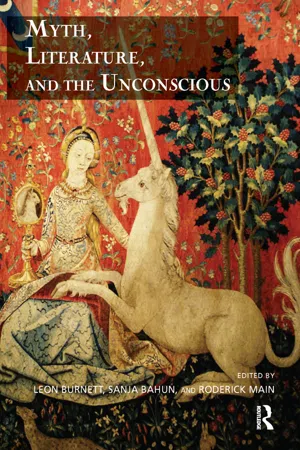
At a time when the place and significance of myth in society has come under renewed scrutiny, Myth, Literature, and the Unconscious contributes to shaping the new interdisciplinary field of myth studies. The editors find in psychoanalysis a natural and necessary ally for investigations in myth and myth-informed literature and the arts. At the same time the collection re-values myths and myth-based cultural products as vital aids to the discipline and practice of psychoanalysis. The volume spans a vast geo-cultural range (including ancient Egypt, India, Japan, nineteenth-century France, and twentieth-century Germany) and investigates cultural products from the Mahabharata to J. W. Goethe's opus and eighteenth-century Japanese fiction, and from William Blake's visionary poetry to contemporary blockbuster television series. It encompasses mythic topics and figures such as Oedipus, Orpheus, the Scapegoat, and the Hero, while mobilising Freudian, Jungian, object relations, and Lacanian psychoanalytic approaches.
eBook - ePub
Myth, Literature, and the Unconscious
- 256 pages
- English
- ePUB (mobile friendly)
- Available on iOS & Android
eBook - ePub
Myth, Literature, and the Unconscious
About this book
Information
PART I
MYTH IN THE MODERN WORLD
CHAPTER ONE
Apocalypse, transformation, and scapegoating: moving myth into the twenty-first century
“Emotion” is a word that tends to put intellectuals off. However, to deal intellectually with myths one must also engage with their emotional effect—not just on the mind of the masses, but on one’s own highly educated mind. In Jungian terms, whenever an archetype or archetypal pattern is constellated—whenever it is activated in the unconscious—the conscious response to it involves strong emotion. To sidestep this emotional response is to short-circuit the process of coming to terms adequately with the power of the myth. Unfortunately, it is at the moment of emotional response that intellectuals tend to sidestep the emotional response in favour of a mainly rational and even hyper-rational conceptual discourse. That is, I believe, a mistake, because, although emotional response can lead to emotional thinking, emotional thinking is a necessary step in the direction of rational thinking, at least in regard to the analysis and understanding of powerful myths. Emotional thinking, like emotion itself, may be confusing and disturbing to the rational mind, but it provides access to unconscious material that the rational mind can then assimilate and analyse.
The myth of the Apocalypse is a case in point: a magnificent evocation of cosmic destruction leading to world renewal, whose emotional power possessed the mind of John of Patmos completely and, as we shall see, wound up half-possessing the mind of D. H. Lawrence almost two thousand years later. Edward F. Edinger has argued in his wonderful book Archetype of the Apocalypse (1999) that the apocalypse myth represents an archetypal power at work in the depths of the individual psyche that also has a world-historical dimension, expressing itself not only in terms of an ordeal of inner psychological evolution and change but also in the bloody political and social antagonisms that continue to afflict the modern world. In my opinion, however, coming to terms with the power of this myth involves first submitting to its emotional power, and only then divesting it of its enchanting and alluring cosmic, or theological, or world-historical, dimensions in order to reconfigure its significance as the projection of archetypal contents of the psyche onto the screen of the world. Thus I cannot follow Edinger in ascribing to the archetype of the apocalypse, powerful as it is in terms of the fate of the individual, any power whatsoever over the fate of the world. More generally, attributing to the collective unconscious any type of world-historical agency that in the past was attributed to the gods, to God, or to the dialectic, is not a step I am willing to take.
But, assuming that the myth of the apocalypse represents a dimension of the human potential inscribed in the archetypal depths of the psyche, what human potential does the myth of the apocalypse have as its ultimate referent? I shall argue that it is the potential for psychic transformation. The final scene of Peter Weir’s 1977 film The Last Wave provides a good example of the inner workings of this archetype. In the course of the film the Sydney corporate tax lawyer David Burton (Richard Chamberlain) has been drawn inexorably into the world of Australian aborigine tribal culture, and has left his family and career behind in order to discover for himself who he really is. He eventually finds his new identity expressed in terms of a transformational image of a tribal shaman figure. His midlife spiritual initiation drama ends as he struggles to emerge from the anguish of initiatory transformation in the darkness of the Sydney sewer system into the early morning light of a nearby beach. In terms of the film’s apocalyptic theme, what David sees rushing towards him is the “last wave” that he has been led to imagine will destroy the world, or at least the Aussie world as he knows it, a familiar world of barbies and wine and corporate comfort. But that is not what actually happens next. After David, kneeling in the gentle surf, washes his eyes—cleans the doors of perception—with the salt water of purification, he looks out, and the camera focuses on a beautiful, but deliberately unrealistic image of a huge wave about to engulf him. At that moment David looks down and closes his eyes. At the end of a film that up to this point has catered to the popular audience’s taste for apocalyptic fantasies, the director has given the intellectual part of his audience a point to ponder: that the Last Wave may not be a cosmic happening, but rather a powerful intrapsychic fantasy. David Burton sees the Wave inside himself, not outside himself. The suggestion is clearly made that it is he who is transformed, not the world.
So one way to think rationally about an inner experience of the myth of apocalypse is to categorise it in Jungian terms as the result of the activation of what Jung called the archetype of rebirth, the archetype that represents the human potential for inner transformation (see Jung, 1970, pp. 45–81). In the interests of rational as opposed to emotional thinking, let us first strip the myth of apocalypse of any grandiose cosmic significance. Looked at rationally and psychologically, the myth of apocalypse does not really concern world destruction and renewal but, as St. Paul put it, the renewal of our minds.
That is perhaps why D. H. Lawrence, dying of tuberculosis, became obsessed with the Apocalypse of John of Patmos, a text that had been the occasion for innumerable emotional rants in the colliers’ non-conformist chapel services of his childhood. It was, at the beginning and then at the end of his life, a text he loved to hate. Lawrence’s last book, also entitled Apocalypse, constituted a savage attack on John of Patmos and later Patmosians, but it was also a paean to the emotional impact on him of the cosmic apocalyptic vision of the New Testament text, whose power as a myth, he believed, stemmed from its ultimate origin in Chaldean star worship and pagan initiation rituals. “I would like”, he wrote, “to know the stars again as the Chaldeans knew them… . And in my Mesopotamian self I long for the sun again … But our experience of the sun is dead, we are cut off” (Lawrence, 1999, p. 51).
Lawrence’s primitivist nostalgia for Etruscan, Chaldean and Greco-Roman polytheistic cultures’ sense of connection with the cosmos takes us back to William Wordsworth’s savage sigh:
Great God! I’d rather be
A Pagan suckled in a creed outworn;
So might I, standing on this pleasant lea
Have glimpses that would make me less forlorn;
Have sight of Proteus rising from the sea;
Or hear old Triton blow his wreathèd horn.
(Wordsworth, 2008, p. 270)
Like Wordsworth, Lawrence realised—or half realised—that the vision of what he wanted to see out there in the cosmos would be the result of a process of what Jungians call a “projection” of archetypal material from the psyche onto the outside world. “I would like,” wrote Lawrence, “to put my ego into the sun, and my personality into the moon, and my character into the planets” (Lawrence, 1999, p. 51). Although it was impossible for Lawrence to become a Chaldean—just as it was impossible for Wordsworth to time-travel and become “a Pagan suckled in a creed outworn”—there still remained for him the possibility of the release of his imagination triggered by the renewal of his love-hate relationship with the myth text of John of Patmos’ Apocalypse, and his obsessive fascination with it—his emotional response to the power of the myth—became the support for an inner vision that helped to satisfy the longings of his soul. But longings for what? On this point Lawrence is perhaps not entirely lucid; in my opinion, he remained stuck to some degree in emotional thinking. Having experienced the emotional impact of the apocalypse myth, he expressed his sense of fascination and wonder in compelling poetic language, but his rational mind remains somewhat subordinated to the emotion generated by contact with an archetypal dimension of the psyche that C. G. Jung called the archetype of rebirth. His regressive nostalgia for a Chaldean—or Etruscan, or Greco-Roman—Golden Age where culture and cosmos were connected—where we were not “cut off” (ibid.) from the sun—conceals a longing on his part for self-transformation, that was probably stimulated by the contemplation of his imminent death from tuberculosis. He may not be able to become a pagan or a Chaldean, but he can become—however partially and reluctantly—a Patmosian, since the Apocalypse of St. John of Patmos was indeed a significant part of the “creed” in which as a child he was “suckled”. However “outworn” this creed of his childhood non-conformist chapels may appear to him now, through it he is able imaginatively to re-experience the power of the apocalyptic myth, but this time with all his adult critical faculties on the alert. There remained only for him to take the last step: to achieve intellectual clarity on the issue of the ultimate referent of his emotional fascination with apocalypse myth, that is, to discern behind the emotional lure of the cosmic myth the personal referent of a glimpse into an inner of rebirth and transformation.
Recognising the inner personal referent of a myth that presents itself as a powerful vision of world destruction and regeneration is not an easy enterprise. Jung himself first toyed with the idea that his thrice-repeated dream in April, May and June of 1914 of a devastating cold wave that swept through north-eastern France might have been a premonitory dream predicting the onset of World War I (although I don’t think you had to be much of a prophet in the spring of 1914 to foresee the likelihood of war). Only with the third insistent occurrence of the dream did the personal nature of the vision become clear to him. As he recounts in his autobiography Memories, Dreams, Reflections, “there stood a leaf-bearing tree, but without any fruit (my tree of life, I thought), whose leaves had been transformed by the effects of the frost into sweet grapes full of healing juices. I plucked the grapes and gave them to a large, waiting crowd” (Jung, 1963, p. 176). So a dream that Jung was initially inclined to interpret as prophetic of apocalyptic world events ultimately pointed towards the theme of personal transformation. In this personal context then, his dream was prophetic: Jung’s own midlife transformation did indeed lead to his coming into his own as an innovative psychologist, whose therapeutic work and writings would help many people.
For another example of how a text can subtly contextualise an apocalyptic cosmic vision in terms of personal transformation, we now turn to the opening of the Bhagavad Gita, where the prince and warrior Arjuna is described as almost having a complete nervous breakdown just before the great battle of Kurukshetra is about to begin. This personal crisis leads to his charioteer and spiritual mentor Krishna expounding over the first ten of the eighteen chapters of the Gita a new and original doctrine showing how the spiritual warrior, the yogi, should act with full mental equilibrium, having renounced any expectation of personal rewards for the results of his actions. Arjuna listens carefully, but it is clear that philosophical enlightenment is not enough for him; his unsettled and precarious state of mind also requires the healing emotional stimulus of an apocalyptic vision in order to complete his transformation from disheartened hero into spiritual warrior and yogi.
Arjuna’s apocalyptic vision will be the substance of book eleven of the Gita, and I will argue that it falls—significantly—into two separate parts. The first part satisfies Arjuna’s request to Krishna to reveal to him his cosmic form as lord of the universe (cf. the figure of Christ as Pantokrator in John of Patmos). Krishna agrees to give him “divine sight” in order for him to be able to see “the entire universe … centered here in this body of mine”, which is all that Arjuna had asked for. Krishna then adds—significantly—that he will also show Arjuna “what-ever else desire to see” (van Buitenen, 1981, 113).
So Arjuna’s apocalyptic vision falls into two distinct parts: the first, in which Krishna reveals to Arjuna his cosmic form, and the second, in which Arjuna will see “whatever else” (yac cânyad)—as yet unspecified—he might wish to see in addition. The first part of the vision is narrated in the epic third person, and recounts how Arjuna saw the whole universe centred in Krishna, and how he was stunned by the emotional impact of this numinous vision. But then something curious happens: Arjuna “folded his hands” (krtânjalir) and “bowed his head” (pranamya shirasâ) as the second part of the vision begins (van Buitenen, 1981, p. 113). At this juncture I would argue that Arjuna can no longer be imagined as looking outwards towards the transformed figure of Krishna, but rather as looking inwards into his own mind (cf. David Burton at the end of The Last Wave), where he experiences a very different kind of vision of Krishna. Appropriately, the narrative of the Gita switches from third to first person narration, and it is Arjuna himself who describes, his head bowed down, what he sees with his inner eye. What he now sees as an inner vision presumably represents everything he personally wanted to see; it is the part of the vision that is designated as what refers to him personally; it is the part of the vision that corresponds to his deepest inner need. It is “what he wants to see”.
And what Arjuna “wants to see” is downright horrific! It is a grotesque nightmare vision of Krishna as a bloodthirsty ogre with flaming mouths and dreadful tusks, who devours all of Arjuna’s foes, including his revered teachers who have chosen to fight on the opposite side. Horrific details accumulate, such as “there are some who are dangling between your teeth, / Their heads already crushed to bits” (van Buitenen, 1981, p. 115). It has turned out that what Arjuna most wanted and most needed to see was a vision of his friend and mentor Krishna as the Flaming Mouths of Death and Universal Destruction, as the Divine Slayer of all those Arjuna had hesitated to kill not long before. No doubt, this vision quickly frightens him, and soon he is begging Krishna to revert to his more comforting god-like form. But the apocalyptic vision has provided him with the healing symbol he needs for his transformation. It has displaced Arjuna’s warrior mission from the personal onto the archetypal plane; the eventual death of his enemies is no longer envisaged as solely the result of his own personal agency; it is Krishna, the embodiment of cosmic death and destruction, who will ultimately slay them. From now on Arjuna’s initiatory ordeal is essentially over, as he has been transformed into a spiritual warrior and yogi, who can return to the battlefield and kill his enemies, even if they happen to be his revered elders and teachers, but without being motivated by ambition and the desire to reap the personal rewards of victory. Even so, the choice to fight or not to fight is ultimately left up to him, as Krishna indicates clearly at the end of the Gita: “Reflect upon this knowledge I have propounded to you, this mystery of mysteries, in its entirety, and then do as you are pleased to do” (van Buitenen, 1981, p. 143). Arjuna has been radically transformed from a conscience-stricken warrior to a spiritually enlightened warrior yogi, not only through Krishna’s spiritual teachings, but also through an apocalyptic vision that enabled him to come to terms with his own worst fears. That is why Kr...
Table of contents
- Cover
- Half Title
- Title Page
- Copyright Page
- Table of Contents
- About The Editors And Contributors
- Introduction
- Part I: Myth In The Modern World
- Part II: Oedipus Reconsidered
- Part III: Theorising Myth And The Unconscious
- Part IV: Readings In Myth And The Imaginary
- Part V: Orpheus And Literature
- Index
Trusted by 375,005 students
Access to over 1.5 million titles for a fair monthly price.
Study more efficiently using our study tools.
Frequently asked questions
Yes, you can cancel anytime from the Subscription tab in your account settings on the Perlego website. Your subscription will stay active until the end of your current billing period. Learn how to cancel your subscription
No, books cannot be downloaded as external files, such as PDFs, for use outside of Perlego. However, you can download books within the Perlego app for offline reading on mobile or tablet. Learn how to download books offline
Perlego offers two plans: Essential and Complete
- Essential is ideal for learners and professionals who enjoy exploring a wide range of subjects. Access the Essential Library with 800,000+ trusted titles and best-sellers across business, personal growth, and the humanities. Includes unlimited reading time and Standard Read Aloud voice.
- Complete: Perfect for advanced learners and researchers needing full, unrestricted access. Unlock 1.5M+ books across hundreds of subjects, including academic and specialized titles. The Complete Plan also includes advanced features like Premium Read Aloud and Research Assistant.
We are an online textbook subscription service, where you can get access to an entire online library for less than the price of a single book per month. With over 1.5 million books across 990+ topics, we’ve got you covered! Learn about our mission
Look out for the read-aloud symbol on your next book to see if you can listen to it. The read-aloud tool reads text aloud for you, highlighting the text as it is being read. You can pause it, speed it up and slow it down. Learn more about Read Aloud
Yes! You can use the Perlego app on both iOS and Android devices to read anytime, anywhere — even offline. Perfect for commutes or when you’re on the go.
Please note we cannot support devices running on iOS 13 and Android 7 or earlier. Learn more about using the app
Please note we cannot support devices running on iOS 13 and Android 7 or earlier. Learn more about using the app
Yes, you can access Myth, Literature, and the Unconscious by Leon Burnett, Professor Sanja Bahun, Roderick Main, Leon Burnett,Professor Sanja Bahun,Roderick Main in PDF and/or ePUB format, as well as other popular books in Literature & Literary Criticism Theory. We have over 1.5 million books available in our catalogue for you to explore.