- 368 pages
- English
- ePUB (mobile friendly)
- Available on iOS & Android
eBook - ePub
About this book
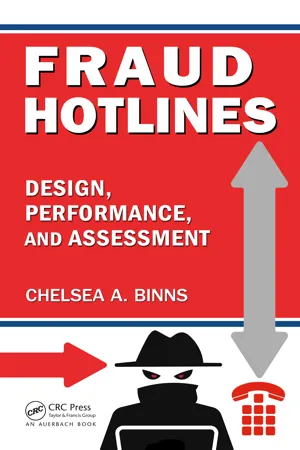
This book provides a complete guide on fraud hotlines. It is designed to educate readers with respect to the history, purpose, operation, use and utility of fraud hotlines. It also equips readers with the knowledge to create, analyze and assess the performance of fraud hotlines.
Information
Publisher
Auerbach PublicationsYear
2017Print ISBN
9780367669867
9781498727433
Edition
1eBook ISBN
9781315353289
Chapter 1
Background, Use, and Value
Introduction
Fraud hotlines are confidential reporting mechanisms for employees and third parties to report fraud, waste, and abuse occurring in all organizations.
In basic terms, fraud hotlines aim to detect and prevent organizational fraud. Although not always successful in achieving said goals, the use of hotlines has continued to expand since the 1970s (in the United States and lately in other countries, like China).
The topic of fraud hotlines is more relevant now than ever. Recent American legislation created a fraud hotline operated by the U.S. Securities and Exchange Commission (SEC), which has paid sizable monetary rewards to callers. In 2015, the SEC awarded a $30 million award to a hotline caller—the largest reward ever granted in the history of their hotline (SEC, 2016, p. 1). As of fiscal year 2016, their whistleblower program has awarded more than $100 million to callers in exchange for their valuable fraud tips (SEC, 2016, p. 1).
This book will serve as a reference guide on fraud hotlines, for practitioners and students alike. It will educate readers with respect to the history, purpose, operation, use, and utility of fraud hotlines. It will also provide the readers with the knowledge to create, analyze, and performance assess a fraud hotline.
Chapter 1 discusses the background, use, and value of hotlines. Chapter 2 outlines the major historical developments that pertain to hotlines. Chapter 3 covers hotline design, including management and implementation, cost, name, anonymity, accessibility, advertisement, and the use of rewards in hotline reporting. Chapter 4 covers hotline performance and assessment. Chapter 5 reviews the theoretical perspectives for hotline operation. Chapter 6 contains several case studies of hotlines in the federal, state, and local governments (three studies); private sector (two studies); and nonprofit (one study) organizations. Chapter 7 discusses future trends and developments related to hotlines.
Definitions
A fraud hotline (“hotline”) is a confidential reporting method. The general purpose of a fraud hotline is to receive tips about fraud, waste, and abuse. The audience of a hotline includes “employees, customers, contractors, service providers, suppliers and other third parties” whose awareness of the hotline is considered an “important component in ensuring a hotline’s effectiveness” (FDIC, 2005).
Employees are the primary callers of fraud hotlines. In their 2016 Report to the Nations, the Association of Certified Fraud Examiners (ACFE) reported over half of their fraud hotline tips came from employees (ACFE, 2016, p. 26). This makes sense because employees are a key source of fraud tips. According to a 2011 National Business Ethics Survey, over half (52%) of Fortune 500 employees polled said they observed misconduct in their workplace (Ethics Resource Center, 2012).
As discussed in this book, there are many ways to refer to a fraud hotline, including whistleblower hotline, ethics line, and tip line. For the purposes of simplicity, this book uses the term fraud hotline or hotline throughout the text to refer to these hotlines in the collective.
Hotline tipsters have a lot of options today. In many cases, someone who wishes to contact a fraud hotline can submit a tip via web form, e-mail, telephone, regular mail, text, and fax. For simplicity, this book uses the terms caller and tipster to refer to someone who provides a hotline tip, in general. There is a reason caller is used in this context. Although there are several reporting methods, telephone tips are preferred by organizations. Hotline calls lead to the best tips due to the open channel of communication that happens during a telephone conversation.
Hotlines can be managed either internally or externally by a third-party vendor, or both. When this book refers to an internal hotline, it is referring to a hotline operated by the organization by its own employees. When this book talks about an external hotline, it is referring to a hotline service provided by a separate company that is contracted by the organization/employer to provide the hotline services. Those hotline workers are employees of the third party. When an organization uses a third party to manage its hotline, their employees report the findings back to the organization for handling. Either way, the organization is ultimately responsible for investigating the claims.
Background
Federal Government
Fraud hotlines have been used in the government sector since the late 1970s, following the Civil Service Reform Act of 1978 (CSRA). The CSRA was the first piece of legislation to increase the legal protections of federal employees who reported misconduct in the workplace (Shimabukuro, Whitaker, & Roberts, 2013). The widespread use of hotlines began in 1989, following President George Bush’s signing of the Whistleblower Protection Act (WPA). The WPA is a federal law that protects government whistleblowers from retaliation by their employer for reporting wrongdoing in the workplace.
One of the first federal fraud hotlines was the U.S. General Accounting Office (GAO) whistleblowing hotline, established in 1979. It was a success, generating 11,000 calls per year. Most callers elected to remain anonymous, and a large number of the tips were accurate (Flesher, 1999). Today, nearly all federal agencies operate hotlines to receive reports pertaining to fraud, waste, and abuse on the part of their respective organizations (Flesher, 1999).
The federal government highly values its fraud hotlines and encourages tipsters to come forward. On the U.S. Office of Personnel Management (OPM) website, they tell the public that “Whistleblower disclosures save lives as well as billions of taxpayer dollars. They play a critical role in keeping our Government honest, efficient and accountable. Recognizing that whistleblowers root out fraud, waste and abuse, and protect public health and safety, Federal laws strongly encourage Federal employees, as well as employees of Federal contractors, to disclose wrongdoing” (OPM, 2017).
Federally operated hotlines may share their data with the public, often through their Office of Inspector General. For some city, state, and federal hotlines, certain hotline data are publicly available for inspection and review on their website.
Private Sector
Hotlines were required in publicly listed companies following the implementation of the Sarbanes–Oxley Act of 2002 (SOX). SOX was named after creators Senator Michael Oxley (R-Ohio) and Representative Paul Sarbanes (D-Maryland). SOX is a federal law created to strengthen the internal controls of publically listed companies following the revelation of internal fraud at several major companies in 2002 (e.g., Enron, Arthur Andersen, Adelphia Communications, Incline, and WorldCom). SOX provisions require that companies have an “anonymous reporting mechanism” for employees to report fraud, and hotlines became the generally accepted way of receiving those tips and satisfying the regulatory requirement.
The Dodd–Frank Wall Street Reform and Consumer Protection Act of 2010 also protects employee whistleblowers against retaliation by their employers for providing a tip, “giving employees who suffer discharge, demotion, suspension, threats, harassment or other forms of discrimination the right to bring a cause of action in federal court” (Government Accountability Project, 2016, p. 3). However, compensation is provided to employees under Dodd–Frank only if they are fired (Government Accountability Project, 2016).
Dodd–Frank reinforced the use of fraud hotlines in the private sector in 2010. Dodd–Frank was instituted in response to major corporate fraud, which contributed to the world financial crisis of 2008 to 2012. In September 2008, there was an unprecedented number of bank closures, and in December 2008, financier Bernard Madoff was arrested after stealing $65 billion from client accounts in a massive Ponzi scheme (McCool & Graybow, 2009). Dodd–Frank is a U.S. federal statute that was signed into law on July 21, 2010. Dodd–Frank is said to represent the most comprehensive change to financial regulation since the Great Depression (Greene, 2011).
Dodd–Frank required regulators to create 243 new rules, designed to enhance accountability and transparency within the financial system (Davis Polk, 2010). Consequently, Dodd–Frank expanded whistleblower provisions in SOX and the Securities and Exchange Act of 1934 (SEA) to provide a whistleblower, who reports violations of certain laws to federal authorities, a payout of between 10% and 30% of recoveries over $1 million (SEC). Under Dodd–Frank, employees may bypass internal hotlines and report known fraud directly to the SEC or the Department of Justice (DOJ). This provision is contrary to SOX, which encouraged employees to report fraud to their company.
The whistleblower rules under Dodd–Frank went into effect in August 2011. The SEC created the Office of the Whistleblower (OWB) within its Division of Enforcement to administer and manage the whistleblower program. The OWB’s mission is to “administer a vigorous whistleblower program that will help the [SEC] identify and halt frauds early and quickly to minimize investor losses” (SEC, 2015). In their 2015 report, the SEC reported paying more than $54 million to 22 whistleblowers since 2011 (SEC, 2015, p. 1). The SEC further reports substantial increases in the number of tips received by the OWB, since its inception. In fiscal year 2015, the OWB received 4,000 tips. This represents a 30% increase in the number of tips since 2012 (SEC, 2015, p. 1).
The success of the OWB is laudable. Yet many organizations are unhappy with the OWB insofar as it encouraged employees to report fraud externally, rather than internally as once required by SOX. In their literature, the OWB states their program was “designed to complement rather than replace, existing corporate compliance programs,” and it “encourages [tipsters] to work within their company’s own compliance structure, if appropriate” (SEC, 2015).
However, there is no mandate for tipsters to report internally—and that was done purposefully. According to one legal expert, “Congress determined that it was important to essentially deputize employees. Congress didn’t want to shackle the whistleblower with a potentially ineffective complaint procedure” (LexisNexis, 2013).
Also, there are no reporting requirements for private sector hotlines. In other words, private sector organizations do not have to share their hotline data with the public. Consequently, most hotline data for private sector entities are unavailable to the public, who in turn has no way of knowing whether the mandated hotlines are working to fight fraud. For the investors in these publicly listed companies, some may say this is problematic. Investors cannot determine whether there is internal fraud in the entity in which they seek to invest. This fact seems contrary to the intent and spirit of a fraud hotline. This is unlikely to change unless specifically mandated.
Nonprofit Sector
In the nonprofit sector, fraud hotlines are not required. Following SOX, nonprofits were advised to use fraud hotlines as a matter of best practices. But there is no requirement to do so, and those that do employ them are not required to share any data. For that reason, it is unclear exactly which nonprofit entities use fraud hotlines. The only way to determine whether a given entity is employing a hotline is to look on their website and/or call them and ask. However, it is unlikely they will provide their caller data. The nonprofits that do have fraud hotlines basically use them as internal mechanisms and seldom report results to the public.
In this sector, fraud is made aware to the public via the Internal Revenue Service’s (IRS) Form 990, which requires a nonprofit organization to publicly disclose fraud. This reporting has more effectively brought nonprofit fraud to the public’s attention. Recent public outrage resulting from these disclosures has resulted in meaningful reform.
Chapter 7 of this book discusses the results of an independent examination into the use of fraud hotlines by this sector. The set of organizations examined included the nonprofit organizations listed on the Forbes 2014 list of the 50 largest charities. The author sought to determine whether said organizations operated a fraud hotline, and whether each organization reported fraud on its Form 990.
Overall, it was determined that 10 out of the 50 (20%) nonprofits employed a fraud hotline. Of those hotlines, this book uncovered only one instance of fraud caught via a hotline that was subsequently reported on the subject nonprofit’s Form 990.
Based on the information gleaned in this examination, it is clear that today the only source of information for the public about fraud in this sector is Form 990. Hotlines could be a useful source of information for the public. But instead, it is clear that they are being utilized as a source of internal policing only and are not for public consumption.
Value
In studying fraud hotlines, a common question asked is: “are hotlines effective in preventing fraud?” There is no easy answer because it depends on the facts and circumstances of each hotline in question. What we do know today is that hotlines are not functioning exactly as intended to prevent and detect fraud. For that reason major corporate frauds are still occurring, despite the existence of fraud hotlines. In these instances, it is unclear whether whistleblowers are not coming forward out of personal choice, or whether they are being silenced by the company via termination following their complaints....
Table of contents
- Cover
- Title Page
- Copyright Page
- Table of Contents
- Author
- 1 Background, Use, and Value
- 2 History
- 3 Hotline Design
- 4 Performance, Assessment, and Best Practices
- 5 Theoretical Perspectives
- 6 Case Studies
- 7 Special Topics
- References
- Index
Trusted by 375,005 students
Access to over 1.5 million titles for a fair monthly price.
Study more efficiently using our study tools.
Frequently asked questions
Yes, you can cancel anytime from the Subscription tab in your account settings on the Perlego website. Your subscription will stay active until the end of your current billing period. Learn how to cancel your subscription
No, books cannot be downloaded as external files, such as PDFs, for use outside of Perlego. However, you can download books within the Perlego app for offline reading on mobile or tablet. Learn how to download books offline
Perlego offers two plans: Essential and Complete
- Essential is ideal for learners and professionals who enjoy exploring a wide range of subjects. Access the Essential Library with 800,000+ trusted titles and best-sellers across business, personal growth, and the humanities. Includes unlimited reading time and Standard Read Aloud voice.
- Complete: Perfect for advanced learners and researchers needing full, unrestricted access. Unlock 1.5M+ books across hundreds of subjects, including academic and specialized titles. The Complete Plan also includes advanced features like Premium Read Aloud and Research Assistant.
We are an online textbook subscription service, where you can get access to an entire online library for less than the price of a single book per month. With over 1.5 million books across 990+ topics, we’ve got you covered! Learn about our mission
Look out for the read-aloud symbol on your next book to see if you can listen to it. The read-aloud tool reads text aloud for you, highlighting the text as it is being read. You can pause it, speed it up and slow it down. Learn more about Read Aloud
Yes! You can use the Perlego app on both iOS and Android devices to read anytime, anywhere — even offline. Perfect for commutes or when you’re on the go.
Please note we cannot support devices running on iOS 13 and Android 7 or earlier. Learn more about using the app
Please note we cannot support devices running on iOS 13 and Android 7 or earlier. Learn more about using the app
Yes, you can access Fraud Hotlines by Chelsea A. Binns in PDF and/or ePUB format, as well as other popular books in Business & Business Ethics. We have over 1.5 million books available in our catalogue for you to explore.