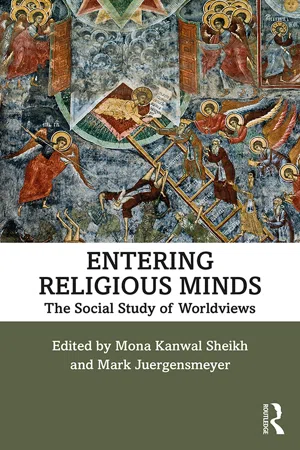
eBook - ePub
Entering Religious Minds
The Social Study of Worldviews
- 126 pages
- English
- ePUB (mobile friendly)
- Available on iOS & Android
eBook - ePub
Entering Religious Minds
The Social Study of Worldviews
About this book
Led by Mona Kanwal Sheikh and Mark Juergensmeyer, nine authors journey into the worlds of unusual, sometimes violent religious groups. Together, these original first-person contributions provide an integrated, problem-solving approach to field research in religious extremism, illustrating ground-breaking methods in gaining access to their subjects' worldviews. In a narrative style that is at once both conversational and rigorous, the book demonstrates for students, researchers, and journalists the relevance of religious studies to political science, sociology, and anthropology. It is particularly well suited to upper-level courses at the intersection of religion and the social sciences.
Information
1
INTRODUCTION: THE CHALLENGE OF ENTERING RELIGIOUS MINDS
Some years ago, Ninian Smart, one of the founders of the modern field of religious studies, was fond of lecturing to his students from both sides of the lectern. He would stand on one side in the guise of an adherent of a particular tradition when discussing, say, the origins of Islam. That voice would enunciate the distinctiveness of the revelations of the Prophet and the miracle of the Qur’an. Then he would switch to the other side of the podium and adopt a different voice, that of the scholar. The scholar would put the whole event in historical context, and talk about the role that other traditions, including Judaism and Nestorian Christianity, played in the world of the Arabian Peninsula at the time of the early Islamic revelations.
Which side was uttering the truth? “Would the real Ninian Smart,” we might ask, “please stand up?” The point of the exercise, however, was to show that both sides were standing up. Both sides were, from their points of view, speaking the truth. But the truth as perceived by the believer might look quite different – at least in emphasis if not in kind – than the truth perceived in the critical eye of the scholar. Also, implicit in the exercise was Smart’s conviction that scholars were well advised to consider the truth from the perspective of the believer in trying to fully understand the significance of the religious experience. Smart, a Scottish scholar, helped to develop the department of religious studies at the University of California, Santa Barbara after founding the program in religious studies at Lancaster, U.K.
On the other side of the North American continent, a Canadian who helped to develop the program in the study of religion at Harvard, Wilfred Cantwell Smith, came to much the same conclusion. He went so far as to say that scholars should not describe the main features of religious traditions without ascertaining from the faithful in those traditions that their interpretations were correct. This was not Smart’s position, but he agreed that the study of religious experience must take into account the phenomena as perceived by those experiencing it.
This position has become a hallmark of the field of religious studies, not only at Santa Barbara and Harvard, but wherever the programs have been established as an independent field. The same, however, cannot be said about the study of religious matters within the social sciences, where the attitude is often one of careful distance – almost as if too much familiarity with the toxic subject would lead to an infection of it. A recent study showed that the twenty leading journals of political science in the U.S. and Europe featured religion-related issues in only 1.34 percent of their articles, and most of them were about religious identities in voting behavior statistics (Kettell 2012).
The absence of models of studying religious experience creates a problem for scholars in general. It is a major hurdle for social scientists in particular, because a strong and defining dogma within this group of fields has been the separation of values and beliefs from science and facts. Both editors of this volume were trained as political scientists and have focused their research on violent religious activists in contemporary political conflicts. We wanted to know what religion had to do with the means and motivations of the activists. But when we turned to our common disciplinary approaches, we discovered very few examples of studies of the political aspects of religious experience, and what studies existed on religion were largely related to superficial matters, such as religious markers of identity in voting behavior statistics.
What we wanted to know when pursuing our respective research agendas was how to study the role that religious ideas and images played in the worldviews of activists engaged in political struggle. To understand this challenge meant entering their religious minds, adopting what the great sociologist Max Weber once described as verstehen. This German word literally means to “stand there,” in the sense of standing in someone else’s place, getting into their skins, one might say using the English language idiom.
Weber, who is often credited as a founder of the modern social sciences, regarded verstehen as the foundation on which all other social knowledge is constructed. He went so far as to define sociology as “a science which attempts the interpretive understanding of social action in order thereby to arrive at a causal explanation of its course and effects” (Weber 1964[1947]:88). The phrase “the interpretive understanding of social action” is the English translator’s way of making sense out of the term, verstehen. One of Weber’s colleagues, Georg Simmel, went so far as to say that the task of verstehen means not only understanding the subject’s perspective but also seeing an aspect of yourself in someone else’s position.
A similar empathetic approach to understanding is taken up by the philosopher, Wilhelm Dilthey, in developing the field of literary and philosophic studies known as hermeneutics, the science of interpretation. Although criticized by the philosopher Martin Heidigger and Hans-Georg Gadamer, hermeneutics as Dilthey understands it is a matter of entering the nexus of shared understandings that allow texts to communicate their meanings and for social actions to make sense within their communal contexts. What is interesting about Dilthey’s work is that it has had an impact on both literary and sociological scholarly circles of his time and played a role in the development of both literary hermeneutics and interpretative sociology.
In the 20th century, Weber’s notion of verstehen is revived within the social sciences by such figures as the Harvard sociologist, Talcott Parsons, whose structural-functionalist approach embraced what Parsons called an “analytic realism” that takes seriously the way that the complex systems of a society work and requires an internal understanding of its social relationships. One of Parson’s leading students, Robert Bellah, revived the Weberian notion of interpretive sociology in a series of studies of the relation of religion to society in several traditions, including Islam, Buddhism, Christianity and Native American religion. In this way, Bellah’s project was not unlike that of Weber’s in his comparative studies of religious traditions and society. One of Weber’s best-known works, published in English as The Protestant Ethic and the Spirit of Capitalism, shows the relevance of the Protestant Christian belief system to the rise of American and European capitalism; Bellah’s early work on Japan’s Tokugawa Religion is a similar attempt to show the relevance of religious ideas to this period of Japan’s social development (Bellah 1957).
It was the work of sociologists in the 1960s and 1970s such as Bellah and Peter Berger, whose books on the sociology of religion embraced aspects of theology that led another sociologist, Roland Robertson, to observe that social and religious analysis had come together in something that he called “sociotheology.” What Robertson meant by this term was an approach to the study of religious experience that took seriously not only the social context in which these experiences took place but also the perception of those experiences from the point of view of the subjects themselves. What Robertson appreciated about Bellah, Berger and similar sociologists was their application of verstehen to the social study of religion.
In this book are efforts to take seriously the perspectives of the subjects in the social analysis of religious experience. Some of the authors in this volume quarrel with Robertson’s term, sociotheology, and our adoption of it since it seems to privilege the academic field of theological studies over the more neutral term, “religious studies.” The point of using this term, however, is not to praise the field of theology but to respect what that field has done over the centuries – give voice to the perspective of those who are the subjects of the social analysis of religious phenomena. It is for this reason we still find the phrase “sociotheology” to be useful in describing the increased interest in taking the experience of the subject into account when undertaking social analysis. The main arguments for using the term, and the description of what the editors call “the sociotheological turn” in the social sciences, may be found in our essays on the topic in the bibliography of this volume (Juergensmeyer and Sheikh 2013, Juergensmeyer 2013).
While the field of political science does not have a “sociotheological turn” comparable to the field of sociology, there increasingly are efforts within that discipline to open up space for a more interpretive approach to the examination of political phenomena. The subfield of constructionism posits that some of the most significant artifices of political organization and international relations are based not on material interests and needs but on ideas and other socially constructed ways of understanding power relationships within societies and across national borders. Political scientists such as Peter Katzenstein, Elizabeth Shakman Hurd and John Ruggie have shown the importance of ideas and cultural assumptions in the configuration of international relations, and other political scientists, including Dan Philpott, Cecilia Lynch and Monica Duffy Toft have shown that cultural perspectives, include those regarding secularism and religion, play a significant role in political organization and dissent on the national and local levels.
Thus, the study of ideas and activities related to religion can be understood not just as epiphenomenal but also as part of the social and political milieus of which they are a part. For this reason, it is at times necessary for social and political analysts to take seriously the experience of religious actors in order to understand the nexus of social and political constructions in which they operate. We call these social constructions their worldviews, and the only way to understand them, to recreate the nexus of relationships between ideas and action, is to try in a sense, to inhabit their worlds.
The authors of this book have tried to enter into the worldviews of their subjects in a variety of different studies. They have each taken a Weberian verstehen approach to the study of religious experience and locate those experiences within their social contexts. Whether or not they accept what they are doing as sociotheology, each has tried to take seriously the social construction of the realities of the world as they perceive it. In discussing what each of them shared with the others in their analytic perspective, the phrase that seemed to resonate among the participants in this volume is the term, “epistemic worldview analysis.” It is epistemic in the way Michel Foucault uses the term, episteme. That is, it is the logical framework through which one views the world. The term episteme, which Foucault introduces in his book, The Order of Things, is often applied by Foucault to scientific paradigms, indicating the fundamental assumptions that one makes about what is true and false, or real and unreal, in the world (Foucault 1966). But it is also applied to the everyday knowledge that one has about the reality of the world one inhabits.
By applying this notion of episteme to worldviews, the scholars represented in this volume are saying that their hope is not just to understand how someone sees the world but also how they see what is basically true and real about the world around them. In other words, epistemic worldview analysis takes seriously the notion that one’s worldview contains logical connections of basic premises that constitute a sense of what is fundamentally trustworthy and true in the reality one confronts. The challenge is to penetrate into this worldview sufficiently so that the outsider scholar can gain a sense of how these paradigms of reality – these epistemic worldviews – cohere and on what are they based.
Each of the scholars represented in this volume has worked on projects involving adherents of a religious worldview different from their own. And they have all tried to describe the experience of those they have studied or attempted to explain the internal logic of the worldview that they studied. Exactly how the different scholars have done that – how they have entered the religious minds of their subjects of analysis – is what this volume will reveal.
We hope that this volume can inspire students of religious movements across the fields of religious studies, theology and social sciences. It has been our aim to provide some methodological, practical and theoretical reflection that can inform and inspire students and other scholars who are embarking on research that dissolves the barricades between inside and outside approaches to religious phenomena.
The authors of this volume come from varied disciplinary backgrounds, but common is their academic passion for getting closer to those who stand “on the other side of the podium.” Many of the authors have made significant contributions to religious studies and to the interdisciplinary subfield of religious violence. In this volume, we have asked the authors to make explicit how they do what they do, to share insights gained through their personal intellectual journeys. This means that the chapters are also personal accounts in which the authors show the difficulties in attempting to enter into the religious minds and experiences of other people, and what ethical or practical challenges the authors have met.
The chapters are organized and presented in two main parts. Common for the first part is that the authors explain, challenge or cross the disciplinary boundaries between religious studies, theology and social sciences through honest descriptions of their personal intellectual journeys. The four contributors of this section elaborate on how they study religious worldviews, and what brought them to find the task of immersion important. Ann Taves, a professor of religious studies who has contributed extensively to the theoretical conversation on how to study religious experience, argues that immersing ourselves as fully as possible in the religious worlds of others, whether as historians, anthropologists, or social scientists, is an essential precondition for explaining their worlds in social scientific terms. As she writes “It is only through my immersion in insiders’ worldviews that I discovered what I needed to explain.” Taves gives the example of a historical event that is a part of the founding of the Mormon faith, Joseph Smith’s discovery of the “golden plates” on which the sacred book of Mormon is inscribed. In sharing this discovery with a small circle of intimate associates, Smith has presented the believers with an important datum of religious faith, but it also presents the scholar of religious experience with a challenge for understanding what was happening on a social level. For Taves, her scholarly task was to attempt to enter into that worldview of the early Mormon witnesses and understand the power of the shared belief in the materiality of their vision.
Richard Madsen, a comparative sociologist of religion and culture who has been a member of the sociological team led by Robert Bellah in creating the landmark study of American individualism and community, Habits of the Heart, describes his journey from theology to sociology. He describes how he began his research on Buddhist movements by taking part in their religious rituals, and how his study of religion in China was shaped by his upbringing in a tightly regulated religious community. In this chapter, Madsen reaches a useful definition of what he calls “religious worlds” by describing these as “structured communities which constitute the horizons of understanding [that] give direction and purpose to activities and foster distinctive moral virtues and emotional dispositions.”
Ariel Glucklich, who is a professor in theology and a specialist in the Hindu religious tradition, turns to the Middle East for the study described in his chapter for this book. In it he describes his encounter with a spiritual community, Neot Smadar, in a desert area in Southern Israel. Glucklich tells how he was intrigued by the charismatic cult leader Yossef Safra, who compelled successful urban professionals to move to the hot and harsh dessert to be near to the leader and in doing so form a religious community with other followers. Glucklich is interested in understanding how charismatic leadership can endure and how a community can cohere through a variety of tensions and describes that he had to participate in the life and the work of the community over time in order to understand the perspective from within the movement.
In the last chapter of this part of the book, Julie Ingersoll, a specialist on Evangelical Protestant Christianity, underlines the problem that researchers have when they possess a rigid understanding of what counts as being authentically religious. Their positions, she argues, tells us more about them than about the subjects they are discussing. She then focuses on two issues: The first is about “translating worldviews” as a researcher who does epistemic worldview analysis, and she describes the methods developed through her research. The second relates to the question of defining religious studies, arguing that there ought not be any divide between religious studies and social studies in the intellectual approach that scholars take in their analysis.
The second part of this volume relates to the topic of religious violence and is written by scholars who have all stepped into a field where only few researchers have dared to go, into the mind set of those whose actions have branded them as terrorists. The authors describe the ethical, practical and theoretical challenges they have met in their encounters with violent actors and adherents of extremist movements. Mark Juergensmeyer, a political sociologist who has worked on cases of religion and violence in various parts of the world for some years, opens this section of the book with a chapter that tells stories about how he managed to interview leaders of movements like Hamas, the Aum Shinrikyo, a militant Christian anti-abortion movement and the group related to al Qaeda that was involved in the 1993 attack on the World Trade Center. Even more challenging than securing the interviews, Juergensmeyer states, was the challenge of conducting and interpreting them. He offers four guidelines for entering the mind set of religious activists: conducting informative conversations, applying relational reasoning, bracketing our judgements about what is true and using the subject’s perspective to recreate their view of the world.
Michael Jerryson continues this line of thinking about how to undertake empathetic immersions into the worldviews of extremists by focusing on his own research on militant monks in Southern Thailand. He reviews the methods that made it possible for a researcher from an American university to gain ac...
Table of contents
- Cover
- Half Title
- Title Page
- Copyright Page
- Table of Contents
- List of contributors
- Acknowledgments
- 1. Introduction: The Challenge of Entering Religious Minds
- PART I: Bridging Disciplines: Theology, Religious Studies and Social Science
- 2. From Methodists to Mormons: Reflections on Describing and Explaining Religious Worldviews
- 3. Finding a Vocation Between Religious Worlds
- 4. Route 40: Encountering a Spiritual School in the Desert
- 5. Translating Worldviews: Religious Studies as a Social Science
- PART II: Encountering Religious Violence: Fieldwork, Empathy and Immersion
- 6. Talking with Terrorists, Entering Their Minds
- 7. Epistemic Worldviews: Buddhist Perspectives on Violence
- 8. Lessons from my Study of the Pakistani Taliban
- 9. Interviewing White Ethno(-Religious) Nationalists: Reflections on Fieldwork
- 10. Grasping Ritualized Violence in Ancient Texts
- 11. The Significance of Worldview Analysis for Social Sciences
- Index
Trusted by 375,005 students
Access to over 1.5 million titles for a fair monthly price.
Study more efficiently using our study tools.
Frequently asked questions
Yes, you can cancel anytime from the Subscription tab in your account settings on the Perlego website. Your subscription will stay active until the end of your current billing period. Learn how to cancel your subscription
No, books cannot be downloaded as external files, such as PDFs, for use outside of Perlego. However, you can download books within the Perlego app for offline reading on mobile or tablet. Learn how to download books offline
Perlego offers two plans: Essential and Complete
- Essential is ideal for learners and professionals who enjoy exploring a wide range of subjects. Access the Essential Library with 800,000+ trusted titles and best-sellers across business, personal growth, and the humanities. Includes unlimited reading time and Standard Read Aloud voice.
- Complete: Perfect for advanced learners and researchers needing full, unrestricted access. Unlock 1.5M+ books across hundreds of subjects, including academic and specialized titles. The Complete Plan also includes advanced features like Premium Read Aloud and Research Assistant.
We are an online textbook subscription service, where you can get access to an entire online library for less than the price of a single book per month. With over 1.5 million books across 990+ topics, we’ve got you covered! Learn about our mission
Look out for the read-aloud symbol on your next book to see if you can listen to it. The read-aloud tool reads text aloud for you, highlighting the text as it is being read. You can pause it, speed it up and slow it down. Learn more about Read Aloud
Yes! You can use the Perlego app on both iOS and Android devices to read anytime, anywhere — even offline. Perfect for commutes or when you’re on the go.
Please note we cannot support devices running on iOS 13 and Android 7 or earlier. Learn more about using the app
Please note we cannot support devices running on iOS 13 and Android 7 or earlier. Learn more about using the app
Yes, you can access Entering Religious Minds by Mona Kanwal Sheikh, Mark Juergensmeyer, Mona Kanwal Sheikh,Mark Juergensmeyer in PDF and/or ePUB format, as well as other popular books in Social Sciences & Politics. We have over 1.5 million books available in our catalogue for you to explore.