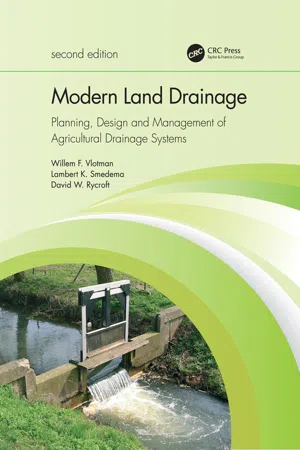
Modern Land Drainage 2nd edition is a fully revised and updated edition of the 2004 edition. Modern Land Drainage describes traditional drainage formulas (Hooghoudt, Kirkham, Donnan, Ernst, Glover-Dumm) for rainfed agriculture in the humid temperature zone. Significant parts are devoted to drainage for salinity control of irrigated land in (semi-) arid zones, and to drainage of rice land in the humid tropics. Institutional, management and maintenance aspects are extensively covered, as well as the mitigation of adverse impacts of drainage interventions on the environment. The latest computer applications for drainage design in the context of integrated water management are described (DRAINMOD, HEC, SWAP, etc.).
Field surveys are executed by governments, with the aid of consultants, but rarely are the end stakeholders (i.e., farmers and general public) involved from inception to planning to execution of a drainage system. Yet, during the Operation, Management and Maintenance (OMM) phase of a water management system, they are expected to takeover, run, bear and be responsible for the costs of OMM. The book describes successful methodologies and processes to be followed for engagement of stakeholders at all levels, from government to farm, from minister to farmer, and, from beginning to end.
The book covers all aspects needed for sustainable drainage. The latest survey methodologies with satellites and drones are suggested to assess cause and effect. Waterlogging and salinity are the effect of something caused most likely upstream of the drainage problem location. Hence treating the cause may be more cost-effective. Triple Bottom Line (social, environmental and financial considerations) and the water-food-energy nexus are an integral part of the drainage design process. Controlled drainage, i.e. the balance of removal and conservation of drainage water and minimising solute transport as low as reasonably achievable (ALARA principle) is extensively described.
This work is intended for use both as a university level textbook and as a professional handbook; it is of particular value to professionals engaged in drainage development in the context of integrated water resources and river basin management, civil and agricultural engineers, government officials, university students and libraries.
eBook - ePub
Modern Land Drainage
Planning, Design and Management of Agricultural Drainage Systems
- 472 pages
- English
- ePUB (mobile friendly)
- Available on iOS & Android
eBook - ePub
Modern Land Drainage
Planning, Design and Management of Agricultural Drainage Systems
About this book
Information
Table of contents
- Cover
- Half Title
- Title Page
- Copyright Page
- Contents
- List of tables
- List of figures
- List of boxes
- Preface
- About the authors
- PART I Introduction
- PART II Investigations
- PART III Systems and technology
- PART IV Design
- PART V Salinity control
- PART VI Special topics
- PART VII Management and New Developments
- References and further reading
- Index
Trusted by 375,005 students
Access to over 1.5 million titles for a fair monthly price.
Study more efficiently using our study tools.
Frequently asked questions
Yes, you can cancel anytime from the Subscription tab in your account settings on the Perlego website. Your subscription will stay active until the end of your current billing period. Learn how to cancel your subscription
No, books cannot be downloaded as external files, such as PDFs, for use outside of Perlego. However, you can download books within the Perlego app for offline reading on mobile or tablet. Learn how to download books offline
We are an online textbook subscription service, where you can get access to an entire online library for less than the price of a single book per month. With over 1.5 million books across 990+ topics, we’ve got you covered! Learn about our mission
Look out for the read-aloud symbol on your next book to see if you can listen to it. The read-aloud tool reads text aloud for you, highlighting the text as it is being read. You can pause it, speed it up and slow it down. Learn more about Read Aloud
Yes! You can use the Perlego app on both iOS and Android devices to read anytime, anywhere — even offline. Perfect for commutes or when you’re on the go.
Please note we cannot support devices running on iOS 13 and Android 7 or earlier. Learn more about using the app
Please note we cannot support devices running on iOS 13 and Android 7 or earlier. Learn more about using the app
Yes, you can access Modern Land Drainage by Willem Vlotman,Lambert Smedema,David Rycroft,Willem F. Vlotman,Lambert K. Smedema,David W. Rycroft in PDF and/or ePUB format, as well as other popular books in Technology & Engineering & Botany. We have over 1.5 million books available in our catalogue for you to explore.