- 320 pages
- English
- ePUB (mobile friendly)
- Available on iOS & Android
eBook - ePub
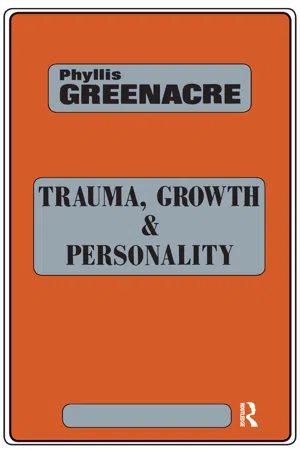
Trauma, Growth and Personality
About this book
This collection of papers focuses on the interaction of maturation phases and special traumas in the first few years of life and the probable effect of these early patterns on the structure of the later personality.
Information
CHAPTER II
The Predisposition to Anxiety
Part I*
THE considerations which are presented here have to do chiefly with the predisposition to anxiety and its relation to increased narcissism, especially in severe neuroses. These considerations are largely in the form of questions rather than conclusions. The stages by which I arrived at these questions are given here in order to present the background of this study: (1) the analysis of particularly severe neuroses in adults, (2) the searching for supportive or related data in the medical, psychiatric and psychoanalytic clinical experience of myself and others, (3) a supplementary review of some experimental work and observations, (4) a review of Freud’s later publications concerning anxiety, especially The Problem of Anxiety, and finally (5) a return to my own case material which I reviewed in the light of my questioning. For the sake of consolidating this presentation, however, this circle of search is taken in a little different order. I shall reserve the presentation of the case material for the second part of this chapter, in which will be discussed also some special considerations of treatment. I have chosen this order because I believe that the clinical material in itself is inevitably so detailed as to be possibly confusing unless the reader is already aware of the underlying thesis. In my work, however, the clinical material came first and the thesis was the result of my observations. I shall first discuss Freud’s later statements concerning anxiety, then present factual observations and the results of experiments of some significance in the problem of basic anxiety.
I
In The Problem of Anxiety, Freud (1) says:
‘Anxiety is the reaction to danger. … But the dangers in question are those common to all mankind; they are the same for everybody; so that what we need and do not have at our disposal is some factor which shall enable us to understand the basis of selection of those individuals who are able to subject the affect of anxiety, despite its singularity, to normal psychic control, or which on the other hand determines those who must prove unequal to this task’ (p. 121).
Then after commenting briefly on the inadequacy of Adler’s organ inferiority explanation, Freud turns to a critique of Rank’s birth trauma theories. What Freud says here is of importance in regard to his own evaluation of the role of the birth trauma and is in no sense an endorsement of Rank’s somewhat mystical therapeutic aggrandizement of it.
‘The process of birth constitutes the first danger situation, the economic upheaval which birth entails becomes the prototype of the anxiety reaction; we have already followed out the line of development which connects this first danger, this first anxiety-occasioning situation with all subsequent ones; and in so doing we saw that they all retain something in common in that they all signify a separation from the mother, first only in a biological aspect, then in the sense of a direct object loss, and later of an object loss mediated in indirect ways’ (p. 122).
Then, in objecting to Rank’s emphasis on the severity of the birth trauma as a determinant—the main determinant—in producing varying degrees of intensity of the anxiety reaction in different individuals, Freud says:
‘The emphasis on the varying severity of the birth trauma leaves no room for the legitimate aetiological claim of constitutional factors. This severity is an organic factor, certainly, one which compared with constitution is a chance factor, and is itself dependent upon many influences which are to be termed accidental, such as for example timely obstetrical assistance.… If one were to allow for the importance of a constitutional factor, such as via the modification that it would depend much more upon how extensively the individual reacts to the variable severity of the birth trauma, one would deprive the theory of meaning and have reduced the new factor … to a subordinate role. That which determines whether or not neurosis is the outcome lies, then, in some other area, and once again in an unknown one. … For no trustworthy investigation has ever been carried out to determine whether difficult and protracted birth is correlated in indisputable fashion with the development of neurosis—indeed, whether children whose birth has been of this character manifest even the nervousness of earliest infancy for a longer period or more intensely than others. If the assertion is made that precipitate births … may possibly have for the child the significance of a severe trauma, then a fortiori it would certainly be necessary that births resulting in asphyxia should produce beyond any doubt the consequences alleged.… I think it cannot yet be decided how large a contribution to the solution of the problem [of the fundamental basis of neurosis] it [i.e., difficult birth] actually makes’ (pp. 124–126).
From his chapter on ‘Analysis of Anxiety’ in the same book, I quote the following:
‘But what is a “danger”? In the act of birth there is an objective danger to the preservation of life. … But psychologically it has no meaning at all. The danger attending birth has still no psychic content. … The foetus can be aware of nothing beyond a gross disturbance in the economy of its narcissistic libido. Large amounts of excitation press upon it, giving rise to novel sensations of unpleasure, numerous organs enforce increased cathexis in their behalf, as it were a prelude to the object-cathexis soon to be initiated; what is there in all this that can be regarded as bearing the stamp of a “danger situation”? … It is not credible that the child has preserved any other than tactile and general sensations from the act of birth [in contrast to Rank’s assumption of visual impressions]. … Intrauterine life and early infancy form a continuum to a far greater extent than the striking caesura of the act of birth would lead us to believe’ (pp. 96, 97, 102).
Here I realize we are symbolically and figuratively in deep water, but at the risk of finding myself in a sink-or-swim situation, I shall raise some questions now and repeatedly throughout the rest of the material of this chapter. It certainly seems clear that the birth trauma occupies no such exalted place in etiology or therapy as was once assigned to it by Rank; it seems indeed to have fallen quite into disrepute as an etiological factor in the neuroses. Yet we raise the question whether variations in the birth trauma are so insignificant in their effect on later anxiety—when birth is indeed the prototype of human anxiety —as we have been assuming. Is the birth trauma so opposed to the importance of constitutional factors as is implied in Freud’s critique of Rank’s position, as really ‘to leave no room for the legitimate aetiological claim of constitutional factors,’1 or may not the anxiety-increasing factors of a disturbed birth process combine with or reinforce the constitutional factors in the fashion of multiple determination of symptoms with which we are quite familiar? If the accumulated birth trauma of the past is so important as to leave an anxiety pattern in the inherited equipment of the race, is it then to be expected that the individual birth experience will have been nullified by this inherited stamp? If so, when does an anxiety reaction begin to appear—after birth, at birth, or is it potentially present in intrauterine life, to be released only after birth?
We are used to thinking of anxiety as having psychological content, but is there a preanxiety response which has very little psychological content? There are anxiety-like behaviour patterns in lower animals, even in those that are not viviparous. The human anxiety pattern varies greatly in its symptomatic form. Most commonly it contains cardiorespiratory symptoms which seem indeed to be the nucleus of the birth experience. But are there events besides birth itself, perhaps in the way of untoward events in intrauterine life or in the first few weeks following birth, which might constitute danger situations and be reacted to with something akin to anxiety in fetal life or in the first few weeks of postnatal life?
The fetus moves about, kicks, turns around, reacts to some external stimuli by increased motion. It swallows, and traces of its own hair are found in the meconium. It excretes urine and sometimes passes stool. It has been repeatedly shown that the fetal heartbeat increases in rate if a vibrating tuning fork is placed on the mother’s abdomen. Similar increases in fetal heart rate have been recorded after sharp loud noises have occurred near the mother. This finding is reported by a number of investigators. Two of them, Sontag and Wallace (2), found marked increase in fetal movement in response to noise of a doorbell buzzer; this was especially strong and consistent when the buzzer was placed over the fetal head. Responsiveness to sound began at the thirty-first week of intrauterine life and increased as the fetus neared term (3). The fetus may suffer hiccoughs, even as early as the fifth month; and respiratory-like movements are noted in the last month. Sometimes the fetus sucks its own fingers, and cases have been recorded in which the infant was born with a swollen thumb (4);1 and it is by no means rare for newborn babies to put their hands directly to their mouths. One questions what has been the role of sucking in these cases. Has a fortuitous meeting of hand and mouth served any function and been prolonged because of this? It would seem that the fetus is relatively helpless; and that while we cannot speak of any perception of danger, we still are faced with the quandary of what is the reaction to untoward conditions of intrauterine life, such as might in postnatal life produce pain and discomfort and be reacted to by crying. I raise the question whether the fetus which even cries in utero if air has been accidentally admitted to the uterine cavity, reacts to ‘discomfort’ with an acceleration of the life movements at its disposal —sucking, swallowing, heartbeat, kicking. What is the relation of such accelerated behaviour to anxiety? This is not the more or less organized anxiety pattern which we are used to thinking of as the anxiety reaction, to be sure; but do not these responses indicate an earlier form of anxiety-like response of separate or loosely constellated reflexes? I realize here that I run the risk of encroaching on the domain of neurology and reflex reactions, and on the field of biology, which describes anxiety-like (frantic) behaviour in lower animals and even insects. So I must retreat again to an attitude of inquiry.1
II
When we examine (vicariously) the behaviour of the newly born infant (according to Watson’s studies (5) made in 1918–1919), we find three types of emotional reaction, described by Watson as ‘fear,’ ‘rage’ and ‘love.’ The behaviour which Watson describes as a ‘fear’ response is ‘a sudden catching of the breath, clutching randomly with the hands, sudden closing of the eyelids, puckering of the lips, then crying.’ These responses are present at birth. Watson found no original ‘fear’ of the dark, and postulated correctly that later fear of the dark in older infants was due rather to the absence of familiar associated stimuli. The conditions which he found capable of producing a ‘fear’ response were: (1) sudden removal of all means of support, i.e., dropping the child (or this same condition in a lesser degree—namely the pulling or jerking of the blanket or the sudden sharp pushing of the infant itself when the child is falling asleep or just awakening, and (2) loud sounds made near the child. Thus we see here a response (with the addition only of the cry) similar to the one which presumptively is called forth in utero, and provoked by the reversal of the most favourable mechanical features of intrauterine life, namely, the full support of the fetus, and the presence of a shock absorbing fluid pad. The reaction to noise both in intrauterine life and immediately after birth raises the interesting problem as to whether this is real hearing or whether it is a tactile reaction to vibration. In favour of its being a reaction to actual hearing are the facts that embryological research has shown that the ear is functionally complete in anatomical structure and nerve supply long before birth (6), and that many clinical observations of prematurely born infants indicate that they are almost uniformly hypersensitive to sound; also that fetal reactions are greatest when the sound stimulus is applied over the fetal head. Of this reaction to sound I shall have more to say later. It seems possible, in fact, that the intrauterine situation in which the fetus is surrounded by water may furnish conditions in which sound is actually magnified: that is, the amniotic fluid may absorb mechanical shock but amplify sound.
The behaviour which Watson characterizes as ‘rage’ is indicated in the newborn infant by ‘stiffening and fairly well-co-ordinated slashing or striking movements of the hands and arms. The feet and legs are drawn up and down; the breath is held until the child’s face is flushed. These reactions continue until the irritating situation is relieved, and sometimes beyond. Almost any child from birth can be thrown into rage if its movements are hampered; its arms held tightly to its side, or sometimes even by holding the head between cotton pads.’ Here I would emphasize that this behaviour appears as an aggressive reactive response to situations which are at least faintly reminiscent of the recent birth experience, in which the child was perforce helpless and the victim.1
Watson designates as ‘love’ the response characterized by cessation of crying followed by smiling or gurgling, but does not differentiate between a positive pleasure gained and relative pleasure from relief of fear or discomfort. This pleasure response he sees produced as the result of stroking, tickling, gentle rocking, patting and turning upon the stomach across the nurse’s knee. These behaviour reactions of newborns described by Watson would appear, then, as centrifugal and centripetal responses possibly correlated with disturbances of intrauterine life in the case of ‘fear,’ and with prolonged or difficult birth processes in the case of ‘rage.’ This is too schematic, however, and I shall presently be in danger of over-emphasizing a contrast beyond its value. Certainly in most instances they would combine and reinforce each other. In brief, then, I would raise the question of a preanxiety intrauterine response to (threatening) stimuli, consisting of reflex oral, muscular, cardiac and possibly prerespiratory reactions. This precedes the anxiety pattern established by the birth trauma, and probably augments it. It is inconceivable to me that there should be much psychic content to this, and it may indeed be the stuff of which blind, free-floating, unanalysable anxiety is constituted—sometimes adding just that overload to the accumulation of postnatal anxiety which produces the severe neurotic.
There is one other phenomenon sometimes associated with birth: the frequent appearance in male babies of an erection immediately after birth. (In Part II of this chapter the corresponding reaction in the female is considered.) Although this phenomenon has been frequently observed clinically, I am under the impression that systematic studies of its occurrence are lacking. It has mostly been observed and then passed by. There is a possibility, however, that its occurrence immediately following birth is not merely coincidental but is the result of stimulation by the trauma of birth itself. In a verbal communication from one of the obstetricians on the New York Hospital staff, I learned that erections in male babies are not the rule but are by no means rare. The erection is usually present immediately after birth. As this man described it, ‘I turn the baby over, and there it is. I have to be careful not to clamp the penis in with the cord.’ It has never occurred to him to consider the cause of these very early erections and he had no idea whether they were in any degree correlated with birth traumata or prolonged births. Again I ask, is there any correlation of such birth erections with anomalies or disturbances of the birth process resulting in more than the ordinary—and presumably benign— sequela of tension?
That extreme emotional excitation may be accompanied by an orgasm even in adults has also been noted (7)1 and is in line with Freud’s early conception of the overflow of dammed-up libido. Cannon (8), approaching the same phenomenon from a physiological angle, says in discussing this, ‘Certain frustrations which bring about strong emotional upheavals characteristically energize at least some parts of the parasympathetic division. … Great emotion, such as is accompanied by nervous discharge via the sympathetic division, may also be accompanied by discharges via the sacral fibres. … The orderliness of the central arrangements is upset and it is possible that under these conditions the opposed innervations discharge simultaneously rather than reciprocally.’ Later he states that ‘any high degree of excitement in the central nervous system— whether felt as anger, terror, pain, anxiety, joy, grief or deep disgust—is likely to break over the threshold of the sympathetic division, and disturb the functions of all organs which that division innervates.’
Mrs. Margaret Blanton (9), in some observations on the behaviour of the human infant during the first thirty days of life, published as far back as 1917, noted that erections occur immediately after birth, and mentioned specifically erections in four different babies whom she studied. Although this study meticulously and objectively recorded the infant behaviour, even measuring the angle of the erection, it is unfortunately of little value for our purpose as no systematic record of the behaviour in relation to the infant’s biography to date is given; nor was the total number of infants observed ...
Table of contents
- Cover
- Half Title
- Title Page
- Copyright Page
- Contents
- Preface
- Introduction
- I The Biological Economy of Birth
- II The Predisposition to Anxiety, Part I and Part II
- III Infant Reactions to Restraint: Problems in the Fate of Infantile Aggression
- IV Urination and Weeping
- V Pathological Weeping
- VI Vision, Headache, and the Halo
- VII Anatomical Structure and Superego Development
- VIII Conscience in the Psychopath
- IX A Contribution to the Study of Screen Memories
- X The Prepuberty Trauma in Girls
- XI General Problems of Acting Out
- XII Special Problems of Early Female Sexual Development
- XIII Respiratory Incorporation and the Phallic Phase
- XIV Some Factors Producing Different Types of Genital and Pregenital Organization
- References
- Index
Trusted by 375,005 students
Access to over 1.5 million titles for a fair monthly price.
Study more efficiently using our study tools.
Frequently asked questions
Yes, you can cancel anytime from the Subscription tab in your account settings on the Perlego website. Your subscription will stay active until the end of your current billing period. Learn how to cancel your subscription
No, books cannot be downloaded as external files, such as PDFs, for use outside of Perlego. However, you can download books within the Perlego app for offline reading on mobile or tablet. Learn how to download books offline
Perlego offers two plans: Essential and Complete
- Essential is ideal for learners and professionals who enjoy exploring a wide range of subjects. Access the Essential Library with 800,000+ trusted titles and best-sellers across business, personal growth, and the humanities. Includes unlimited reading time and Standard Read Aloud voice.
- Complete: Perfect for advanced learners and researchers needing full, unrestricted access. Unlock 1.5M+ books across hundreds of subjects, including academic and specialized titles. The Complete Plan also includes advanced features like Premium Read Aloud and Research Assistant.
We are an online textbook subscription service, where you can get access to an entire online library for less than the price of a single book per month. With over 1.5 million books across 990+ topics, we’ve got you covered! Learn about our mission
Look out for the read-aloud symbol on your next book to see if you can listen to it. The read-aloud tool reads text aloud for you, highlighting the text as it is being read. You can pause it, speed it up and slow it down. Learn more about Read Aloud
Yes! You can use the Perlego app on both iOS and Android devices to read anytime, anywhere — even offline. Perfect for commutes or when you’re on the go.
Please note we cannot support devices running on iOS 13 and Android 7 or earlier. Learn more about using the app
Please note we cannot support devices running on iOS 13 and Android 7 or earlier. Learn more about using the app
Yes, you can access Trauma, Growth and Personality by Phyllis Greenacre in PDF and/or ePUB format, as well as other popular books in Psychology & Developmental Psychology. We have over 1.5 million books available in our catalogue for you to explore.