- 332 pages
- English
- ePUB (mobile friendly)
- Available on iOS & Android
eBook - ePub
About this book
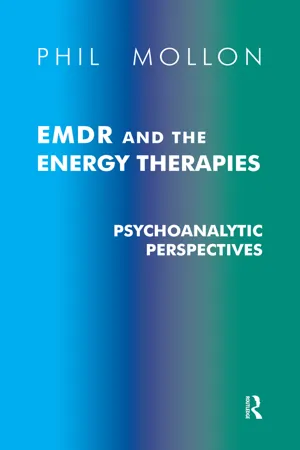
Eye Movement Desensitization and Reprocessing (EMDR), along with methods from the new field of energy psychology, such as the Emotional Freedom Techniques (EFT), enable the rapid processing and release of traumatic memories and painful emotion. In this innovative work, Phil Mollon demonstrates how the perspectives of EMDR, energy psychology, and psychoanalysis can inform and enrich each other. By summarising relevant research and providing many clinical examples, Mollon has produced a challenging and invigorating scrutiny of psychoanalysis and an expanded vision of the potential for psychosomatic healing.
Information
Chapter One
Eye movement desensitization and reprocessing (EMDR), emotional freedom techniques (EFT), and psychoanalysis
“If the clinical use of EMDR has shown clinicians anything during the past decade, it is that PTSD [post traumatic stress disorder] is an excellent benchmark for the problems that underlie most pathologies. That is, dysfunctional physiological encoding of perceptions is not limited to the obvious trauma victims but is actually a contributor to most problems that bring clients into therapy”
(Shapiro, 2002b, p. 8)
What is (EMDR)?
EMDR is a therapeutic method, incorporating eye movements and other “bilateral” or “dual attention” stimuli, and involving a free-associative exposure to anxiety-evoking or emotionally distressing memories, thoughts, and images. Clinicians who become skilled in its use tend to find that it is greatly more effective than purely verbally based forms of psychological therapy. The method has adherents from a wide range of therapeutic backgrounds, including psychoanalytic, cognitive, behavioural, systemic, and neurobiological (Shapiro, 2002a).
Shapiro’s discovery of eye movements
EMDR was originally a method of desensitization for anxiety, used primarily in relation to post traumatic stress disorder. It was developed by a clinical psychologist, Francine Shapiro, after she noticed herself experiencing some relief following the spontaneous performance of side-to-side eye movements during a period of stress. She conducted a controlled study (1989a) and a case study (1989b), which supported her hypothesis that eye movements were related to desensitization of traumatic memories. From this observation, Shapiro developed a therapeutic protocol incorporating deliberate eye movements. This strategy, of deliberately undertaking actions that are often done spontaneously, is a recurrent feature of Shapiro’s development of EMDR. In this way it builds upon the natural healing processes of the mind and brain. Eye movements turned out to be an extremely effective means of desensitization. It was taken up by Joseph Wolpe, one of the founders of behaviour therapy (Shapiro, 2002a, p. xix), and his report of therapeutic success with the method (Wolpe & Abrams, 1991) helped to attract wider interest. However, Shapiro discovered that EMDR also led to spontaneous change in the person’s dysfunctional thoughts—their trauma-related cognitions. Rather astonishingly, eye movements appeared to bring about a radical reappraisal of the trauma and the person’s view of self. As a result, Shapiro added the word “Reprocessing” to the name of the method—and thus placed it beyond the realm of a purely behavioural desensitization therapy. Later, Shapiro recognized that the method brings about a general accelerated processing of emotional information. She also discovered that the effect is not reliant upon eye movements, but can occur using any kind of bilateral stimulation, whereby the two sides of the body or sense organs are stimulated alternately—presumably thereby stimulating the two cerebral hemispheres. For these reasons she subsequently regretted the name she had given the method, preferring a term such as “adaptive information processing”, but the original has stuck. Emotion processing, facilitated by bilateral stimulation, appears to bring about changes at a neurobiological level (Levin, Lazrove, & van der Kolk, 1999; Stickgold, 2002), revealing a profound healing of psychological trauma.
Emotions are bodily events
EMDR is, in part, a bodily-based form of therapy, recognizing that emotions are indeed bodily events.1 The client is asked to notice bodily sensations—”just notice that …” being the facilitating comment. Somehow, the act of directing attention to the sensation, while continuing the eye movements or other bilateral stimulation, tends to bring about a bodily change, usually in the direction of reduction of physiological agitation. Some emotional states—such as severe anxiety or panic—are intensely physical in their manifestation, with pounding heart, sweating, shaking, breathing difficul-ties, dryness of the mouth, etc. These are notoriously difficult to alleviate through talking therapies alone. In the case of post traumatic stress disorder, psychoanalytic discourse may bring about understanding but the tendency to re-experience the disabling physiological symptoms of anxiety will remain unchanged. EMDR addresses these somatic imprints of trauma (van der Kolk, 2002).
“Mindfulness”
The EMDR procedure leads the client to an observant stance in relation to his or her mental contents and processes. He or she is advised just to notice the thoughts, feelings, and images that pass through consciousness. This is rather similar to Freud’s “fundamental rule” of free association. It is also somewhat akin to the practice of “mindfulness”, recently developed as a component of cognitive therapy (Segal, Williams, & Teasdale, 2002) and of dialectical behaviour therapy (Linehan, 1993).
Changes in self-related cognitions
The EMDR practitioner is alert to the significant thoughts that a person has developed in relation to the trauma. Those that are particularly important concern beliefs, judgements, or negative attributions about the self. As the traumatic experience is processed, these begin spontaneously to change. The shift in the “negative cognitions” can be facilitated by choosing an appropriate “positive cognition”. The latter must be a realistic, yet positively-toned, appraisal of the self. With further processing, these become increasingly accepted as valid. On first encountering EMDR I was puzzled by its apparent capacity both to remove excessive emotional reactions (desensitization) and to install positive cognitions. The underlying principle appears to be that EMDR always moves emotional processing in a positive direction.
Chains of associated traumatic memories
EMDR leads to the emergence into consciousness of associatively linked memories of trauma or emotional pain. A present-day trauma may have evoked seemingly exceptional or prolonged stress reactions because it is associatively linked with an earlier experience, perhaps from childhood. The more recent trauma cannot be fully processed until the earlier event with which it resonates has been processed. Often these chains of associated experiences will emerge spontaneously during bilateral stimulation, but they may be elicited more rapidly by a simple question, such as, “When have you felt like this before?” The sequence of processing involving tracking back through chains of linked emotional memories, paying attention to the bodily aspects of these, is greatly resonant with features of Freud’s original approach to hysteria (Breuer & Freud, 1895d).
Does EMDR involve insight?
Although EMDR was not originally designed as an insight-based form of psychotherapy, insights and understanding of psychodynamic conflicts and their origin do emerge. To a large extent these emerge spontaneously in response to bilateral stimulation, but they can be facilitated by content introduced by the therapist—the so-called “cognitive interweave”—that would include the psychoanalytic interpretation. Shapiro has noted that a frequent feature of EMDR is the progressive emergence of an adult perspective regarding a childhood trauma. The childhood feelings of powerlessness, confusion, lack of control, and sense of inadequacy, begin to give way and are replaced by the adult’s more realistic view.
Is EMDR a “stand alone” therapy?
Shapiro did not design EMDR as an entire psychological therapy. She viewed it initially as a treatment for desensitizing traumatic memories and reducing the intensity of distressing emotions in post traumatic stress disorder, and its proven effectiveness has been most clearly demonstrated in this area. However, other practitioners have explored its use with a very wide range of mental health problems. It seems to have some applicability in almost every area of psychopathology, but particularly where trauma or anxiety plays a part. Nevertheless, its effective and safe use depends upon considerable skill and prior clinical experience of the therapist. It would normally be incorporated within another more traditional therapeutic framework. While EMDR treatment of a single traumatic experience, in the absence of significant prior psychopathology, is often easy and rapid, more complex problems inevitably require longer and more complex work. A person whose childhood was characterized by repeated interpersonal traumas, rejections, and humiliations by care-givers, will have developed a personality structured around traumatic experiences. His or her adult behaviour will feature deeply embedded reactions designed to ward off the danger of re-experiencing unbearable mental pain, combined with recurrent surges of overwhelmingly negative affect on encountering circumstances that act as associative triggers to early traumatic experience. EMDR may usefully form part of the therapeutic work, but a great deal of more traditional psychotherapeutic or psychoanalytic activity will also be required.
Is EMDR an exposure therapy?
EMDR evokes psychodynamic, cognitive, physiological, and neuro-biological phenomena, bringing about change at all these levels. How does it do that and what is its crucial mechanism of change? Research has demonstrated beyond question that the changes brought about by EMDR are substantial and cannot be attributed to placebo or non-specific effects (Carlson, Chemtob, Rusnak, Hedlund, & Maraoka, 1998; Davidson & Parker, 2001; Marcus, Marquise, & Sakai, 1997; Scheck, Schaeffer, & Gillette, 1998; Van Etten & Taylor, 1998) Some have argued that EMDR might be essentially an exposure therapy, similar to other standard behavioural treatments involving exposure to anxiety-eliciting stimuli in order to bring about extinction of response through the principles of classical conditioning (e.g. Lohr, Lilienfield, Tolin, & Herbert, 1999). However, it is usually assumed that in such treatments the exposure should be prolonged, continuous and uninterrupted, without shifting from the target scene or stimulus (Foa & McNally, 1996; Lyons & Keane, 1989; Marks, Lovell, Noshirvant, Livanou, & Thrasher, 1998). All of these apparently necessary conditions are violated in EMDR’s protocol of brief, interrupted exposures, and elicitation of free-association.
Are eye movements necessary?
The role of eye movements in relation to emotion processing was known long before EMDR was developed (Antrobus, Antrobus, & Singer, 1964), and Eden (1998) reports that she has “heard of versions of this technique being passed down in various cultures for thousands of years” (p. 330). Some studies have compared a repeated exposure method with the same procedure but with the addition of eye movements and found that this component produced significant decreases in levels of distress and psycho-physiological arousal (Lohr, Tolin, & Kleinknecht, 1995, 1996; Montgomery & Ayllon, 1994). Siegel (2002) reports that when he used non-bilateral, or non-alternating sensory stimulation with patients who had previously shown positive responses to EMDR, they no longer experienced relief and relaxation. Studies of eye movements alone, without the other components of EMDR, indicate that these do have effects, such as decreasing physiological arousal and reducing the vividness of memory images (Andrade, Kavanagh, & Baddeley, 1997; Barrowcliff, MacCulloch, & Gray, 2001; Kavanaugh, Freese, Andrade, & May, 2001; Muris, Salemink, & Kindt, 2001; Sharpley, Montgomery, & Scalzo, 1996; van den Hout; Wilson, Silver, Covi, & Foster, 1996) However, other studies, involving a variety of designs and outcome measures, have produced equivocal results. Smyth and Poole (2002) argue that EMDR’s focus on the trauma image, body sensations, affect, and beliefs is essentially that of emotion processing and cognitive elements of cognitive behaviour therapy, so that EMDR minus the eye movements “can be considered a parsimonious integration of all the core elements of old and new behavioural treatments” (Smyth & Poole, 2002, p. 159). As yet, substantial research on other forms of bilateral stimulation has yet to be carried out. Maxfield (2002) has summarized the current position regarding research findings concerning EMDR, including the role of eye movements, as well as indicating areas requiring further research. Those who are familiar with EMDR in practice are unlikely to be doubtful about the contribution of bilateral stimulation; sometimes they will have encountered the “whoosh” effect, as emotion floods out when eye movements commence.
Integrating left and right brain functions
Clinicians were not slow to recognize the possible connection between the eye movements of EMDR and rapid eye movement (REM) stages of sleep (Shapiro, 2001). Both dreams and EMDR are to do with processing emotional information, and the REM stages of sleep may be concerned with moving information from storage as episodic memory in the hippocampus to more generalized knowledge, or semantic memory, in the neocortex (Stickgold, 2002). One patient described this very clearly: she reported having noticed that after some sessions of EMDR she was no longer troubled by intrusive memories of specific incidents of childhood sexual abuse, but instead was left with just a knowledge that this was what had happened in her childhood; and in this way she felt free of her past. A further hypothesis concerns the facilitation of communication between right and left hemispheres, brought about by bilateral sensation that stimulates each hemisphere alternately. The hypothesis that eye movements are associated with activation of the opposite side of the brain was supported in work presented by Kinsbourne thirty years ago (Kinsbourne, 1972, 1974). Siegel (2002) points to the finding that people tend to look to the left when retrieving an autobiographical memory (indicating activation of the right hemisphere) and that flashback traumatic memories seem to involve intense activation of the right hemisphere (and the visual cortex), while the linguistic left hemisphere is deactivated. Factual and semantic elements of memory seem to involve the left hemisphere. Thus, the hypothesis emerges that the rhythmic bilateral stimulation brings about an activation of both hemispheres and thereby facilitates integration of different elements of memory, perhaps also allowing the formation of new synaptic pathways in place of the previous perseverative patterns of traumatic arousal. The facilitation of intercourse between the emotion-processing right brain (Schore, 2003a, 2003b) and the linguistic left brain, combined with the requirement that the client provide a brief verbal report at the end of each set of bilateral stimulation, seems likely to foster an integration of emotion and language—resulting in a story that can be told, rather than an experience to be endlessly relived like a waking dream.
A further perspective is provided by the argument that traumatic stress brings about brain disorganization, particularly involving a shutting down of the integrative pathways of the corpus collosum and anterior commissure, linking the left and right hemispheres (Krebs, 1998). The result is that logic and rational thinking cannot be brought to bear on the emotional experience, and the visual image and verbal representation of an experience (processed in the left and right hippocampus respectively) may not integrate adequately. Various cognitive dysfunctions may flow from this, and, in the case of children, learning difficulties may develop. Eye movements, rather similar to those used in EMDR, have been used to correct this kind of neurological disorganization (Dennison & Dennison, 1994; Krebs, 1998).
Implications for the understanding of psychopathology
Shapiro states:
The central thesis of EMDR therapy is that the physiological storage of earlier life experiences is the key to understanding behaviour, personality, and attendant psychological phenomena. According to this view, the perceptual information of past experiences, both negative and positive, is conceptualised as stored in memory networks. Natural learning takes place as unimpeded adaptive associations are made. However, if a trauma occurs the system can become imbalanced and the experience is stored dysfunction-ally. If an experience is dysfunctionally stored, it has within it the original perceptions, including disturbing emotions, and physical sensations that were experienced at the time. [Shapiro, 2002, p. 42]
This summary statement by Shapiro emphasizes the point that experience is embodied, rooted in physiology—perhaps calling to mind Freud’s statement that the ego is “first and foremost a body ego” (1923b, p. 27). Freud’s early investigations were of the body: his first patients were those with hysterical disturbances of body function, and his theorizing concerned neurobiological processes, zones of bodily excitation, and the bodily pathways of the libido. Freud hypothesized (in “Project for a scientific psychology”, 1895) that biologically driven desire would, in the course of encounters with reality...
Table of contents
- Cover
- Half Title
- Title
- Copyright
- CONTENTS
- Dedication
- ACKNOWLEDGEMENTS
- ABOUT THE AUTHOR
- PREFACE
- CHAPTER ONE Eye movement desensitization and reprocessing (EMDR) emotional freedom techniques (EFT), and psychoanalysis
- CHAPTER TWO The waking dream: from Freud to EMDR
- CHAPTER THREE What happens during an EMDR session?
- CHAPTER FOUR The abandonment of memory, trauma, and sexuality: the excessive preoccupation with “transference”, and other problems with contemporary psychoanalysis
- CHAPTER FIVE Disintegration anxiety: the bedrock resistance to psychological change
- CHAPTER SIX EMDR treatment of a travel phobia with complex traumatic roots
- CHAPTER SEVEN Jane: EMDR and psychotherapy with a traumatized and abused woman
- CHAPTER EIGHT Brief case illustrations
- CHAPTER NINE Using EMDR and energy methods in practice
- CHAPTER TEN A comprehensive model of the psycho-somatic matrix: towards quantum energy therapy
- CHAPTER ELEVEN Research conclusions
- CHAPTER TWELVE Two therapists’ personal experiences
- REFERENCES
- APPENDIX I
- INDEX
Trusted by 375,005 students
Access to over 1.5 million titles for a fair monthly price.
Study more efficiently using our study tools.
Frequently asked questions
Yes, you can cancel anytime from the Subscription tab in your account settings on the Perlego website. Your subscription will stay active until the end of your current billing period. Learn how to cancel your subscription
No, books cannot be downloaded as external files, such as PDFs, for use outside of Perlego. However, you can download books within the Perlego app for offline reading on mobile or tablet. Learn how to download books offline
Perlego offers two plans: Essential and Complete
- Essential is ideal for learners and professionals who enjoy exploring a wide range of subjects. Access the Essential Library with 800,000+ trusted titles and best-sellers across business, personal growth, and the humanities. Includes unlimited reading time and Standard Read Aloud voice.
- Complete: Perfect for advanced learners and researchers needing full, unrestricted access. Unlock 1.5M+ books across hundreds of subjects, including academic and specialized titles. The Complete Plan also includes advanced features like Premium Read Aloud and Research Assistant.
We are an online textbook subscription service, where you can get access to an entire online library for less than the price of a single book per month. With over 1.5 million books across 990+ topics, we’ve got you covered! Learn about our mission
Look out for the read-aloud symbol on your next book to see if you can listen to it. The read-aloud tool reads text aloud for you, highlighting the text as it is being read. You can pause it, speed it up and slow it down. Learn more about Read Aloud
Yes! You can use the Perlego app on both iOS and Android devices to read anytime, anywhere — even offline. Perfect for commutes or when you’re on the go.
Please note we cannot support devices running on iOS 13 and Android 7 or earlier. Learn more about using the app
Please note we cannot support devices running on iOS 13 and Android 7 or earlier. Learn more about using the app
Yes, you can access EMDR and the Energy Therapies by Phil Mollon in PDF and/or ePUB format, as well as other popular books in Psychology & History & Theory in Psychology. We have over 1.5 million books available in our catalogue for you to explore.