A Practical Guide to Mindfulness-Based Compassionate Living: Living with Heart is a step-by-step guide for those who wish to deepen their mindfulness skills with compassion for a healthier, happier life and more fulfilling relationships. It offers a clear structure as well as ample freedom to adjust to individual needs, starting with learning to be kind to yourself and then expanding this to learn how to be kind to others.
This guide consists of eight chapters that follow the eight sessions of the mindfulness-based compassionate living training programme. To enhance the learning experience, this book features accessible transcripts and downloadable audio exercises, as well as worksheets to explore experiences during exercises. It also includes suggestions for deepening practice at the end of each session.
A Practical Guide to Mindfulness-Based Compassionate Living explores thescience of compassion in an easy-to-understand and comprehensive manner, one which will appeal to both trained professionals and clients, or anyone wishing to deepen their mindfulness practice with 'heartfulness'.
Session one: how we evolved – threat, drive and soothing systems
Life is simple, it’s just not easy.
—Unknown source
Being human is a challenge
Being human is a big mystery. It is as if we wake up one day, finding ourselves thrown into this life, realising we are a human being. We start off by not choosing to be here and then we are continually confronted by circumstances that were not our choice either. We did not choose where we came from and how evolution shaped us. We are an ongoing work in progress, trying to adapt to life’s ever-changing challenges, not knowing where we are going. Even if you were lucky enough to have a fair start and were raised in a warm and loving family, in relatively peaceful and prosperous circumstances, you will sooner or later encounter difficulties, smaller or bigger traumas, frustrations and losses. Even if you feel fine at the moment, you know you are going to grow old and die and eventually lose all that is dear to you. The world is impermanent, largely uncontrollable and practically unpredictable.
All this may not sound very cheerful but bear with us a little longer. This is exactly where compassion begins. When we realise suffering is inevitable because we live in an imperfect body, in an imperfect world, with many others who are just as imperfect as we are, compassion is not a luxury but a basic need.
Compassion: not for the faint-hearted
So, why is it so difficult to be compassionate? To explore this, reflect a while on the following question: Why would you not practise compassion towards yourself?
When we ask participants in a training course, they often tell us things like:
– I will have to invest time and energy in something that might not even help.
– It might stir up pain and sorrow.
– I do not deserve it.
– I might become selfish or lazy.
– There are so many people in this world who need it more than I do.
– I was raised to be firm with myself. I do not want to become a wimp.
– What on earth would my mates at the football club think?
There may also be arguments not to practise compassion towards others, such as:
– I am already exhausted from looking after others’ needs.
– There is so much suffering in this world. It makes me feel so helpless.
– Why should I feel compassion for people who hurt me?
– How can you be compassionate with dictators and terrorists?
We like to get these ideas and biases about compassion into the open, because they are common and fully understandable. We will not give them a lot of discussion however, because clarity about these issues will more likely come from your own experience of the practices offered in this course rather than from discussion. It may be good, however, to offer a concise definition of compassion. Having researched compassion for decades, Paul Gilbert1 defines compassion as
a sensitivity to suffering in ourselves and others (it goes both ways!); and
a commitment to try to alleviate and prevent it.
So, compassion is definitely not for the faint-hearted. It has a receptive and tender side, but also an active and powerful side. Clearly, it involves courage to face our suffering and deal with it as best as we can. On the other hand, it is not about jumping into the deep end when you cannot swim. Compassion also needs wisdom and patience. We certainly do not want you to feel pressurised to become compassionate, neither with yourself nor with others. Just try the exercises you feel ready to do and mindfully observe what happens while you do them.
It may reassure you to know that scientific evidence is piling up that compassion not only alleviates suffering, it also contributes to happiness, and, like mindfulness, you can cultivate it with practice.2 So, we would like to start with a brief exercise, which you can do any time during the day when it is safe to pause. It is derived from the Three Minute Breathing Space known from MBCT3 combined with the practice of Soothing Breathing Rhythm, which is a basic exercise in Compassion Focused Therapy.4 It consists of three phases which, of course, may be longer or shorter than one minute each.
※ BREATHING SPACE WITH KINDNESS
1Open, kind awareness
Find a comfortable position, either sitting, lying or standing … noticing what you are experiencing right now … thoughts, feelings, physical sensations, or sounds ... kindly acknowledging whatever arises, the pleasant and the unpleasant … welcoming all experiences, just as they present themselves.
2Focus on the breath and allowing a soothing breathing rhythm
Then let your attention rest on the breath, following every in- and out-breath with relaxed attention. Allow a calming, soothing breathing rhythm to emerge by gently slowing down and deepening the movements of the breath. Allow the out-breath to flow out all the way, until the direction of flow changes by itself. Let the body fill on the in-breath, until the next out-breath naturally follows. A soothing breathing rhythm may be supported by consciously sensing the ground that supports you, allowing your muscles and face to soften, your chest and heart to open like a flower towards the light, your belly to freely rise and fall … If you like, kindly placing one or both hands on the body. When the breath has found its soothing rhythm, you can just let it follow its own course. Be kind when you realise your mind has drifted off. It is what minds normally do. As soon as you notice this, mindfulness has returned. Acknowledge what is there right now. Gently guide your attention back to the breath, and if you lose the soothing rhythm, allow it to return.
3Whole body awareness and offering a kind wish
Then expand your awareness to the body as a whole, the breathing body as it sits, lies or stands here. Tune into yourself and notice what comes up when you ask yourself: ‘What could be a kind, supportive wish to myself right now? For instance, ‘May I feel safe’ … or ‘May I feel healthy … happy … at ease’. Choose the words that come from your heart and that can be taken to heart … If you like you can allow this wish to flow through you on the rhythm of the breath. For instance, ‘May I…’ on the in-breath and ‘… feel safe’ on the out-breath. Repeat the whole phrase or just one or two keywords and mindfully acknowledge what arises while you let this kind wish flow through you. A gentle smile may accompany the offering of the wish, like you would also do when you give a present to another person. Feeling the touch of one or both hands on your heart may support your receiving of the wish. Every experience, pleasant or unpleasant, can be welcomed as part of the practice. You may end this exercise when you wish and return to it whenever you find a good moment.
The human brain and its flaws
The human brain changes with experience like no other organ, enabling us to learn from and adapt to varying circumstances. Evolution scientists view the human brain as a complex survival organ with properties dating back to prehistoric times, long before humans ever existed. Evolution is such a slow process that our bodies and brains always fall behind in their ability to handle new circumstances and new situations. We are, for instance, not designed to eat fast food, sit nonstop behind computer screens, and keep up 24/7 with messages from social media and smartphones. Still, this is what many of us do every day. The design of our brains and bodies was shaped when we lived in caves as hunter gatherers, protecting ourselves from predators. Although we may live longer nowadays, we are not necessarily healthier and happier. There are gross mismatches between our nature and our culture, between the design of our brain and body and our modern lifestyles and rapidly changing world.
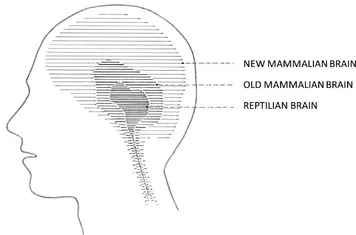
The brain is thought to have evolved into a multi-layered organ.5Figure 1.1 illustrates the main layers:
– The reptilian brain or brainstem is the oldest part, with an estimated history of 500 million years, enabling largely automatic reactions for basic survival, such as escaping threat, hunting prey, digesting food and mating.
– The old mammalian or emotional brain evolved in mammals some 200 million years ago, when living in groups became crucial for survival. It enables emotional processes important for social bonding, working out rank and status, and giving and receiving care.
– The new mammalian brain, simply new brain, or neocortex, the youngest and most changeable part, evolved ‘just’ 2 million years ago, when our ancestors ‘got smart’ and adapted to ever more complex societies. It enables imagery, reason and language, memory and planning, worry and fantasy, art and science.
Figure 1.1 The evolved brain
Taken together, the reptilian brain and emotional brain are called the old brain. The old brain reacts fast to information received from the senses. These reactions are largely instinctual and automatic, guided by what feels pleasant or unpleasant, along fast neural circuits, often referred to as the short route or low road. On the other hand, the new brain is slower. It processes sensory information and emotional responses through reflection and reasoning, which takes time. Therefore, it is called the long route or high road. To com...
Table of contents
Cover
Half Title
Title Page
Copyright Page
Contents
FOREWORD
ACKNOWLEDGEMENTS
Introduction: a warm welcome
1 Wired to survive rather than thrive: Session one: how we evolved - threat, drive and soothing systems
2 Embracing inner demons: Session two: threat and self-compassion
3 Treating habits kindly: Session three: untangling desires and patterns
4 Out of the mud into the light: Session four: embodying compassion
5 Receiving and giving with every breath: Session five: self and others - widening the circle
6 Making friends for life: Session six: growing happiness
7 Heartful mind, mindful heart: Session seven: weaving wisdom and compassion into daily life
8 Healing life: Session eight: living with heart
AUDIO DOWNLOADS
WORKSHEET DOWNLOADS
FURTHER READING
INDEX
Trusted by 375,005 students
Access to over 1.5 million titles for a fair monthly price.
Study more efficiently using our study tools.
Frequently asked questions
Yes, you can cancel anytime from the Subscription tab in your account settings on the Perlego website. Your subscription will stay active until the end of your current billing period. Learn how to cancel your subscription
No, books cannot be downloaded as external files, such as PDFs, for use outside of Perlego. However, you can download books within the Perlego app for offline reading on mobile or tablet. Learn how to download books offline
Perlego offers two plans: Essential and Complete
Essential is ideal for learners and professionals who enjoy exploring a wide range of subjects. Access the Essential Library with 800,000+ trusted titles and best-sellers across business, personal growth, and the humanities. Includes unlimited reading time and Standard Read Aloud voice.
Complete: Perfect for advanced learners and researchers needing full, unrestricted access. Unlock 1.5M+ books across hundreds of subjects, including academic and specialized titles. The Complete Plan also includes advanced features like Premium Read Aloud and Research Assistant.
Both plans are available with monthly, semester, or annual billing cycles.
We are an online textbook subscription service, where you can get access to an entire online library for less than the price of a single book per month. With over 1.5 million books across 990+ topics, we’ve got you covered! Learn about our mission
Look out for the read-aloud symbol on your next book to see if you can listen to it. The read-aloud tool reads text aloud for you, highlighting the text as it is being read. You can pause it, speed it up and slow it down. Learn more about Read Aloud
Yes! You can use the Perlego app on both iOS and Android devices to read anytime, anywhere — even offline. Perfect for commutes or when you’re on the go. Please note we cannot support devices running on iOS 13 and Android 7 or earlier. Learn more about using the app
Yes, you can access A Practical Guide to Mindfulness-Based Compassionate Living by Erik van den Brink,Frits Koster,Victoria Norton in PDF and/or ePUB format, as well as other popular books in Social Sciences & Mental Health in Psychology. We have over 1.5 million books available in our catalogue for you to explore.