eBook - ePub
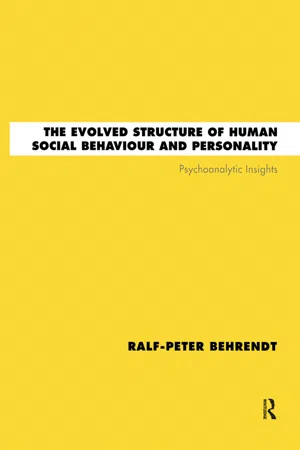
The Evolved Structure of Human Social Behaviour and Personality
Psychoanalytic Insights
- 296 pages
- English
- ePUB (mobile friendly)
- Available on iOS & Android
eBook - ePub
The Evolved Structure of Human Social Behaviour and Personality
Psychoanalytic Insights
About this book
This book, concerned with psychoanalytic conceptualisations, helps to lay the foundation for a biologically and evolutionarily sensible model of human social behaviour and personality, and also helps to bridge the gap between psychoanalysis and neuroscience.
Information
Chapter One
Introduction
Insights gained by psychoanalytic theory need to be harnessed if we want to understand the way in which interrelated processes of anxiety, aggression, avoidance, submission, and care-seeking/care-giving behaviour give rise to the complexities of interpersonal behaviour, mental illness, and social structure. Here, we are concerned with psychoanalytic conceptualisations insofar as they help us to lay the foundation for a biologically and evolutionarily sensible model of human social behaviour and personality; the aim is not to provide a critique of psychoanalytic writings.1 There is a need for a model of the mind that allows us to discern the relevance of animal data for human behaviour and that advances our understanding of functional neuroanatomy, neurophysiology, and neurochemistry as well as of the evolution of the nervous system (insofar as it subserves social behaviour and personality). The functions of hippocampus, ventral striatum, amygdala, and their interconnectivity are still poorly understood; but it has long been recognised that, whatever the nature of the involvement of these ancient structures in social behaviour, their contribution is critical. Eventual success in efforts to illuminate brain-behaviour relationships will depend on our ability to anchor the complexities of human behaviour and psychopathology in the evolution of defensive, offensive (territorial), and parental behaviours in animals. Apart from psychoanalysis, ideas that have emanated from the field of ethology, in particular, open the prospect of arriving at an internally consistent and evolutionary grounded model of the mind—a model that has the potential to explain neuroscientific data more parsimoniously. Complementing a recent review of findings from functional neuroanatomy, neurophysiology, and neurochemistry relevant to attempts to shed light into the regulation and evolution of social behaviour (Behrendt, 2011), the intention here is to take a top-down approach towards understanding how the brain could have evolved to generate social behaviour and personality (as well as their variations into psychopathology).
Psychoanalytic and ethological concepts support the notion that human social behaviour reflects an interplay of unconscious processes, namely (i) active solicitation of affiliative reward (reward that is related to maternal ministrations of care) from increasingly abstract derivatives of the primary love object (the mother); (ii) the aversiveness of social unconnectedness and rejection (related to the infant's separation distress), which promotes the acquisition of attachment behaviours; (iii) maintenance of attachment to derivatives of the object and active solicitation of social inclusion—unconsciously in order to increase the probability of receiving affiliative reward; (iv) the aversiveness of social punishment (displays of others' offensive aggression), which promotes the acquisition of socially normative behaviour; (v) expression of normative and complying behaviours (including culturally ritualised variations of innate appeasement gestures)—unconsciously in order to inhibit the innate offensive aggressiveness of other individuals who compete for attention and care provided by the derivative of the primary object (such as a group leader's attention); (vi) expression of offensive aggression (rooted in evolutionary older territorial aggression), which—when expressed in culturally sanctioned forms—serves to maintain a social position or rank associated with protection against punishment and access to affiliative reward; and (vii) anxiety relating to the unpredictable exposure to others' offensive aggression. All of these interacting processes can be shown to contribute to the constitution of the self (an experience that manifests a control mechanism of social behaviour); and all of these processes can be related to neural structures, neural systems, and global regulatory mechanisms studied in experimental animal paradigms that capture essentials of evolutionary precursors of these fundamental processes (Behrendt, 2011).
Psychoanalytic theory inspires and enriches a conceptual framework within which we can understand human social behaviour deterministically. No other species has such high needs for relatedness on a background of such profound latent insecurity (anxiety), and no other species uses such complex methods of escaping anxiety and maintaining relatedness. These are factors that critically contribute to mental illness in humans. Psychoanalytic theory has revealed the dynamics involved in various forms of personality disorder and mental illness—insights that have to merge with a conceptualisation of social behaviour in terms of interacting defensive and parental-care systems that are deeply rooted in evolutionary history. Object relations theory, which has provided many critical insights into the ontogenesis of social behaviour and the pathogenesis of mental disorders, has to be made accessible to those who are concerned with the scientific study of human behaviour but unfamiliar with psychoanalysis. Concepts such as introjection, ego splitting, or projective identification seem to be irrelevant to the challenges facing behavioural neurosciences, but they contain fundamental insights into the organisation and regulation of human social behaviour—insights that are critical for an evolutionarily founded model of personality and for our ability to map normal and pathological human behaviour onto brain anatomy and physiology.
Psychoanalysis reveals the hidden structure underlying social behaviour and psychopathology; and it is this structure that needs to be mapped onto what we know, and what we still need to find out, about the brain. It is argued that a perspective informed by psychoanalysis will help us to integrate an accumulating wealth of neurobiological data pertaining to normal behaviour and mental illness and overcome a sense of theoretical confusion. The relationship between consciousness (including the phenomenal world as it is constructed subjectively) and unconscious processes (the discussion and conceptualisation of which is dependent on, and embedded in, conscious awareness) needs to be made clearer if we are to succeed in efforts to deterministically and parsimoniously relate brain processes to social and psychopathological phenomena; and here again, psychoanalysis provides important leads. The approach taken here is not related to, or borne out of, the field surrounding cognitive neuroscience and cognitivist-analytical philosophy. It may be time to give credit to theoretical achievements of psychoanalysis and ethology and to reemphasise the role of psychoanalysis as a conceptual framework for understanding brain-behaviour relationships (especially insofar as social behaviour is concerned), rather than engage with the tradition of cognitive theory and neuroscience, which has very many advocates. It is also time to revive a deterministic framework (as opposed to the teleological one implicit in cognitivism) for psychiatry and psychology that would be more compatible with evolutionary views and recent advances, made by the natural sciences, in understanding the self-organisation of matter on progressively higher levels of complexity. Alongside the need to reground our understanding of human behaviour and psychopathology in a biologically and evolutionarily feasible framework, enshrined assumptions underlying social policy making and psychiatric "service development" may need to be challenged.
1Inconsistencies, contradictions, and sometimes contrived conceptualisations can be shown, and have been shown, in the works of Freud, Freudian pioneers (such as Bergler, Burrow, Federn, Hartmann, Schilder), or Kleinian theoreticians (such as Fairbairn and Bion), however a critical emphasis likely overshadows, or distracts us from, valuable insights gained, and important contributions made, by these writers.
Chapter Two
Deterministic metapsychology
One meets with passionate opposition from non-biologists when one attempts to explain that, in spite of its universal tendency to develop from the simple to the complex, from the probable to the improbable—in a word, from the lower to the higher—the whole of organic life is governed by the laws of chance and necessity. ... To realize that the great laws of nature admit of no exceptions seems to conflict with our consciousness of free will and with the value we attach to it as one of the supreme human possessions and an inalienable human right. (Lorenz, 1973, p. 232)
Psychoanalytic theory helps us to map psychic, psychopathological, interpersonal, and social phenomena onto a network of ancient motivational processes, which, in turn, can be subjected to experimental study in behavioural neuroscience. Phenomena on every level of organisation of matter require their own explanatory framework. Determinism is a fundamental principle that should apply to whatever level of organisation of matter we consider. Behaviourism understands behaviour, in general, deterministically. Behaviourism maintains that no agent can be held responsible for our thoughts, feelings, or actions. The notion of an agent as "an originator of action" is rejected (Zuriff, 1985). All behaviour can be traced causally to environmental and internal physical variables. In what appears to be "voluntary" behaviour, the relationship between enviromnent and overt behaviour is mediated by chains of covert behaviour (including "anticipatory goal reactions") (Zuriff, 1985). Psychoanalysis provides a framework within which psychopathological and social phenomena can be understood deterministically. In psychoanalysis, human beings are conceived as being motivated "not by rational desires to achieve ends and to fulfil purposes envisaged by the imagination as desirable, but as impelled by a drive from below whose strength is derived from forces which are both incalculable and irrational" (Joad, 1955, p. 189).
2.1 Instinct and drive
Nietzsche (1886) considered human behaviour and thought to be expressions of an interplay of natural forces that seek discharge. According to Freud (1915), "psychic energy" or "tension" that originates in instinctive needs is expressed in behaviour or psychological performance. The aim of instinctive behaviour is to eliminate an underlying instinctive need; and satisfaction of the need leads to a reduction in tension. Freud distinguished between "instinct" and "drive", suggesting that "instincts" are intermittent sources of motivation, while "drives" (such as libido and aggression) are constant sources of motivation (sources that are not dependent on environmental and physiological stimulation) (Kernberg, 1992). "Affects", in Freud's system, are discharge processes of drives; affective behaviour reduces "tension" associated with drives. Nevertheless, "instinct" and "drive" are often used synonymously in the psychoanalytic literature. McDougall (1924) saw instincts as the "prime movers of all human activity". An instinct "determines the outflow of energy into all bodily organs that take part in the instinctive activity" (p. 106). Motor mechanisms, which "require to be 'driven' by some impulse, by a stream of energy derived from some instinct", are the "channel[s] of outlet for the energy liberated from any of the instincts" (McDougall, 1924, p. 117). "Instinctive energy" is discharged and redistributed in the course of behaviour, and persists for as long as the instinct has not reached its end. Instinctive action strives towards "a change of situation of a particular kind, which alone can satisfy the impulse and allay the appetite and unrest of the organism" (p. 119). It is "the kind of change of the animal's situation which its movements, whatever they may be, tend to bring about" that defines the instinct and that "when it is achieved, brings the train of behaviour to a close" (McDougall, 1924, pp. 118-119).
From an ethological perspective, instincts are inherited, relatively fixed patterns of behaviour (and communication) that are activated by appropriate environmental and/or physiological stimulation (Lorenz, 1963). Bowlby (1973) spoke of "causal factors" that are required to either activate or terminate "systems" responsible for instinctive behaviour. "Causal factors" that activate or terminate a "behavioural system" include hormonal levels, proprioreceptive stimuli, and environmental stimuli. Behaviour that results from activation of a "behavioural system" is considered to be "instinctive" insofar as "it follows a recognizably similar pattern in almost all members of a species" (Bowlby, 1973, p. 81). Each "behavioural system" serves a "biological function" that "promotes the survival of the species" (p. 82). The "biological function" is served "when a system is active in the organism's environment of evolutionary adaptedness" (Bowlby, 1973, p. 82). The notion of "drive" is more closely related to learned appetitive (preparatory) behaviour, which prepares the organism for the release of innate instinctive patterns. Hull (1943) considered "drives" as important "intervening variables" in a behavioural input-output (stimulus-response) system. Learning, according to Hull, takes place when needs (that is, deviations from homeostasis) are satisfied and drives undergo reduction. It was a rapid drive reduction that was considered to strengthen the association between stimulus and response (Hull, 1943).
2.1.1 Cathexis
Husserl (1928) suggested that instincts derive their satisfaction from "stable experiential units". Instincts play a crucial role in constituting increasingly complex and stable objects of our perception. By giving perception its "intentional directedness", instincts institute the world as experienced by the subject. For Husserl (1928), our consciousness of the world is but an explication of our endowment with instincts (reviewed in Smith, 2003). McDougall (1924) thought that an instinct "renders possible the perception of the specific object" that acts as "the key to the instinct" (p. 106). According to Freud (1915), "psychic energy", or "tension", is "invested" into objects (cathexis). "Cathexis" refers to the investment of libidinal or aggressive instinctual energy ("psychic energy") into a representation of an object or the self. Through the object, "the instinct attains its external aim"; while "its internal aim is always a somatic modification which is experienced as satisfaction" (Freud, 1933, p. 126). Each instinct is directed onto, or invested into, its object. "Displacement" refers to the shifting of instinctual energy onto a substitute for the object into which the energy is normally invested. In Kleinian theory, libidinal energy is projected outwards to create good objects, while aggressive energy (death instinct) is projected outwards to create bad objects. Good and bad objects are thence "reintrojected" to produce an inner representational world (reviewed in Cashdan, 1988).
Toman (1960) thought that objects signify conditions under which "desires", that is, drives, can be satisfied. Not only the perception of objects, and generally the perception of conditions for the satisfaction of desires, but also the experience of ideas are automatic consequences of resurging desires. Object cathexis, as a learning process, occurs as we satisfy desires. By means of cathexis and object formation, "the Ego builds up a person's world or reality in which desires can be satisfied" (Toman, 1960, p. 32). Early in development, desires are still primitive and the efficacy of behaviour is limited. We learn to control primitive desires and to satisfy them under an ever increasing range of conditions. Behaviour becomes instrumental to the satisfaction of desires (that is, instrumental to the procurement of reward). Echoing reinforcement learning theory, Toman (1960) stated that "as cathexis of conditions under which desires can be satisfied progresses, those forms of behavior that can influence and even create any of these conditions are more and more likely to be among the cathected" (p. 64). Thus, we gain control over conditions under which we can satisfy our desires (Toman, 1960).
It looks as if a person's world and what he can do in it gets ordered into a network of "instrumentality", as he grows up. Part of a person's knowledge of the world as a whole, which includes himself, is to know in ever so many ways what leads to what. (Toman, 1960, p. 65)
Countercathexis
As Toman (1960) realised, other people "are inevitable and indispensible conditions of all satisfactions that we can ever hope to attain" (p. 60). Satisfaction of our desires depends on other people's desires, however, in satisfying their desires, others may deprive us of the satisfaction of our desires. According to Toman (1960), deprivation of a desire produces anxiety, pain, and/or aggression. A desire may become impossible to satisfy. The individual has to learn not to respond to objects or situations that have previously led to deprivation and anxiety. This form of learning—reminiscent of avoidance learning—is called countercathexis. Countercathexis "means 'learning how to avoid' or 'learning how to fear'" (p. 24). Anxiety is a cue suggesting that countercathexis has been insufficient and further countercathexis (that is, avoidance learning) is necessary. Countercathexis, which, like cathexis, is a function of the ego, prevents the recurrence of anxiety. When the individual is faced with resurging desires, he "scans" the situation for action possibilities. How the situation is perceived is determined by ail previous cathexes and countercathexes "of conditions under which the desires in question could or could not be satisfied, respectively" (p. 76). The situation is perceived—in accordance with all pertinent previous cathexes and countercathexes—"before any action can even be contemplated" (p. 73). The perceived situation "will represent a specific 'opportunity profile' in accordance with the individual's cathexes and counter-cathexes of previous situations", as well as "in accordance with the 'intensity profile' of his desires at that time" (Toman, 1960, p. 79).
2.1.2 Objects and emotions
There is no perception, no imagination, no thought which is not action, which does not contain in itself motility, i....
Table of contents
- Cover
- Half Title
- Title
- Copyright
- Contents
- ABOUT THE AUTHOR
- CHAPTER ONE Introduction
- CHAPTER TWO Deterministic metapsychology
- CHAPTER THREE Aggression
- CHAPTER FOUR Submission and harm avoidance
- CHAPTER FIVE Praise and acceptance
- CHAPTER SIX Anxiety
- CHAPTER SEVEN Object relations theory
- CHAPTER EIGHT Social structure
- CHAPTER NINE Mental disorder
- CHAPTER TEN Conclusions
- REFERENCES
- INDEX
Trusted by 375,005 students
Access to over 1.5 million titles for a fair monthly price.
Study more efficiently using our study tools.
Frequently asked questions
Yes, you can cancel anytime from the Subscription tab in your account settings on the Perlego website. Your subscription will stay active until the end of your current billing period. Learn how to cancel your subscription
No, books cannot be downloaded as external files, such as PDFs, for use outside of Perlego. However, you can download books within the Perlego app for offline reading on mobile or tablet. Learn how to download books offline
Perlego offers two plans: Essential and Complete
- Essential is ideal for learners and professionals who enjoy exploring a wide range of subjects. Access the Essential Library with 800,000+ trusted titles and best-sellers across business, personal growth, and the humanities. Includes unlimited reading time and Standard Read Aloud voice.
- Complete: Perfect for advanced learners and researchers needing full, unrestricted access. Unlock 1.5M+ books across hundreds of subjects, including academic and specialized titles. The Complete Plan also includes advanced features like Premium Read Aloud and Research Assistant.
We are an online textbook subscription service, where you can get access to an entire online library for less than the price of a single book per month. With over 1.5 million books across 990+ topics, we’ve got you covered! Learn about our mission
Look out for the read-aloud symbol on your next book to see if you can listen to it. The read-aloud tool reads text aloud for you, highlighting the text as it is being read. You can pause it, speed it up and slow it down. Learn more about Read Aloud
Yes! You can use the Perlego app on both iOS and Android devices to read anytime, anywhere — even offline. Perfect for commutes or when you’re on the go.
Please note we cannot support devices running on iOS 13 and Android 7 or earlier. Learn more about using the app
Please note we cannot support devices running on iOS 13 and Android 7 or earlier. Learn more about using the app
Yes, you can access The Evolved Structure of Human Social Behaviour and Personality by Ralf-Peter Behrendt in PDF and/or ePUB format, as well as other popular books in Psychology & Evolutionary Psychology. We have over 1.5 million books available in our catalogue for you to explore.