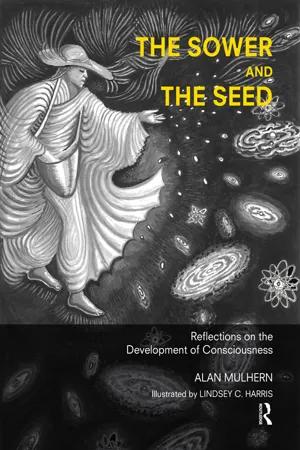
The Sower and the Seed explores the origins of consciousness from a mytho-psychological angle. The concept of immanence, a vast intelligence within the evolutionary process, provides the underlying philosophy of the book, presented as a creative-destructive spirit that manifests higher orders of complexity (such as life, intelligence, self-consciousness) and then dissolves them. The book explores the human psyche as immersed in nature and the realm of the Great Mother, showing how the themes of fertility and power, applicable to all life forms, saturate the history of humanity - most evidently in the period stretching from 40,000 years ago up to modern civilizations. The book examines in particular the transition to patriarchal religious consciousness, in which a violent separation from the world of nature took place.
- 272 pages
- English
- ePUB (mobile friendly)
- Available on iOS & Android
eBook - ePub
About this book
Information
Part I
Origins, Becoming, and Emergence
Creation myths deal with basic puzzles such as how the world began and what is mankind’s place in it. This book is no different. It attempts to combine ancient wisdom with findings of modern science, for example, those of cosmology, evolution, and palaeo-anthropology, and tells an old story of a vast intelligence that has created but also evolved the cosmos and all its life forms, including ourselves. Like all creation myths the narrative rapidly centres on mankind’s consciousness and moral dilemmas. Part I is divided into three chapters.
The first, “Origins”, contemplates the beginning of things and gazes, as it were, at the night sky, at a universe that began 13.8 billion years ago and is still expanding. Inevitably, into its starry mirror we project ourselves. Human consciousness is part of that which it observes. Part I suggests a primal intelligence or spirit that manifests itself through the material universe and ourselves.
The second, “Becoming”, outlines the creative-destructive process that, we argue, evolves all matter and life. It suggests, as Heraclitus and the Taoists did, that the universe is in constant change, and moreover there have been countless universes, for the cosmos is eternal, as the Hindus have believed for thousands of years. Life and intelligence are not accidental to this evolving creation but are at its core. In particular, human intelligence is its evolved, living spirit.
The third, “The emergence of human consciousness”, provides a summary view of human nature, strongly influenced by palaeoanthropology and the school of Jungian psychology, which has evolved from the animal world through hominids to Homo sapiens who emerged in Africa a mere 200,000 years ago. Five evolved interrelated layers of our nature are outlined: animal inheritance, emotional structure, ego consciousness, the unconscious, and a higher consciousness, held together by an intelligence, called by Jung the archetype of the Self, an expression of the integrated intelligence of the life process itself. Thus, human nature evolves from an underlying intelligence. The purpose of human consciousness, it is suggested, is to fulfil all parts of our nature and to unite with this intelligence.
Chapter One
Origins
Something formless yet complete,
Precedes both man and earth.
It lay outside of space and time,
It had no death or birth.
It did exist before this world,
All things it does bring forth.
It is the mother of all life,
The father of all thought.
Precedes both man and earth.
It lay outside of space and time,
It had no death or birth.
It did exist before this world,
All things it does bring forth.
It is the mother of all life,
The father of all thought.

Figure 2. Origins
Human beings long for harmony within themselves, a sense of meaning and belonging in the cosmos. In the mirror of the starry firmament we find the creative-destructive nature of our own psyche. We also sense, and are thrilled at, the wholeness that underlies these opposites—an integrative intelligence that permeates all things including the depths of our own nature.
Our consciousness is compelled to look at the preconscious state and divine its nature. Symbols of the totality, found in all cultures and epochs, intimate that once, before time, the universe was one; that despite the problematic entrance of consciousness there was, is, and shall be a unity to the cosmos. There is a longing and intuition that the conflicted human being, consisting of so many parts, derives from and can return to a unity outside ego consciousness.
The uroborus, (see Figure 2), the serpent with its tail in its mouth, symbolises the self-contained nature of the totality. This mythological, original state is a union of opposites, light and dark, positive and negative, the state before creation. It therefore transcends consciousness, giving an intuitive, symbolic form to a preconscious condition outside of time, space, causality, and the duality of existence in which the opposites are contained. Here, we may contemplate symbolically the beginning of things, the world, all life, and ourselves. It refers to an original self-contained circle, where all opposites are united. Plato intimates: “Therefore the demiurge made the world in the shape of a sphere, giving it the figure which of all is the most perfect and the most equal to itself.” (in Sallis, 1999).
There are various points of contact with such an image-symbol. It represents:
A primal intuition that there is an essence that encompasses all things, a foundation of every thing, a force that is omnipresent through the material and non-material world, that underlies both the human self and nature.
A pre-dawn symbol of the state of humanity before the birth of consciousness.
A symbol of existence in our mothers’ womb and infancy before the formation of ego.
A mandala symbol that occurs in spiritual, mystic, and artistic states as an image of wholeness, healing the fragmentation of the psyche. It arises spontaneously in children’s drawings, dreams, and trance states of all peoples.
A supreme goal of consciousness which is to strive to end the struggle of opposites that constitute human existence. It is an intuitive representation of transcendence.
Alpha and omega, since it prefigures the state after consciousness when all opposites are reduced back to a unity. It is therefore a symbol of death and a transpersonal wholeness transcending the state of individuals or indeed the species.
By perceiving a unity in the original state, we sense the wholeness of the cosmos, a unity of all things—including ourselves. Since human beings are from the earth, which in turn evolved from the universe, an identity should exist between mankind and the cosmos. While this must be true physically, for example that the carbon atoms of the early universe are required for the carbon in our bodies, it also hints at a psychological and spiritual dimension. Our basic identity with the cosmos is what we have always longed for instead of experiencing ourselves as baffled observers or alien intrusions.
Modern science has discovered that the immense galaxy, within which the earth is situated, consists of hundreds of billions of stars, not to mention their planets. But our galaxy is only one amongst hundreds of billions of others across the visible universe. All this is only a small fraction of the dark matter and energy that fills the apparent void. Since the expansion of the universe can be measured, its beginning can be dated to circa 13.8 billion years ago, presumably to a state of heat and compression in some sense equal to the force of the expansion to follow. Outside this original singularity, black hole, or dark perfect sphere nothing could exist—no time, space, light, energy, or matter. Within it, the totality of the cosmos, in potentia, existed. Creation and destruction, matter and spirit were as one. The possibility of all life, and even consciousness, is prefigured here in this alchemical vessel. This matrix expanded very quickly, creating, from the primal energy, the material, form, and time of the still-expanding universe. 4.5 billion years ago our solar system was formed from the gas and matter in this spatial region that contracted under the force of gravity. There is immense propulsion towards the creation of higher order in the evolution of the universe and life. Intelligence is integral to the cosmos. Yet, from beginning to end, it is pitched against destruction, chance, disorder, and death.
Human beings in early civilisations moved beyond their state of immersion in nature to consideration of origins, envisioning gods that created the world. They were at the edges of their consciousness, the most far-flung contemplation and mystical experiences that could help them formulate an idea or articulate an image of the beginnings of all things. This inevitably is a projection of consciousness as it contemplates the conditions of its pre-existence.
The consciousness of modern man has expanded to include evolution, a vast universe evolved over billions of years, a knowledge of physics, chemistry, and biology immensely more advanced than that of the ancient world. Nevertheless, our contemporary theory of origins, in some respects, closely resembles certain intuitions of early civilisations, especially the Hindu, and in a similar manner our psyche projects itself into it and then searches for the impossible—for language that describes the state beyond the opposites which underlies our consciousness. The Rig Veda, written 1500–1000 BC, comments:
Then was not non-existent nor existent:
There was no realm of air, no sky beyond it.
Death was not then, nor was there aught immortal:
No sign was there, the day’s and night’s divider.
That One Thing, breathless, breathed by its own nature:
Apart from it was nothing whatsoever …
The Gods are later than this world’s production.
Who knows then whence it first came into being?
He, the first origin of this creation,
whether he formed it all or did not form it,
Whose eye controls this world in highest heaven,
He verily knows it, or perhaps he knows not.
There was no realm of air, no sky beyond it.
Death was not then, nor was there aught immortal:
No sign was there, the day’s and night’s divider.
That One Thing, breathless, breathed by its own nature:
Apart from it was nothing whatsoever …
The Gods are later than this world’s production.
Who knows then whence it first came into being?
He, the first origin of this creation,
whether he formed it all or did not form it,
Whose eye controls this world in highest heaven,
He verily knows it, or perhaps he knows not.
Rig Veda, Hymn 129: Creation (Griffith, 1896/2009)—see Appendix Three for a more extended text and author’s comments.
The astronomer’s lens, peering out to the creation of our universe, is human consciousness, like a mirror to its deep centre, forever examining its origins, birth, and even the preconditions of its existence. But ultimate knowledge forever vanishes beyond our scope. In the moment of dating the universe we realise there must be others preceding it; that the cosmos must be infinite and eternal; that there have been endless cycles of creation and dissolution. The intelligence of mankind gazes at the universe only to realise that we are an expression of this infinite intelligence itself. That which we have called God or Brahman we then name cosmos; that which we named cosmos we now call Self. Consciousness and the universe are inextricably linked. One searches for the creator, forever finding oneself.
Chapter Two
Becoming
Creation acts through power divine,
Through destruction life is born.
God rests at centre of the wheel,
Serpent makes the world of form.
Our mother life, our mother death,
All becoming, source of all.
We, thy children, human race,
Seek your wisdom, hear your call.
Through destruction life is born.
God rests at centre of the wheel,
Serpent makes the world of form.
Our mother life, our mother death,
All becoming, source of all.
We, thy children, human race,
Seek your wisdom, hear your call.

Figure 3. Becoming
The cosmos undergoes eternal cycles of creation and dissolution. The world and all its life forms have evolved, but its intelligence or spirit is coexistent with matter and is immanent in this evolution.
The original oneness is beyond all existence but in its unfolding contains the matter, energy, intelligence, and spirit of the whole universe. The original cosmic singularity precedes time, causality, mass, and space and yet is the origin and determiner of all things, the potentiator of our universe, which from the beginning to end of its cycle is an evolving drama of creation and destruction. The impulsion towards higher order, seeded into the cosmos, produces life forms throughout the universe that evolve ever greater degrees of intelligence. These, in turn, are subject to dissolution.
The notion of the evolution of the universe, the earth, and life is now undeniable but it is by no means the whole story. In its current state the theory of evolution neglects the inherent intelligence or spirit, coexistent with matter, that lies in the cosmos and in life. Thus, spirit is immanent within matter and evolution. The vehicle of this becoming is an eternal cycle of creative destruction through which higher degrees of intelligence evolve and disintegrate. This view contrasts with the narrow materialist belief that intelligence, life, and consciousness are incidental rather than inherent to the cosmos. It also contrasts with the religious belief in a transcendent god who, as creator of the universe, is somehow outside of creation. The view of immanence expressed here is that intelligence or spirit is within creation and is manifested in its development. Evolving intelligence is its expression.
It was commonly believed, up to the recent past, that the earth was the centre of the solar and stellar system, that there was constancy in the heavens and earth, and that this staggering complexity resulted as an act of creation by God. With no idea of the age of the earth there were also serious propositions in the seventeenth century that it was created in 4004 BC (Bishop Usher, 1650). Similarly, in many religions humans believed they were unique and different, the chosen of God; that their reason and consciousness, the gift of a creator, distinguished them from all creatures, making them masters. Just as the earth was centre of the universe, man was the raison d’être of creation. The paradigm change in our cosmology and psychology has been revolutionary.
In the twentieth century ego intelligence was displaced from its supposed central position and revolved around the unconscious. The story of evolution is now established and ego intelligence, moreover, is no longer the exclusive feature of Homo sapiens but actually preceded him in the homo lineage by Homo neanderthalis and Homo erectus among others (see Appendix One). Primate intelligence is also far more advanced than previously thought. Indeed self-consciousness, the previously supposed exclusive property of humans, exists in certain primates and, probably, other animals. The conclusion is inescapable. Advanced intelligence and even self-consciousness developed in evolution in various animals and hominids; Homo sapiens is its inheritor. Intelligence is not exclusive to any species, even our own. It is, rather, inherent within evolution itself.
While the precursors of our consciousness lie in our animal and hominid evolutionary past its origins are in the intelligence of life itself and beyond that in the intelligence of the cosmos. This viewpoint requires a paradigm shift away from a dead and mechanistic universe in which the emergence of life and consciousness are accidents. The alternative vision is that the cosmos is intelligence or spirit itself and has an ordering principle or Logos (see Glossary). Matter is no longer primary but coexistent with spirit. Intelligence precedes Homo sapiens, primates, and, indeed, all life forms. It is woven into the cosmos and the emergence of life and consciousness are the expression of it as, indeed, is its evolution into higher forms. The following distinctions are therefore made.
The material world is “manifested” and arises from a deeper source than is apparent to our immediate reason, consciousness, or senses. Such a proposition is not simply mysticism (although it certainly includes that) but is also a coherent interpretation of relativity and quantum theory where the world of matter, space, time, and causation, typical of the world view of classical physics, dissolves and is replaced by an immensely dynamic and powerful, interconnected field of inter-relationships (see Bohm, 1980, and Capra, 1975).
Intelligence lies in the cosmos, in nature and in all life forms. It pre-exists consciousness, which is a later development within life forms. Just as higher degrees of order and intelligence evolved on earth, so they evolve throughout the universe.
As the Hindus intuited thousands of years ago (Rig Veda, Bhagavata Purana, Griffith, 1896/2009), there are countless universes following one another. Therefore, on the macro scale, one may think of time as cyclical, with intelligence and evolution in a perpetual cycle of creative destruction. Linear evolution, leading to one absolute and final goal, does not fit with the circular viewpoint. Intelligence does not evolve de novum, fresh and original out of evolution. Rather, it is built into the cosmos eternally, has repeatedly arisen in previous universes and is teeming throughout the current one. Intelligence is neither an end point of evolution, or external to life, nor the gift of a personal God, or accidental—it is part of the fabric of nature and evolves into ever higher degrees of order.
Consciousness is concentrated intelligence in the brains of creatures promoting their survival and evolving and manifesting from the inherent intelligence within nature.
Self-awareness is the further development of consciousness particularly characterising human beings, though it began to evolve in other species in the homo lineage, as well as existing to a limited though definite extent in certain animals, especially primates. It is the capacity of intelligence to examine itself.
Higher consciousness is transcendent awareness and symbolic communication over and above survival and ego needs.
The Self is an inner directing function of order, growth, and individuation in...
Table of contents
- Cover
- Half Title
- Title
- Copyright
- CONTENTS
- ACKNOWLEDGEMENTS
- ABOUT THE AUTHOR
- PREFACE
- COMMENTS BY THE ILLUSTRATOR
- INTRODUCTION
- PART I: ORIGINS, BECOMING, AND EMERGENCE
- PART II: CONSCIOUSNESS EMERGING FROM NATURE
- PART III: SEPARATION: THE RISE AND FALL OF CONSCIOUSNESS
- PART IV: THE FALLEN AND THE HIGHER STATES OF HUMANITY
- PART V: THE ENLIGHTENMENT AND CAPITALIST PROJECT
- PART VI: THE QUEST
- APPENDIX ONE
- APPENDIX TWO
- APPENDIX THREE
- APPENDIX FOUR
- GLOSSARY
- REFERENCES
- INDEX
Trusted by 375,005 students
Access to over 1.5 million titles for a fair monthly price.
Study more efficiently using our study tools.
Frequently asked questions
Yes, you can cancel anytime from the Subscription tab in your account settings on the Perlego website. Your subscription will stay active until the end of your current billing period. Learn how to cancel your subscription
No, books cannot be downloaded as external files, such as PDFs, for use outside of Perlego. However, you can download books within the Perlego app for offline reading on mobile or tablet. Learn how to download books offline
Perlego offers two plans: Essential and Complete
- Essential is ideal for learners and professionals who enjoy exploring a wide range of subjects. Access the Essential Library with 800,000+ trusted titles and best-sellers across business, personal growth, and the humanities. Includes unlimited reading time and Standard Read Aloud voice.
- Complete: Perfect for advanced learners and researchers needing full, unrestricted access. Unlock 1.5M+ books across hundreds of subjects, including academic and specialized titles. The Complete Plan also includes advanced features like Premium Read Aloud and Research Assistant.
We are an online textbook subscription service, where you can get access to an entire online library for less than the price of a single book per month. With over 1.5 million books across 990+ topics, we’ve got you covered! Learn about our mission
Look out for the read-aloud symbol on your next book to see if you can listen to it. The read-aloud tool reads text aloud for you, highlighting the text as it is being read. You can pause it, speed it up and slow it down. Learn more about Read Aloud
Yes! You can use the Perlego app on both iOS and Android devices to read anytime, anywhere — even offline. Perfect for commutes or when you’re on the go.
Please note we cannot support devices running on iOS 13 and Android 7 or earlier. Learn more about using the app
Please note we cannot support devices running on iOS 13 and Android 7 or earlier. Learn more about using the app
Yes, you can access The Sower and the Seed by Alan Mulhern in PDF and/or ePUB format, as well as other popular books in Theology & Religion & Mind & Body in Philosophy. We have over 1.5 million books available in our catalogue for you to explore.