- 405 pages
- English
- ePUB (mobile friendly)
- Available on iOS & Android
eBook - ePub
About this book
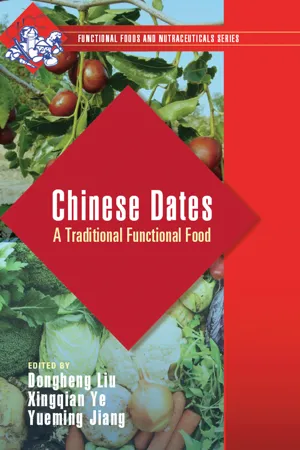
Chinese Dates: A Traditional Functional Food delivers unique information on Chinese dates (jujubes) as typical ethical foods and traditional health-promoting foods. It conveys a better understanding of Asian food cultures and provides historical information in regard to traditional functional foods and their dietary applications. It discusses the h
Information
Topic
MedicineSubtopic
Nutrition, Dietics & BariatricsSection II
Chemical and Biochemical Properties, and Health Benefits of Chinese Dates (Jujubes)
3
Bioactive Compounds from Ziziphus jujuba and Allied Species
Mendel Friedman
CONTENTS
3.1 Introduction
3.2 Bioactive Jujube Fruit, Seed, Leaf, and Bark Compounds
3.2.1 Amino Acids and Dietary Protein
3.2.2 Cyclopeptide Alkaloids
3.2.3 Fatty Acids
3.2.4 Indoleacetic Acid Derivatives
3.2.5 Nucleosides, Nucleotides, and Nucleobases
3.2.6 Phenolic Compounds and Flavonoids
3.2.7 Polysaccharides
3.2.8 Saponins
3.2.9 Tannins
3.2.10 Toxins
3.2.11 Triterpenic Acid
3.2.12 Volatile Compounds
3.3 Effect of Preharvest Factors on Composition
3.3.1 Soil Composition
3.3.2 Water Irrigation
3.3.3 Ripening Stage
3.3.4 Variability among Cultivars
3.3.5 Jujube Genome
3.4 Effect of Postharvest Treatments on Jujube Fruit Composition
3.5 Conclusion
Acknowledgment
References
3.1 Introduction
The jujube fruit is widely cultivated from China to southwest Europe, India, and the Middle East. Fresh, processed, and dried jujube fruit is used as a food, mostly in fresh form or as dried dates, and confectionary recipes. For example, Tunisian people have been using different parts of the Ziziphus jujuba plant, including leaves, pulp, and seeds (Elaloui et al. 2015), to prepare jujube teas. In the United States, jujube products are available in health food stores. In addition to its value as a nutritional food (Nyanga et al. 2013), jujubes have been used in many traditional medicines and have been shown to exhibit numerous health-promoting effects. Jujubes may therefore be considered as a so-called functional food, having nutritional as well as medicinal uses.
Jujube fruit and seed extracts and pure compounds are reported to exhibit numerous beneficial, health-promoting effects; most studies to date, however, have been in rodents and cells. These reported beneficial properties include antiadipogenic (Kubota et al. 2009), antidiabetic (Michel et al. 2011), antiepileptic (Pahuja et al. 2011), anti-inflammatory (Yu et al. 2012), antimicrobial (Daneshmand et al. 2013a, b), antifungal (Ansari et al. 2013), antioxidant (Brito et al. 2015; Li et al. 2014), antitermite (Ahmad et al. 2011), antiviral (Yen et al. 2014), antitumor and antipain (Kaleem et al. 2013), antinephrotoxic (Awad et al. 2014), antitumor (Choi et al. 2012; Plastina et al. 2012; Xu et al. 2014), anticholinesterase (Zare-Zardini et al. 2013), neuroprotective (Yoo et al. 2010), sedative (San et al. 2013; Dey and Dey 2013), and improved learning (Zhang et al. 2014b) effects.
The extensive range of these and possibly other health-promoting effects stimulated worldwide interest in isolating and characterizing the structures of pure organic compounds in jujube fruit and seeds that may be responsible for the beneficial bioactivities. The major objective of this chemistry-oriented chapter is to outline the various categories of jujube compounds that may be responsible for the observed bioactivities of jujube products (the compounds are described in alphabetical order). The possible impacts of preharvest and postharvest factors that may influence the jujube composition are also mentioned. Figures 3.1, 3.4 illustrate the characterized structures of several classes of bioactive jujube compounds.
3.2 Bioactive Jujube Fruit, Seed, Leaf, and Bark Compounds
The bioactive compounds synthesized by different parts of the jujube plant including fruit, seeds, leaves, and bark do not seem, with some exceptions, to be different. Beneficial health-promoting effects following consumption of different plant parts would also be expected to differ. To better understand the complexity of overlapping jujube bioactivities, here we briefly outline in alphabetical order the different categories of nutritional and bioactive compounds.
3.2.1 Amino Acids and Dietary Protein
Free amino acids in plant foods exert a dual role in the diet. They represent a source of nitrogen and of nutritionally essential amino acids such as Lys, Met, and Thr. They can also participate in reactions to form desirable and undesirable browning products. One browning product, acrylamide, formed from free Asn and glucose during food processing is potentially toxic. One way to mitigate the formation of acrylamide during processing of plant foods is to reduce the biosynthesis of asparagine. The total and the relative amount of free Asn affects the amount of acrylamide formed. The reducing amino acid Cys can lower formation of acrylamide (Rayburn and Friedman 2010).
We previously described the distribution of free amino acids in three Korean jujube fruits and two jujube seeds listed in the order of elution positions (Choi et al. 2011, 2012). In g/100 g dry weight, total free amino acid content measured by ion-exchange chromatography ranged from 5.2 to 9...
Table of contents
- Cover
- Half Title
- Series Page
- Title Page
- Copyright Page
- Table of Contents
- Series Preface
- Preface
- Acknowledgments
- Editors
- Contributors
- Section I Origin, Distribution, and Growing Conditions of Chinese Dates (Jujubes)
- Section II Chemical and Biochemical Properties, and Health Benefits of Chinese Dates (Jujubes)
- Section III Chinese Dates (Jujubes) Products and Postharvest Technology
- Section IV Chinese Dates (Jujubes) Industry in Different Countries
- Index
Trusted by 375,005 students
Access to over 1.5 million titles for a fair monthly price.
Study more efficiently using our study tools.
Frequently asked questions
Yes, you can cancel anytime from the Subscription tab in your account settings on the Perlego website. Your subscription will stay active until the end of your current billing period. Learn how to cancel your subscription
No, books cannot be downloaded as external files, such as PDFs, for use outside of Perlego. However, you can download books within the Perlego app for offline reading on mobile or tablet. Learn how to download books offline
Perlego offers two plans: Essential and Complete
- Essential is ideal for learners and professionals who enjoy exploring a wide range of subjects. Access the Essential Library with 800,000+ trusted titles and best-sellers across business, personal growth, and the humanities. Includes unlimited reading time and Standard Read Aloud voice.
- Complete: Perfect for advanced learners and researchers needing full, unrestricted access. Unlock 1.5M+ books across hundreds of subjects, including academic and specialized titles. The Complete Plan also includes advanced features like Premium Read Aloud and Research Assistant.
We are an online textbook subscription service, where you can get access to an entire online library for less than the price of a single book per month. With over 1.5 million books across 990+ topics, we’ve got you covered! Learn about our mission
Look out for the read-aloud symbol on your next book to see if you can listen to it. The read-aloud tool reads text aloud for you, highlighting the text as it is being read. You can pause it, speed it up and slow it down. Learn more about Read Aloud
Yes! You can use the Perlego app on both iOS and Android devices to read anytime, anywhere — even offline. Perfect for commutes or when you’re on the go.
Please note we cannot support devices running on iOS 13 and Android 7 or earlier. Learn more about using the app
Please note we cannot support devices running on iOS 13 and Android 7 or earlier. Learn more about using the app
Yes, you can access Chinese Dates by Dongheng Liu,Xingqian Ye,Yueming Jiang in PDF and/or ePUB format, as well as other popular books in Medicine & Nutrition, Dietics & Bariatrics. We have over 1.5 million books available in our catalogue for you to explore.