- 208 pages
- English
- ePUB (mobile friendly)
- Available on iOS & Android
eBook - ePub
How Money Talks
About this book
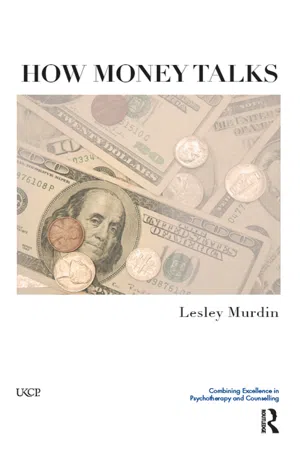
Money speaks in everyday life and in literature of our greed and our generosity, our pride and our humiliation and as it passes among us it shows our creativity and our ability to co-operate even while it can also lead us to fight to the death. This book is for psychological therapists and for the general reader interested in human nature. Money has mattered since the first human attempts to symbolise value and enable people to wait for the return on their own labours. Since the financial crisis of 2008 its impact at a macro as well as a micro level is inescapable. It has become a means of exchange, much like language and has opened up social mobility to factors other than birth. This book looks at the origin of money and its history but most of all, what attitudes to money tell us about the way we connect to each other.
Information
PART I
MONEY TALKS
CHAPTER ONE
I’m a mess
Alice got off the bus and thought “This is it. This is what I have decided to do and it must be all right.” She looked at her watch, anxious to be on time but not sure exactly where the house was. She thought she would need about five minutes to walk from the bus stop. She really wanted to get there on time because her friend Rosalie who was already seeing a psychotherapist had told her that that they are very hot on times so that you have to arrive dead on time and you will be asked to leave after exactly fifty minutes. Alice wanted to look like someone who knew how things were done.
The bus had dropped her in a busy main road with narrow footpaths and 1950s houses, beginning to look a little seedy although they all had gardens. She noticed that the busy road didn’t stop people from having at least one car each with the result that about half the gardens had been transformed into hard standing. “Hard standing,” she thought. “Yes, standing is hard. I wonder whether she will expect me to lie down.”
The map of the area was in Alice’s mind, although she had forgotten to bring the map page that she had printed and then left on the printer. She often did that. Maybe the therapist would say whether she was getting early-onset Alzheimer’s, whatever that was. She crossed the road and walked along two blocks, looking for the address that she had been given. It was a bit further than she had expected but she hadn’t really begun to panic when she found the road with the right name. She hoped that the house numbers would be clear because she was a bit short sighted and she worried about having to go up to people’s front doors to see who they were. Well, not who they were but what their number was. Some people obviously think it matters to identify themselves with lovely big, clear numbers that you can easily see and others don’t care whether you can see them or not. The road wound on down a hill, now with trees, making it into an avenue. “This is better,” she thought, although the houses were still semi-detached and all still identical. She found two numbers so that she could count her way to the right house. She walked more and more slowly but got there just the same.
In the driveway was a big, dusty Volvo estate car. Alice squeezed past it to the front door wondering whether she was being watched from the window. It was two minutes to the hour, so she thought that was good enough. A small woman with grey hair in an untidy short cut answered the bell quickly. “She was watching me,” thought Alice. There wasn’t much time to think more about that, as the woman smiled warmly and said, “You must be Alice, come in. I’m Margaret.” That worried Alice. Rosalie had told her that formality was important to psychoanalytic psychotherapists. She ought to be calling herself “Dr Andrews.”
Alice followed down a passage right to the back of the house, past several firmly closed doors. She wondered who might be in these rooms and whether one of the doors might open. That led to the question of whether Margaret might have a family. She looked about fifty so probably no young children but you never know. Was she married? Alice wondered about that briefly and thought she would ask her. She was shown into a small room with two chairs and a divan. Margaret gestured towards the further chair. That was a relief. She was not expected to lie down. Besides, other people had been lying there. It might even still be warm. For the moment Alice was glad that someone else was taking charge. Margaret sat down in the other chair and smiled. “What brings you here?” she asked. Alice gave another sigh of relief. She had thought she would sit there in silence while Margaret waited for her to say something. At least she seemed to want to hear what Alice had to say.
”I am in a mess,” Alice said and explained.
I am losing everything. My husband has been diagnosed with prostate cancer. I had a really good job and I am losing it. That’s not all of course but I’ll tell you about the job first. I have run a small charity here in Bradford called Mental Freedom and I made a mistake and the mistake that I made came back to haunt me. I’ll tell you about how it started. I suppose it goes back to the days when I had my children and come to think of it, maybe that also has its roots in my own childhood. Well of course it must. How could my mistakes as a parent not have some connection with the mistakes as well as the good things that I experienced with my own parents?
I have an Oxbridge degree and I felt that I ought to have an interesting career. Because I married a distinguished scientist, my career to some extent had to follow along behind him. That makes me feel terrible now because …
Alice stopped because she did not want to cry but she could feel that she was going to. Margaret said nothing; she sat quite still and gave just the slightest nod which clearly said that she was listening and waiting to hear what Alice wanted to say.
Alice turned her head to look out of the window and focussed on what she could see of the small garden. She likes flowers, Alice thought. But how can she let it be so wild. The lawn appeared to have been cut but round the edges there were wild profusions of weeds and flowers. Nothing seemed to have been excluded. It made her think of her garden at home. “I like your garden,” she said, “even though it reminds me of mine.”
Our garden has become a scene for argument and in a way it sums up how we have wasted opportunities with each other. I can see Oliver, standing in the kitchen doorway. I was outside trying to weed the bed which I might use to plant vegetables one day. At the moment, the best I hope for is to keep the weeds at bay enough that it doesn’t return completely to its natural, unregenerate state. I can impose my will on it a little. Besides I like the totally undemanding feeling of kneeling there on the ground with nothing more worrying to decide than whether this green stem belongs to a weed or a potential flower.
Perhaps I had a romantic delusion that I can be like Mary in The Secret Garden and that Oliver would come out and join me like the poor crippled Colin and be calmed by the regenerative power of the garden. A robin often comes and sits nearby watching me, his black beady eye measuring just how much I am turning over the soil. “Well, all right” I tell him, “I’m not the world’s most expert gardener but I am doing my best.” He shakes his head just a little: “Not good enough I’m afraid.” Then I turn to Oliver who does tell me what he is thinking: “What on earth are you doing? You need to work systematically from one end to the other. Don’t just dot about like that taking things out wherever you feel like it.”
”Come and help me then if you know so much about it.”
”You know perfectly well that I haven’t the time. I have to finish an article for the publishers by the end of the week.”
Before I had time to list any of the things that I also had to do by the end of the week, he had turned and retreated into the darkness of his study. That sort of exchange took its toll. I would feel furious and storm around making dinner in a way which was to be read as a complex message of protest and injured martyrdom. That was the way it usually went. Then came the never-to–be-forgotten day.
He was leaning against the door jamb of the kitchen door as usual, but instead of commenting on my gardening ineptitude, he just said “Come into the study later; I need to talk to you.” I was surprised but noting the tone of his voice, which had a quality in it that I couldn’t quite place, I realised that this was not the usual combative situation. Something else was going on. I pulled out a few more random weeds in a desultory, disorganised way, feeling very guilty that I still had not been organised about working from one end to the other. Oliver was right really. It would be much better to use my energy in a focussed way. Maybe I did the same at work. Perhaps that was what was going wrong there. I sat back on my heels wiping hair out of my face with a muddy glove. The robin flew off in disgust. If I wasn’t going to work, and expose grubs and beetles, he wasn’t going to wait around.
My mind started to process my anxiety about Oliver. Was he going to tell me that he had found someone better and would leave me? Had he found someone really organised who would at least pay attention to what he said? I knew I was stubborn and determined. One of the Trustees had said in a meeting in front of all the others: “Don’t worry about her. She’s as tough as old boots.” I thought at the time he just wanted to pave the way for making more demands on me to produce even more money out of nowhere, but I have thought about it often since and I realise now that perhaps I am stronger than I had realised before. How much strength would I need?
I ran over in my mind a whole set of terrible scenarios. Oliver was working in the university as a lecturer in biological science where, although he didn’t make a great deal of money, his job was secure enough. I could not imagine that there was a serious problem with his job. So that left him. And me. They say that your whole life runs before you when you are drowning. I think I had a partial version of one of those moments just then.
I thought about my job. I had been unhappier than I had ever been before, just when I should have been most content. I had managed to achieve a high status job. I was appointed Chief Executive of Mental Freedom doing work that I passionately supported. What we did was support prisoners by training and managing a team of counsellors who would go in to support the staff in the prisons across Yorkshire and Lancashire. We also worked with probation officers and provided counsellors who would work with exoffenders. The work was difficult and demanding and we had to be very careful of our mostly young staff. I had enjoyed the role that I had in the training initially, after teaching in various schools. I realised that teaching adults was still challenging but in a totally different way from teaching adolescents in schools. When I was teaching children, I had needed presence. Presence I didn’t have, or at least not enough of the right sort. I was short and quietly spoken and neither of those are good qualities in a class of 35 noisy adolescents. The challenge with our adult counselling students was mostly about the actual knowledge and theory that I was presenting. They needed to know about the prison population and about the techniques that had been found to help them. I could cope with that. In fact I enjoyed it.
I was now regretting that my drive to be promoted that had led me to agree to apply for the post of Chief Executive when our much-respected boss left. As a charity all our doings are subject to the authority of the Board of Trustees. The BOT, as we called them, was chaired at the time by a retired banker who had a very good sense of both the need for the work that we do and how to keep a charity’s head above water by making good friends and useful contacts in the world of business. I respected him and I think he liked me. In the interview he was generous to me and he must have given me the benefit of any doubt because there were some very serious candidates as I later discovered. One was a Vicar and a wonderful talker. Another was a colleague, Mike, whom I had known when he was on our staff. He had left and gone to work for another charity but he wanted now to come back and I knew that he was a most accomplished talker.
As an internal candidate, I knew that I had advantages and disadvantages. The Trustees knew my record and at that stage I was proud of it. I had good feedback from all my teaching groups and even though there was sometimes an odd one who would find my style irritating or my attitude to minority groups not gung-ho enough, mostly they seemed to find me open and encouraging as I wanted to be. They appreciated the encouraging part and I loved doing the encouraging. I suppose I appropriated their achievements so that they became partly my achievements. Probably all teachers are doing that if they are honest. Is that fair? I am not sure.
Margaret shifted on her chair slightly but said nothing. Alice decided to go on:
On the other hand there were disadvantages to being on the inside. They knew that I had my limitations. I had only just learned to read accounts and had never had occasion to use Excel spread sheets so my knowledge was limited to setting up a sum but I certainly could not do anything much more complex than that. Other candidates could say “yes, yes, yes” when asked what they could do. Unless they were tested, no-one would know how true it was. We weren’t tested. But they gave me the job anyway and my troubles began.
I thought I was invincible at that moment. I had the approval of the whole BOT in the sense that they all had to agree on my appointment. Marcus, the Chairman, told me that the whole group was delighted with my appointment but I later found out that he was being a little economical with the truth. At that stage though,I thought everything was fine. What I need to say now is what happened next. That is difficult because I don’t even want to think about it myself, let alone tell anyone else.
I have to accept that to some extent I brought it on myself. The charity was not bringing in enough money. That was always the bottom line. We had supporters who donated small amounts, often a one-off small cheque when they felt they could manage to peel off a layer of their financial security and give it away. Most of them are over sixty five and are terrified that they will not have enough to get by when they are really old. Some of them have set up small direct debits. That’s better but it doesn’t bring in enough to keep us going. So what could I do? I did the only thing that seemed possible: I appointed a fund raiser. She was a delightful woman, with excellent credentials. She told us that she had a young baby but I was very careful not to discriminate against anyone for such reasons and I resolutely put it on one side and offered her the job based on her experience for other large and successful charities. That turned out to be the problem. Lana came in for her first morning about thirty minutes late. “So sorry,” she breezed, “child care not yet properly in place. Be fine tomorrow.” I didn’t say anything but my heart sank. I took her to the desk that we had organised for her in a small but well equipped office. “It is a bit small,” she said disapprovingly. “I don’t know whether there’ll be room for all my files. I will have a lot of files. Where are the current donor files?”
”Well,” I said, “all the supporters are supposed to be on line but that is something we need you to check. Are you happy with the software? We did mention it at the interview.”
”Yes, but I am a bit rusty. We’ll take a look and see what I can do. I’ll just sort out my things and maybe we can have a talk after that”
I was so taken aback at the general breeziness that I merely said “Yes. Fine. I’ll expect you in my room at 10 o’clock.”
”It would be much more useful if you were to come back here. Then we can sort out what the software will or will not do. That will be much quicker.” I was starting to find this approach irritating: “There is more to consider than the donor data-base but I will come and make sure that you can use its full potential.”
This conversation and the outcome in which I did exactly what Lana wanted me to and didn’t complain about her lateness set the tone for the relationship that we had for the next six months. I somehow had the impression that she might just walk out if we didn’t measure up to the standards of National Chest Foundation which she had worked for most recently. I needed results fast and I needed a successful fund raiser to save us from imminent disaster. Thinking she might leave was ridiculous and I don’t know what made me worry about it. My problem turned out to be very different. That very first morning I just introduced Lana to several key staff. I took her to meet the receptionists first and then the administrators of the training group. They were all happy to know that our financial problems would soon be at an end and, they hoped, their salaries would be increased. I have to admit that none of us was earning very much. I was keen that the differential between my salary and the senior staff salaries should not be too great and had kept it at a relatively small number. We couldn’t afford any more but I had said that increasing staff salaries was a high priority.
June Halliday, the manager of all the office staff took to Lana straight away. June had no children but she was very keen to have a baby soon and she got into a deep conversation with Lana at the first coffee break.
At lunchtime Lana knocked on my half open door “Come in,” I said without enthusiasm. Lana breezed in.
”I’ve enjoyed meeting some of the staff this morning but now I would like to meet my administrator.” I looked at her in surprise. “We told you that we are a small charity with very few staff. I can give you a few hours a week of help when you need something like envelopes stuffing or leaflets printing.”
”You expect me to raise substantial amounts of money with no help!”
”No,” I said shortly, “with a few hours a week.”
”That will make it really difficult.”
I thought we had better get down to what we expected from her rather than following this golden thread of what she expected us to do for her.
I soon discovered that the fund-raising that she had done for NCF could not be replicated for us. “First,” she said, “I need to review your high worth donors.”
”What,” I asked “is a high worth donor? We just have donors.”
”Oh come on. You must have some old dears who can fork out for you. I need to know how many you have so that we can sort out an event that will appeal to them.”
”Yes,” I agreed, “we want an event straight away. I believe that you made a lot of money from events when you were at NCF.”
”You can’t have an event straight away. You have to plan at least a year ahead and that’s after I find out who we can invite.”
”I thought you would know who to invite. Or find them.”
”That’s not my job. I will schmooze them for you but this is not health or children or donkeys, is it? Your donors will be very different from mine at ...
Table of contents
- Cover
- Half Title
- Title Page
- Copyright Page
- Dedication
- Table of Contents
- ACKNOWLEDGEMENTS
- ABOUT THE AUTHOR
- INTRODUCTION
- PART I: MONEY TALKS
- PART II: WHAT MONEY MEANS
- PART III: WHAT MONEY SAYS TO THERAPISTS
- CONCLUSIONS
- REFERENCES
- INDEX
Trusted by 375,005 students
Access to over 1.5 million titles for a fair monthly price.
Study more efficiently using our study tools.
Frequently asked questions
Yes, you can cancel anytime from the Subscription tab in your account settings on the Perlego website. Your subscription will stay active until the end of your current billing period. Learn how to cancel your subscription
No, books cannot be downloaded as external files, such as PDFs, for use outside of Perlego. However, you can download books within the Perlego app for offline reading on mobile or tablet. Learn how to download books offline
Perlego offers two plans: Essential and Complete
- Essential is ideal for learners and professionals who enjoy exploring a wide range of subjects. Access the Essential Library with 800,000+ trusted titles and best-sellers across business, personal growth, and the humanities. Includes unlimited reading time and Standard Read Aloud voice.
- Complete: Perfect for advanced learners and researchers needing full, unrestricted access. Unlock 1.5M+ books across hundreds of subjects, including academic and specialized titles. The Complete Plan also includes advanced features like Premium Read Aloud and Research Assistant.
We are an online textbook subscription service, where you can get access to an entire online library for less than the price of a single book per month. With over 1.5 million books across 990+ topics, we’ve got you covered! Learn about our mission
Look out for the read-aloud symbol on your next book to see if you can listen to it. The read-aloud tool reads text aloud for you, highlighting the text as it is being read. You can pause it, speed it up and slow it down. Learn more about Read Aloud
Yes! You can use the Perlego app on both iOS and Android devices to read anytime, anywhere — even offline. Perfect for commutes or when you’re on the go.
Please note we cannot support devices running on iOS 13 and Android 7 or earlier. Learn more about using the app
Please note we cannot support devices running on iOS 13 and Android 7 or earlier. Learn more about using the app
Yes, you can access How Money Talks by Lesley Murdin in PDF and/or ePUB format, as well as other popular books in Psychology & History & Theory in Psychology. We have over 1.5 million books available in our catalogue for you to explore.