While keeping the scope and essential thrust of the original book unchanged, this third edition has been updated to reflect the latest technology. For instance, important revisions have been made to a few chapters, while one chapter has been eliminated and replaced with a newer chapter dealing with recent developments in digital and consumer electronics that are relevant to laboratory instrumentation. The authors hope the readers of this text will be more confident with instrumentation and more willing to experiment with it, as well as be able to appreciate the possible ways that electronic instrumentation can be used in their work.
The book was written with the undergraduate in speech and hearing sciences uppermost in mind. Instead of detailed information about individual pieces of instrumentation, a more basic and broad descriptive approach has been used. Throughout, examples have been provided regarding how certain pieces of equipment can be used in the clinic or laboratory. One or more step-by-step exercises are included at the end of certain chapters to help students obtain hands-on experience and equipment flowcharts help reinforce the exercise. Students who complete this book will have a basic understanding of the major pieces of instrumentation in the hearing and speech clinic/laboratory.

eBook - ePub
Instrumentation
An Introduction for Students in the Speech and Hearing Sciences
- 208 pages
- English
- ePUB (mobile friendly)
- Available on iOS & Android
eBook - ePub
Instrumentation
An Introduction for Students in the Speech and Hearing Sciences
About this book
Information
1
Introduction to Basic Electricity
Almost without exception, when a person decides to use an instrument, it must first be connected to an electrical outlet. Because electricity is almost always available for our use, we tend to take it for granted, never questioning what it is or from where it comes. There are, however, some fundamental electrical concepts that are important to the overall understanding of clinical and laboratory equipment as it is discussed in later chapters of this book. But even more important, these concepts should be understood in order to operate instruments safely. This chapter contains a simplified discussion of where electricity comes from, what its basic parameters are, and how it can be used safely. Some simple equations and formulas illustrate the basic concepts, and you are encouraged to study them.
ELECTRICAL FIELDS AND CHARGES
Atoms are no longer thought of as the smallest particle of an element. We now know that atoms are made up of much smaller particles, some of which are: electrons, protons, and neutrons. Electrons and protons are the stuff of which electrical energy is made. Electrons have an electrical charge with a negative value, whereas protons have an electrical charge with a positive value. Both protons and electrons are of fundamental importance to the presence of electricity. Because neutrons have a neutral or zero charge, we will not be concerned with them in this chapter.
Figure 1.1 demonstrates a basic characteristic of electrical charges. Charges that are of the same value or sign will repel each other; charges that are of dif-
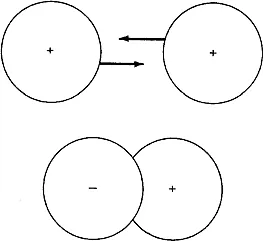
FIG. 1.1. Polarity of electrical charges showing that different charges attract and similar charges repel.
ferent values or signs attract. Most of us have demonstrated an analogous property to ourselves with magnets. If we hold the south poles of two magnets together and then release them, the magnets jump apart. If, on the other hand, we hold the south pole of one magnet and the north pole of the other magnet close together and then release them, they jump together. There is a field of force (attraction) between the magnets just as there is with the electrical charges. This force field pushes like charges away and attracts dissimilar charges. By convention, this field of force is usually visualized from the perspective of the positive electrical charge. Figure 1.2 shows the field of force as arrows pushing away from the positive charge and pushing toward the negative charge. In other words, if the charge is positive, the direction of the force field is away from it; if the charge is negative, the direction of the force field is toward it.
Figure 1.3 shows a force field between two plates; one with a positive charge and one with a negative charge. Arrows show the direction of the electrical field of force, and a single, movable charge is midway between the two plates. The charge is being pushed down away from the top plate and pulled down toward the bottom plate. It is important to remember that the force of the field is constant anywhere between the two plates. That is, the farther away from the positive plate the charge moves, the less force is exerted from the top, but an increased force of equal strength pulls from the bottom. For example, if the charge is subjected to a force of two Newtons at point A, it is also subjected to a force of two Newtons at points B and point C. Midway between the two plates, the downward push equals the downward pull. When the positive charge is closer to the upper plate, the downward push is stronger than the pull, but the sum of the two equals the same value as when the charge was at the midpoint. The same is true if the charge is closer to
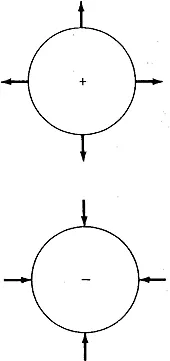
FIG. 1.2. Electrical fields of force.
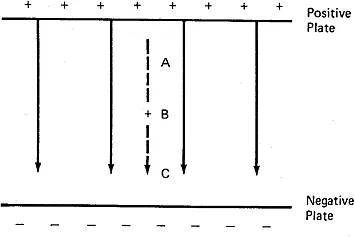
FIG. 1.3. The relationship between a movable electrical charge and the electrical field (Source: Adapted from Resistive and Reactive Circuits, Albert P. Malvino. New York: McGraw Hill, 1974, p. 18).
the bottom plate because now the downward pull is greater than the downward push.
Another way to set up a constant electrical field is with a battery. When a wire is connected across the poles of the battery, it produces a constant electrical field inside the wire. Any movable charge inside the wire feels the force of the poles of the battery. The force then pushes the charges through the wire—that is, causes electricity to flow.
At this point it is reasonable to ask, “Where do these electrons or charges that travel through the wire come from?’’ Before answer...
Table of contents
- Contents
- Illustrations
- Preface to Third Edition
- Preface to Second Edition
- Preface to First Edition
- Introduction
- 1 Introduction to Basic Electricity
- 2 Combining Equipment Into Arrays
- 3 Transducers
- 4 Digital Signal Processing and Experiment Control
- 5 Spectrum Analysis
- 6 Amplifiers, Attenuators, Mixers, and Filters
- 7 CRT Displays, Oscilloscopes, Recording, and Plotting
- 8 Analog and Digital Magnetic Tape Recorders
- 9 Sound Level Meters
- 10 Interfacing Laboratory Equipment With Consumer Electronics
- Glossary
- Suggested Readings
- Author Index
- Subject Index
Trusted by 375,005 students
Access to over 1.5 million titles for a fair monthly price.
Study more efficiently using our study tools.
Frequently asked questions
Yes, you can cancel anytime from the Subscription tab in your account settings on the Perlego website. Your subscription will stay active until the end of your current billing period. Learn how to cancel your subscription
No, books cannot be downloaded as external files, such as PDFs, for use outside of Perlego. However, you can download books within the Perlego app for offline reading on mobile or tablet. Learn how to download books offline
Perlego offers two plans: Essential and Complete
- Essential is ideal for learners and professionals who enjoy exploring a wide range of subjects. Access the Essential Library with 800,000+ trusted titles and best-sellers across business, personal growth, and the humanities. Includes unlimited reading time and Standard Read Aloud voice.
- Complete: Perfect for advanced learners and researchers needing full, unrestricted access. Unlock 1.5M+ books across hundreds of subjects, including academic and specialized titles. The Complete Plan also includes advanced features like Premium Read Aloud and Research Assistant.
We are an online textbook subscription service, where you can get access to an entire online library for less than the price of a single book per month. With over 1.5 million books across 990+ topics, we’ve got you covered! Learn about our mission
Look out for the read-aloud symbol on your next book to see if you can listen to it. The read-aloud tool reads text aloud for you, highlighting the text as it is being read. You can pause it, speed it up and slow it down. Learn more about Read Aloud
Yes! You can use the Perlego app on both iOS and Android devices to read anytime, anywhere — even offline. Perfect for commutes or when you’re on the go.
Please note we cannot support devices running on iOS 13 and Android 7 or earlier. Learn more about using the app
Please note we cannot support devices running on iOS 13 and Android 7 or earlier. Learn more about using the app
Yes, you can access Instrumentation by T. Newell Decker,Thomas D. Carrell in PDF and/or ePUB format, as well as other popular books in Education & Inclusive Education. We have over 1.5 million books available in our catalogue for you to explore.