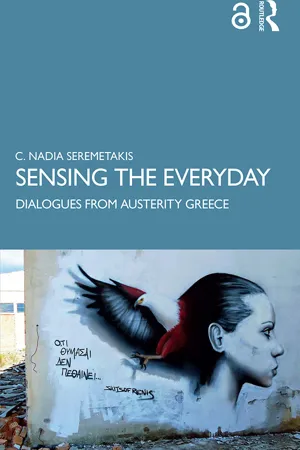
Sensing the Everyday is a multi-sited ethnographic inquiry based on fieldwork experiences and sharp everyday observations in the era of crisis. Blending sophisticated theoretical analyses with original ethnographic data, C. Nadia Seremetakis journeys from Greece to Vienna, Edinburgh, Albania, Ireland, and beyond. Social crisis is seen through its transnational multiplication of borders, thresholds and margins, divisions, and localities as linguistic, bodily, sensory, and performative sites of the quotidian in process. The book proposes everyday life not as a sanctuary or as a recessed zone distanced from the structural violence of the state and the market, but as a condition of im/possibility, unable to be lived as such, yet still an encapsulating habitus. There the impossibility of the quotidian is concretized as fragmentary and fragmenting material forces. Seremetakis weaves together topics as diverse as borders and bodies, history and death, the earth and the senses, language and affect, violence and public culture, the sociality of dreaming, and the spatialization of the traumatic, in a journey through antiphonic witnessing and memory. Her montage explores various ways of juxtaposing reality with the irreal and the imaginal to expose the fictioning of social reality. The book locates her approach to ethnography and the 'native ethnographer' in wider anthropological and philosophical debates, and proposes a dialogical interfacing of theory and practice, the translation of academic knowledge to public knowledge
- 250 pages
- English
- ePUB (mobile friendly)
- Available on iOS & Android
eBook - ePub
About this book
Information
PART I
Interfaces
1
On board/on border
This book is composed of diverse, self-reflexive ethnographic explorations that capture transitions in and of contemporary Greek everyday life and culture, transitions that occur imperceptibly and often remain unmarked in macrological analysis.
Today’s socio-economic crisis and the co-occurring fracturing and intensification of insecurities, are comprehended and over-discussed on the level of the macro. This book focuses instead on how such fractures are transcribed and translated within the micrological structures of everyday life. These fractures also serve as a reserve space for critical commentary on the normative organization of those formations that are customarily seen as superstructural. In this immersion of the quotidian there will always be gaps, silences and dead spaces opening between the insignia of the everyday and the sign systems of the macrological. Consider that from the point of view of the latter, the everyday is predominantly a dead space, a space of non-signification. As a result, the gaps and silences that lie between the micrological and macrological are ultimately structural effects and a political technology of the superstructure.
I am interested in an ethnography of the everyday that lacks the securities, facilities and utilities of a homogenizing and synchronizing context. In the agonistic interplay between the macrological and the everyday, time, space and the body are intrinsically disjointed; such ruptures are refracted in language, visuality and the senses. This excavation of the historical experience of fracture, of discontinuity or nonsynchronicity, at the level of Greek urban everyday life seeks to repoliticize the micrological dimensions of the quotidian.
The turn to the micrological as a pool of alternative perceptions of reality is an ethnographic project. But, in an era of globalization that homogenizes and totalizes human society and culture, and routinizes human existence, it is also a political task. It acquires an added importance in neocolonial cultures which have long been characterized by an acute formalism that renders the quotidian nonvisible and the present devoid of cultural meaning.
In contrast, however, to other ethnographic projects that address modernity at the level of the quotidian (see for example Veena Das’ work), I do not propose everyday life as a sanctuary or as a recessed zone distanced from the structural violence of the state and the market. Rather, I see everyday life as a condition of im/possibility, unable to be lived as such but still an encapsulating habitus. There the impossibility of the quotidian is concretized as fragmentary and fragmenting material forces.
This fragmentation is mirrored in the book’s stylistic aesthetic. Sensing the Everyday is not a story-shaped ethnography, but rather an assemblage of the impossible whole from a series of partial complexes, the constellation of which produces specific ethnographic affects. This is a multi-sited inquiry, and the various explorations, which weave together old and new ethnographic experiences, aim particularly at capturing the Greek social crisis as a crisis of borders: cartographic, somatic and psychic. These borders are in turn interfaced with the crises of translation of the Other in anthropology proper as both theory and practice.
Sensing the Everyday is thus a reflection on ethnography as the study of the quotidian in process. It explores border spaces, spaces of trauma, in a journey through antiphonic witnessing and memory. The focus on the borders of the everyday allows one to see macro-transformations in-the-making. The taken-for-grantedness of the everyday, instead, is responsible for an after-the-fact response to crucial events in and of everyday social and political life by academics and politicians alike.
*
The border marks transitions in space and time. It is the shared topos of the historian, the anthropologist, the archaeologist, the artist and the poet, all of whom are translators of the past and future to the present, of the inside to the outside, of the particular to the general. Borders are the meeting points of mind and body, ideas and senses, science and literature. Borders are points that release vision.
A discourse on the border is thus a discourse on dialogue. Silent or vocal, communication requires the mastery and exchange of linguistic and extra-linguistic codes. For dialogue is not simply a talk between equals, nor is it necessarily a talk with an external other – as dialogue is customarily understood and promoted by modern media.1 Any communication on and from the border is a dialogue that is meant to decenter, and in taking place at a limen, it is already decentered.
Knowledge from the borders, then, can decenter and reshape everyday life; it allows new forms of life and social relations to emerge. It is in this sense a decolonization of conventional time, freeing history from evolutionist perceptions that locate Greek identity either in the archaic past or the European future, thereby rendering the present nonvisible. The recent focus, moreover, has not been on futurity so much as it has centered on catastrophic pasts, thematizing war-memory or experiences of natural disaster. The political implications of the macro-structural inattention of the present have recently become evident in Greece with the immigrant crisis. An archaeology of this present would reveal history and culture as a polyphonic process, demanding dialogical relations between histories, cultures, human and nonhuman species and objects. Such dialogical archaeology would transcend and liberate dualistic constructions, such as nature and culture, mind and body, language and affect. Our present is marked by traumatic events. We experience physical disasters and violent vivisections of our social and personal bodies that foster a growing realization of our vulnerability. These traumas lead to a reconsideration of what constitutes the human now.
Knowledge from the borders constitutes a counter-discourse to legal realism and to the growing biologization of culture. By extension, border knowledge combats renewed or new configurations of racism. True, developments in life sciences and new technologies increasingly allow for a perception of life as amenable to human intervention and as infinitely flexible. But in the era of individualism, alternative models of everyday social relations are needed even more, relations governed by sensory and affective reciprocity between humans and nonhumans, the living and the dead – social relations grounded on democracy.
The ethnographic miniatures
The micrological ethnographic sites explored in the book are diverse. They trace, translate and analyze cultural phenomena and practices as performative dynamics of and in everyday life; yet, they are cross cut by recurrent themes. These include the spatialization of sensory experience and memory, an archaeology of vernacular language, the relation of experience to commensality, the antiphonic structure of social communication, the individual body collapsing into a mass body politics conceptualized as a nervous system or a sensory infrastructure, and the border as that porous line between eros and thanatos, or life and death.
The montage of these fragments explores various ways of juxtaposing reality, the irreal and the imaginal in order to expose the fictioning of social reality; for the truth about social reality, as Brecht would agree, can be conveyed in various forms and styles. These narrations of fragmentations and bordering are supplemented by a meditation on the decontextualization and mediation of Anglophone anthropology in areas like Greece where the field has undergone rather arbitrary expropriation and fragmentation in its own right. In this context, I recognize my own antinomic subject position as a so called ‘native’, or ‘indigenous’ ethnographer and also as a diasporic, American-trained, post-Boasian anthropologist. The indigenous practice of verbal performativity, antiphony, is remediated as framing the dialogic at play between my projects and the wider discipline. Such projects include the gender poetics of premodern and contemporary Greece and extend to comparative discussions with other cultures and areas beyond Greece, such as Vienna and Edinburgh, Albania and Africa, among others.
*
My ethnographic explorations in this book begin with the massive spread of little street memorials for the dead in the Greek urbanscape during the current socio-economic crisis but before the global refugee crisis. These memorials, erected outside of cemeteries and enjoying no official church ritual, interrupt the quotidian space. They stand as austere homages to the reintegration of death into life, the sacred into the secular, the cities of the dead (cemeteries) with those of the living. A Situationist inspired analysis here speaks of a ‘democratization of death’, and points to the détournement of these residual boundaries as an emerging third stream anamnesis; that is, memory focused on the postsecular historicity of the everyday which is marginalized by the dominant public culture, split as it is between European cosmopolitanism and the Greek archaic. By claiming the ‘citizenizing’ of both the dead and their bereaved survivors, these memorials point to an alternative form of citizenship. This is also attested to by the victims of massive fires and their efforts to defy homelessness and a forced condition of post-disaster flexible citizenship. This ‘new’ evidence of public death in everyday Greek life and culture is further discussed by rethinking Eric Wolf’s idea of the sacralization of the Mediterranean domestic space as a sanctuary space, Giorgio Agamben’s notion of the profanation of restrictive institutional semiologies, Philip Aries’ privatization of the dead, De Certeau’s pedestrian speech acts, and Nigel Thrift’s urging for a spatial politics of affect.
This discussion of the eruption of death in the city is followed by one on the eruption of the earth and the death of the city itself. The debuilt habitus of the city of Kalamata after a devastating earthquake and its struggle with the anamnesis of the natural disaster are discussed in relation to another habitus, beyond Greek borders, the built environment of Vienna (as a mimesis of death state, recalling Adorno). This discussion is extended to the massive fires that deadened the region of Ilia later. Here the antinomy of the archaicized (Vienna) and the emergent (post-disaster Kalamata/Ilia) is played out again.
Shifting to the literal border, between Albania and Greece at a time that Albanians were frequent economic migrants to Greece and the EU in the 1980s and 1990s, Europe appears to be besieged by its own borders. Cultural identity shifts from the metropole and from conventional cultural heritage sites to the frontiers. Today, the various contaminating others – Albanians, Pakistanis, Eastern Europeans, Africans – in the recent experience of massive immigrant and refugee flows threaten the political rigidification of borders between nations and within nations. These population flows are discussed with the recognition that health and disease do not obey national boundaries. When it comes to public health issues, the borders of nations are as permeable as the borders of the body, and attention to these political boundaries is as crucial as medical attention is to bodily boundaries. Indeed, the crisis also expresses the reconfiguration of the nation as a medical metaphor, a body biopolitic in which risk and threat are cast as unhuman and virological. The generic and initial response to dangerous viruses in popular mentalities around the world is to construct an imaginary boundary that encloses ‘risk’ within particular communities of the margin, such as ethnic and racial minorities. Immunity or security seems to require a boundary, a wall of defense against the attacker. This enclosure has inhibited trans-communal and trans-national awareness of the scope and nature of such viruses and inhibited the internationalization of skills, tools and resources.
Borders can be places where things and people are walled off and excluded, but they can also be sites of dynamic and productive transactions, bringing together cultural diversity and difference. Cavafy,2 in his poems The Walls (1896–7) and Waiting for the Barbarians (1898), spoke early of such exclusions of society’s Others in the context of Greece, and Wendy Brown (2010) in her book Walled States, Waning Sovereignty transfers us to the contemporary international scene and the need and desire to raise walls to mark national borders for protection, even amid proclamations of extroversion and global connectedness. Both authors, from different socio-historical contexts, are critical of the nation-state and its institutions and the idea of state sovereignty for, amid its decline, state power and national identity continue to persist and the Other continues to be walled out.
Among those institutions of the state, the Greek university in particular is discussed in the last chapter as a space of trauma, to the extent that it can wall out those who resist an unquestioned assimilation in an institutional culture that in practice defies what it claims to safeguard and promote, which is to say, democracy. The response lies in Cavafy’s ironic verse ‘these people [the barbarians] were a kind of solution’, by which he marks the necessity of the invasive other as contributor to political self-definition.
Extending my discussion of the glocal, I track, with the advent of globalization, everyday practices and processes that point to the crossing of bodily boundaries between animal and human, such as food poisoning, ‘mad cow’ disease or avian flu. These practices point to the closing, penetration and violation of individual and national bodily boundaries, as do other cases considered here: aesthetic surgery and anatomical exhibits, where death is walled out through plastination; as well as evil eye infliction and coffee cup reading. But these practices also point to the opening of the body by forensic or vivisectionist ethnic violence, and to the leaking of borders, borders in pain, as in the case of the recent flows of immigrants and refugees, dead or alive.
These explorations reveal post-secularity in the era of globalization – the simultaneous mythification of and exit from modernity, the trans-nationalization of embodiment, and attempts to remediate technicity, as in telephone evil eye exorcisms, which open the body. Telephonic intervention for diagnosis and cure, very much like computer intimacy, magnifies the ability to act on the body at a distance, this time in service of the afflicted. Here the optical as the source of social negativity (evil eye), is countered by the tactile and the auditory.
Sensing the Everyday is thus an experiment on ethnography as the study of the traumatic in everyday life and an attempt to write the sensorium that emerges from this fracture. This is a sensorium of trauma as an everyday practice, rather than one that refracts a state of emergency or a state of exception. The everyday is revealed as extra-ordinary as we traverse spaces like the road, the wall-boundary, the natural disaster site, the university as a public secret, and the interruption of quotidian space by little street graves. This sensorium refracts a crossing of the senses and of bodies, and points to the intimate relation of eros and thanatos in Greek thought and culture.
The erotic themes discussed here include food consumption, aesthetic surgery, desire through advertising, and the medicalization of art, which is linked to the medicalization of eros in modernity. They all reveal a distrust of the body’s surface and an urge to get below the skin. This is a new configuration of the body that is not limited to the grotesque war-site alone, but can be found in everyday life practice. In turn, the inter-ethnic violence that Greece experiences today, the flexibility of the dead beyond biological death – as the little ‘street graves’ indicate – and the thanatopolitical scenography of the modern urbanscape capture an ongoing historical mutation of thanatos.
Several examples speak as much about death as about desire and pleasure. Violence and death, as in the case of ethnic violence, is about a failed erotics of social life which degenerates into thanatos. Gunder Von Hagens’ famous anatomical exhibition of aestheticized corpses is a case in point. This exhibition, posing as art around the world, is about thanatos and desire: the exhibited corpses with their interiors exposed become desired and eroticized. Similarly, the vivisectionist reading of the Mona Lisa, Da Vinci’s p...
Table of contents
- Cover
- Half Title
- Series Page
- Title Page
- Copyright Page
- Dedication
- Table of Contents
- Acknowledgements
- PART 1: Interfaces
- PART 2: Death drives in the city
- PART 3: Senses revisited
- PART 4: Sensing the invisible
- PART 5: Borders of translatability
- PART 6: The violence of the lettered
- Bibliography
- Index
Trusted by 375,005 students
Access to over 1.5 million titles for a fair monthly price.
Study more efficiently using our study tools.
Frequently asked questions
Yes, you can cancel anytime from the Subscription tab in your account settings on the Perlego website. Your subscription will stay active until the end of your current billing period. Learn how to cancel your subscription
No, books cannot be downloaded as external files, such as PDFs, for use outside of Perlego. However, you can download books within the Perlego app for offline reading on mobile or tablet. Learn how to download books offline
Perlego offers two plans: Essential and Complete
- Essential is ideal for learners and professionals who enjoy exploring a wide range of subjects. Access the Essential Library with 800,000+ trusted titles and best-sellers across business, personal growth, and the humanities. Includes unlimited reading time and Standard Read Aloud voice.
- Complete: Perfect for advanced learners and researchers needing full, unrestricted access. Unlock 1.5M+ books across hundreds of subjects, including academic and specialized titles. The Complete Plan also includes advanced features like Premium Read Aloud and Research Assistant.
We are an online textbook subscription service, where you can get access to an entire online library for less than the price of a single book per month. With over 1.5 million books across 990+ topics, we’ve got you covered! Learn about our mission
Look out for the read-aloud symbol on your next book to see if you can listen to it. The read-aloud tool reads text aloud for you, highlighting the text as it is being read. You can pause it, speed it up and slow it down. Learn more about Read Aloud
Yes! You can use the Perlego app on both iOS and Android devices to read anytime, anywhere — even offline. Perfect for commutes or when you’re on the go.
Please note we cannot support devices running on iOS 13 and Android 7 or earlier. Learn more about using the app
Please note we cannot support devices running on iOS 13 and Android 7 or earlier. Learn more about using the app
Yes, you can access Sensing the Everyday by C. Nadia Seremetakis in PDF and/or ePUB format, as well as other popular books in Social Sciences & Anthropology. We have over 1.5 million books available in our catalogue for you to explore.