Complex Situations in Coaching is a collection of 20 typical yet underdiscussed issues in coaching, ranging from value conflicts, multiple agendas, power dynamics, and emotion management, to the role of money, etc. Organized into ten chapters, they are positioned into the literature and commented on by world-class coaches, coaching researchers, educators, and program directors. This plurality of voices is designed to foster dialogue, questions, and solutions; this setting, supportive of reflexivity, critical thinking, and diversity awareness, is essential to the development and education of coaches in an increasingly complex world where ready-made solutions prove limited. Thus, beyond a 'toolkit approach', this book engages in a thought-provoking and multi-perspective journey in support of the professionalization and continuous education of coaches, instructors, and/or supervisors.
eBook - ePub
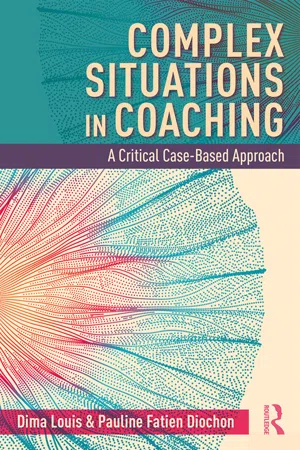
Complex Situations in Coaching
A Critical Case-Based Approach
- 238 pages
- English
- ePUB (mobile friendly)
- Available on iOS & Android
eBook - ePub
1 Multiple agendas in coaching
Introduction
Given that most, if not all, coaching interventions involve some sort of objective, we may wonder what informs their definition, implementation, and successful attainment. This chapter depicts how the interplay between multiple stakeholders, from the coach, the coachee, to the organization, potentially generates multiple, contradictory, and hidden agendas, resulting in dilemmas and missed coaching opportunities.
Typical hidden agendas within the triadic coaching relationship include:
- The individualization of an issue. It is not unusual to hear that the designated coachee is not the one who really needs coaching. Indeed, the coachee can sometimes be framed as “a ‘problem person’” (Tobias, 1996, p. 89), potentially leading to scapegoating while other, more holistic approaches might be more suitable to addressing the root causes of the problem. This phenomenon has been termed the individualization or psychologicalization of an issue (Amado, 2004; Fatien Diochon & Lovelace, 2015) when collective problems are rendered individual or psychological.
- The conflicting agendas. The various stakeholders involved in a coaching intervention expect to achieve different coaching goals, each trying to advance their own agenda without sharing it with the group (Louis & Fatien-Diochon, 2014).
- The organization excluded. Coachees work on an issue with the coach, without informing the organization, for example, preparing a career move away from the current organization (St John-Brooks, 2010).
- The poisonous gift. The organization has some intentions for the future of the executive and is using coaching as a “last resort” or an “excuse” to show that despite all their efforts, the executive still doesn’t meet expectations, making the coaching a “poisonous gift” (Fatien, 2012, p. 309). A typical situation is when coaching is used to justify the coachee’s firing.
In this chapter, The organization excluded explores the dilemma of Lisa, whose client, Peter, divulges that he wants to leave the company, a large UK publishing company, and expects Lisa to prepare him for this move. Should Lisa accept Peter’s agenda or follow the initially agreed-upon agenda? In The poisonous gift, John realizes that in coaching the Chief Operating Officer (COO) of a large American asset management company, he has unwittingly contributed to the COO’s firing.
The two cases with their commentaries below thus allow exploration of how hidden agendas can result in a number of challenges and dilemmas for coaches and can compromise the outcome of the coaching.
Case 1.1. The organization excluded
Lisa was hired by a large publishing company to coach Peter to “stop being so negative in meetings.” While Lisa had noticed some friction between Peter and Daniel in the three-party meeting, they were able to agree upon a coaching agenda. Their objective was then to identify the reasons behind the perceived negativity in order to help Peter become a more positive contributor in meetings. Pretty straightforward, right?
Well, once Lisa began the coaching sessions, she quickly realized the situation was far more complicated than she originally thought. Peter explained that he was unhappy at his job, so much so that he intended to leave. On top of this, he asked for Lisa’s help with his next move. He explained that rumors of a buyout by a larger publishing company had been circulating, and though he’d been unhappy for quite some time, these rumors had him rattled. Now, he was convinced to leave, and in the meantime, he was simply trying his best not to let anyone notice while he sorted things out for himself.
Peter’s request put Lisa in a difficult position. She wasn’t sure how to deal with it. On one hand, she thought to herself: “He’s still employed by the company, and they’re investing in his development, so he needs to be focused on that, or just quit.” His intention to stay in the organization until he found a better job and to use the coaching assignment to prepare for the next move made her uncomfortable.
On the other hand, she thought: “If the organization is paying me to work with an employee, then the employee is my client. Therefore, if he says ‘I want to leave,’ then I should help him. Furthermore, he is no longer passionate about his work, he isn’t invested, and he’s lost the motivation to drive the business forward. It’s not good for the organization to have someone in that position.”
Reflexive questions
- What key issues does this case raise for Lisa? And for you?
- In this scenario, should Lisa’s fundamental alliance be to her coachee or the client organization that hired her?
- When coachees leave their organization after a coaching intervention, do you consider the coaching intervention to be a failure? Why, or why not?
Ultimately, Lisa decided to help Peter with his request, using the coaching sessions to prepare him for his departure. Even though she remained uneasy about the situation, she believed it was not in her role to share this information with the company. Instead, while helping Peter, she encouraged him to be honest and transparent about his intentions. Just as he needed to prepare for his next move, the company needed to prepare to find a replacement.
Reflexive questions
- Do you agree with Lisa’s decision to help Peter with his request? Why, or why not?
- Would you have handled this situation differently?
Commentary 6.1.a
Thomas Diamante
Overview of the case: points to ponder
It is clear that the coaching process in this case would benefit from structure. While there are a number of professional or psychological orientations in the literature, they more generally share a defined process for delivery. Coaches approach their work with varying psychological rubrics; however, the engagement is fairly predictable in terms of protocol. This is evident even on a global scale (Diamante & Primavera, 2004; Spence, Cavanagh, & Grant, 2006).
The protocol of the coach in this case, however, is somewhat elusive. It is clear that Peter has a plan and wants help executing it (i.e., departure). But what is Lisa’s plan?
The incongruity between the hiring organization (client), the needs of the individual to be coached, and the professional expectations of the coach require resolution before a coaching engagement is activated. How can this occur? When should it occur? And who is responsible?
Research heavily influences the coaching profession, but it is still an evolving practice and remains unregulated in terms of licensing and oversight. This makes the profession exciting but also demands a higher level of vigilance by all practitioners to ensure standards are shared, discussed, agreed upon, and improved. Coaching can be advisory, motivational, cathartic, constructive, and educational. Regardless of its shape and form, however, clarity of goals, transparency of relationships, and the design process of the coaching experience all require consideration as they bring ethical and practical implications (London & Diamante, 2018; Spence et al., 2006). In this case, the design (approach) to the engagement and consequent goals are impacted by a degree of ambiguity apparent from the outset where the engagement plan, the organization’s goals, and the coachee Peter’s goals are incongruent. An agenda needs to be set with the hiring organization.
The criticality of setting mutual expectations is basic to any management consultation, and coaching is no exception. In this instance, the coach is struggling with the setting of visible goals that appear incompatible to the coachee’s hidden or unrevealed goals or agenda. The client organization says stay and improve your team performance, while Peter ponders, “Get me out!” The multi-faceted nature of interpersonal and organizational dynamics in this case is not unusual. Arguably, it is the responsibility of the coach to catalyze the process of parsing out these complexities to bring clarity, understanding, and eventually action. These elements can and do intersect with personal, interpersonal, and organizational goals (Goodstone & Diamante, 2002; Diedrich, 2001).
The coaching process is an alliance. The rapport between the coach and the individual being coached (coachee) is central to progress. Rapport is earned based upon shared information, mutual openness, and authentic conversation, where confidentiality is the currency that leads to the sharing of hidden thoughts, if not their discovery, so that analysis of behavior has context. There should be a mutual “testing” where the credibility, integrity, and humanity of the helping relationship are examined – this leads to an advisory relationship that is genuine (Natale & Diamante, 2005). This alliance, however, is not limited to the coach-coachee dyad; there is also a need to involve the hiring (client) organization. Disparate treatment between coach-coachee-client can lead to confusion, conflict, and unrealized outcomes. This needs to be avoided. In this case, alliance management throughout the engagement requires attention. The coach is not attending to this alliance sufficiently and needs to take action. Why is this happening?
The psychological component that impacts the professional execution of coaching conversations is key to understanding this case (Diamante, 2013). The self-awareness of the coach who strives to catalyze positive change in others is relevant, especially because more often than not, the coach is not the target of the engagement. Still those who talk to others to counsel, coach, or otherwise engage with the goal of helping should retain keen awareness of their thoughts, beliefs, evaluations, and goals in relation to those of the client and coachee (Diamante, 2011; Leonard, 2017).
In this case the coach is needlessly conflicted between delivering a coaching engagement to “save” Peter by retaining him in the client organization or to “save” Peter by establishing a better, healthier path for him. The cognitive strain being experienced by the coach requires personal examination. The coach can benefit from reflecting on feelings toward the client organization, the request of this hiring organization, and the perception of the role (or business situation) that Peter finds himself in (Diamante & Primavera, 2004). Is the coach reading the situation based on personal feelings? Are the coach’s own tendencies interfering with her analysis of how best to handle this engagement? Can this coach “push back” on the goals expressed by the hiring organization? Is this reasonable? Is it right? Is it professional?
The turbulence in this case might be exacerbated by the internal state of the coach. The coach, based on the shared business situation, views her role as either a means to retain the employee for the client organization or as a tool to help the employee escape. What is her role, as the coach? How does she add value? What are her ethics?
Total workplace dynamics are affecting behavior in this case. The coach does not need to be singularly focused on the individual. This would be a “systemic” approach to the problem, which would lead to identification of the organizational culture, the expectations (and behaviors) of leaders, the norms and values, and all the intangible elements that are so very present and often influencing the behavior of employees heavily, such as the anticipated merger. Total system analytics (e.g., open systems theory) and organizational change principles can inform the coach about the business situation, the stresses and strains that all of management is experiencing, and with that in mind, equip the coach to better help Peter sort things out cognitively, emotionally, and behaviorally (Burke, 2018; Kotter, 2012). How can parsing out these elements lead to more effective coaching?
By identifying the reasons for Peter’s disengagement, it may be possible to change his behavior. How can the coach best get at the root causes? Peter must come to realize that his desire to leave is predicated on his beliefs about his life, his work, his culture, and the people with whom he works – all that impacts his performance, and he is sharing that with the world. Are these beliefs impeding his ability to relate effectively with others? Is he aware of this? How can the coach surface this issue? Peter brings fear of job loss due to a merger, and his behavior is making that unwanted possibility a likely probability. Can the coach bring this to light? What tools or gathered data might be useful to enhance self-awareness? Does Peter know the impact of his behavior on others, especially in team settings? How can that be extracted so Peter can inspect it? And change it?
Awareness of the organizational elements that influence behavior leads to enhanced self-direction (Diamante, Natale, & London, 2006; de Haan & Nilsson, 2017). To what extent can the coach define these elements, and what is the best way to present them to the coachee? How can discussing the approach to the engagement help the coach overcome the gaps between her, the client, and the coachee? How will surfacing the organizational elements that are pressing upon the individual enable all parties to clarify goals and agree to potential, desirable outcomes?
Lisa wants to help Peter. What does help look like?
In complex organizational systems, especially where uncertainty of business direction is implicated, being broad-based during an assessment (or intake) of a coaching case can be advantageous. Understanding the frame within which the picture of Peter is placed can trigger questions for the hiring organization and the coach that might not otherwise be revealed. How can the coach create an opportunity to conduct an organizational diagnostic prior to coaching? Would Peter need to be involved? Who would? How can the information gathered from such an assessment help all parties target goals for Peter? Long term, how does this reduce risk for the coach while increasing the chances of success for Peter?
The focus of the coaching, upon presentation, was improving performance on the job. The hidden agenda of desired departure and better team performance are not mutually exclusive. Peter, through coaching, can learn why his team behavior is inadequate, and the coach can help fix it. That is a key goal – it must be met. However, is that enough? Coaching is generally accepted as being focused on professional and personal development. The coachee’s “hidden” agenda does not need to remain hidden if the coach can somehow connect “intent to leave” with its cause. Can Peter improve his team behavior and ready himself for departure?
The coach best serves everyone involved when she factors in her own state of mind, the psychological strain experienced by the individual being coached and the needs of the client organization. When can the coach turn this chain of strain into a dialectic self-understanding and organizational understanding? This can lead to better decisions by Peter, better support by the coach, and better outcomes for the organization.
The coach has responsibilities to the hiring organization and the coachee. Do you think that focusing on Peter’s personal goal rather than the organizational problem will lead to failure for the coach? Will it lead to failure for Peter, as well?
Enabling professionals to chart a path toward a more productive life requires personal, interpersonal, and organizational alignment. In this case, the onus is on the coach to make certain that all parties are headed in the same direction toward mutual goals.
Commentary 1.1.b
David E. Gray
The agenda in this case is that Peter has been allocated a coach to support him to “stop being so negative in meetings.” This, in itself, is often not the best start to a coach-coachee relationship since it appears to be using coaching in a remedial context – sorting out someone who is not fitting into the organization. As Reeves (2006) comments: “Coaching is not a remedial tool to help failing executives or to solve serious behavioral problems” (p. 48). If an organization persists in allocating coaching largely to those employees it sees as “a problem,” it taints its own internal coaching culture with a remedial stamp: “Coaching is for ...
Table of contents
- Cover
- Half Title
- Title
- Copyright
- Contents
- List of tables
- List of figures
- List of cases
- List of contributors
- Acknowledgments
- Introduction
- 1 Multiple agendas in coaching
- 2 Power in coaching
- 3 Boundaries in coaching
- 4 Values in coaching
- 5 Cultural issues in coaching
- 6 Contracts in coaching
- 7 Money in coaching
- 8 Emotions in coaching
- 9 Codes in coaching
- 10 Violence in coaching
- Conclusion
- Index
Trusted by 375,005 students
Access to over 1.5 million titles for a fair monthly price.
Study more efficiently using our study tools.
Frequently asked questions
Yes, you can cancel anytime from the Subscription tab in your account settings on the Perlego website. Your subscription will stay active until the end of your current billing period. Learn how to cancel your subscription
No, books cannot be downloaded as external files, such as PDFs, for use outside of Perlego. However, you can download books within the Perlego app for offline reading on mobile or tablet. Learn how to download books offline
Perlego offers two plans: Essential and Complete
- Essential is ideal for learners and professionals who enjoy exploring a wide range of subjects. Access the Essential Library with 800,000+ trusted titles and best-sellers across business, personal growth, and the humanities. Includes unlimited reading time and Standard Read Aloud voice.
- Complete: Perfect for advanced learners and researchers needing full, unrestricted access. Unlock 1.5M+ books across hundreds of subjects, including academic and specialized titles. The Complete Plan also includes advanced features like Premium Read Aloud and Research Assistant.
We are an online textbook subscription service, where you can get access to an entire online library for less than the price of a single book per month. With over 1.5 million books across 990+ topics, we’ve got you covered! Learn about our mission
Look out for the read-aloud symbol on your next book to see if you can listen to it. The read-aloud tool reads text aloud for you, highlighting the text as it is being read. You can pause it, speed it up and slow it down. Learn more about Read Aloud
Yes! You can use the Perlego app on both iOS and Android devices to read anytime, anywhere — even offline. Perfect for commutes or when you’re on the go.
Please note we cannot support devices running on iOS 13 and Android 7 or earlier. Learn more about using the app
Please note we cannot support devices running on iOS 13 and Android 7 or earlier. Learn more about using the app
Yes, you can access Complex Situations in Coaching by Dima Louis,Pauline Fatien Diochon in PDF and/or ePUB format, as well as other popular books in Business & Business General. We have over 1.5 million books available in our catalogue for you to explore.