There is more to setting up a successful business than just a good idea. Creating a Business examines concisely all the relevant aspects: the excitement and satisfaction that business entails, the challenges that face the entrepreneur, the risks that lie in wait.
The textbook is organized around a practical example: a company setting out to launch a new line of clothing. Aspects of setting up a business, including management, marketing, legislation, and financial management are examined.
Including pedagogical features, such as end-of-chapter questions and illustrations, Creating a Business will interest students of small business and entrepreneurship.
The chapter outlines characteristics of entrepreneurs and the importance of preparing a business plan in section 1.1. The external environment in which the firm operates is discussed in section 1.2. Nowadays corporate responsibility is set high on management agendas. Section 1.3 focuses on ethical concepts. Section 1.4 gives an introduction to enterprise risk management and section 1.5 discusses the influence of culture on a firm’s strategy. The last section (1.6) outlines how to use Visionplanner.
1.1 The challenges of an entrepreneur
Entrepreneur
An entrepreneur is a person who creates a new business in the face of risk and uncertainty with the purpose of achieving profit and growth by identifying opportunities and possible competitive advantages in doing something better than the competition. Once an opportunity has been identified, the entrepreneur can start researching the company’s feasibility and then plan for its launch.
Opportunity
Owning a business gives entrepreneurs independence and the opportunity to achieve what is important to them. They reap the intrinsic reward of knowing they are the driving force behind their business. Owning a business challenges the owner’s skills, abilities and determination. The only barriers to success are those which the owner imposes on him- or herself. Small-business owners are often among the most respected and trusted members of society. Business deals based on mutual trust and respect are the hallmark of many established small companies. The most important benefit of owning a business may be the fact that entrepreneurs have made their hobbies their work and enjoy what they do.
Drawbacks
However, there are drawbacks to owning a business. There is no guarantee that the owner will earn enough to survive. In the early days the owner often has trouble meeting financial obligations, and is always the last to be paid. The failure rate of starting a business is high – as mentioned in the Introduction, 20% of start-ups fail in their first year – so entrepreneurs should consider the risk-reward trade-off before putting their personal assets and mental wellbeing on the line. Most starting business owners work more than 60 hours per week without paid holidays, and this can result in high levels of stress.
In order to understand the risks an organisation faces, it is important to understand its network of interrelated individuals, entities and external forces, and the way the organisation creates value within this network. Successful entrepreneurs understand they aren’t simply creating a job for themselves and a few employees, they are building a business that can create value for themselves and their community.
Nowadays businesses are confronted with issues as globalisation, shorter product life cycles, shorter business cycles, cultural differences, real-time data processing and distance control. Power of customers and suppliers, new technology, new entrants on the market, competitors, regulation have all contributed to enhance strategic thinking. Strategy is more important than ever!
Strategic planning
A crucial ingredient in business success is strategic planning, often ignored by starting companies. The planning process forces potential entrepreneurs to subject their ideas to an objective evaluation of the competitive market. The goal of developing a strategic plan is to create competitive advantage – the aggregation of factors that sets the business apart from its competitors and gives it a unique position in the market. There are several steps in the strategic planning process. These include:
develop a clear vision and translate it into a meaningful mission statement
define the firm’s core competencies, such as quality, service, innovation, team-building, flexibility, and its target market segments to position the business to compete effectively
assess the company’s strengths and weaknesses (positive and negative internal factors)
identify the company’s opportunities and threats (positive and negative external forces)
identify key success factors
analyse the competition
create company goals and objectives
formulate strategic options
translate strategic plans into action plans
establish accurate controls, e.g. a balanced scorecard which provides managers with a comprehensive picture of the company’s total performance.
Balanced scorecard
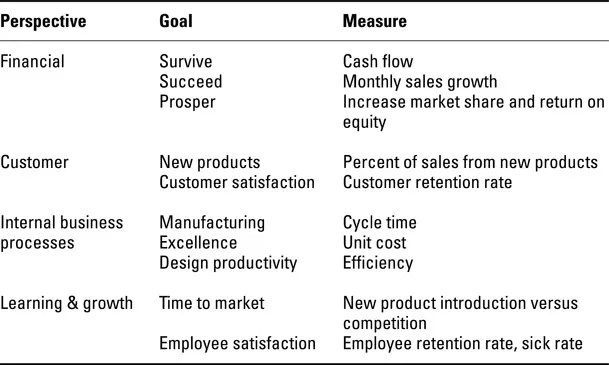
A balanced scorecard is like the dials in an airplane cockpit: it gives the manager complex information at a glance. For the complex task of navigating and flying a plane, pilots need detailed information about many aspects of the flight such as speed, fuel, altitude, destination and weather reports. Reliance on purely one instrument can be fatal. Similarly, the complexity of managing an organisation requires that managers can look at the business from various angles. The balanced scorecard translates the company’s mission and strategy into goals and measures, organised in four different perspectives: financial, customer, internal business process, and learning and growth. To build a balanced scorecard, the manager has to develop goals and measures for these four critical performance variables:
financial, such as operating profit, market share price, return on equity (see section 6.7)
customer, such as customer satisfaction, customer retention, customer loyalty
internal business process, such as quality measures, cycle time measures
learning and growth, such as employee satisfaction, sickness rate, employee training.
By combining these four perspectives, the balanced scorecard helps managers understand many interrelationships, as you can see in the following example.
■ Example 1.1 Strategic planning for COOOL
The strategic planning for COOOL includes the following characteristics:
COOOL’s owner, Jan Nest, has created a mission statement: ‘Our mission is to make young, ambitious people feel happy in casual clothes’
The core competencies include social responsibility, high quality, technical experience, and an entrepreneurial mind (see section 2.1)
The target market is young graduates in the European business community (see section 4.1)
COOOL’s strengths include technical expertise, the owner’s educational background and work experience, a risk-seeking mind, and a location near the gateway of Europe. Lack of experience in managing personnel may be perceived as a weakness
The increasing number of business school graduates and the customary ‘casual Friday’ in many organisations form an opportunity for COOOL. However, high competition and increasing regulation by governmental authorities may pose a threat to COOOL
The key success factors for running the business are Jan Nest’s educational background, his experience in the textile industry resulting in the necessary technical knowledge, his ability to negotiate with banks, his enthusiasm, and his ambition.
COOOL’s balanced scorecard is designed as follows.
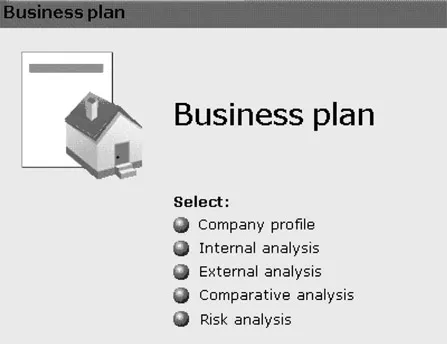
The following figure shows the construction of a business plan using Visionplanner (figure 1.1).
Figure 1.1Business plan Visionplanner
1.2 The economy and important trends
Globalisation
Today, the global marketplace is as much the territory of small starting companies as it is of giant multinational corporations. Commercial trade has become the force that drives global interaction. Political, social, cultural, and economic changes are sweeping the world, creating a host of opportunities for small companies ready to capitalise on them. Businesses can no longer consider themselves to be domestic companies in this competitive global environment. Going global is a matter of survival, not preference. Going global can put tremendous strain on a small company, but it can also have several benefits, such as offsetting sales decline in the domestic market, increased sales and profits, extended product life-cycles, lower manufacturing costs, higher quality levels, better customer orientation, and improved competitive position.
Going global presents the manager with new and often perplexing problems. The manager must be adept at dealing with a wide range of economic, legal, political, socio-cultural and technological factors, since the manager’s plans, organisation, incentives and controls will be moulded by them. The simplest and cheapest way for a firm to begin conducting business globally is to establish a site on the internet. With a well-designed website, the company can reach its customers anywhere in the world 24 hours of the day. Another relatively easy way to break into international markets is by using a trade intermediary, a domestic agent that serves as distributor in foreign countries.
Export
Small firms may begin exporting through the receipt of unsolicited orders from abroad, rather than as a result of any formal export strategy. It makes sense for companies to invest in export when it maximises long-term revenues or comp...
Table of contents
Cover
Half Title
Dedication
Title
Copyright
Preface
Contents
Introduction
1 The entrepreneurial venture
2 Managerial aspects
3 Legal aspects
4 Marketing aspects
5 Financial management aspects
6 Financial accounting aspects
7 Management accounting aspects
8 Fiscal aspects
Case study
Test answers
Solutions to problems
References
Index
Trusted by 375,005 students
Access to over 1.5 million titles for a fair monthly price.
Study more efficiently using our study tools.
Frequently asked questions
Yes, you can cancel anytime from the Subscription tab in your account settings on the Perlego website. Your subscription will stay active until the end of your current billing period. Learn how to cancel your subscription
No, books cannot be downloaded as external files, such as PDFs, for use outside of Perlego. However, you can download books within the Perlego app for offline reading on mobile or tablet. Learn how to download books offline
Perlego offers two plans: Essential and Complete
Essential is ideal for learners and professionals who enjoy exploring a wide range of subjects. Access the Essential Library with 800,000+ trusted titles and best-sellers across business, personal growth, and the humanities. Includes unlimited reading time and Standard Read Aloud voice.
Complete: Perfect for advanced learners and researchers needing full, unrestricted access. Unlock 1.5M+ books across hundreds of subjects, including academic and specialized titles. The Complete Plan also includes advanced features like Premium Read Aloud and Research Assistant.
Both plans are available with monthly, semester, or annual billing cycles.
We are an online textbook subscription service, where you can get access to an entire online library for less than the price of a single book per month. With over 1.5 million books across 990+ topics, we’ve got you covered! Learn about our mission
Look out for the read-aloud symbol on your next book to see if you can listen to it. The read-aloud tool reads text aloud for you, highlighting the text as it is being read. You can pause it, speed it up and slow it down. Learn more about Read Aloud
Yes! You can use the Perlego app on both iOS and Android devices to read anytime, anywhere — even offline. Perfect for commutes or when you’re on the go. Please note we cannot support devices running on iOS 13 and Android 7 or earlier. Learn more about using the app
Yes, you can access Creating a Business by Jenny van Sten-van't Hoff in PDF and/or ePUB format, as well as other popular books in Business & Business General. We have over 1.5 million books available in our catalogue for you to explore.