Hemicelluloses and Lignin in Biorefineries provides an understanding of lignocellulosic biomass, which is mainly composed of cellulose, hemicelluloses, and lignin. It promotes the valorization of these molecules in the context of the bioeconomy and presents hemicelluloses and lignin, which are generated in lignocellulosic biorefineries, as the molecules of the future. The viability of these molecules lies in their renewability and potential. This book covers all aspects of hemicelluloses and lignin including structure, biosynthesis, extraction, biodegradation, and conversion. The book also looks ahead to the socioeconomic and environmental value of biobased industry and emphasizes an understanding of the potential of lignocellulosic biomass.
eBook - ePub
Hemicelluloses and Lignin in Biorefineries
- 308 pages
- English
- ePUB (mobile friendly)
- Available on iOS & Android
eBook - ePub
Hemicelluloses and Lignin in Biorefineries
About this book
Information
1 | Introduction |
1.1 BIOECONOMY AND CIRCULAR BIOECONOMY
This book is intended to accelerate the emergence of the bioeconomy defined as those parts of the economy that use biological renewable resources to produce food, feed, materials, chemicals, and energy. It will demonstrate why the bioeconomy is crucial for the future generations.
The bioeconomy is circular by nature because carbon is sequestered from the atmosphere by plants. After uses and reuses of products (or molecules) made from those plants, the carbon is cycled back as soil carbon or as atmospheric carbon once again (Figure 1.1).1
The circular economy focuses mainly on the efficient use of finite resources and ensures that those are used and recycled as long as possible.2 The bioeconomy integrates the sustainable production and conversion of renewable resources. It is the renewable part of the circular economy. The principle of the circular economy is thus complementary to the renewable character of the bioeconomy and must facilitate the recycling of carbonaceous molecules after efficient uses (Figures 1.2 and 1.3). The huge benefits from the circular economy will be truly felt if the bioeconomy—the renewable part of the circular economy concept—is made to play its important and growing role.
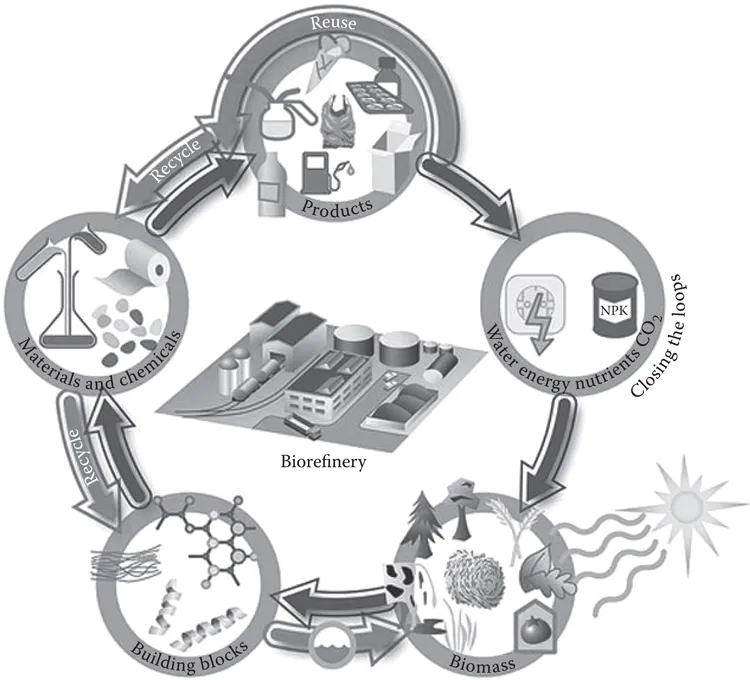
FIGURE 1.1 Bioeconomy as part of the circular economy. (Courtesy of Patrick van Leeuwen; Reproduced from Bio-based Industries Consortium, Bioeconomy: Circular by Nature, http://biconsortium.eu/news/bioeconomy-circular-nature, 2015. With permission.)
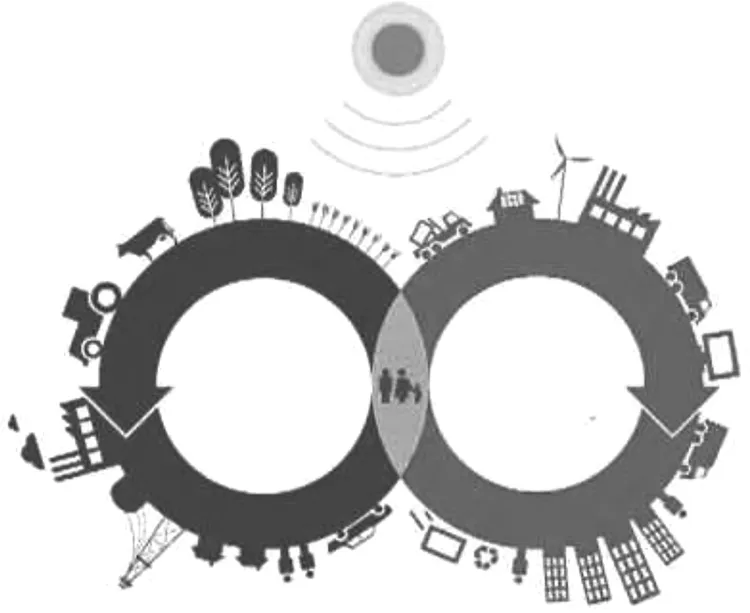
FIGURE 1.2 The left circle is the bioeconomy; the right circle is the technical economy. (Courtesy of Loes Deutekom; Reproduced from Partners4Innovation, Towards a Biobased and Circular Economy, https://www.youtube.com/watch?v=3ibJsOQdeoc, 2013. With permission.)
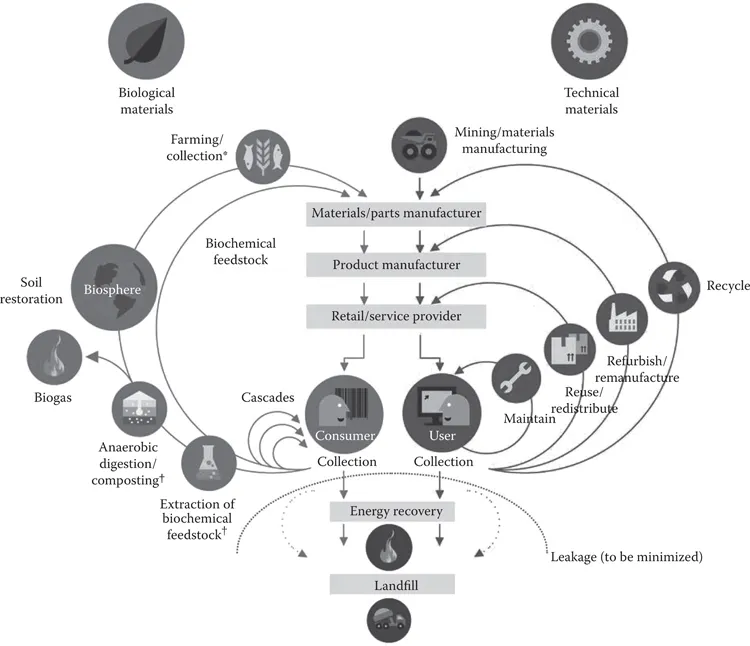
FIGURE 1.3 Inspired by living systems, the circular economy concept is built around optimizing an entire system of resource or material flows. Like biological materials, technical materials can be part of a cycle built around reuse, remanufacture, and recycling. A circular economy advocates a shift away from the consumption of products to services. (Reprinted by permission from Macmillan Publishers Ltd. Nat. Clim. Change, Ellen MacArthur Foundation, 3, 180, copyright 2013.)
In the core of this economy are the biorefineries that sustainably transform biomass into food, feed, chemicals, materials, and bioenergy (fuels, heat, and power) generally through combination of plant chemistry and biotechnologies.
Lignocellulosic biomass consists of three major components—cellulose, hemicelluloses, and lignin—which form the plant cell wall. Although the cell walls of plants vary in both composition and organization, they are all constructed using a structural principle common to all fiber composites.5 How the cell wall is biosynthesized is not yet completely understood today.
Historically, cellulose was investigated the first, about 20 years ago, which resulted in bioethanol fuel. Research on hemicelluloses followed resulting in valorization of 5 carbon (C5) sugars. Investigation on lignin is starting now, with the growing understanding that the whole plant should be valorized and not only its cellulose and hemicelluloses fractions.
1.2 BIOECONOMY
1.2.1 DEFINITION AND STAKES
Over the coming decades, the world will witness increased competition for limited and finite natural resources. A growing global population will need a safe and secure food supply. Climate change will have an impact on primary production systems such as agriculture, forestry, fisheries, and aquaculture.6
A transition is needed toward an optimal use of renewable biological resources. We must move toward sustainable primary production and processing systems that can optimally produce food, fiber, and other biobased products with fewer inputs, less environmental impact, and reduced greenhouse gas emissions. The optimal production refers to modern concepts such as Functional Economy. The Functional Economy is a concept that describes new economic dynamics based on providing solutions including the use of equipment and services from a perspective that reduces the mobilization of material resources while increasing the servicial value (the useful effects) of the solution.7 The model proposes to exchange the material goods by functional goods.
In 1989, the World Commission on Environment and Development—created by the United Nations and chaired by the Norwegian Prime Minister Gro Harlem Brundtland—has defined sustainable development as “development which meets the needs of current generations without compromising the ability of future generations to meet their own needs.”8 Sustainability includes three pillars: environment, social, and economic. That definition explains without ambiguity that economic and social well-being cannot coexist with measures that impact over the environment (Figure 1.4).
According to the EU definition, the bioeconomy encompasses the sustainable production of renewable biological resources and their conversion into food, feed, biobased products, and bioenergy.11 It includes agriculture, forestry, fisheries, food and pulp, and paper production, as well as parts of chemical, biotechnological, and energy industries. Its sectors and industries have a strong innovation potential due to an increasing demand for its goods (food, energy, other biobased products) and to their use of a wide range of sciences (from agronomy to process engineering or materials sciences) and industrial technologies, along with local and tacit knowledge.
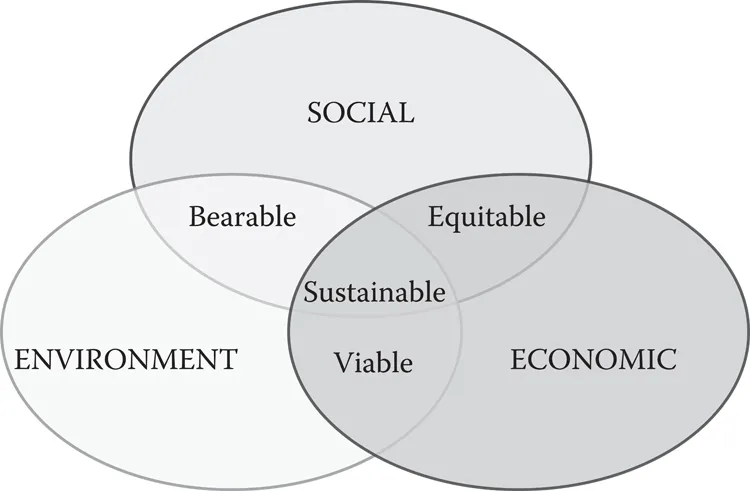
FIGURE 1.4 The three pillars of sustainability. (Adapted from Green Planet Ethics, http://greenplanetethics.com/wordpress/sustainable-development-can-we-balance-sustainable-development-with-growth-to-help-protect-us-from-ourselves; http://en.wikipedia.org/wiki/File:Sustainable_development.svg.)
TABLE 1.1
The Bio...
The Bio...
Table of contents
- Cover
- Half Title
- Title Page
- Copyright Page
- Table of Contents
- Foreword
- Preface
- Acknowledgments
- About the Authors
- Chapter 1 Introduction
- Chapter 2 Carbohydrate-Active Enzymes
- Chapter 3 Cellulose, the Main Component of Biomass
- Chapter 4 Structure and Biosynthesis of Hemicelluloses
- Chapter 5 Biodegradation of Hemicelluloses
- Chapter 6 Structure and Biosynthesis of Lignin
- Chapter 7 Biodegradation of Lignin
- Chapter 8 Pretreatments of Lignocellulosic Biomass
- Chapter 9 Valorization of Hemicelluloses
- Chapter 10 Valorization of Lignin
- Chapter 11 Perspectives
- Glossary
- Index
Trusted by 375,005 students
Access to over 1.5 million titles for a fair monthly price.
Study more efficiently using our study tools.
Frequently asked questions
Yes, you can cancel anytime from the Subscription tab in your account settings on the Perlego website. Your subscription will stay active until the end of your current billing period. Learn how to cancel your subscription
No, books cannot be downloaded as external files, such as PDFs, for use outside of Perlego. However, you can download books within the Perlego app for offline reading on mobile or tablet. Learn how to download books offline
Perlego offers two plans: Essential and Complete
- Essential is ideal for learners and professionals who enjoy exploring a wide range of subjects. Access the Essential Library with 800,000+ trusted titles and best-sellers across business, personal growth, and the humanities. Includes unlimited reading time and Standard Read Aloud voice.
- Complete: Perfect for advanced learners and researchers needing full, unrestricted access. Unlock 1.5M+ books across hundreds of subjects, including academic and specialized titles. The Complete Plan also includes advanced features like Premium Read Aloud and Research Assistant.
We are an online textbook subscription service, where you can get access to an entire online library for less than the price of a single book per month. With over 1.5 million books across 990+ topics, we’ve got you covered! Learn about our mission
Look out for the read-aloud symbol on your next book to see if you can listen to it. The read-aloud tool reads text aloud for you, highlighting the text as it is being read. You can pause it, speed it up and slow it down. Learn more about Read Aloud
Yes! You can use the Perlego app on both iOS and Android devices to read anytime, anywhere — even offline. Perfect for commutes or when you’re on the go.
Please note we cannot support devices running on iOS 13 and Android 7 or earlier. Learn more about using the app
Please note we cannot support devices running on iOS 13 and Android 7 or earlier. Learn more about using the app
Yes, you can access Hemicelluloses and Lignin in Biorefineries by Jean-Luc Wertz,Magali Deleu,Séverine Coppée,Aurore Richel in PDF and/or ePUB format, as well as other popular books in Biological Sciences & Biochemistry. We have over 1.5 million books available in our catalogue for you to explore.