- 176 pages
- English
- ePUB (mobile friendly)
- Available on iOS & Android
eBook - ePub
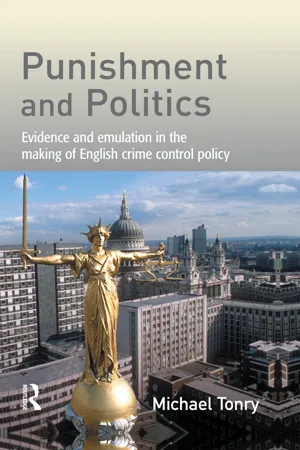
Punishment and Politics
About this book
Labour has embarked upon a root and branch remaking of the criminal justice system in England and Wales, with a mass of new legislation implemented or planned. It has ensured a continuously high profile for criminal justice issues, and they have been at the centre of wider political discourse. Yet the basis and evidence on which these reforms are being introduced is both uncertain and highly controversial. Despite spending tens of millions of pounds of research into the criminal justice system in the name of evidence-based policy, evidence has counted only in relation to lowlevel technocratic issues. On the big issues the clear weight of evidence points in opposite directions to those which the government has taken. The primary drivers of recent policies have rather been the emulation of recent USA policies (at a time when these are now being abandoned in the USA because they have been shown to be ineffective); and a media-driven agenda with a focus on conspicuous crime prevention which have had the effect of heightening rather than assuaging public fears and concerns. This provocative yet authoritative book seeks to expose and to unravel what has really driven the making of criminal justice policy in the UK. It will be essential reading for anybody interested in knowing what is going on in criminal justice, and why it is so central to political debate more generally.
Information
Chapter 1
Evidence
Crime-control policy in England and Wales of late has been tumultuous and schizophrenic. The tumult is evidenced by the following observation in the Halliday report, the foundation document on which the Criminal Justice Act 2003 builds:
The onus is on those who propose change to show that it would be worthwhile. That is especially so after a decade that has seen more change in this field than any other in living memory. Many … have expressed frustration over apparently incessant and disconnected changes, and pessimism about the likelihood that further changes will be beneficial.
(Home Office 2001b: 1)
The schizophrenia is seen in the sometimes startling contrast between the Labour government’s claim to engage in ‘evidence-based’ policy-making, and its determination always and on all issues, no matter what the evidence may show, to be seen as ‘tough on crime’. Tens of millions of pounds have been devoted to piloting and evaluating new criminal justice programmes, in the name of evidence-based policy. Preoccupation with media imagery, however, has led to support for harsh, symbolic policies for which there is no supporting evidence, to knee-jerk responses to shocking incidents like the New Year’s Eve 2002 gun killings of two young women in Birmingham, and to rhetoric like this from Justice for All, a 2002 White Paper: ‘The people are sick and tired of a sentencing system that does not make sense’ (Home Office 2002a: 86).
Both the tumult and the schizophrenia can be dated from legislative repeal and judicial emasculation of key features of the Criminal Justice Act 1991. That Act, which capped at least five years of careful planning, was not at the time highly controversial, except among judges (Windlesham 1996: 3–10; Dunbar and Langdon 1998: 92–7). Its values were consistent with policies that had reduced the prison population from 50,000 in 1987–88 to 42,500 in 1991.
The 1991 Act had three key features. First, the seriousness of the crime should be the primary determinant of punishment. This expressed retributive, or ‘just deserts’, ideas about sentencing. The rationales were that punishments in a just system of criminal law should be proportioned to the seriousness of the crime, and that the heavy weight of the research evidence showed that differences in punishments for any given offence have no discernible effects on crime rates. In other words, though many judges believe that the sentences they impose act as deterrents to other would-be criminals, there is no good reason to believe that to be true. Accordingly, there is no good reason why considerations other than those related to just punishments should guide sentencing decisions.
Second, prior criminal convictions should be given relatively little weight in setting sentences. Otherwise, people who had committed a string of minor offences like shoplifting or minor drug sales might be punished more severely than people who committed serious crimes like robbery or rape. That would defy widely shared intuitions about deserved punishments.
Third, convicted people should, whenever possible, be sentenced to community penalties. A new sanction, the unit fine, was created, and the repertoire of other community penalties was reconfigured. The unit fine was a financial penalty meant to be used in place of imprisonment. It could in the number of units ordered be calibrated to the seriousness of the crime, and in the unit’s amount (basically the offender’s daily net pay) to the offender’s financial resources.
The English judiciary quickly, and disingenuously, uncoupled ‘proportionality’ from just deserts (Windlesham 1996: 20; Faulkner 2001). A key phrase directing that prison sentences be ‘commensurate with the seriousness of the offence’, the underlying White Paper (Home Office 1990) made clear, was a reference to desert-based ideas about punishment. That White Paper explicitly invoked the scholarly literature on punishment, in which ‘just deserts’ and ‘the proportionality principle’ are synonyms, and ‘commensurate with the seriousness of the offence’ is a term of art.
The Court of Appeal, however, in Cunningham (1993) 14 Cr App R (S) 444, redefined the phrase to mean ‘commensurate with the punishment and deterrence that the seriousness of the offence requires’ (Ashworth 2001: 78). This stood the 1990 White Paper, the 1991 Act, and, since the Parliament can be presumed in enacting government legislation to subscribe to the government’s expressed purposes, the will of Parliament, on their heads.
Michael Howard was by then Home Secretary, enthusiastically declaiming that ‘Prison works’, and enamoured of the apparent successes of ‘zero-tolerance policing’ in Rudy Giuliani’s New York City. The Conservative government in the Criminal Justice Act 1993 quickly abolished unit fines and repealed the legislation directing judges normally to disregard previous convictions in deciding on sentences. It did this largely in reaction to Labour’s effort to establish itself as the new tough-on-crime party, exemplified by Tony Blair’s slogan, first offered in a 10 January 1993 interview, ‘Tough on crime, tough on the causes of crime’ (Dunbar and Langdon 1998: 101).
David Downes and Rod Morgan, in their survey of the politics of crime in England and Wales since World War II, described the dynamic:
First Blair, then Straw, not only dogged Howard’s heels; they became his doppelgänger, even his caricature. They beat him to the punch on several fronts. They trumpeted their admiration for the ‘zero-tolerance’ policing in New York, the need to crack down on ‘incivilities’, ‘squeegie merchants’, and beggars. The punitive proposals in the 1994 Criminal Justice and Public Order Bill went unopposed by Labour, as did proposals for mandatory sentencing … Looking back, it is more accurate to see Kenneth Baker and Michael Howard as the prisoners of Blair and Straw’s agenda rather than – as generally assumed – the reverse.
(Downes and Morgan 2002: 296–7)
Since then, and particularly since New Labour took office in 1997, criminal justice policy-making in England and Wales has been more theatrical than substantive. Focus groups, tabloid front pages and political advisors have had more influence on government proposals and policies than have criminal justice professionals, systematic evidence or subject-matter experts. Ill-considered but attention-grabbing tough-on-crime proposals – on-the-spot fines for ‘louts’, housing benefit cuts for truants’ parents – are impulsively offered by the Prime Minister or the Home Secretary, and as quickly abandoned. Gun and violence and drug and gangsta rap ‘summits’ are announced on a week’s notice, and generate little except press releases and a few days’ headlines. And in 2003, despite dozens of careful evaluations of ‘What works?’ and solid and insightful policy analyses commissioned by the government, Parliament enacted an omnibus Criminal Justice Act full of misconceived, bound-to-fail and repressive measures. The questions this book addresses are: How could the Labour government have got so much so wrong?, and How, assuming the government really believed its own rhetoric about evidence-based policy, might current policies be refashioned in ways that make them likelier to achieve their nominal goals?
The tumult and schizophrenia continue. The Labour government, and the civil servants it deploys, are of multiple minds. Many people do appear to believe in general in the desirability of evidence-based policy-making. Not everything in the Criminal Justice Act 2003 is single-mindedly repressive or merely politically expedient. Some issues are addressed substantively and on the basis of evidence. Sometimes repressive measures, for example, abrogation of the double-jeopardy doctrine, are so hedged by procedural conditions that they are as much symbolic gestures as law reforms. Sometimes ill-thought-out proposals gradually improved on the path from white paper to bill to act – the community penalties provisions are an example.
A line seems to have been drawn between low-visibility and technical subjects unlikely to attract the attention of the tabloids and high profile, emotive subjects that are. The former are often addressed substantively and on the basis of evidence and experience; the latter symbolically and on the basis of emotion and ideology.
Later chapters discuss particular central law reform subjects and trace out the evolution of key proposals and identify weaknesses and strengths. The first three chapters look in broader terms at the substance and the rhetoric of current and recently proposed crime-control policies. This chapter briefly introduces major recent proposals. Some are evidence-based and sensible. Examples include the creation of a single community punishment order tailored to the offender’s risks and needs and placement of greater authority over criminal charges in the hands of the Crown Prosecution Service. Some are muddled and bound to fail to achieve their aims: proposals for a Sentencing Council, sentencing guidelines and suspended sentences are examples. Some lack substance, or sacrifice fundamental human rights of alleged offenders, or both, and are explicable only in terms of populist politics and posturing. Examples include mandatory minimum sentences, preventive detention of ‘dangerous offenders’, and abrogation of venerable procedures and rules aimed at preventing wrongful convictions.
The second chapter examines the rhetoric and symbolism of English crime-control policy. Why would the recent criminal justice White Paper set ‘rebalancing the criminal justice system in favour of the victim’ as its primary aim, and what does the phrase mean and the aim imply? Why would the White Paper say the public is ‘sick and tired’ of a sentencing system ‘that does not make sense’, and what might those phrases mean? Why would the government feel obliged to respond to every serious crime incident or upward shift in crime rates with ‘summits’ and ill-considered proposals?
The third chapter ponders the lessons from the first two. The Labour government has apparently decided that an end it values – its own perpetuation in power – justifies undesirable means: adoption of ineffective and mean-spirited crime-control policies. Tony Blair has himself been quoted in the press as acknowledging that his government’s proposals for locking up 12- to 15-year-olds in secure facilities are ‘horrible’, but necessary because the politics of law and order require it (Paveley 2002).
Muddled, poorly informed law reform provisions will fail. They will waste money, damage lives and allow serious problems to continue unabated. Public perceptions of the legitimacy of government and the justice system will be undermined if transparently hypocritical and primarily symbolic policies remain the order of the day. Support for fundamental ideas about liberty will weaken if government consistently abrogates and undermines individuals’ protections from the power of the state.
England’s Labour Government is in the process of a root-and-branch remaking of the country’s criminal justice system. This includes reorganization of criminal justice agencies, setting performance targets and goals, looking for ways to increase cost-effectiveness and efficiency, and altering the statutory framework in numerous ways.
Processes have been under way since 1999 that look toward fundamental changes in the ways criminal courts are organized and operate and in the ways convicted offenders are dealt with. Seven major documents serve as milestones. The first, The Way Ahead (Home Office 2001a), is a Labour government policy document published just before the 2001 general election. The second is the final report of the Home Office Review of the Sentencing Framework, Making Punishments Work (Home Office 2001b), commonly known as the Halliday report after its head, John Halliday. The third is the report of the Review of the Criminal Courts, commonly called the Auld Report after its author, Sir Robin Auld (Auld 2001). The fourth is a government White Paper, Justice for All (Home Office 2002a), which set out policy proposals partly based on the Auld and Halliday reports. The fifth is the Criminal Justice Bill introduced into Parliament in November 2002. The sixth is the ensuing legislation, the Criminal Justice Act 2003. The seventh, commonly called the Carter Report after its writer Patrick Carter (2003), prepared for the Home Office Strategy Unit, proposes a number of innovations in use of community penalties. It also sets out plans for amalgamating the Probation and Prison Services into a new National Offender Management Service.
Because my emphasis here is mostly on policy proposals relating to punishment of offenders, I devote greatest attention to the Halliday report, the White Paper, and the Criminal Justice Bill and Act. I briefly discuss seven provisions in the Criminal Justice Bill and Act that range from sensible technocratic and substantive ideas through misconceived proposals that are bound to fail, to proposals that can be understood only as symbolic gestures or as cynical efforts to play on public fears and anxieties. For each, I take seriously the idea of evidence-based policy and ask what the evidence is and whether the proposals take it into account.
A number of proposals take the idea of evidence seriously. Not all systematic evidence, however, comes from empirical research. Much comes from professional experience and simple observation. I discuss proposals in a sequence that begins with the sensible and technocratic and ends with the primarily polemical.
Charging
The White Paper and the Bill proposed various ways in which police and prosecutors can work together more efficiently. In particular, they propose that for most significant crimes the power to charge suspects be shifted from the police to the prosecutor (Home Office 2002a, chap. 3). The Act, in sections 28 and 29 and Schedule 2, adopts those proposals. In general, police will make initial decisions as to whether suspects will be charged, released without charge, or referred to prosecutors for a charging decision, but subject to guidance issued by the Director of Public Prosecutions.
These are sensible, experienced-based incremental steps in a longterm shift from use of police prosecutors to use of independent prosecutors. The Crown Prosecution Service is a recent invention. Previously police filed charges, prosecuted lesser cases, and referred serious cases to outside counsel. After the Crown Prosecution Service was established in 1986, police continued to file charges, with inevitable tensions when prosecutors dismissed charges police had filed, claimed that charges were insufficiently grounded in evidence, or otherwise criticized police work.
No doubt police and prosecutors will always complain about each other but it is hard to doubt that shifting authority over charges to the agency that prosecutes them will be more effective and consistent than splitting authority over prosecutions. This is not exciting stuff, and the evidence is mostly experiential, but it counts as sensible, evidence-based policy-making.
Community punishment orders
So do proposals for a single community punishment order to which conditions meeting the circumstances of particular crimes and criminals can be attached. Halliday proposed the creation of a simple penal system consisting of four broad kinds of sanctions: confinement, community/confinement hybrids, community punishment orders and financial penalties. He did this to tidy up confused and complicated prior arrangements, and to allow judges and magistrates more accurately to tailor sentences to offenders’ circumstances.
When Halliday wrote in 2001, English sentencers chose from a menu of community penalties that included curfew orders, probation orders, community service orders, combination orders, drug treatment and testing orders, attendance centre orders, exclusion orders and drug abstinence orders. Each had its own governing statutory language and its own technical provisions. The proliferation, said Halliday, was ‘not helpful to understanding sentencing. The present law … is complex and should be simplified and made more understandab...
Table of contents
- Cover Page
- Title Page
- Copyright Page
- Contents
- Preface
- Acknowledgements
- 1 Evidence
- 2 Rhetoric
- 3 English exceptionalism
- 4 Race
- 5 Sentencing
- 6 Violence
- 7 What’s next?
- References
- Index
Trusted by 375,005 students
Access to over 1.5 million titles for a fair monthly price.
Study more efficiently using our study tools.
Frequently asked questions
Yes, you can cancel anytime from the Subscription tab in your account settings on the Perlego website. Your subscription will stay active until the end of your current billing period. Learn how to cancel your subscription
No, books cannot be downloaded as external files, such as PDFs, for use outside of Perlego. However, you can download books within the Perlego app for offline reading on mobile or tablet. Learn how to download books offline
Perlego offers two plans: Essential and Complete
- Essential is ideal for learners and professionals who enjoy exploring a wide range of subjects. Access the Essential Library with 800,000+ trusted titles and best-sellers across business, personal growth, and the humanities. Includes unlimited reading time and Standard Read Aloud voice.
- Complete: Perfect for advanced learners and researchers needing full, unrestricted access. Unlock 1.5M+ books across hundreds of subjects, including academic and specialized titles. The Complete Plan also includes advanced features like Premium Read Aloud and Research Assistant.
We are an online textbook subscription service, where you can get access to an entire online library for less than the price of a single book per month. With over 1.5 million books across 990+ topics, we’ve got you covered! Learn about our mission
Look out for the read-aloud symbol on your next book to see if you can listen to it. The read-aloud tool reads text aloud for you, highlighting the text as it is being read. You can pause it, speed it up and slow it down. Learn more about Read Aloud
Yes! You can use the Perlego app on both iOS and Android devices to read anytime, anywhere — even offline. Perfect for commutes or when you’re on the go.
Please note we cannot support devices running on iOS 13 and Android 7 or earlier. Learn more about using the app
Please note we cannot support devices running on iOS 13 and Android 7 or earlier. Learn more about using the app
Yes, you can access Punishment and Politics by Michael Tonry in PDF and/or ePUB format, as well as other popular books in Social Sciences & Public Policy. We have over 1.5 million books available in our catalogue for you to explore.