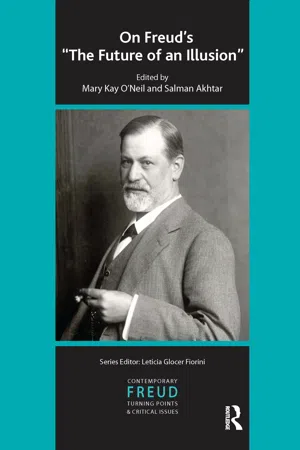
eBook - ePub
On Freud's The Future of an Illusion
- 318 pages
- English
- ePUB (mobile friendly)
- Available on iOS & Android
eBook - ePub
On Freud's The Future of an Illusion
About this book
"The Future of an Illusion" reveals Freud's reflections about religion as well as his hope that in the future science will go beyond religion, and reason will replace faith in God. The discussion with an imaginary critic revealed his internal debate, mirroring the debate about this subject in the outside world. However, it also enlightens his way of thinking: deconstructing and constructing at the same time. This volume considers Freudian ideas and their implications today, while focusing on the contradictions and gaps in Freud's proposals. The question of the coexistence between religion and psychoanalysis, as well as the place of ideals, belief, illusion, and imagination - and, no less important, the benevolent and destructive aspects of religion - also come into play.
Information
part I
The Future of an Illusion
(1927c)
Sigmund Freud
THE FUTURE OF AN ILLUSION
I
When one has lived for quite a long time in a particular civilization1 and has often tried to discover what its origins were and along what path it has developed, one sometimes also feels tempted to take a glance in the other direction and to ask what further fate lies before it and what transformations it is destined to undergo. But one soon finds that the value of such an enquiry is diminished from the outset by several factors. Above all, because there are only a few people who can survey human activity in its full compass. Most people have been obliged to restrict themselves to a single, or a few, fields of it. But the less a man knows about the past and the present the more insecure must prove to be his judgement of the future. And there is the further difficulty that precisely in a judgement of this kind the subjective expectations of the individual play a part which it is difficult to assess; and these turn out to be dependent on purely personal factors in his own experience, on the greater or lesser optimism of his attitude to life, as it has been dictated for him by his temperament or by his success or failure. Finally, the curious fact makes itself felt that in general people experience their present naively, as it were, without being able to form an estimate of its contents; they have first to put themselves at a distance from it—the present, that is to say, must have become the past—before it can yield points of vantage from which to judge the future.
Thus anyone who gives way to the temptation to deliver an opinion on the probable future of our civilization will do well to remind himself of the difficulties I have just pointed out, as well as of the uncertainty that attaches quite generally to any prophecy. It follows from this, so far as I am concerned, that I shall make a hasty retreat before a task that is too great, and shall promptly seek out the small tract of territory which has claimed my attention hitherto, as soon as I have determined its position in the general scheme of things.
Human civilization, by which I mean all those respects in which human life has raised itself above its animal status and differs from the life of beasts—and I scorn to distinguish between culture and civilization—, presents, as we know, two aspects to the observer. It includes on the one hand all the knowledge and capacity that men have acquired in order to control the forces of nature and extract its wealth for the satisfaction of human needs, and, on the other hand, all the regulations necessary in order to adjust the relations of men to one another and especially the distribution of the available wealth. The two trends of civilization are not independent of each other: firstly, because the mutual relations of men are profoundly influenced by the amount of instinctual satisfaction which the existing wealth makes possible; secondly, because an individual man can himself come to function as wealth in relation to another one, in so far as the other person makes use of his capacity for work, or chooses him as a sexual object; and thirdly, moreover, because every individual is virtually an enemy of civilization, though civilization is supposed to be an object of universal human interest.1 It is remarkable that, little as men are able to exist in isolation, they should nevertheless feel as a heavy burden the sacrifices which civilization expects of them in order to make a communal life possible. Thus civilization has to be defended against the individual, and its regulations, institutions and commands are directed to that task. They aim not only at effecting a certain distribution of wealth but at maintaining that distribution; indeed, they have to protect everything that contributes to the conquest of nature and the production of wealth against men’s hostile impulses. Human creations are easily destroyed, and science and technology, which have built them up, can also be used for their annihilation.
One thus gets an impression that civilization is something which was imposed on a resisting majority by a minority which understood how to obtain possession of the means to power and coercion. It is, of course, natural to assume that these difficulties are not inherent in the nature of civilization itself but are determined by the imperfections of the cultural forms which have so far been developed. And in fact it is not difficult to indicate those defects. While mankind has made continual advances in its control over nature and may expect to make still greater ones, it is not possible to establish with certainty that a similar advance has been made in the management of human affairs; and probably at all periods, just as now once again, many people have asked themselves whether what little civilization has thus acquired is indeed worth defending at all. One would think that a re-ordering of human relations should be possible, which would remove the sources of dissatisfaction with civilization by renouncing coercion and the suppression of the instincts, so that, undisturbed by internal discord, men might devote themselves to the acquisition of wealth and its enjoyment. That would be the golden age, but it is questionable if such a state of affairs can be realized. It seems rather that every civilization must be built up on coercion and renunciation of instinct; it does not even seem certain that if coercion were to cease the majority of human beings would be prepared to undertake to perform the work necessary for acquiring new wealth. One has, I think, to reckon with the fact that there are present in all men destructive, and therefore anti-social and anti-cultural, trends and that in a great number of people these are strong enough to determine their behaviour in human society.
This psychological fact has a decisive importance for our judgement of human civilization. Whereas we might at first think that its essence lies in controlling nature for the purpose of acquiring wealth and that the dangers which threaten it could be eliminated through a suitable distribution of that wealth among men, it now seems that the emphasis has moved over from the material to the mental. The decisive question is whether and to what extent it is possible to lessen the burden of the instinctual sacrifices imposed on men, to reconcile men to those which must necessarily remain and to provide a compensation for them. It is just as impossible to do without control of the mass1 by a minority as it is to dispense with coercion in the work of civilization. For masses are lazy and unintelligent; they have no love for instinctual renunciation, and they are not to be convinced by argument of its inevitability; and the individuals composing them support one another in giving free rein to their indiscipline. It is only through the influence of individuals who can set an example and whom masses recognize as their leaders that they can be induced to perform the work and undergo the renunciations on which the existence of civilization depends. All is well if these leaders are persons who possess superior insight into the necessities of life and who have risen to the height of mastering their own instinctual wishes. But there is a danger that in order not to lose their influence they may give way to the mass more than it gives way to them, and it therefore seems necessary that they shall be independent of the mass by having means to power at their disposal. To put it briefly, there are two widespread human characteristics which are responsible for the fact that the regulations of civilization can only be maintained by a certain degree of coercion—namely, that men are not spontaneously fond of work and that arguments are of no avail against their passions.
I know the objections which will be raised against these assertions. It will be said that the characteristic of human masses depicted here, which is supposed to prove that coercion cannot be dispensed with in the work of civilization, is itself only the result of defects in the cultural regulations, owing to which men have become embittered, revengeful and inaccessible. New generations, who have been brought up in kindness and taught to have a high opinion of reason, and who have experienced the benefits of civilization at an early age, will have a different attitude to it. They will feel it as a possession of their very own and will be ready for its sake to make the sacrifices as regards work and instinctual satisfaction that are necessary for its preservation. They will be able to do without coercion and will differ little from their leaders. If no culture has so far produced human masses of such a quality, it is because no culture has yet devised regulations which will influence men in this way, and in particular from childhood onwards.
It may be doubted whether it is possible at all, or at any rate as yet, at the present stage of our control over nature, to set up cultural regulations of this kind. It may be asked where the number of superior, unswerving and disinterested leaders are to come from who are to act as educators of the future generations, and it may be alarming to think of the enormous amount of coercion that will inevitably be required before these intentions can be carried out. The grandeur of the plan and its importance for the future of human civilization cannot be disputed. It is securely based on the psychological discovery that man is equipped with the most varied instinctual dispositions, whose ultimate course is determined by the experiences of early childhood. But for the same reason the limitations of man’s capacity for education set bounds to the effectiveness of such a transformation in his culture. One may question whether, and in what degree, it would be possible for a different cultural environment to do away with the two characteristics of human masses which make the guidance of human affairs so difficult. The experiment has not yet been made. Probably a certain percentage of mankind (owing to a pathological disposition or an excess of instinctual strength) will always remain asocial; but if it were feasible merely to reduce the majority that is hostile towards civilization to-day into a minority, a great deal would have been accomplished—perhaps all that can be accomplished.
I should not like to give the impression that I have strayed a long way from the line laid down for my enquiry [p. 5]. Let me therefore give an express assurance that I have not the least intention of making judgements on the great experiment in civilization that is now in progress in the vast country that stretches between Europe and Asia.1 I have neither the special knowledge nor the capacity to decide on its practicability, to test the expediency of the methods employed or to measure the width of the inevitable gap between intention and execution. What is in preparation there is unfinished and therefore eludes an investigation for which our own long-consolidated civilization affords us material.
II
We have slipped unawares out of the economic field into the field of psychology. At first we were tempted to look for the assets of civilization in the available wealth and in the regulations for its distribution. But with the recognition that every civilization rests on a compulsion to work and a renunciation of instinct and therefore inevitably provokes opposition from those affected by these demands, it has become clear that civilization cannot consist principally or solely in wealth itself and the means of acquiring it and the arrangements for its distribution; for these things are threatened by the rebelliousness and destructive mania of the participants in civilization. Alongside of wealth we now come upon the means by which civilization can be defended—measures of coercion and other measures that are intended to reconcile men to it and to recompense them for their sacrifices. These latter may be described as the mental assets of civilization.
For the sake of a uniform terminology we will describe the fact that an instinct cannot be satisfied as a ‘frustration’, the regulation by which this frustration is established as a ‘prohibition’ and the condition which is produced by the prohibition as a ‘privation’. The first step is to distinguish between privations which affect everyone and privations which do not affect everyone but only groups, classes or even single individuals. The former are the earliest; with the prohibitions that established them, civilization—who knows how many thousands of years ago?—began to detach man from his primordial animal condition. We have found to our surprise that these privations are still operative and still form the kernel of hostility to civilization. The instinctual wishes that suffer under them are born afresh with every child; there is a class of people, the neurotics, who already react to these frustrations with asocial behaviour. Among these instinctual wishes are those of incest, cannibalism and lust for killing. It sounds strange to place alongside one another wishes which everyone seems united in repudiating and others about which there is so much lively dispute in our civilization as to whether they shall be permitted or frustrated; but psychologically it is justifiable to do so. Nor is the attitude of civilization to these oldest instinctual wishes by any means uniform. Cannibalism alone seems to be universally proscribed and—to the non-psycho-analytic view—to have been completely surmounted. The strength of the incestuous wishes can still be detected behind the prohibition against them; and under certain conditions killing is still practised, and indeed commanded, by our civilization. It is possible that cultural developments lie ahead of us in which the satisfaction of yet other wishes, which are entirely permissible to-day, will appear just as unacceptable as cannibalism does now.
These earliest instinctual renunciations already involve a psychological factor which remains important for all further instinctual renunciations as well. It is not true that the human mind has undergone no development since the earliest times and that, in contrast to the advances of science and technology, it is the same to-day as it was at the beginning of history. We can point out one of these mental advances at once. It is in keeping with the course of human development that external coercion gradually becomes internalized; for a special mental agency, man’s super-ego, takes it over and includes it among its commandments.1 Every child presents this process of transformation to us; only by that means does it become a moral and social being. Such a strengthening of the super-ego is a most precious cultural asset in the psychological field. Those in whom it has taken place are turned from being opponents of civilization into being its vehicles. The greater their number is in a cultural unit the more secure is its culture and the more it can dispense with external measures of coercion. Now the degree of this internalization differs greatly between the various instinctual prohibitions. As regards the earliest cultural demands, which I have mentioned, the internalization seems to have been very extensively achieved, if we leave out of account the unwelcome exception of the neurotics. But the case is altered when we turn to the other instinctual claims. Here we observe with surprise and concern that a majority of people obey the cultural prohibitions on these points only under the pressure of external coercion—that is, only where that coercion can make itself effective and so long as it is to be feared. This is also true of what are known as the moral demands of civilization, which likewise apply to everyone. Most of one’s experiences of man’s moral untrustworthiness fall into this category. There are countless civilized people who would shrink from murder or incest but who do not deny themselves the satisfaction of their avarice, their aggressive urges or their sexual lusts, and who do not hesitate to injure other people by lies, fraud and calumny, so long as they can remain unpunished for it; and this, no doubt, has always been so through many ages of civilization.
If we turn to those restrictions that apply only to certain classes of society, we meet with a state of things which is flagrant and which has always been recognized. It is to be expected that these underprivileged classes will envy the favoured ones their privileges and will do all they can to free themselves from their own surplus of privation. Where this is not possible, a permanent measure of discontent will persist within the culture concerned and this can lead to dangerous revolts. If, however, a culture has not got beyond a point at which the satisfaction of one portion of its participants depends upon the suppression of another, and perhaps larger, portion—and this is the case in all present-day cultures—it is understandable that the suppressed people should develop an intense hostility towards a culture whose existence they make possible by their work, but in whose wealth they have too small a share. In such conditions an internalization of the cultural prohibitions among the suppressed people is not to be expected. On the contrary, they are not pr...
Table of contents
- Cover
- Half Title
- Title Page
- Copyright Page
- Contents
- Contemporary Freud
- Acknowledgements
- Editors and Contributors
- Introduction
- Part I The Future of an Illusion (1927c)
- Part II Discussion of The Future of an Illusion
- Epilogue
- References
- Index
Trusted by 375,005 students
Access to over 1.5 million titles for a fair monthly price.
Study more efficiently using our study tools.
Frequently asked questions
Yes, you can cancel anytime from the Subscription tab in your account settings on the Perlego website. Your subscription will stay active until the end of your current billing period. Learn how to cancel your subscription
No, books cannot be downloaded as external files, such as PDFs, for use outside of Perlego. However, you can download books within the Perlego app for offline reading on mobile or tablet. Learn how to download books offline
Perlego offers two plans: Essential and Complete
- Essential is ideal for learners and professionals who enjoy exploring a wide range of subjects. Access the Essential Library with 800,000+ trusted titles and best-sellers across business, personal growth, and the humanities. Includes unlimited reading time and Standard Read Aloud voice.
- Complete: Perfect for advanced learners and researchers needing full, unrestricted access. Unlock 1.5M+ books across hundreds of subjects, including academic and specialized titles. The Complete Plan also includes advanced features like Premium Read Aloud and Research Assistant.
We are an online textbook subscription service, where you can get access to an entire online library for less than the price of a single book per month. With over 1.5 million books across 990+ topics, we’ve got you covered! Learn about our mission
Look out for the read-aloud symbol on your next book to see if you can listen to it. The read-aloud tool reads text aloud for you, highlighting the text as it is being read. You can pause it, speed it up and slow it down. Learn more about Read Aloud
Yes! You can use the Perlego app on both iOS and Android devices to read anytime, anywhere — even offline. Perfect for commutes or when you’re on the go.
Please note we cannot support devices running on iOS 13 and Android 7 or earlier. Learn more about using the app
Please note we cannot support devices running on iOS 13 and Android 7 or earlier. Learn more about using the app
Yes, you can access On Freud's The Future of an Illusion by Mary Kay O'Neil, Salman Akhtar, Mary Kay O'Neil,Salman Akhtar in PDF and/or ePUB format, as well as other popular books in Theology & Religion & History & Theory in Psychology. We have over 1.5 million books available in our catalogue for you to explore.