Learn how to shift from teaching science content to teaching a more hands-on, inquiry-based approach, as required by the new Next Generation Science Standards. This practical book provides a clear, research verified framework for building lessons that teach scientific process and practice abilities, such as gathering and making sense of data, constructing explanations, designing experiments, and communicating information. Creating Scientists features reproducible, immediately deployable tools and handouts that you can use in the classroom to assess your students' learning within the domains for the NGSS or any standards framework with focus on the integration of science practice with content. This book is an invaluable resource for educators seeking to build a "community of practice," where students discover ideas through well-taught, hands-on, authentic science experiences that foster an innate love for learning how the world works.
eBook - ePub
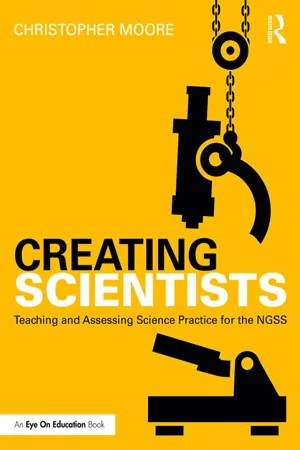
Creating Scientists
Teaching and Assessing Science Practice for the NGSS
- 184 pages
- English
- ePUB (mobile friendly)
- Available on iOS & Android
eBook - ePub
About this book
Information
Part I
Teaching and Assessing Science Practice

1
What Is Science Practice?
“Science practices are ‘habits of mind’ of scientists and engineers, things that they do on a regular basis in their work.”
—The Rutgers Physics and Astronomy Education Research Group (Etkina et al., 2017)

If we want to teach students science practices, then we first have to define what we mean by the term. Fundamentally, science practices are simply those things that expert scientists do. If we can teach students to think and act like practicing scientists, then they will learn the community accepted practices for discovering new truths about the physical world around them. It seems simple enough, but it does present the question: What exactly does a scientist do? What does it mean to be a capable scientist? How does an expert practice science, and how does a novice student think it should be practiced? The focus of this chapter is on answering these questions.
First, we’ll look at how students think science should be done, and then we’ll look at how scientists actually do science. As an educated science teacher, you will probably not be surprised by the types of practices put into place by professional scientists and their views about the discipline; however, you may be surprised by how students view science and its practices. We will examine the typical student’s view of what science is and compare that to the expert’s view, exposing the wide gap between the two. This will be important when we start to look at how to teach practices in the next chapter. If we aren’t careful, the laboratories and many classroom activities we use could actually reinforce the student’s novice view of science, and lead to the propagation of poor practices.
As we continue this chapter, we’ll look at what the Next Generation Science Standards (NGSS) expects students should be able to do with respect to science practices throughout their K–12 education. I’ll define science practices more explicitly, as they are outlined in the National Research Council’s excellent document A Framework for K–12 Science Education (which I’ll refer to as simply the Framework throughout the rest of the book; National Research Council, 2012). We’ll also examine how these science practices are integrated within the performance expectations in the NGSS.
How Do Students View the Practice of Science?
My own research and that of my colleagues over the past decade has shown that fundamentally, the major distinction between the novice student and the expert scientist is in the way they think about and view science and its practice (Moore, 2012). In particular, the psychology and education professor Deanna Kuhn suggests that the distinction is most clear through their “epistemological appreciation” of how new knowledge is formed (Kuhn, 2004). Epistemology is the study of the nature of knowledge and how we go about acquiring knowledge. This is very relevant to our discussion about science practice, because it turns out that how a student views the practice of science is fundamentally a function of their epistemological beliefs (Edmondson & Novak, 1993).
As one example, the novice student will often make subconscious justifications for the way they practice science based on their view that science knowledge is “propagated stuff.” They use a specific equation to solve some problem because an expert told them that that is how it should be done. Or, they learn that the mitochondria is the “powerhouse of the cell” from their textbook or class lecture. Maybe they memorize the periodic table of the elements for recall on an exam in the future. All of this is science knowledge, but it isn’t sense-making, in that they may know the fact but not necessarily the why and how. Their view of knowledge acquisition in the sciences, their epistemology, is that “experts” provide “facts.”
If a student gets stuck in this mental framing in the science class, and it seems that they often do, then that student starts seeing science as merely a collection of facts, and experiments as mere ancillaries to learning those facts (Tsai, 1998). Obviously, we want to move students away from this naïve view about science, experiments, and the nature of knowledge formation, because this just isn’t how science is practiced. If we want to create scientists, then we need students to start viewing science as a process of discovery.
We can actually learn a lot about how students view science from prior research. For example, the Views About Sciences Survey (VASS) is a relatively short and simple pencil-and-paper assessment that probes student views about science along six dimensions (Hestenes & Halloun, 1996):
- Structure
- Methodology
- Validity
- Learnability
- Reflective thinking
- Personal relevance
Over the past few decades, this assessment has been deployed in numerous science classrooms across the United States. From the results, we can build a fairly good picture of how the novice student views science across these dimensions. These novice student views are summarized in Table 1.1 (Hestenes & Halloun, 1998).
For the purposes of this book, let’s focus on the first three dimensions of student views: structure, methodology, and validity. These three dimensions make up the foundational views used by students to construct an understanding of the practice of science. Specifically, results from the VASS suggest that students typically view the structure of science as being a collection of facts, the practice of science as situationally dependent, and the validity of science as being absolute, with no room for growth. Also note that students have an interesting view about how science is learned: by memorizing facts.
| Dimension | How Students View Science |
| Structure | Science is a loose collection of directly perceived facts. |
| Methodology | The methods of science are specific to the discipline. |
| Validity | Scientific knowledge is exact, absolute, and final. |
| Learnability | Science is learnable by a few talented people. |
| Reflective thinking | For meaningful understanding of science, one needs to memorize facts. |
| Personal relevance | Science is of exclusive concern to scientists. |
Source : Adapted from (Hestenes & Halloun, 1998)
In contrast, Table 1.2 shows the stark difference between the novice student and the expert scientist in their views across these three dimensions (Hestenes & Halloun, 1998). The expert scientist recognizes the tentative nature of science that is an ever-expanding body of knowledge with cross-cutting methodologies. The scientist believes the learning of science happens through the practice of science.
What’s really scary is that studies have shown that as students go through school, their views about science actually get worse! Our teaching could be pushing students away from expert-like views about science (Adams et al., 2006; Shan, 2013). How is this so? Let’s think about a possible example where we readily give away the answers in the classroom. A student may ask: “Why is the air above the toaster wiggly?” As science teachers, we love getting questions like this from students, because they demonstrate genuine curiosity within those brains. But maybe we are a little too quick to launch into a lecture on air density and refraction. Once students know the answer, they have a fact. Imagine observing a magic act where the trick is revealed. You may nod your head and feel some satisfaction for learning a fact, but you are certainly no closer to becoming a magician. There is an art to the practice of magic that goes beyond knowing tricks.
What are we doing when we spend a majority of our time focusing on the teaching of facts in the science classroom? We are reinforcing this novice-like conception about science that it is a collection of facts to be learned, when science is really a process that leads to new knowledge. Just like you might walk away from our magic show assuming magic is a collection of tricks to be learned, and nothing more.
| Dimension | How Scientists View Science |
| Structure | Science is a coherent body of knowledge about patterns in nature. |
| Methodology | The methods of science are cross-cutting. |
| Validity | Scientific knowledge is tentative and refutable. |
Source: Adapted from (Hestenes & Halloun, 1998)
But what about the laboratory component of the science class? The middle school student might melt ice in a cup and measure the change in temperature as a function of the mass of the ice to demonstrate the already taught “law” that heat transfer is proportional to the mass. The high school student might use these same data to determine the heat capacity of the material. The student may drop items of varying weight from the bleachers to determine that they truly do fall at the same rate. These are examples where the answer is already known. Typically, the experiment is given to the student, too!
There is no real discovery for the student dropping items from the bleachers. It sure is fun, but the student is merely demonstrating a “fact” that he or she probably already “learned” in class. The hypo...
Table of contents
- Cover
- Title
- Copyright
- Dedication
- Contents
- About the Author
- Acknowledgments
- Introduction: How Do You Create Scientists?
- Part I: Teaching and Assessing Science Practice
- Part II: Science Practice in the Classroom
- Part III: Putting It All Together
Trusted by 375,005 students
Access to over 1.5 million titles for a fair monthly price.
Study more efficiently using our study tools.
Frequently asked questions
Yes, you can cancel anytime from the Subscription tab in your account settings on the Perlego website. Your subscription will stay active until the end of your current billing period. Learn how to cancel your subscription
No, books cannot be downloaded as external files, such as PDFs, for use outside of Perlego. However, you can download books within the Perlego app for offline reading on mobile or tablet. Learn how to download books offline
Perlego offers two plans: Essential and Complete
- Essential is ideal for learners and professionals who enjoy exploring a wide range of subjects. Access the Essential Library with 800,000+ trusted titles and best-sellers across business, personal growth, and the humanities. Includes unlimited reading time and Standard Read Aloud voice.
- Complete: Perfect for advanced learners and researchers needing full, unrestricted access. Unlock 1.5M+ books across hundreds of subjects, including academic and specialized titles. The Complete Plan also includes advanced features like Premium Read Aloud and Research Assistant.
We are an online textbook subscription service, where you can get access to an entire online library for less than the price of a single book per month. With over 1.5 million books across 990+ topics, we’ve got you covered! Learn about our mission
Look out for the read-aloud symbol on your next book to see if you can listen to it. The read-aloud tool reads text aloud for you, highlighting the text as it is being read. You can pause it, speed it up and slow it down. Learn more about Read Aloud
Yes! You can use the Perlego app on both iOS and Android devices to read anytime, anywhere — even offline. Perfect for commutes or when you’re on the go.
Please note we cannot support devices running on iOS 13 and Android 7 or earlier. Learn more about using the app
Please note we cannot support devices running on iOS 13 and Android 7 or earlier. Learn more about using the app
Yes, you can access Creating Scientists by Christopher Moore in PDF and/or ePUB format, as well as other popular books in Education & Education General. We have over 1.5 million books available in our catalogue for you to explore.