eBook - ePub
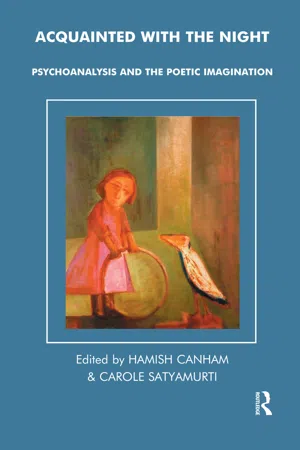
Acquainted with the Night
Psychoanalysis and the Poetic Imagination
- 240 pages
- English
- ePUB (mobile friendly)
- Available on iOS & Android
eBook - ePub
About this book
This book explores some of the ways in which an understanding of poetry, and the poetic impulse, can be fruitfully informed by psychoanalytic ideas. It could be argued that there is a particular affinity between poetry and psychoanalysis, in that both pay close attention to the precise meanings of linguistic expression, and both, though in different ways, are centrally concerned with unconscious processes. The contributors to this volume, nearly all of them clinicians with a strong interest in literature, explore this connection in a variety of ways, focusing on the work of particular poets, from the prophet Ezekiel to Seamus Heaney.Part of the Tavistock Clinic Series.
Information
Chapter One
The vale of soul-making
There are many affinities between the poetic process and the psychoanalytic process. The value of engaging with inner and outer experience and their meeting ground, and of finding some way of communicating that experience is the stuff of each. I shall constantly be drawing on the one to illuminate the other, while not wishing to blur distinctiveness nor to oversimplify similarity. But I have a specific focus: that it is this very engagement with experience, the capacity to suffer it and to think about it, that is essential to the growth of the mind. The vale of soul-making of my title was Keats’s metaphor for the life of the mind, one that is lived through creative psychic activity (Williams, 1991, pp. 109–125). In Keats’s journal-letter to George and Georgiana Keats (Letters, 1819: p. 249) he offers a wonderful description of the process which has become intrinsic, implicitly, to the contemporary psychoanalytic picture of human development: that development is rooted in the capacity to undergo experience, neither evading it nor being defeated by it, and that psychic growth only occurs in so far as a person’s experience makes sense by having been worked on truthfully internally. This picture underlies my central concern with the nature of meaning, how meaning is generated and registered.
The congruencies between poetry and psychoanalysis have long been recognized. Finding symbolic form for elusive and possibly as-yet-unknown emotions or psychic states—the power that Shakespeare ascribed, in A Midsummer Night’s Dream, to the “poet’s pen” to give to “airy nothing” a “local habitation and a name”—this process is shared by poets and psychoanalysts alike (Williams, 1991, pp. 8–52). Psychoanalyst Thomas Ogden (2002) writes as follows:
Perhaps what is most fundamental to both poetry and psychoanalysis is the effort to enlarge the breadth and depth of what we are able to experience. It seems to me that both poetry and psychoanalysis at their best use language in a way that encompasses a full range of human experience—as Jarrell (1955), speaking of Frost, put it—from “the most awful and the most nearly unbearable parts to the most tender, subtle, and loving parts, a distance so great” (p. 62). Both poetry and psychoanalysis endeavour to “include, connect, and make humanly understandable or humanly un-understandable so much” (p. 62). [p. 113]
Writing explicitly about the relationship between the poet and the psychoanalyst, in this case, T. S. Eliot and W. R. Bion, Anna Halton (1980) notes a striking comparison:
When an analyst describes an interpretation like this:
“I was listening to the silence; I was listening to the interference; I was listening to what came between him and me; I can now draw you a picture in words … a representation of what I intuited during so many minutes, or weeks, or years,” it reminds us of a poem.
When a poet describes poetry like this: “… the abstract conception of private experience at its greatest intensity, becoming universal”, it reminds us of an interpretation. This is Bion and Eliot attempting to communicate something of the nature of the complex task they have set themselves, [p. 25]
Reaching within, the poet distils emotional states, finds expression for them and makes them, thus, available for thought. So often poems express the extraordinary in the ordinariness of human emotion. Drawing on Heaney, Hamish Canham describes how “detailed and honest description of a moment, or a memory, can open it up … subjecting this moment or memory to such scrutiny can be both transforming and liberating” (this volume, p. 190). This is precisely the process to which Hanna Segal draws attention in her discussion of Proust (1991, pp. 86–89). Familiar to psychoanalysts will be this urge, particularly in twentieth-century writing, to establish the significance of the apparently mundane and the value of engaging with all experience.
It is in the understanding of dreaming, and in the role of dream interpretation, that the psychoanalytic and the poetic become especially close. The contemporary view of dream-life is that it is the product, as Donald Meltzer (1984) puts it, of “the meaningful core of the experience which requires transformation into symbolic form in order for it to be thought about and communicated to fellow creatures” (p. 27). This way of seeing things construes the metaphors of dream-work as tracing and communicating inner reality, a process which is made possible by the prior containment of the raw sensa of emotional experience within a psychically “holding” relationship—whether this be between mother and baby, between therapist and patient, or between artist and art-object. These are loose analogies rather than exact parallels, but such relationships can each bring about a kind of “realization” which lies outside the realm of consciousness. The medium is symbolic form. In the language of poetic diction, “the metaphor attempts to arouse cognition of the unknown by suggestion from the known” (Barfield, 1928, p. 110), or, as Shelley put it, effectively defining the essence of poetry: “Metaphorical language marks the before unapprehended relations of things” (quoted by Barfield, p. 67).
The way in which the meaning of a dream emerges in the shared work of analyst and analysand is a rather wonderful experience, akin to the dawning recognition of what a poem is actually about. In the contained and structured space of the analytic setting those “unapprehended relations of things” become apparent, just as literary form captures and yields up the experience which underlay the creative act itself.
And yet psychoanalysis is not poetry. Certainly the poet’s task of being true to the self and of communicating to others through words is related to the task both of the patient and of the analyst, yet the poet’s talent, as I hope to show, condenses and builds on what the analyst tries to do and, in more publicly shareable ways, “moves” in Dryden’s words, “the sleeping images of things towards the light”. As Carole Satyamurti puts it:
… poetry, like psychoanalysis, is centrally concerned with the way language behaves; … the poet and the analyst share an acute attentiveness to the precise and multiple meanings and associations that words may have, and to the way they are transformed by the specific context in which they are used … [this volume p. 32]
… what the language of an achieved poem does is to transform experience, not merely provide a verbal equivalent of it … the making of the poem is … just as much “life itself” as life itself … The form—the language—is, in part, the content, [p. 36]
Barfield (1928) stated that “meaning can never be conveyed from one person to another; words are not bottles; every individual must intuit meaning for himself, and the function of the poetic is to mediate such intuition by suitable suggestion” (p. 138). This description of the poetic encapsulates rather beautifully and specifically something essential to the developmental process. In my exploration of meaning, I shall be touching on the complexities of the psychoanalytic interpretative function as mediating “intuition by suitable suggestion”, especially in relation to the interpretation of dreams, and the deep affinity both between that process and the role of the poet, and also between dreaming itself and the making of the poem.
In Bion’s later work, the problem of how to engage with meaning, to express it and to elaborate it becomes central. It becomes central in ways which often evoke quite arresting resonances with the preoccupations and dilemmas of creative artists over the years—especially of the poets and, of those poets, perhaps most of all the Romantics—to be later echoed and re-echoed by many others, but stated with particular force in the poetry and reflective prose of T. S. Eliot.
Throughout his life, and perhaps more than most psychoanalysts, or at least more explicitly than most, Bion struggled to find language for his clinical insights; some way of conveying the immediacy of experience without reducing its impact and significance and without de-limiting the relationship and shared perceptions which were precariously in the process of becoming. He, like many others, was acutely aware that words, indeed, “are not bottles”, that words belong in the particularities of the analytic relationship, itself highly structured by the setting. Here, too, words are finely wrought, culled from the shared relationship and having a particular specificity of tone, pace, and temperature. The issue of at what point, and why, words may be registered as meaningful in a transformative, or perhaps catastrophic, way, commands continuous attention, scrutiny, and debate.
Bion is at his most explicit in his final trilogy, A Memoir of the Future. Through dramatic fiction, rather than theory, he illuminatingly, though not wholly successfully, sought to express the meaning of the internal world. His endeavour was to find a way to avoid pinioning meaning by the discursive analytic mode. He was acutely aware of the predicament both of the psychoanalytic interpretation and of psychoanalytic theorizing more generally. “The words in which we dress ideas disguise, as readily as they display, the meaning to which we aspire” (p. 478). In the persona of PA, the psychoanalyst of the internal drama, Bion speaks challengingly and poignantly to what he felt to be his own plight: “Language … as used by me, is a distorted, distorting, turbulent reflecting surface” (p. 490). “The ‘pen’… will imprison me and my meaning—inescapably” (p. 477). At this point, Bion was rejecting what he called the “Satanic Jargonieur” and was, with jokey seriousness, suggesting that “Disguised as fiction the truth occasionally slipped through” (p. 302).
A central tenet of this trilogy is the problem of ordinary language being inadequate to formulate thoughts which reach beyond the sensual for their formal structure and require, essentially, the evocative. The Memoir seeks to engage with the problem of how external world events are uniquely registered internally and how internal world events impinge back on external ones. Echoing Coleridge (“the chameleon darkens in the shade of him who bends over to ascertain its colours” [1839, p. 80]), Bion was quite clear that the thing itself is altered by being observed, and particularly by being articulated.
The constraining and camouflaging function of words, how they can reduce rather than enhance experience, is beautifully caught in two short, contemporary poems which, with extraordinary simplicity and clarity, evoke, respectively, a child and a young girl’s sense of words being substituted for the immediacy of passionate involvement (limiting or foreclosing development), and of words being used to dissimulate, and so to confuse, mystify, and distort (also limiting and foreclosing development). Each poem describes the potential stultification of young experience and the road-blocks which words can pose when they are at odds with felt experience, when they lack the ring of truth. At the same time each one also demonstrates the developmental possibilities when words and felt experience coalesce. The first is by Anne Stevenson (2000), “A Surprise on the First Day of School”.
They give you a desk with a lid, mother.
They let you keep your book.
My desk’s next to the window.
I can see the trees.
But you mustn’t look out of the window
at light on the leaves.
You must look at the book.
A nice-smelling, shiny book, mother,
With words in it and pictures.
I mostly like the pictures,
some of them animals and birds.
But you mustn’t look at the pictures.
You don’t ever read the pictures.
You read the words!
They let you keep your book.
My desk’s next to the window.
I can see the trees.
But you mustn’t look out of the window
at light on the leaves.
You must look at the book.
A nice-smelling, shiny book, mother,
With words in it and pictures.
I mostly like the pictures,
some of them animals and birds.
But you mustn’t look at the pictures.
You don’t ever read the pictures.
You read the words!
The metric and rhythmic variations in this poem artfully catch the child’s sensuous delight—enthusiastically attracted by sun on leaves and pictures of animals and birds—and starkly contrasts that delight with the reining-in of imaginative impulsiveness by the end-stopped lines of the school regimen. The poem suggests that that first day of school signals some kind of death to the spirit of childhood in a learning-about culture where words become privileged above all other aesthetic responses—words, here, signifying the loss of a whole world, the constriction of unfettered joy and freedom in favour of learning defined by externals, arresting emotional experience and setting the individual apart from his or her former self. It expresses the price to the personality of the exigencies of conformity, and succinctly evokes Bion’s fundamentally important distinction, where personal development is concerned, between learning about things and learning from experience.
Yet so much more is embedded in the lines of this beguilingly simple poem. It offers a taut expression for all those life experiences which hold in precarious balance the possibility of genuinely moving on psychically, and the danger of living merely by the trappings of development, the external experiences concealing the internal lack. The poem’s voice immediately establishes the tension between two worlds—the “they” of the external world and the “mother” of the internal. “They give you a desk with a lid, mother”. That first line asserts the lure of things, of pride of possession, of special features, of status and position. One can sense the seductive power of those external-world values and, as the poem unfolds, the increasingly authoritarian hold they come to have on the personality. The lines, despite their straightforwardness, are by no means merely descriptive. In the slightly breathless tempo and tone there is a hint of the persuasive, the proud, but also of the tentative—as if the “child” persona senses, and struggles with, the betrayal of inner values. The poem is more than a statement of the hitherto untried blandishments of external reality, it is a statement ridden with conflict and uncertainty, as if with an unconscious awareness of seduction, and also of relinquishment—seduction and relinquishment, a painful duo which thereafter attends, or is at play in, every further step towards necessary social adaptation and away from the personal and, perhaps, too idiosyncratic links with inner reality.
The words also carry a hint of appeasement—registering the child’s sense of the mother’s loss, the loss of the child who is now making his/her way away—into the world outside, a world apart from the security of the known mother-child relationship. This child’s account of the school-day suggests some feeling for the maternal wrench of yi...
Table of contents
- Cover
- Half Title
- Series Page
- Title
- Copyright
- Dedication
- CONTENTS
- ACKNOWLEDGEMENTS
- SERIES EDITOR’S PREFACE
- FOREWORD
- CONTRIBUTORS
- Introduction
- CHAPTER ONE The vale of soul-making
- CHAPTER TWO “First time ever”: writing the poem in potential space
- CHAPTER THREE Wordless words: poetry and the symmetry of being
- CHAPTER FOUR The poet and the superego: Klein, Blake and the Book of the Prophet Ezekiel
- CHAPTER FIVE “Time will come and take my love away”: love and loss in three of Shakespeare’s sonnets
- CHAPTER SIX The preacher, the poet, and the psychoanalyst
- CHAPTER SEVEN Ghosts in the landscape: Thomas Hardy and the poetry of “shapes that reveries limn”
- CHAPTER EIGHT The elusive pursuit of insight: three poems by W. B. Yeats and the human task
- CHAPTER NINE “Feeling into Words”: evocations of childhood in the poems of Seamus Heaney
- INDEX
Trusted by 375,005 students
Access to over 1.5 million titles for a fair monthly price.
Study more efficiently using our study tools.
Frequently asked questions
Yes, you can cancel anytime from the Subscription tab in your account settings on the Perlego website. Your subscription will stay active until the end of your current billing period. Learn how to cancel your subscription
No, books cannot be downloaded as external files, such as PDFs, for use outside of Perlego. However, you can download books within the Perlego app for offline reading on mobile or tablet. Learn how to download books offline
Perlego offers two plans: Essential and Complete
- Essential is ideal for learners and professionals who enjoy exploring a wide range of subjects. Access the Essential Library with 800,000+ trusted titles and best-sellers across business, personal growth, and the humanities. Includes unlimited reading time and Standard Read Aloud voice.
- Complete: Perfect for advanced learners and researchers needing full, unrestricted access. Unlock 1.5M+ books across hundreds of subjects, including academic and specialized titles. The Complete Plan also includes advanced features like Premium Read Aloud and Research Assistant.
We are an online textbook subscription service, where you can get access to an entire online library for less than the price of a single book per month. With over 1.5 million books across 990+ topics, we’ve got you covered! Learn about our mission
Look out for the read-aloud symbol on your next book to see if you can listen to it. The read-aloud tool reads text aloud for you, highlighting the text as it is being read. You can pause it, speed it up and slow it down. Learn more about Read Aloud
Yes! You can use the Perlego app on both iOS and Android devices to read anytime, anywhere — even offline. Perfect for commutes or when you’re on the go.
Please note we cannot support devices running on iOS 13 and Android 7 or earlier. Learn more about using the app
Please note we cannot support devices running on iOS 13 and Android 7 or earlier. Learn more about using the app
Yes, you can access Acquainted with the Night by Hamish Canham,Carole Satyamurti in PDF and/or ePUB format, as well as other popular books in Literature & Literary Criticism in Poetry. We have over 1.5 million books available in our catalogue for you to explore.