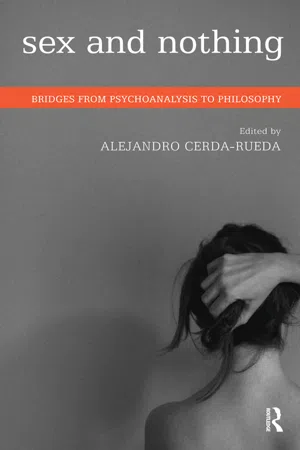
From its etymological roots, sex is related to a scission, Latin for sectus, secare, meaning "to divide or cut." Therefore, regardless of the various studies applied to defining sex as inscribed by discursive acts, i.e. merely a 'performatively enacted signification,' there is something more to sex than just a social construction or an aprioristic substance. Sex is irreducible to meaning or knowledge. This is why psychoanalysis cannot be formulated as an erotology nor a science of sex (scientia sexualis). In this matter, sex escapes the symbolic restraints of language; however, it is through its failure that it manifests itself through the symbolic, e.g. symptoms or dream life. So, what is sex? Sex and Nothing embarks upon a dialogue between colleagues and friends interested in bridging psychoanalysis and philosophy, linking sex and thought, where what emerges is a greater awareness of the irreducucibility of sex to the discourse of knowledge and meaning: in other words, sex and nothing.
- 240 pages
- English
- ePUB (mobile friendly)
- Available on iOS & Android
eBook - ePub
About this book
Information
Introduction
Alejandro Cerda-Rueda
Ljubljanski zmaji
A couple of meters away from the emblematic Triple Bridge (Tromostovje) within the Prešeren Square lies the baroque-style Franciscan Church of the Annunciation. As we take a stroll down the streets we come across the Zmajski most, a triple-hinged arch bridge over the Ljubljanica river. There, one is met by four fiery sheet-copper dragon statues standing on pedestals in every corner of the overpass. Even when the overpass—formerly known as the Jubilee Bridge of the Emperor Franz Josef I, in honour of the Austro-Hungarian monarch, and later renamed Dragon Bridge in 1919—prevails as a landmark for bystanders and visitors, the reference to the steadfast creatures cannot be ignored. In short, Ljubljana, the capital of Slovenia, is prominently known as a land of dragons.
Where do these dragons come from? According to Slavic mythology, the slaying of a dragon released the waters and ensured the fertility of the earth. Furthermore, written records by Sozomen and Zosim, Antiquity writers from the fifth and sixth century, establish that when the Argonauts traveled through this region, while returning home after having taken the Golden Fleece, they found a lake surrounded by a marsh inhabited by dragons. Legend has it that when Jason killed a monster that lived in the marshlands, which turned out to be a dragon, Emona was founded, an ancient Roman colony serving as a mythical ancestor to Ljubljana. Moreover, according to the Slovenian art historian Gorazd Makarovič, the knowledge of dragons within Slovenian folklore was only introduced during the fourteenth century by church depictions of Saint George (the city’s protector) slaying dragons. Notwithstanding, it is also important to denote that the Greek word δράκων preserves the ambivalent disposition dragons hold towards humans: they can either be benevolent companions or evil opponents. In addition, it is interesting to point out that in Slovenian, a dragon is commonly referred to by using the masculine form of the word for snake, zmaj.
However, this book is not about dragons, but rather it is about a town inhabited by them. Ljubljana is a capital with a vast history expanding across many centuries, from a strong Catholic influence prior to the Second World War to being part of the former socialist republic of Yugoslavia. Indeed, its background is rich and what concerns us here is its global relevancy in the field of psychoanalysis and philosophy. What is it about these dragons that still inhabit the city’s hearthstone?
In this sense, while walking along the asphalt streets of Ljubljana under a summer sky, approaching the zmaji that await ceremoniously on the overpass, it is tempting, as when Oedipus addressed the Sphinx at Thebes, to ask these monumental sheet-copper statues a fundamental question: why is sex so important?
Freud and the mark of sex
In his renowned Letter 52 (December 6th, 1896), Freud asserts to a specific annotation concerning sex: it is uninhibitable. He describes that while other psychic processes compromise to inhibitions in order to maintain normal defenses (or even pathological ones), there is, indeed, one case in which inhibition does not suffice. He explains: “If A, when it was current, released a particular unpleasure, and if when it is reawakened it releases fresh unpleasure, then this cannot be inhibited. [. . .] This case can occur only with sexual events, because the magnitudes of the excitations which these release increase of themselves with time (with sexual development)” (Masson, 1985, p. 209). Therefore one could be misled to relate sexual events only to unpleasurable increasing amounts of tension, which is not the case, but rather one should focus on the consequences of such mixture between pleasure/unpleasure cathexias.
According to Freud, a sexual event is uninhibitable in any phase of development, be it during childhood or the adult stage. Even when not all sexual experiences release unpleasure, which usually most of them release far greater pleasure, “this reproduction of most of them is linked with uninhibitable pleasure” (Masson, 1985, p. 209). This is what Freud called “compulsion”. Henceforth, following Freud’s thoughts in this missive, the process of translation from one successive registration to “successive epochs of life” will remain inhibited while the sexual event is constant (i.e., uninhibitable). In a way, we could understand this as a female patient pointed out: “I don’t understand why I need to talk about this [an early sexual experience] if it happened a long time ago.” In short, we could say that that which “happened a long time ago” was never inhibited and thus is happening hic et nunc.
On the other hand, let us focus for a brief moment on the critiques that have plagued an ubiquitous commonplace signaling towards a certain Freudian pansexualism. Apparently, everything that Freud considered relevant had to do exclusively with sex. In a way, these remarks are right and wrong at the same time. There is, indeed, a special place for sex in psychoanalysis, but this is usually not the locus many individuals (and even psychoanalysts) tend to imagine it to be. Rather than being a firm ground of placement and archetypal symbols, it is more closely related to a cornerstone of disjunction—one might even say, the unobtainable missing piece of an undeterminable puzzle. If Freud pinpointed so adamantly towards sex, it meant that it had to do with something other than everything. Sex, in this case, is basically linked to nothing.
The subject stumbles with its limit
From its etymological roots, sex is related to a scission, Latin for sectus, secare, “to divide or cut”. Therefore, regardless of the various studies applied to defining sex as inscribed by discursive acts, i.e., merely a “performatively enacted signification”, there is something more to sex than just a social construction or an aprioristic substance. As Copjec contests: “If sex is something that is ‘made up,’ it can also be unmade” (Copjec, 1994, p. 202). This does not enable the individual to make/unmake sex at will, but rather it allows the possibility of establishing a division within, an internal fissure. Consequently, when psychoanalysis confronts the question of sex, in fact, it is attempting to comprehend the problem of limit. In this sense, the concept of limit is best understood as the subject’s finitude, most importantly distinguishing it as a sexed being. Nevertheless, this does not mean that sex is exclusive to human activity, since other animals employ it as means of reproduction as well. In order to maintain this specificity of sex, one should not rush into balancing sex with gender, nor reducing it to a discursive practice, a biological aim, or a cultural phenomenon. This is why in Three Essays on the Theory of Sexuality, published in 1905 (Freud, 1905d/1953), Freud clearly described a significant fact concerning sex: there is absolutely nothing natural about it.
In relation to the concept of limit, we are confronted with the problem of language. What exactly is this limit about? What does it limit? In this sense, such limit should not be taken as a siege or a stretched-out fence, but rather the subject’s division through the effects of language, ergo a sectis. Furthermore, this limit is what enables the subject to speak, a limit concerning the subject’s finitude, not as a complete entity, but as a constitutive mark that allows the individual to emerge as a split subject in itself. In short, sex is there to remind us that we are never complete. However, this doesn’t imply then that there is a complementarity to this incompleteness, henceforth Lacan’s foremost statement “Il n’y a pas de rapport sexuel”. In fact, the limit is established in order to delineate the incommensurability between sex and sense. If according to Copjec, “sex is the stumbling block of sense” (Copjec, 1994, p. 204), this means that sex doesn’t aim to make sense, that it is most assuredly ridiculous as it opposes all types of interpretations that want to reduce it into something palpable and enduring of signification. On that account, sex is the rock where the subject constantly stumbles upon.
For sex is here not an incomplete entity but a totally empty one—it is one to which no predicate can be attached. [. . .] Sex is disjoined from the signifier, it becomes that which does not communicate itself, that which marks the subject as unknowable. To say that the subject is sexed is to say that it is no longer possible to have any knowledge of him or her. Sex serves no other function than to limit reason, to remove the subject from the realm of possible experience or pure understanding. (Copjec, 1994, p. 207)
Sex is irreducible to meaning or knowledge. This is why psychoanalysis can not be formulated as an erotology nor a science of sex (scientia sexualis), as Foucault misleadingly contested. Following this argumentation, in the final class of his eleventh seminar (June 24th, 1964), Lacan asserts that psychoanalysis has proven to be uncreative in the realm of sexuality. He says: “[Psychoanalysis] teaches us nothing new about the operation of sex. Not even a tiny piece of erotological technique has emerged from it” (Lacan, 1981, p. 266). In line with Lacan, this knowledge of sex is better left to be discovered in books of Arab, Hindu or Chinese tradition. But, then, what is it that psychoanalysis presents when dealing with sex? Lacan continues: “Psychoanalysis touches on sexuality only in as much as, in the form of the drive, it manifests itself in the defile of the signifier, in which is constituted the dialectic of the subject in the double stage of alienation and separation” (Lacan, 1981, p. 266).1 While sexuality is not of the exclusive domain of psychoanalysis in terms of knowledge and technique, it is, in fact, bundled up and swirled into the jumbled grounds of the drive. In conclusion, Freud was not, by all means, an early sexologist, but rather what Merleau-Ponty has claimed: a true philosopher of the flesh.
Lacanian gourmet
Sex does not engrave itself within the symbolic: only the failure of its inscription is marked in the symbolic. In this matter, sex escapes the symbolic restraints of language, however, it is by this failure that it manifests itself through the symbolic, e.g., symptoms or dream life. If we understand sex as the limit of reason, a failure in the signification process, then it is necessary to compare sex to an open latch where its attributes and qualities do not make us fundamentally human at all. On the contrary, sex is what dehumanises us, it sets the field for a certain deviant road away from our “human” nature. According to Alenka Zupančič, what is considered sexual for psychoanalysis is, in fact, a radical disorientation factor, an inherent contradiction that doesn’t necessarily make us individuals, but fairly subjects. She explains: “What Freud calls the sexual is thus not that which makes us human in any received meaning of this term, it is rather that which makes us subjects, or perhaps more precisely, it is coextensive with the emerging of the subject” (Zupančič, 2008, p. 12). In other words, it is through the scission of the effects of language that cause an intrinsic limit by which a subject comes about. How so? This is where psychoanalysis touches on sexuality in the form of the drive.
In his text “Position of the unconscious”, written for the 1960 Bonneval Colloquium but rewritten in 1964 as a major contribution to Lacan’s eleventh seminar, we are introduced to a novel cogitation to the concept of libido. Libido is not a free flowing fluid, reduced to mere sexual “energy”, nor can it be divided up. Instead, Lacan takes the notion of libido and formulates it as an organ in its own right. He says: “This image shows ‘libido’ to be what it is—namely an organ, to which its habits make it far more akin than to a force field” (Lacan, 1964/2006, p. 718). But, what is this image? The image Lacan talks about is that of a lamella: “something extra-flat, which moves like the amoeba. [. . .] It goes everywhere. And as it is something [. . .] that is related to what the sexed being loses in sexuality, it is, like the amoeba in relation to sexed beings, immortal—because it survives any division, any scissiparous intervention” (Lacan, 1981, p. 197). In short, the lamella is unending and indestructible. However, the importance for this mythological contribution from Lacan is addressed toward what happens to the subject in relation to libido.
In accordance with Lacan, the sexed being loses “something” through sex, something that is considered an intimate part of the subject itself. In order to illustrate this loss, Lacan applies a cooking metaphor, thus inviting us into the unruly delights of Lacanian cuisine by showing us how to make an hommelette. By doing so, he jokes around with the homonym usage of homme (man) and omelette (beaten eggs quickly cooked) as he introduces this neologism. He writes: “Man (l’Homme) is made by breaking the egg, but so is the ‘Manlet’ [l’Hommelette]” (Lacan, 1964/2006, p. 717). He later continues to demonstrate that this “large crêpe [. . .] moves like an amoeba, so utterly flat that it can slip under doors, omniscient as it is guided by the pure life instinct, and immortal as it is fissiparous” (Lacan, 1964/2006, p. 717). This hommelette is nothing but the metastasis of the lamella or libido once the egg is broken and the placenta removed. If it is divided or cut up, it then reproduces itself like the Hydra in the ever-enduring task of seeking a pure existence through means of partiality: “My lamella represents here the part of a living being that is lost when that being is produced through the straits of sex” (Lacan, 1964/2006, p. 718). In other words, once that “something” is lost, the lost object in situ, then the partiality of the drive will seek through the lamella’s margins—the erogenous zones and orifices which generate gaps to the unconscious—a divergent road towards a vacillating reunification. However, this operation can not be left exclusively in the field of the drive, it must be partially experienced and attained precisely in the field of the Other (according to Laplanche (1992), the sexual invariable leads to the question of the other). Henceforth, if sex is the breach that causes the subject to emerge through the effects of language, then something is always subtracted by means of sexuality: immortality. Likewise, just as sex is fixed as the mediator to the drive, it is also the founding stone only as a cut (secare) for the subject where the partial drive proliferates into its own vicissitudes. When the egg is broken the partial drive exudes the subject into a haven separate from its own nature.
Lastly, let us recall that sex is an empty entity. What is this emptiness all about? Does it represent an image of a limitless void, or does it convey the breaking point, a form of gap, between the subject and the drive? This empty entity would be exactly nothing. Therefore this places us once again remotely closer to the constitution of the subject, if not exactly on it. Lacan expresses it as follows: “the fact of being born with the signifier, the subject is born divided. The subject is this emergence, which, just before, as subject, was nothing, but which, having scarcely appeared, solidifies into a signifier” (Lacan, 1981, p. 199). In other words, before the signifier is inscribed the subject is nothing, and out of this nothingness, the subject becomes visible through the means of an inscription (i.e., a signifier). This is why one should not take this nothingness (néant) as an abysmal vacuum, but certainly as a nothing from which the subject emanates. It is t...
Table of contents
- Cover
- Half Title
- Title
- Copyright
- Contents
- ABOUT THE EDITOR AND CONTRIBUTORS
- INTRODUCTION
- INDEX
Trusted by 375,005 students
Access to over 1.5 million titles for a fair monthly price.
Study more efficiently using our study tools.
Frequently asked questions
Yes, you can cancel anytime from the Subscription tab in your account settings on the Perlego website. Your subscription will stay active until the end of your current billing period. Learn how to cancel your subscription
No, books cannot be downloaded as external files, such as PDFs, for use outside of Perlego. However, you can download books within the Perlego app for offline reading on mobile or tablet. Learn how to download books offline
Perlego offers two plans: Essential and Complete
- Essential is ideal for learners and professionals who enjoy exploring a wide range of subjects. Access the Essential Library with 800,000+ trusted titles and best-sellers across business, personal growth, and the humanities. Includes unlimited reading time and Standard Read Aloud voice.
- Complete: Perfect for advanced learners and researchers needing full, unrestricted access. Unlock 1.5M+ books across hundreds of subjects, including academic and specialized titles. The Complete Plan also includes advanced features like Premium Read Aloud and Research Assistant.
We are an online textbook subscription service, where you can get access to an entire online library for less than the price of a single book per month. With over 1.5 million books across 990+ topics, we’ve got you covered! Learn about our mission
Look out for the read-aloud symbol on your next book to see if you can listen to it. The read-aloud tool reads text aloud for you, highlighting the text as it is being read. You can pause it, speed it up and slow it down. Learn more about Read Aloud
Yes! You can use the Perlego app on both iOS and Android devices to read anytime, anywhere — even offline. Perfect for commutes or when you’re on the go.
Please note we cannot support devices running on iOS 13 and Android 7 or earlier. Learn more about using the app
Please note we cannot support devices running on iOS 13 and Android 7 or earlier. Learn more about using the app
Yes, you can access Sex and Nothing by Alejandro Cerda-Rueda in PDF and/or ePUB format, as well as other popular books in Psychology & Mind & Body in Philosophy. We have over 1.5 million books available in our catalogue for you to explore.