- 168 pages
- English
- ePUB (mobile friendly)
- Available on iOS & Android
eBook - ePub
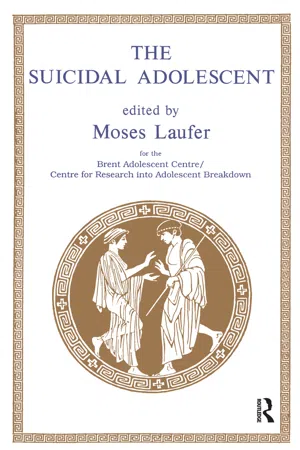
The Suicidal Adolescent
About this book
As our knowledge of the change and turmoil of adolescence grows, so the number of issues on which psychotherapeutic techniques can shed light increases: this monograph focuses on one of the most urgent. It provides not only practical insights into dealing with suicidal or potentially suicidal adolescents - with an emphasis on prevention of the problem as early as possible - but also a model of the way in which adolescents may find themselves becoming suicidal. Suicide attempts are rare in childhood; they are generally triggered after puberty by the adolescent's reaction to changes in his newly sexually mature body. It is the body that is perceived as the enemy, and sometimes the death of the body seems the only recourse. The adolescent who actually attempts to kill himself no longer doubts his actions or his solutions on his mental creations. At the time of his decision to kill himself, he is taken over by his need for peace more than by the fact of his own death.
Information
Part One
Work with Adolescents at Risk
Chapter One
Psychological development in adolescence: “danger signs”
Moses Laufer
Whatever the setting is in which we work—whether it is education, medicine, probation, family work, social welfare, or here at the Brent Adolescent Centre—we are faced constantly with the need to decide about one main crucial question: is this adolescent's behaviour or worries normal, or are there signs of present or future pathology? Whether or not we can immediately say with certainty which criteria we use to decide these questions, there is no doubt that each of us has some idea of what adolescence is or should be, which, in turn, determines our answers to the questions I have raised.
As our knowledge about adolescence as a period of physical, social, and psychological development expands, we are becoming much more certain that this period of life has a crucial part to play in the person's whole development, and especially in his development to adulthood. This is very different from the attitudes that existed in the past—namely, that adolescence is a period of upheaval in the person's life and of trouble to the person himself and to his environment, and that it is a relief to everybody when this period of life has passed and the person has become "mature". We know now that what happens during the period between the ages of 14 and 21 is crucial for the person's future mental and social health or ill-health.
Every adolescent experiences stress at some period. The variations in behaviour during this period are so numerous that it is often difficult to decide which behaviour is due to temporary stress (i.e., to stress that is "normal"), and which behaviour has to be viewed as a sign of more serious psychological disturbance. How can we know, for example, what may be the meaning of such a range of behaviour as stealing, lying, drug-taking, fighting, school failure, work trouble, over-eating, drunkenness, sudden depression, promiscuity, mood swings, friendlessness, and so on? We can begin to answer this question by taking a closer view of the psychological tasks that every adolescent faces, and to which he must find some solution. From the point of view of our day-to-day work with adolescents, assessment of the behaviour as being either normal or a sign of trouble can often prevent a great deal of future distress for the adolescent. To this, it is important to add that misdiagnosis and mishandling can often have a long-term detrimental effect on the person's future life.
From the whole multitude of stresses experienced by every adolescent, it is possible to isolate some common factors that exert a special effect on adolescent behaviour. If the adolescent is to be able to make the move to adulthood, he must find some kind of answer to each of these. These factors, which are of special significance for every adolescent, are:
- His relationship to his parents—that is, the ability during the period of adolescence to change from having been dependent on the parents to becoming more independent emotionally. We should, for example, begin to see signs that the adolescent is able to feel that his thoughts and feelings are his own, and that these feelings are not totally dependent on how the parents might react. This can be formulated as follows: is the adolescent able to separate emotionally from the parents, even if this means that the parents may not approve of the adolescent's way of going about it?
- His relationship to his contemporaries—that is, the adolescent's ability to find and choose as friends other adolescents whose demands and whose expectations of themselves are such that they enhance the adolescent's effort and wish to become an adult.
- The view the adolescent has of himself as a physically mature person—Including the adolescent's attitude to the self as a masculine or as a feminine person, as well as the ability to begin to change this picture of the self from that of child who was mainly in the care of his parents to that of someone who is beginning to feel that he is the owner of his own body.
One can say that this Is what adolescence is about. We know, however, that although we are able to list and define the areas where changes must occur, there are many reasons why things can and do go wrong in the adolescent's efforts to move from childhood to psychological maturity. If we see adults who are "having trouble" in some area of their lives, it is always in one of the areas that I have defined, no matter how the person describes his problem or how he tries to go about dealing with it. This means that something must have gone wrong in the person's adolescence or even earlier, but it is only now that the "trouble" has been noticed.
We often see remarkable changes when the person reaches adolescence, which are due to a combination of factors that, up to this time, were comparatively unimportant or secondary in the life of the child—such as physical sexual maturity, a change in the relationship to the parents, a change in the demands and expectations of the contemporaries, and a drastic change in the attitude of society to the person's behaviour. This, then, means that in that person's life there may have been many potential trouble areas that he was able to keep in some precarious balance during childhood, but which fail when the new demands of adolescence become primary in his life.
It is important, for an understanding of the stresses of adolescence, first to consider development during childhood, and the view we take of the relationship between this period and what takes place when the person reaches adolescence. We begin by assuming that behaviour and development are not accidental. We may find ourselves unable to explain the meaning of certain forms of behaviour, but we nevertheless assume that all behaviour and development are reflections of that person's history, including what has gone on in his own mind and what has happened between him and the most important persons in his life—his parents or those adults who have assumed responsibility for him.
Up to about the age of 5, the child's behaviour is governed by what he thinks will be approved or disapproved of by his parents. It is as if "law" and "morality" exist outside himself— that is, in his parents—but he more or less respects their law and their morality because of his wish to be loved by them. But it is only from about the age of 5 or 6 that we can begin to talk of a child's conscience or of a child's ideals. It is at about this time that the wishes and demands of the parents become part of the child's own mental makeup. This means that whether or not the parents are present, the child begins to judge himself, approve of his own behaviour, have feelings of self-regard, and experience feelings of guilt and shame if he has done something that is contrary to his expectations of himself—expectations that were originally those of his parents but have now become part of his own inner demands. Of course, the specific details of development will vary enormously from one family to the next, one sub-culture or ethnic group to the next, or one religion to the next. I am describing the principles that determine development and behaviour: conscience, ideals, self-regard, guilt, shame, expectations of oneself are constantly in the forefront of the adolescent's life and affect a great deal of his behaviour. I will discuss some of this later.
When we view the behaviour or the development of the child and try to judge whether development is progressing well or whether there are signs of psychological stress, we examine areas of his life that are very different from those that would be examined in assessing the development of the adolescent. In the case of the child, our concern would be with such things as bladder and bowel control, food intake and habits, school performance, relationships to friends, the use the child makes of belongings (such as toys, etc.), sleep habits, whether he plays with boys or with girls (of his own age, or younger or older), whether he can compete with friends while at the same time admiring and envying their achievements. Psychological and social interferences during childhood can severely handicap the child's present and future life. Many children can be very troubled in themselves, but because of their compliance with outside expectations and standards their problems go unnoticed, even though the stress is obvious if one only looks. We are familiar with the good child who is no trouble to anybody, or the quiet child who does as he is told and never complains. But often, if we look, the child may be failing at his school, or he has no friends, or he cries secretly—or, worse still, he shows nothing—that is, he may be unable to show his distress. But when this child reaches adolescence, he is faced (whether he likes it or not) with the sudden terrible fact that his earlier ways of dealing with stress are now greater handicaps than ever. The quiet, rather withdrawn, or good child, who may have been thought of by the parents as being just the kind of child they wanted, is suddenly faced in adolescence with the fact that behaviour that brought approval in childhood is no longer of much use to him now. Instead of approval, he may now feel isolation; he may begin to realize that other adolescents do not want to have much to do with him, and he may have to recognize the distressing fact that some of his thoughts and feelings may be a sign of psychological handicap. As an adolescent, the excuses of childhood prove to be insufficient because the consequences are much more drastic now—isolation, sadness, feeling that something is wrong with him, feeling that he is a failure socially, or perhaps feeling that his thoughts are abnormal and frightening to him.
These are some of the reasons for psychological breakdown In adolescence, which sometimes comes rather acutely. We know of the person who seems to change suddenly, of the adolescent who commits suicide suddenly or who must be hospitalized, or the brilliant child who suddenly fails at school when he reaches adolescence. What we see here is a collapse of the earlier ways of meeting various situations of stress. The adolescent is, instead, faced with the fact that he is failing, or that he is alone, or that he may be developing abnormally, either socially or sexually. An additional disappointment for him is that his parents' approval or reassurance is no longer as effective as it was when he was a child. Now, he seeks approval and recognition from his contemporaries—but in order to get this, he has to perform or behave in a way that is acceptable to them. Their standards may be different from those of his parents.
The picture I am drawing is of a continuum, which begins in infancy and childhood and goes on up to and including adulthood. Each period of development has a crucial contribution to make towards the ability and the wish to lead a normal adult life. If trouble occurs anywhere along the way, it can act as a serious hurdle in development, and it can affect the way in which a person progresses psychologically and socially. If we apply this insight to adolescence, we can begin to see why it is of critical importance to help remove these hurdles during this period. It is usually sometime in adolescence that the person will have to make decisions that will affect his whole future life, such as his future work, his future sexual partner, his future relationship to himself either as a "successful" person or as a "failure". The consequences of the stresses or of the trouble can often be as serious as the trouble itself, and it is for this reason that we should think of helping the adolescent whenever this is at all possible. Too often, we hear of people being told to "pull themselves together", or that they "will grow out of it". In many circumstances, such advice is not only useless but harmful.
A SHORT EXAMPLE
A young man of 19 came to discuss a worry, which he described as follows: he felt attracted to other boys, and this was now affecting his work. He said that he had left school early because "I couldn't be bothered, it was a waste of time". In fact, what had actually happened was that, at the age of 15, he had begun to feel attracted to other boys. Although he was terrified of his homosexual feelings, he nevertheless could not stop himself from thinking about some of the boys. He spent all his free time in the school library, because he felt that he could be near boys more safely and inconspicuously there. There came a point when he began to be very frightened of his own feelings, fearing that he might actually try to touch some of the boys. He began to stay away from school. This finally resulted in his decision to leave school. He then took a job as a clerk, and he was in this job when he came to the Centre for help.
This example illustrates how a personal worry of an adolescent has resulted in it interfering not only with his psychological and social life, but also with his whole future career. This young man had, in fact, hoped to go on with his education, but he felt driven away by his own abnormality. He was at an age when he was free to leave if he chose to do so. Had he suffered from a school phobia as a child, the decision about his attendance at school would not have rested with him. He could not withdraw so easily then—he would either be forced to attend (if he could possibly attend), or help would be available to him through the psychological service of the school.
I could give many examples of cases where such personal worries relating to one's sexual development, loneliness, shyness, and so on not only make life very stressful for the adolescent, but interfere with his life in various ways that then affect his whole future life.
I would now like to return to a point made earlier—that is, that every adolescent experiences stress and that it is often difficult to know when that stress is normal and when it is a sign of more serious worry or psychological trouble.
There are many times when the adolescent will behave in unusual ways, will have mood swings, will feel that life is worthless, or will do something that is completely out of keeping with his usual behaviour. The most important single factor that should help us to evaluate the seriousness of the stress is not whether it is present in the first place, but how the adolescent deals with the stress.
One area of behaviour that affects all adolescents is the conflict experienced about masturbation. We are now a long way from the Victorian, moralistic, judgemental view that masturbation must not take place because it is wrong. We know that masturbation is a normal activity, which reaches its height during adolescence. In fact, we can say that masturbation contributes to normal development, because it gives the person a chance to experience sexual feelings within the temporary safety of his thoughts. We also know, however, that there are some adolescents who are unable to masturbate because of their intense feelings of guilt; there are others who feel they are on the verge of madness because of their need to masturbate compulsively. Some feel they are abnormal not because of masturbation Itself, but because of the frightening thoughts and feelings they sometimes have during masturbation. The adolescents we need to be concerned about are those who renounce any sexual feelings—it is as if they disown their bodies—and are unable to risk masturbating at all; or those who are constantly occupied with thoughts of the harm they have done or are doing to themselves through masturbation. Temporary feelings of guilt are a normal reaction to masturbation; it is when this guilt seriously interferes with the person's whole life that we should take it as a "danger sign".
Although these remarks about masturbation apply to both the male and the female, there are Important differences in the ways that male and female adolescents normally deal with this problem. Most male adolescents are normally more open about this activity and about some of the fears or worries accompanying it. Some female adolescents deal with it in a different way from males, and it is not unusual for girls not to have the conscious wish to masturbate at all. For a girl, this could be quite a normal reaction, whereas in the case of a boy we would see such a reaction as much more related to "danger signs" either now or at some time in the future. Sometimes girls may show their difficulties in this area through various forms of behaviour—promiscuity, lying, or even the inability to concentrate on work or studies.
Various examples elaborate on the question of stress and how the adolescent deals with it. There is the adolescent who never attends a school social function because he is "too busy"—in fact, he feels terrified of girls, or he may be unable to allow himself to touch a girl when dancing; at the other extreme is the adolescent who is often invited to parties because he is considered to be so funny—in fact, he behaves in such a way that he inevitably humiliates himself and is not taken seriously by anybody; or the adolescent who is brilliant and at the top of his class—but the one time when he is not at the top brings about serious depression, body aches and pains, and a feeling of worthlessness (sometimes the early signs of future risk of suicide).
Although I have concentrated on the factors that may make things go wrong during adolescence, it is important to emphasize that many young people—although they experience stress, anxiety, and disappointment—do develop normally and need not be of concern to us. To take this further, there are adolescents who may feel that something is wrong and there are parents who may feel anxious about their adolescent son or daughter, but this in itself should not be taken as sufficient evidence that something is wrong. When assessing what is going on in the adolescent's life, one may see many factors that contribute to the present picture, but these need not add up to the presence of "danger" or of "pathology" in the adolescent.
A SHORT EXAMPLE
The father of a girl aged 16 telephoned to say that he was very worried about his daughter. She had recently become rude and had begun to smoke, and he believed that she was starting to be promiscuous. She began to refuse to attend school, saying that she had lost interest and that there was no purpose in going on. The father anxiously asked that I arrange for a period of psychological help for his daughter. In my interview with the girl it became clear what had made the father anxious—he had obviously become frightened that she might kill herself. It was, of course, wise for him to have enquired about help for his daughter, and he had already prepared himself for the likelihood that I would find his daughter in immediate need of treatment of some kind.
The daughter presented a picture of an intelligent, wellgroomed adolescent, proud of her developing body, but she complained of feeling miserable, of not wanting to go on at school, of having thought of suicide at times, and of feeling hate towards her father for the family difficulties that existed (something the father had omitted in his description of the present crisis). I decided to see her a few times because of my uncertainty of what the trouble was really about, as well as because any adolescent who talks of suicide (even though this may be meant as a threat rather than it being a sign of severe depression) should be taken seriously. It became clear that she was frightened of becoming promiscuous and that this might be a sign of abnormality. In addition to her worry about her own behaviour, she felt ashamed of her present life because of the terrible rows that had been going on between her parents—the threats of separation; the mother's threats of suicide: and the constant expectation by the parents that the daughter should...
Table of contents
- Cover
- Half Title
- Title
- Copyright
- Dedication
- Contents
- LIST OF CONTRIBUTORS
- INTRODUCTION
- PART ONE Work with adolescents at risk
- PART TWO Proceedings of Conference on “The Suicidal Adolescent”
- BIBLIOGRAPHY
- INDEX
Trusted by 375,005 students
Access to over 1.5 million titles for a fair monthly price.
Study more efficiently using our study tools.
Frequently asked questions
Yes, you can cancel anytime from the Subscription tab in your account settings on the Perlego website. Your subscription will stay active until the end of your current billing period. Learn how to cancel your subscription
No, books cannot be downloaded as external files, such as PDFs, for use outside of Perlego. However, you can download books within the Perlego app for offline reading on mobile or tablet. Learn how to download books offline
Perlego offers two plans: Essential and Complete
- Essential is ideal for learners and professionals who enjoy exploring a wide range of subjects. Access the Essential Library with 800,000+ trusted titles and best-sellers across business, personal growth, and the humanities. Includes unlimited reading time and Standard Read Aloud voice.
- Complete: Perfect for advanced learners and researchers needing full, unrestricted access. Unlock 1.5M+ books across hundreds of subjects, including academic and specialized titles. The Complete Plan also includes advanced features like Premium Read Aloud and Research Assistant.
We are an online textbook subscription service, where you can get access to an entire online library for less than the price of a single book per month. With over 1.5 million books across 990+ topics, we’ve got you covered! Learn about our mission
Look out for the read-aloud symbol on your next book to see if you can listen to it. The read-aloud tool reads text aloud for you, highlighting the text as it is being read. You can pause it, speed it up and slow it down. Learn more about Read Aloud
Yes! You can use the Perlego app on both iOS and Android devices to read anytime, anywhere — even offline. Perfect for commutes or when you’re on the go.
Please note we cannot support devices running on iOS 13 and Android 7 or earlier. Learn more about using the app
Please note we cannot support devices running on iOS 13 and Android 7 or earlier. Learn more about using the app
Yes, you can access The Suicidal Adolescent by Moses Laufer in PDF and/or ePUB format, as well as other popular books in Psychology & Abnormal Psychology. We have over 1.5 million books available in our catalogue for you to explore.