- 192 pages
- English
- ePUB (mobile friendly)
- Available on iOS & Android
eBook - ePub
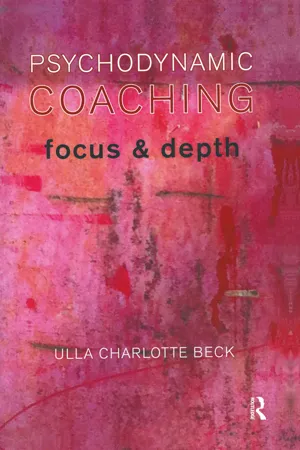
About this book
In a postmodern age we all need a room of our own. A room - or space - where we can explore and reflect on how the rapidly changing world affects us. A room where it is possible to get a feeling of who we are, and wish to be, in the middle of the buzz of our everyday lives. Where it is possible to explore our challenges and possibilities and thus become a more robust human being. Where we can think of our relationships and interactions. Where we can have a break and some relief and where we can summon the energy to act - or not to act - in our lives. Coaching is way of providing the space for such thoughts, reflections, and insights into our possibilities. Most of the different coaching methods do not adhere to a specific psychological theory. However, in this book you will meet a coaching method that is based on a specific theory - psychodynamics.
Information
Chapter One
Psychodynamics and coaching: why?
The purpose of this book is to put together an integrated picture of how it is possible to work through coaching based on a psychodynamic framework of understanding: psychodynamic coaching.
This book is for readers of three types:
- the curious reader who wants to know what psychodynamic coaching is;
- the reader who already knows a little, or perhaps more than just a little, about psychodynamic theory, and would like to know how it can be combined with coaching;
- the reader who knows a little, or more than a little, about coaching, and would like to know how it can be combined with solid theory and a serious conceptual approach.
Any reader who expects a complete overview of psychodynamic theory or of applied coaching will be disappointed. The material has been researched, some of it selected for inclusion, and some rejected. Coaching and psychodynamics are both overwhelming fields, and it would be unrealistically ambitious to attempt to embrace ”everything”. My choices were predominantly based on: (1) what I have gained many years of experience of through practising it; (2) what has worked and, thus, proved meaningful professionally; (3) what I have personally enjoyed, benefited from, and drawn satisfaction from working with; (4) what I believe others—students, participants on courses, colleagues, clients, and competitors—can benefit from.
Psychodynamic theory derives from psychoanalysis, the roots of which can be traced back to Freud at the beginning of the twentieth century, although Freud himself never used the expression “psychodynamic”, calling it “dynamic” instead (Olsen, 2002). Coaching as we know it today is a newer phenomenon, dating back to the mid-1970s, originally targeted at sports performances. So, why this integration now? The good reason is that it adds value to both. The psychodynamic approach adds depth, effect, and seriousness to coaching. Coaching contributes with focus, structure, and drive. Jointly, they provide a unique opportunity for realistic changes with a basis in deep understanding. The purpose of psychodynamic coaching is that the person being coached (the client), through acknowledgement and insight into his or her own history, personal patterns, inner structure, and the present context and its dynamics, can combine past, present, and wishes for the future with realistic, feasible actions. That is an ambitious purpose, both in breadth and in depth. In breadth because it concerns the client’s entire life (working life and personal life), including relations and circumstances, both current and past. This means that psychodynamic coaching is very different from the “lifestyle coaching” or “business coaching” we hear so much about in the media. In personal development work, it makes no sense to divide working life from personal life. We have our “selves” with us in both situations, and even though, on the face of it, different parts of the self move into the foreground depending on the context, other parts of the self are always present in the background. In depth because the psychodynamic investigative method of work seeks both back in time and “down” or “into” the client’s unconscious, because an individual’s motive for that person’s way of living life is hidden in the unconscious. The innermost feelings, memories, fantasies, convictions, associations, and transference patterns are the data with which we can make contact with the unconscious material. The investigative work consists of observing, interpreting, forming hypotheses, and then testing these. The “then and when” is included in the “here and now”. The investigative work takes place within the coach as well as the client and in joint collaboration between coach and client, at one and the same time. We will return to this in different ways in the following chapters.
Previously, I have sought to create clarity within the extensive field called coaching, supervision, role analysis, mentoring, personal development, etc. (Beck, 2004). All methods are engaged in creating development and/or learning on the personal level primarily in connection with, or based on, working life. The concepts are used at random and there is no consistency or logic in the way they are used. Users find themselves in an impenetrable jungle in this field. Nobody knows what they will get before they get it. The users, and this means both clients, who receive personal development/supervision/coaching, and those who provide coaching (and they have to learn it), for instance students, course participants, or consultants in private practice. The way coaching is “labelled”, which can be studied in advertisements, catalogues, educational offers, websites, and books, does nothing to reduce the uncertainty. Well, the object of the intervention is ourselves, our (and other people’s) very private “me”, our personality, so this lack of clarity may have serious consequences. For both professional and ethical reasons, I feel very strongly about working to try to clarify this field and to identify a qualified alternative to the present situation. In my work from 2004, I set up some criteria for the type of practice (Beck, 2004, pp. 319–324) that is to characterize a new hybrid method between supervision and coaching. These criteria are set out below in a shortened form.
- The method must refer to an organizational understanding, which includes an understanding of roles and an understanding of the significance of the task. It must be a model that comprises an understanding of the transport of unconscious material at different levels.
- The method must contain an understanding of personality psychology that makes it possible to investigate personal patterns and the background for the projections that take place in the organization.
- The method must provide the possibility of working on a specific personal issue for a limited time.
- The method must provide the possibility of working in relation to general issues.
- The method must be able to stand alone and not merely in an educational context.
- The method must be “easy”, uncomplicated.
- The method must contain a resistance concept and principles for understanding and working with resistance
- The consultant works from a neutral position. However this is impossible in practice (and, no matter what, the consultant also has an unconscious in play), and, therefore, can only be aspired to as a target. The method must, therefore, include work with transference and countertransference.
If we combine the psychodynamic theory with the practice existing in psychoanalysis, group analysis, couples therapy, supervision, role analysis, personal development groups, and coaching, we then have an abundant selection of what the contents of this “hybrid” can consist. It is called psychodynamic coaching.
An integration of that kind is a daring venture that requires a dogma-free approach to the psychodynamic theory complex, the psychoanalytic tradition, the psychodynamic working methods, and to the many market-orientated methods for personal development that have popped up during the past couple of decades. An integration of that type will probably cause offence. There might, perhaps, be clever theorists and clinicians who will claim and prove that there would be built-in conflicts which would impair the quality of the actual psychoanalytical work; there might be precocious business-orientated commercial psychologists and consultants who would maintain that it is much too heavy and complex, or therapy-like and problem-orientated (with too negative an approach) to produce results. Looking at it from their point of view, they would be right. However, that is the consequence of working free of dogma. The reward—and the hope—is that there will be a real alternative and that it can lead to debate in professional life and, thus, to qualified further development both theoretically and in practice.
Psychodynamic theory
What separates psychodynamic theory from other theories, and is unique and exclusive, is the concept of the unconscious. Psychodynamic theories emphasize the importance of our unconscious mental life. One often encounters the mistaken idea that it is interest in the emotions that characterizes psychodynamic theory. However, there are many schools of psychology that focus on emotions, both those of the individual and as atmospheres in groups and environments or working and family cultures. In psychodynamic theory, emotions are data about the inner mental life, and it is in that perspective—as the informants from the unconscious—that emotions must be understood. Emotions are, therefore, important in psychodynamic theory, just as in other theories, although the distinguishing, characteristic aspect is the way in which feelings, together with conceptions, fantasies, thought, and language, are understood separately and also as they interact. The term “psychodynamic” is found in many psychological models. Psychodynamics is a collective term for all the models and descriptions of the psyche that are primarily preoccupied with unconscious processes. Olsen (2002) describes the special aspect of psychodynamic theories as the fact that they operate with “non-intended motive transformations (changes, distortions, redirections of instinctual impulses, desires or intentions) which can be analysed psychologically” (p. 5). It is the original motives that are repressed, which means they make their appearance in a distorted manifestation, which can be interpreted. It is the original motives that are relegated to the unconscious.
Olsen (p. 648) goes on to define psychodynamic psychology as the part of dynamic psychology that is based on therapy and has Freudian psychoanalysis as its clear foundation. The link between theory and practice is already embedded at the stage of definition. It is interesting to note that while the psychodynamic theories are, in fact a well delineated phenomenon, at the same time the technical language associated with the theories has also become part of everyday communications. For instance, we use words such as “unconscious” and “ego” in daily speech, without necessarily being able to explain the underlying idea behind the concepts. Perhaps this tells us something about the impact of the psychodynamic theories, even though there have been numerous attempts at killing psychoanalysis, that is, rejecting it for the benefit of cognitive, constructionist, biological, or other approaches.
Within the psychodynamic theories there are theories and models that focus on various object fields. The criteria mentioned above for a ”hybrid” are amply fulfilled. Psychodynamic theory includes theoretical sub-disciplines about personality, development, groups, including social psychology, leadership, role, organization, and about phenomena such as resistance and relations. These areas will be dealt with separately in the following chapters. Through the years, psychodynamic theory has developed in many directions and has created independent approaches, both conceptual and practical. Throughout history, some theories have come to terms with previous or present claims and, through criticism, have developed into new aspects and perspectives. Some theories have followed their own paths and deviate on a large number of issues from other parts of psychodynamic theories. They have founded new individual schools that share the same basic beliefs. In this book, some specific theories have been selected, which means some schools and approaches have been excluded, although in other circumstances they would have been included.
Coaching
Unlike psychodynamic theory, coaching is difficult to define as a category, and constitutes a very imprecise name for a lot of different work aimed at personal development and performance. The amount of literature on the subject is astounding. Much of the existing written material is actually marketing to promote the firms of consultants and individuals instead of providing theoretical and methodical material for development and clarification. There is nothing wrong with that; businesses and companies have every right to advertise, draw attention to themselves on the market, and make money. However, the difficulty lies in the fact that it is quite confusing for anyone with an ambition to create clarity that we are talking about the same thing when we say coach and coaching. It could also be considered an ethical and professional problem that the definition of the concepts is, to an increasing extent, being taken over by private companies with their own interests at heart. Imagine the situation if the same applied to services in the generally acknowledged system of professional training, for instance, for medical or legal degrees. This field is, in Denmark at least uncontrolled and without public supervision. Anyone can call himself/herself a coach and give coaching. As long as there are customers, the business will flourish. If you blindly believe in market mechanisms, a selection should leave only the “effective” and “desirable” ones behind. That does not happen, however, in a complex postmodern society, where the market is not transparent and there is almost explosive growth in the supply. In Denmark, the public sector has started to offer coaching as a separate service, or as part of a supplementary training, for example, in connection with government managerial courses. It appears that the consultant firms and the training courses are selling and practising the same things, but they are completely different in every conceivable way. So, it is an exciting and important challenge to try to establish clarity in the field. It is not possible to comment systematically or deal with all the books, brochures, CDs, and pamphlets about coaching. I have called the type of coaching that appears in weekly magazines lifestyle coaching. This is right at the “light” end of the scale, and will not be discussed here. In the descriptions of the more substantial versions there are three common features: (1) it is important to focus on the potentials and desires of the individual; (2) the aim is to set goals for these; (3) it is done by asking (the correct) questions, so the person being coached can find the answers within him/herself. The coach—through questions—is the mediator making it possible for the individual to release his/her true self, feel his/her truly genuine wishes for the future, then to find the energy to change and act and, thus, reach his/her goals. One can get the impression that the word coaching releases something magical, on the level of expectation, at least. One of the products being sold is the actual coaching, and the other is the training to become a coach. You can become a coach—a personal trainer, a problem solving coach—or you can integrate the coach’s role into your managerial style. Various companies sell “training”, where they themselves are the certifying authority. Actually, it is a form of autopoeisis, or professional inbreeding, carrying the risk of jeopardizing the health of the profession.
Coaching and the lack of theory
In most cases coaching is presented as theoryless, meaning without being associated with any theory whatsoever. There might be a few aspects that are reminiscent of social constructionism and cognitive methods. Sometimes, for instance, references are made to both social constructionism and cognitive psychology, while, at the same time, the coaching wants you to learn to hold back on your projections (a concept predominantly rooted in psychodynamics) so that you can see a “pure” view of the “world” and the “other”. References are made to several very different and, in some places, incompatible theories within the same method. In addition, it might raise doubts about whether concepts like projections have been correctly understood. In the promotion of coaching, coaching seems on the one side very simple and on the other rather complex, which gives rise to a number of incompatibilities. The manner in which coaching is generally practised is theoryless, or should I say not aware of which conceptual understandings are embedded in the practice in question. Understanding and pie-understanding both exist, previous understandings on which the current understandings are based, even though there is no explicit theory. Understandings and pre-understandings exist in most cases as something that has not been reflected upon, cliché-like, without any mutually cogent and logical connections. The individual is seldom aware of his or her understandings and pre-understandings. However, that is not necessary, and for most people in their own daily lives it is all right and satisfying, but, in the case of professionally performed work, to which people entrust their life, body and soul, it is only reasonable to demand something more behind the active processes. The lack of theory also shows in the coach’s role. If the coach is to act as a catalyst for the individual’s personal development, then it is logical to see the coach as a neutral, professional sparring partner who can use language as an advanced tool in conversation, asking the right or wrong questions, perhaps uncomfortable and confrontational questions, gradually getting to know the client’s weak points, unconscious patterns, innermost desires, and potential. The coach and client must not have any other relationship with each other apart from the coach and client relationship. Other relational connections must be regarded as sources of error, which will have a disruptive effect on the work for development
As a method used in corporate and personal development coaching has, understandably enough, always been on the lookout for a psychological theory it can connect to. In the 1970s and 1980s, it was predominantly the transaction analysis (Deegan, 1979), which derives from gestalt psychology. Later on, several systemic and social-constructionist approaches emerged, and the majority of these have been included. It is a characteristic of the psychological discourses within these directions that they focus primarily on the individual. To put it simply, it can be said that these theories are based on the following: (1) language is an active tool that works both inwardly and outwardly; (2) truth is a construction; (3) all social spaces are constructed as such. The group and language appear as defining social space—and there might be a battle about the definition of power. It is not irrelevant which theory the coach seeks to include. The coaching in extension of the social-constructivist approach is (of course) defined by the underlying perception: if the truth I carry about myself and my opportunities is a social construction, then the way to develop is to (get help to) construct a new truth for myself. Similarly, cognitive practice has left its traces in coaching, where the initial work is with the client’s thoughts, as these are regarded as the force that creates the client’s emotions, states of mind, and subsequent actions.
In some connections, we might encounter the phenomenon of the leader as coach, or the coaching style of leadership. But can coaching be integrated into the role of leadership, where power and authority are also part of the relationship? If the management is part of the social space in which the “truth” is created, it is difficult to imagine that at the same time there can be a space where you can find inspiration, independence, and freedom for a new “truth”. It would be possible to form the hypothesis that coaching in some companies is more of a socializing process because it has a predefined purpose: adaptation. How does the constructivist approach fit together with the fact that the coach is problem solving? Are all solutions equally good? Attainable and realistic? By being neutral, that is, by not taking a stand as to whether one thing is better than another, do you risk sending your client off on a Sisyphean task? Is any construction just as good as any other, regardless of whether the client breaks his/her neck carrying it out? My claim is that any practised coaching method is closely connected to the theoretical basis, both when it is absent and when it is present. It is understandable, therefore, that coaching and people working with coaching have been, and continue to be, on the lookout for an appropriate theory.
With the appearance of the book Coaching—læring og udvikling [Coaching—learning and development] (Stelter, 2002), a Danish attempt was made to place coaching as the authors practised it in a theoretical perspective. This book links coaching with systemic theory and the method of systemic dialogue. It makes it possible to investigate what significance the theoretical starting point has for the method. The book is a good example of the serious literature that exists on the subject, so it is worth commenting on it. A general thesis running through systemic-based coaching is that the owner of the problem also possesses the key to solving it (Hansen-Skovmoes & Rosenkvist, 2002, p. 85). This postulation forms the basis for coaching: it is the foundation on which coaching is built up. Nevertheless, there are people...
Table of contents
- Cover
- Half Title
- Title
- Copyright
- CONTENTS
- ABOUT THE AUTHOR
- INTRODUCTION
- CHAPTER ONE Psychodynamics and coaching: why?
- CHAPTER TWO Psychodynamic coaching
- CHAPTER THREE Individual psychodynamic coaching
- CHAPTER FOUR Psychodynamic coaching for couples: the psychology of meeting
- CHAPTER FIVE Psychodynamic coaching of groups
- CHAPTER SIX Psychodynamic coaching in organizations
- CHAPTER SEVEN Psychodynamic practice
- APPENDIX 1: Psychodynamic coaching
- APPENDIX 2: Coaching
- APPENDIX 3
- APPENDIX 4: Drawing assignment
- APPENDIX 5: Work structure for the designer team
- REFERENCES
- INDEX
Trusted by 375,005 students
Access to over 1.5 million titles for a fair monthly price.
Study more efficiently using our study tools.
Frequently asked questions
Yes, you can cancel anytime from the Subscription tab in your account settings on the Perlego website. Your subscription will stay active until the end of your current billing period. Learn how to cancel your subscription
No, books cannot be downloaded as external files, such as PDFs, for use outside of Perlego. However, you can download books within the Perlego app for offline reading on mobile or tablet. Learn how to download books offline
Perlego offers two plans: Essential and Complete
- Essential is ideal for learners and professionals who enjoy exploring a wide range of subjects. Access the Essential Library with 800,000+ trusted titles and best-sellers across business, personal growth, and the humanities. Includes unlimited reading time and Standard Read Aloud voice.
- Complete: Perfect for advanced learners and researchers needing full, unrestricted access. Unlock 1.5M+ books across hundreds of subjects, including academic and specialized titles. The Complete Plan also includes advanced features like Premium Read Aloud and Research Assistant.
We are an online textbook subscription service, where you can get access to an entire online library for less than the price of a single book per month. With over 1.5 million books across 990+ topics, we’ve got you covered! Learn about our mission
Look out for the read-aloud symbol on your next book to see if you can listen to it. The read-aloud tool reads text aloud for you, highlighting the text as it is being read. You can pause it, speed it up and slow it down. Learn more about Read Aloud
Yes! You can use the Perlego app on both iOS and Android devices to read anytime, anywhere — even offline. Perfect for commutes or when you’re on the go.
Please note we cannot support devices running on iOS 13 and Android 7 or earlier. Learn more about using the app
Please note we cannot support devices running on iOS 13 and Android 7 or earlier. Learn more about using the app
Yes, you can access Psychodynamic Coaching by Ulla Charlotte Beck in PDF and/or ePUB format, as well as other popular books in Psychology & Mentoring & Coaching. We have over 1.5 million books available in our catalogue for you to explore.