- 302 pages
- English
- ePUB (mobile friendly)
- Available on iOS & Android
eBook - ePub
About this book
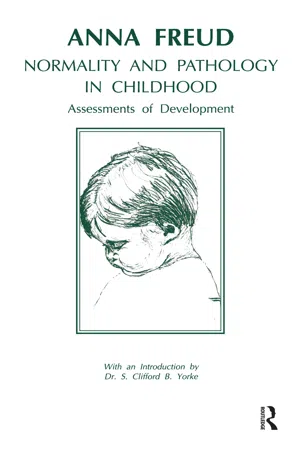
The author's book deals with a most neglected aspect of psychoanalysis - normality. Its chief concern is with the ordinary problems of upbringing which face all parents and the usual phenomena encountered by every clinician. Yet, though primarily practical and clinical in its approach, it also makes a major theoretical contribution to psychology. The author begins with an account of the development of analytic child psychology, its techniques and its sources in child and adult analysis and direct observation of the child. The author then describes the course of normal development, how it can be hindered or eased, what are the unavoidable stresses and strains and how variations of normality occur. The author outlines a scheme for assessing normality and for gauging and classifying pathological phenomena in terms of the obstruction of normal progress rather than the severity of symptoms. Stress is laid on the problem of predicting the outcome of infantile factors for adult pathology in the face of the child's continual development. Finally, child analysis is considered both as a therapeutic method and as a means for the advance of knowledge.
Information
CHAPTER 1
The Psychoanalytic View of Childhood: Long-Distance and Close-Up
Reconstructions From The Analyses Of Adults And Their Applications
Since the beginning of psychoanalysis, when the discovery was made that “Hysterics suffer mainly from reminiscences” (Breuer and Freud, 1893), analysts have been concerned more with the past of their patients than with their present experiences, and more with the era of growth and development than with maturity.
It was this preoccupation with the early happenings in life which raised hopes in many quarters that analysts would become experts on childhood, even when they were engaged in the therapy of adults only. Their knowledge of the processes of mental growth, and their understanding of the interplay between the external and internal forces which shape the individual, were expected to qualify them automatically for being knowledgeable in all instances where a child’s emotional stability or normal functioning were in doubt.
So far as the earliest era of psychoanalytic work is concerned, a survey of the literature shows that little was done specifically to fulfill these hopes. At that time the efforts were devoted entirely to fact finding and to perfecting the technique which was unearthing such new facts as a sequence of libidinal phases (oral, anal, phallic), the oedipus and the castration complex, infantile amnesia, etc. Since these important discoveries owed their origin to deductions from the analyses of adults, the method of “reconstructing” childhood events was held in high esteem and was used consistently to produce more of the data which today form the core of psychoanalytic child psychology.
On the other hand, it did not take more than one or two decades of such work before a number of analytic authors ventured beyond the boundaries of fact finding and began to apply the new knowledge to the upbringing of children. The temptation to do so was almost irresistible. The therapeutic analyses of adult neurotics left no doubt about the detrimental influence of many parental and environmental attitudes and actions such as dishonesty in sexual matters, unrealistically high moral standards, overstrictness or overindulgence, frustrations, punishments, or seductive behavior. It seemed a feasible task to remove some of these threats from the next generation of children by enlightening parents and altering the conditions of upbringing, and to devise thereby what was called hopefully a “psychoanalytic education,” serving the prevention of neurosis.
The attempts to reach this aim have never been abandoned, difficult and bewildering as their results turned out to be at times. When we look back over their history now, after a period of more than forty years, we see them as a long series of trials and errors. Much of the uncertainty which accompanied these experiments was inevitable. It was at that time not possible to have full insight into the whole complicated network of drives, affects, object relations, ego apparatuses, ego functions and defenses, internalizations and ideals, with the mutual interdependencies between id and ego and the resultant defects of development, regressions, anxieties, compromise formations, and character distortions. The body of psychoanalytic knowledge grew gradually, one small finding being added to the next. The application of the relevant data to the problems of upbringing and of prevention of mental illnesses had no option except to proceed equally step by step, always following closely in the same slow and laborious path. As new discoveries of pathogenic agents were made in clinical work or arrived at by the changes and innovations in theoretical thinking, they were lifted out, translated into warnings and precepts for parents and educators, and became part and parcel of psychoanalytic upbringing.
The sequence of these extrapolations is well known by now. Thus, at the time when psychoanalysis laid great emphasis on the seductive influence of sharing the parents’ bed and the traumatic consequences of witnessing parental intercourse, parents were warned against bodily intimacy with their children and against performing the sexual act in the presence of even their youngest infants. When it was proved in the analyses of adults that the withholding of sexual knowledge was responsible for many intellectual inhibitions, full sexual enlightenment at an early age was advocated. When hysterical symptoms, frigidity, impotence, etc., were traced back to prohibitions and the subsequent repressions of sex in childhood, psychoanalytic upbringing put on its program a lenient and permissive attitude toward the manifestations of infantile, pregenital sexuality. When the new instinct theory gave aggression the status of a basic drive, tolerance was extended also to the child’s early and violent hostilities, his death wishes against parents and siblings, etc. When anxiety was recognized as playing a central part in symptom formation, every effort was made to lessen the children’s fear of parental authority. When guilt was shown to correspond to the tension between the inner agencies, this was followed by the ban on all educational measures likely to produce a severe superego. When the new structural view of the personality placed the onus for maintaining an inner equilibrium on the ego, this was translated into the ,need to foster in the child the development of ego forces strong enough to hold their own against the pressure of the drives.
Finally, in our time, when analytic investigations have turned to earliest events in the first year of life and highlighted their importance, these specific insights are being translated into new and in some respects revolutionary techniques of infant care.
Owing to this protracted and piecemeal elaboration, the fabric of psychoanalytic education could not but remain unsystematic at all times. Furthermore, its precepts changed direction repeatedly, emphasis being first on freedom for drive activity, then on ego strength, then again on the intactness of libidinal relations. In the unceasing search for pathogenic agents and preventive measures, it seemed always the latest analytic discovery which promised a better and more final solution of the problem.
Some of the pieces of advice given to parents over the years were consistent with each other; others were contradictory and mutually exclusive. Some proved beneficial, almost beyond expectation. Thus, analytic education can count among its successes the greater openness and confidence between parents and children which was arrived at after sexual matters were treated and discussed with greater honesty. Another victory was over the stubborn obstinacy of certain early ages which disappeared almost completely after the problems of the anal phase were recognized and bowel training was carried out later and less harshly. Also certain eating disturbances of children ceased to exist after infant feeding and weaning were altered to correspond more closely to the oral needs. Some sleeping disturbances (i.e., difficulties in falling asleep) were removed after the struggles against masturbation, thumb sucking, and other autoerotic activities were lessened.
On the other hand, there was no lack of disappointments and surprises. It was unexpected that even the most well-meant and simply worded sexual enlightenment was not readily acceptable to young children and that they persisted in clinging to what had to be recognized as their own sexual theories which translate adult genitality into the age-appropriate terms of orality and anality, violence and mutilation. It was equally unexpected that the disappearence of the masturbation conflict would have—besides its beneficial consequences—some unwanted side effects on character formation by eliminating struggles which, in spite of their pathogenic aspects, had served also as a moral training ground (Lampl-de Groot, 1950). Above all, to rid the child of anxiety proved an impossible task. Parents did their best to reduce the children's fear of them, merely to find that they were increasing guilt feelings, i.e., fears of the child's own conscience. Where, in its turn, the severity of the superego was reduced, children produced the deepest of all anxieties, i.e., the fear of human beings who feel unprotected against the pressure of their drives.
In short, in spite of many partial advances, psychoanalytic education did not succeed in becoming the preventive measure that it set out to be. It is true that the children who grew up under its influence were in some respects different from earlier generations; but they were not freer from anxiety or from conflicts, and therefore not less exposed to neurotic or other mental illnesses. Actually, this need not have come as a surprise if optimism and enthusiasm for preventive work had not triumphed with some authors over the strict application of psychoanalytic tenets. There is, according to the latter, no wholesale “prevention of neurosis.” The very division of the personality into an id, ego, and superego presents us with the picture of a psychic structure in which each part has its specific derivation, its specific aims and allegiances, and its specific mode of functioning. By definition, the various psychic agencies are at cross-purpose with each other, and this gives rise to the inner discords and clashes which reach consciousness as mental conflicts. These latter exist therefore wherever complex structural personality development has come into being. There are of course instances where an “analytic upbringing” helps the child toward finding adequate solutions which safeguard mental health; but there are also many others where inner disharmony cannot be prevented and becomes the starting point for one or the other kind of pathological development.
The Advent Of Child Analysis And Its Consequences
Some of the doubts and uncertainties governing the field were dispelled with the introduction of the analysis of children. Psychoanalysis moved a step nearer to providing what it had set out to provide from the beginning: a service of child experts.
There was from then onwards an additional source of material for the systematic building up of a psychoanalytic child psychology, and the integration of the two kinds of data, direct and reconstructed, became a. rewarding task. While reconstruction of childhood events from the analyses of adults kept its place, reconstructions from the analyses of older children and findings from analysis of the youngest were added to it. But child analysis provided more than this. Besides studying the “interaction between the concrete environment and the development of the child’s capacities,” it opened up a “host of intimate data about the child’s life,” so that “his fantasies as well as his daily experiences became accessible to observation . . . only the child analyst provided a setting in which daydreams and night-fears, games and productive expressions of the child became understandable . . . in a much more concrete sense than the secret parts of a child’s experiences . . . had ever before become accessible to adult understanding.”1 Also, in the analyses of the young, the infantile complexes and the turmoil created by them in the mind were found to be more open to view, not yet shut off from consciousness by amnesia or distorted by the later action of cover memories.
The close-up view of childhood which developed over the years on the basis of child analytic work provides for the child analyst an approach to personality development which differs subtly from that of those colleagues who see children through the medium of the adult only. Child analysts, therefore, offer not only welcome confirmations of analytic assumptions, as they had been expected to do from the outset; they also help toward providing decisions where “alternative hypotheses had been advanced by reconstructive methods.”2 They succeed in altering the emphasis laid on particular points and in correcting perspectives (see A. Freud, 1951). And finally, as I hope to show in what follows later, they make their own contribution to metapsychology and the theory of psychoanalytic therapy.
Direct Child Observation In The Service Of Psychoanalytic Child Psychology
In their theoretical writings it took analysts some time to “come to the conclusion that psychoanalytic psychology” (and especially psychoanalytic child psychology) “is not limited to what can be gained through the use of the psychoanalytic method” (Heinz Hartmann, 1950a). Not so in action. Following the publication of the Three Essays on the Theory of Sex (S. Freud, 1905), the first generation of analysts had already begun to watch and report their children's behavior with regard to the details of infantile sexuality, the oedipus and castration complexes. Analyzed nursery school teachers, school teachers, and those working with adolescents, delinquents, and young criminals carried on this work in the 1920s and ‘30s, long before such work developed into the systematic enterprises they became after the Second World War.3
Nevertheless, as regards observational work outside the analytic setting, the analyst who habitually deals with repressed and unconscious materials has to overcome misgivings before he can extend his interest to surface behavior. In this respect it may be useful to review the relations between psychoanalysis and direct observation4 as they have developed over the years. The question whether the latter, namely, direct scrutiny of the surface of the mind, can penetrate into the structure, functioning, and content of the personality has been answered at different times in different ways, but, especially so far as insight into child development is concerned, with increasing positiveness. Although there is no clear historical sequence which can be traced, there are several aspects and factors which, partly consecutively and partly simultaneously, have been of relevance in this respect.
The Analyst’s Exclusive Concentration on the Hidden Depth
In the earliest period of psychoanalytic work, and long before child analysis came into being, there was a strong tendency to keep the relations between analysis and surface observation wholly negative and hostile. This was the time of the discovery of the unconscious mind and of the gradual evolvement of the analytic method, two directions of work which were inextricably bound up with each other. It was then the task of the analytic pioneers to stress the difference between observable behavior and hidden impulses rather than the similarities between them and, more important than that, to establish the fact in the first instance that there existed such hidden, i.e., unconscious, motivation. Furthermore, this work had to be carried out in the face of opposition from a public who refused to believe in the existence of an unconscious to which consciousness had no free access, or in the possibility that factors could influence the mind without being open to view for the observer. Lay people especially were inclined to mistake the painstaking elaborations of material within the analytic process for an alleged uncanny ability of analysts to see the innermost secrets of a stranger at a glance, and persisted in this belief in spite of all protestations that the analyst is tied to his own laborious and slow method of observation and sees no more without it than the bacteriologist, deprived of his microscope, sees of bacilli with his naked eye. Psychiatric clinicians too were known to neglect the differences, for example, between the manifest occurrence of rape of a female child by her psychotic father and the unconscious latent strivings of the oedipus complex, and to call the former, instead of the latter, a “Freudian fact.” In a famous criminal case of the time,5 a judge even used the ubiquity of death wishes of sons against their fathers as an indictment, without taking into account the mental alterations which are needed to allow unconscious and repressed impulses to become conscious intent and to be discharged into action. Academic psychologists, in their turn, attempted to verify or disprove the validity of the oedipus complex by inquiry and questionnaire, that is, by methods which by their very nature are unable to penetrate the barriers be...
Table of contents
- Cover
- Half Title
- Title Page
- Copyright Page
- Contents
- Acknowledgements
- Introduction to this edition
- Foreword to the 1980 edition
- 1. The Psychoanalytic View of Childhood: Long-Distance and Close-Up
- 2. The Relations Between Child Analysis and Adult Analysis
- 3. The Assessment of Normality in Childhood
- 4. Assessment of Pathology Part I. Some General Considerations
- 5. Assessment of Pathology Part II. Some Infantile Prestages of Adult Psychopathology
- 6. The Therapeutic Possibilities
- Bibliography
- Index
Trusted by 375,005 students
Access to over 1.5 million titles for a fair monthly price.
Study more efficiently using our study tools.
Frequently asked questions
Yes, you can cancel anytime from the Subscription tab in your account settings on the Perlego website. Your subscription will stay active until the end of your current billing period. Learn how to cancel your subscription
No, books cannot be downloaded as external files, such as PDFs, for use outside of Perlego. However, you can download books within the Perlego app for offline reading on mobile or tablet. Learn how to download books offline
Perlego offers two plans: Essential and Complete
- Essential is ideal for learners and professionals who enjoy exploring a wide range of subjects. Access the Essential Library with 800,000+ trusted titles and best-sellers across business, personal growth, and the humanities. Includes unlimited reading time and Standard Read Aloud voice.
- Complete: Perfect for advanced learners and researchers needing full, unrestricted access. Unlock 1.5M+ books across hundreds of subjects, including academic and specialized titles. The Complete Plan also includes advanced features like Premium Read Aloud and Research Assistant.
We are an online textbook subscription service, where you can get access to an entire online library for less than the price of a single book per month. With over 1.5 million books across 990+ topics, we’ve got you covered! Learn about our mission
Look out for the read-aloud symbol on your next book to see if you can listen to it. The read-aloud tool reads text aloud for you, highlighting the text as it is being read. You can pause it, speed it up and slow it down. Learn more about Read Aloud
Yes! You can use the Perlego app on both iOS and Android devices to read anytime, anywhere — even offline. Perfect for commutes or when you’re on the go.
Please note we cannot support devices running on iOS 13 and Android 7 or earlier. Learn more about using the app
Please note we cannot support devices running on iOS 13 and Android 7 or earlier. Learn more about using the app
Yes, you can access Normality and Pathology in Childhood by Anna Freud in PDF and/or ePUB format, as well as other popular books in Psychology & Developmental Psychology. We have over 1.5 million books available in our catalogue for you to explore.