eBook - ePub
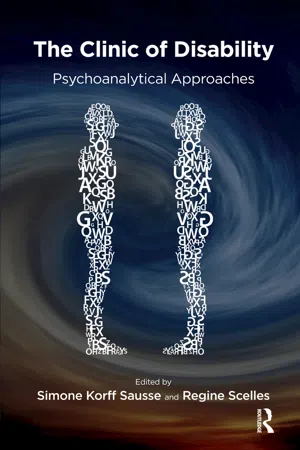
The Clinic of Disability
Psychoanalytical Approaches
- 236 pages
- English
- ePUB (mobile friendly)
- Available on iOS & Android
eBook - ePub
The Clinic of Disability
Psychoanalytical Approaches
About this book
This book focuses on the clinical treatment of disability from French researchers in the fields of psychology, anthropology, psychiatry, and philosophy. It provides English-speaking readers with an insight into the way French authors raise the relevant issues and implement innovative practices.
Information
CHAPTER ONE
Virility, masculine identity, and disability
Pierre Ancet
Introduction: virility and masculinity
What exactly is masculinity, when not confused with virility? Can one be manly without being virile, or should the very image of virility be revised in order to integrate it within new forms of masculinity? These questions are not anodyne, since they relate to sexual identity, a part of identity that is socially constructed in a deployment of sexuality. Masculinity–virility intervenes therein not in the sense of sex, as a descriptive concept (“a male individual”), but in the sense of gender (“a real man”), which is an evaluative and prescriptive notion: “being a man” means having to show muscle power, strength, daring, or even aggressiveness. These characteristics, to which must be added genital potency, are traditionally attributed to the male. Virility places individual masculine identity within the dimension of social gender and its attributes. This issue can thus be seen to affect all men, not just physically disabled man, supposedly devoid of virility. Many men would like to correspond to the virile heterosexual ideal of the dominant male, but many of them must content themselves with being merely male individuals. Each man will probably admit that he possesses only some of the characteristics of virility. How then could such relative virility be denied to men with disabilities? Is it not possible to play a masculine role (e.g., sexually or in the workplace) without having the stereotypical attributes of virility? Are not modern-day fathers themselves far removed from the traditional image of the father (Korff Sausse, 2009), in a masculine role that is, therefore, also accessible to a disabled man?
Virility, rivalry, and seduction
It would be easier to put virile values into perspective if they were not so strongly associated with domination: domination over a female partner, but, above all, supremacy over male competitors. Virility is created in and by rivalry, for which the mere love of a woman (whether mother or lover) cannot compensate. The feeling of being virile is largely linked to self-confidence, as a man among men. The foils of virility, such as “doddering old man”, “the disabled man”, or “the gay man/the queer” can never be seen as competition, but each in a different way. Their only link is to be perceived as being beneath any conceivable form of rivalry. Such individuals are attributed the position of neutered males, not as asexual beings, but, rather, as emasculated by their supposed weakness.
The fact still remains that heterosexual virility can also be tested through female desire, and that such desire may focus on someone theoretically excluded from male rivalry. The disabled man can prove himself there, just as any other man may, by such qualities as steadfastness, temperance, the ability to listen, and might perhaps succeed even better than many men, in terms of being attentive to his partner.
When questioned about representations of virility, Zig Blanquer, a consultant and trainer with a degenerative illness that has slowly caused him to become quadriplegic, remarked that most disabled men whose muscular capacity is impaired do not have deep voices,
but rather a quiet, almost inaudible, even reedy, voice. Because of this, we tend to focus more on the eyes, on visual communication, which is not generally a male strong point (the male gaze is more circular, more sweeping, whereas the female gaze is more settled, more focused).
Similarly, the male body must be fully present, with a presence which resolutely occupies space, whether through posture or gesture. A man will often sit on a sofa and spread out his arms and legs, thus occupying more space. We lack the opportunity to occupy space in this way, confined as we are to our wheelchairs. It seems to me that this particular spatial concentration of disabled men, their way of not “gesticulating” in space allows them to acquire instead an acute consciousness of space, paying great attention to others. (Personal interview)
The perception of space and the perception of others in space become particularly acute. The motionless body fills this space with intensity, through the face and the eyes. The gaze can be a way of touching other people, a form of contact in its own right for someone who can neither caress with his own hand nor draw nearer with his own body. Many men with disabilities have developed this capacity to caress with their eyes and with their smile, a quality that is often overlooked in masculine seduction, yet is essential to it.1 The discussions I have had on this subject with Marcel Nuss are extremely revealing: his considerable disability (quadriplegia related to infantile spinal muscular atrophy) does not undermine his potential for seduction, or women’s perception of his virility.2 Indeed, the strength of character, the determination, courage, and certainty of creating desire and giving pleasure that fall within the definition of manhood may very well exist in the absence of muscle power. Virility also involves assertiveness, which is not only the fact of imposing oneself on others: regarding sexuality, says Marcel Nuss,
everything depends on your attentiveness, your way of being present and open with your partner, not on your way of doing things. No physical ability is required in order to give and receive, rather than merely take and wait. And such giving and receiving can be completely successful, whatever the disability. Whatever the circumstances, everything is a matter of attention and intention, not of what passes for performance. (Ancet & Nuss, 2012, p. 74, translated for this edition)
The “feminine”3 perception of virility must, therefore, involve greater attention to the qualities of presence, commitment, and sensitivity than a “masculine” viewpoint could foresee, even in the domain of seduction, where norms function to the highest extent. This does not prevent men from seeking to establish their identity through a stereotyped virility, which presents the normative advantage of anchoring the individual in the group.
Learning to be virile
The virility of the “male” is perceived as that by which it is possible to measure up to each other “man to man”. Whoever refuses to join in, who recoils or who cannot participate is no longer included in the virile connection that unites a group of men through latent antagonism. The education of young boys is conditioned from the outset by the non-choice that orientated rivalry represents. This rivalry is generally reinforced by the idea that physical strength is needed to reduce the other to silence in a group of men (but there are also symbolic ways to reduce others to silence, which would be the form of domination preferred by intellectuals).
How does this belief in a normalising virility develop? It exists in our societies in many mono-gendered spaces that Daniel Welzer-Lang has termed “the house of men”, in reference to the anthropological research of Maurice Godelier (2004). Among many peoples, the separation of the sexes is very strong, and there are specific places either for men or for women, which are prohibited to the other gender. There are also places in our society where boys are initiated among men into virility (e.g., school playgrounds, gyms, sports clubs, pubs, and stadiums), and socialised within the hierarchical picture of male–female relationships, where femininity (of which a part could also belong to men) becomes the negative central pole, the inner enemy to be fought against:
The education of men is socialisation to gender violence, against women, but also and primarily against weak, fragile boys, who become scapegoats, a fate that threatens any man who is not overtly virile. But the homophobic socialisation of boys is also a form of violence against oneself, so that the body becomes what is expected of one of the lads. In this house-of-men, one learns how to exclude sensitivity, gentleness, and empathy, while also learning how to fight to be the strongest, the best, and the first. And woe to those who reject the codes of virility! They are downgraded from the group of men, and are regarded as women, or their symbolic equivalents, the homosexuals. (Welzer-Lang, 2009, p. 49, translated for this edition)
These sites of homophobic socialisation are often centred either around athletic performance, the capacity for action, or verbal agility, which are all areas likely to exclude, for one reason or another, those boys with disabilities who might be tempted to frequent them (or is it a form of prejudice to affirm that?). Rivalry sporadically plays a part, in the form of peaks of contained aggressiveness: a quick rush of physical aggression, resulting in a virile struggle, where two forces agree to be measured against one another; a sharp rise in verbal aggression, which one must be able to answer without fear, and especially without fearing to get drawn into the game of one-upmanship. This might eventually lead to mutual esteem between those partners capable of measuring up to one another. In fact, those who enter these places of rivalry are individuals who are not only able to react, but who also implicitly agree to measure themselves against others, sporadically. On this basis, a virile agreement is established, based on relationships of domination that are pacified, at least temporarily; privileged places for the expression of a libido dominandi that takes many forms throughout one’s lifetime.
In such contexts, the disabled boy is summed up by his physical weakness, his “natural” disabilities being supposed to exclude him automatically from the “competition”. It seems difficult to accept that he may enter, as others do, into adolescence, the age of male rivalry, of confrontation with the world, of the physical risk-taking particularly prevalent among boys (Le Breton, 2007). It seems clear to parents that their child will not be able to enter these zones of competition, where it is no longer possible for them to protect him from this symbolic or real violence.
In general, the boy learns his social role at an early age, from his parents and the people around him, through the remarks made to him, people’s attitude towards him, and any encouragement he receives. He quickly learns that it is good to be aggressive, “not to let himself be trifled with”, “to have character”, to impose his will, to be noisy, never to show pain or fatigue, to have a “virile” scatological vocabulary. He must be a “man” and not be tied to his mother’s apron strings or behave like a “little girl”, or he risks being disqualified as a male. (Le Breton, 2007, p. 65, translated for this edition)
The author adds a social aspect to the attributes of manhood: the femininity of a man might be accepted in bourgeois circles or among the wealthy, but not among the lower social classes, or in inner city areas, where “an insecure boy, in any situation of exclusion, tends to cling to models of virility that he will caricature” (Le Breton, 2007, p. 67, translated for this edition). His quest for limits and virile identity can take various forms: “dangerous games, drunkenness, speeding, whether on a bike or by car, suicide, delinquency, physical violence, contempt for women, etc. . . .” (Le Breton, 2007, p. 67, translated for this edition).
Driving at speed, or physical challenge, must, therefore, be part of the construction of masculine self-identity. But can one take risks to demonstrate one’s virility, when one is dependent? Physical disability creates many more risks and, at the same time, the impossibility of taking risks as other adolescents do, due to the permanent presence of adults. One of the challenges for carers today is that of letting young people with disabilities refuse help, encounter difficulties, and be faced with their inability to accomplish what they desire, even when the outcome seemed obvious to adults even before the attempt. This confrontation with real life (even without genuine life-threatening risk) is present more or less patently among all adolescents. The ability to accept one’s choices with complete self-awareness is not unthinkable, and neither is autonomy, if we regard it in the etymological sense (ability to create one’s own standards of life), and not as the ability to cope alone in life by living “just like everyone else”. But this path requires us to renounce the stereotypes of virility, which are generally a condition for inclusion in a group of young men, and in that way achieving an identity that is recognised by one’s peers (unless, yet again, we are labouring under our own illusions, while disability might, in fact, be perceived by the peer group as one of those extreme experiences so sought after today by adolescent groups).
The next stage in the classic recognition of male identity is the socially recognised union with a woman, then access to fatherhood and parenthood (with the paternal authority that springs from this). Yet, even as we discover the modern-day father, who also adopts some more traditionally feminine values, it seems that men with disabilities must still remain dependent (even in their own representations) on the traditional figure of the Father.
However, this fundamentally dominant figure is not necessarily linked to an incarnation: the statue of the commander is not to be touched. Immaterial, it resists even death, and haunts with overwhelming power those who suffer its yoke. Why should authority still be associated with physical power? We will explore these issues through our previously mentioned discussions with Marcel Nuss.
Paternal virility and paternal authority
When asked about risk-taking and fatherhood, Marcel Nuss told us that, in his case, the two things were interdependent: at the age of twenty, he had chosen to remain hospitalised (for life, as he then thought) in an intensive care unit, in order no longer to be dependent on his parents. This was, for him, a way of entering the adult world. In fact, this decision allowed him to meet his first wife and have children with her.
Curiously, the plain fact of being married and becoming a father was not enough for his virility to be recognised, which meant that he ran the risk of internalising this refusal:
Regarding the qualities required for one to be virile, life has taught me that it is the gaze fixed upon you at a given moment that will reveal your virility or extinguish it. You cannot declare yourself virile; you either become virile or you don’t; it is a slow, contextual, and cultural transformation.
He adds, regarding the function of authority that fathers are thought to possess,
How many times have I heard, particularly when my children were very young, that in my state of complete physical dependence, it was impossible for me to have any authority?
This is a false premise. For if there is one thing that disability has taught me, it is that authority is a matter of presence and not of physical strength. It’s not the scary people—those who represent a threat, or a potential danger—who possess authority, but rather those who “impress” others by their force of persuasion.
Authority is a fundamental part of what we are, not what we do (along the lines of “I will hurt you if . . .”). Consequently, one does not need to compel by force, but rather to convince by experience; it is necessary to convince others that you are in the right, rather than compelling them by the principle that “might is right”.
Finally, there can be no good authority without a minimum of trust, and, therefore, freedom. All existence is built on experience, whether good or, sometimes, bad. Confidence in others, trust in life, and self-confidence are essential to living and loving well. Furthermore, good authority must be able to teach its neighbours, whoever they may be, to be self-confident.
A person who knows how to inspire respect and give confidence has authority, even if that person is disabled. (personal interview)
The role of father figure can, therefore, be played by a disabled person, even more so when we think of the role of modern-day fathers, which involves listening and understanding, traditionally assigned to the maternal figure (Korff Sausse, 2009, p. 93). Why should disabled men need to be castrating fathers instilling fear, unyielding judges bearing the Law and the word, when so many con temporary fathers are no l...
Table of contents
- Cover
- Half Title
- Title
- Copyright
- Contents
- ABOUT THE EDITORS AND CONTRIBUTORS
- INTRODUCTION by Valerie Sinason
- CHAPTER ONE Virility, masculine identity, and disability
- CHAPTER TWO The traumatic effects of encountering disability: the bond and psychic transmission put to the test
- CHAPTER THREE Cultural interpretation of disability
- CHAPTER FOUR Prediction, disability, and genetics
- CHAPTER FIVE The psychoanalytical approach to disability
- CHAPTER SIX The normality of the abnormal: disability, norms, and normality
- CHAPTER SEVEN The enigma of disability: talking about it with children, listening to them, letting them talk to each other
- CHAPTER EIGHT Bodies lost and bodies gained: the major periods in the history of disability
- CHAPTER NINE Prenatal diagnosis and handicap
- CHAPTER TEN Your child is a vegetable! Ethical requirements for all clinical practices in dealing with severe disability
- CHAPTER ELEVEN Adolescence: psychic process or a mere stage in biology?
- INDEX
Trusted by 375,005 students
Access to over 1.5 million titles for a fair monthly price.
Study more efficiently using our study tools.
Frequently asked questions
Yes, you can cancel anytime from the Subscription tab in your account settings on the Perlego website. Your subscription will stay active until the end of your current billing period. Learn how to cancel your subscription
No, books cannot be downloaded as external files, such as PDFs, for use outside of Perlego. However, you can download books within the Perlego app for offline reading on mobile or tablet. Learn how to download books offline
Perlego offers two plans: Essential and Complete
- Essential is ideal for learners and professionals who enjoy exploring a wide range of subjects. Access the Essential Library with 800,000+ trusted titles and best-sellers across business, personal growth, and the humanities. Includes unlimited reading time and Standard Read Aloud voice.
- Complete: Perfect for advanced learners and researchers needing full, unrestricted access. Unlock 1.5M+ books across hundreds of subjects, including academic and specialized titles. The Complete Plan also includes advanced features like Premium Read Aloud and Research Assistant.
We are an online textbook subscription service, where you can get access to an entire online library for less than the price of a single book per month. With over 1.5 million books across 990+ topics, we’ve got you covered! Learn about our mission
Look out for the read-aloud symbol on your next book to see if you can listen to it. The read-aloud tool reads text aloud for you, highlighting the text as it is being read. You can pause it, speed it up and slow it down. Learn more about Read Aloud
Yes! You can use the Perlego app on both iOS and Android devices to read anytime, anywhere — even offline. Perfect for commutes or when you’re on the go.
Please note we cannot support devices running on iOS 13 and Android 7 or earlier. Learn more about using the app
Please note we cannot support devices running on iOS 13 and Android 7 or earlier. Learn more about using the app
Yes, you can access The Clinic of Disability by Simone Korff Sausse, Regine Scelles, Simone Korff Sausse,Regine Scelles in PDF and/or ePUB format, as well as other popular books in Psychology & History & Theory in Psychology. We have over 1.5 million books available in our catalogue for you to explore.