- 160 pages
- English
- ePUB (mobile friendly)
- Available on iOS & Android
eBook - ePub
About this book
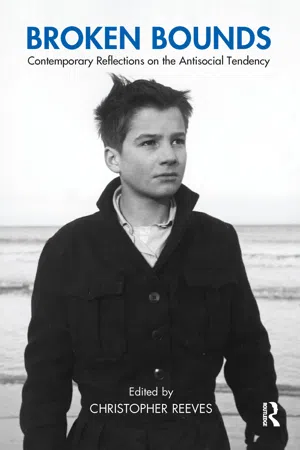
In 2009-2010, The Squiggle Foundation, whose aim is to stimulate interest in the work of Donald Winnicott, organized a series of lectures on the theme of "the antisocial tendency". These lectures are offered here to the wider public much as they were originally given. The speakers, each one an established figure in child care policy or in the residential and therapeutic management of disaffected youngsters, reflect on society's changing attitudes towards antisocial behaviour and its manifestations over the past half century. They consider how altered childrearing practices, the greater incidence of family break-up, and the increasing part played by central government in the determination of child care policies, have contributed to a shift towards the more punitive attitudes towards "wayward youth" prevalent today. Brief, pointed, and accessible, these lectures address topics of contemporary social concern by identifying some of the underlying questions to be asked regarding the child, the family, and society in a mass-communication and mass-organized environment.
Information
Lecture Six
Society and the antisocial tendency: “physician, heal thyself!”
Richard Rollinson
Setting the scene
This being the last lecture in this series, I am aware you do not need telling, or even reminding, about Winnicott and the antisocial tendency. Therefore, I shall operate here as “the Fifth Business”, to take a phrase from the celebrated novel by Robertson Davies (1970)—that is, as the one whose role in a drama is supposedly that of being neither Hero nor Heroine, Confidante nor Villain, but still essential for the dénouement of the plot. In this guise I plan to speak in rather extempore fashion in a way I hope Winnicott himself would approve of. I shall play around with a number of important ideas about young people and society from his times and his perspective as a way of tackling some serious current issues in our own.
A very different world from ours?
Dr. Winnicott delivered his paper, “The Antisocial Tendency”, fifty-four years ago on 20 June 1956 before the British Psychoanalytic Society. What else was happening during that year?
In no particular order of significance:
I was seven years of age and a New Yorker. That was my world, the world as far as I was concerned.
- It was a Leap Year.
- The film, The Wizard of Oz, was televised for the very first time, and certainly not the last!
- The play, West Side Story, by Bernstein and Sondheim, was produced for the stage.
- The first IBM hard drive was developed, twenty miles from where I lived.
- James Dean starred posthumously in the film, Rebel Without a Cause. It was released in November 1955 but was distributed in January 1956. Hence over long years the nickname “56 Gang” came to be employed popularly to identify real and “wannabe” bikers.
- And Billy Dougherty, my sixteen year-old next door neighbour, was serenaded each summer night by his gang who hooted under his window, “Wilbur’s tied to his mother’s apron strings!”, for which mother cursed them loudly before they roared off to commit mayhem.
- It was a presidential election year: war hero Eisenhower vs. patrician diplomat Adlai Stevenson. I was introduced to the Cold War while playing in the park. Older boys were arguing, one saying that if Eisenhower won, half the world would be destroyed by fire; the other insisting that if Stevenson won, half the world would freeze. In the face of such informed political debate (which, I now realize, was not far off the level of adult discourse at that time!) I was frightened and thought: “What! How can that be fair, either way?!”
As you will readily appreciate, my context and memories are mid-century American ones, whereas yours almost certainly are not. But that is not important. In the society of the post-war 1950s, on both sides of the Atlantic, everyone knew their place—hot or cold—or so it is supposed. It still felt like a long time to the 1960s when JFK would be proclaiming in his inaugural address: “The world is very different now.” From my standpoint, more than half a century on, I would say that the world is always different. In 1956 many more people married when starting a family, and less than 2% divorced. Now, as I write this, two-thirds of children starting nursery/pre-school in September will not be living in the same family by the age of sixteen. That’s different. I will not say if it is better or worse; just that it’s different, and will be different again, fifty years on.
Getting the measure of ourselves: a mature society?
Winnicott (1963) asked whether our society was strong enough, healthy enough, to tolerate antisocial behaviour and recognize, receive, and manage its younger citizens into the social and civic world. Clare Winnicott stated in her introduction to her husband’s Deprivation and Delinquency (1984): “[T]he practical question is how to maintain an environment that is humane enough and strong enough to contain all, even those who may then be bent on destroying it” (p. 5).
On that measure how are we doing today? What are we doing in society to meet the challenge and to answer Winnicott’s question—fifty-four years after he wrote his paper “The Antisocial Tendency”, forty-seven years after “Struggling through the doldrums”, and forty-three years after “Delinquency as a sign of hope”?
Let’s look honestly at our performance as he would expect us to do.
In important ways, and again not listed in any rank order of priority:
- We diminish and degrade public spaces for other purposes
We privatize some areas, abandon others, and oversee many more with an undemocratic zeal and a disregard for people that we used to impute to Iron Curtain regimes. In particular, we restrict child and young person access to these areas by various “devices” including the current high-pitch sound emitters intended to drive groups away. Out of fear, parents can contribute to this public disapproval of their presence, often tightly controlling where their children can go.
Shopping malls and NHS Trust facilities send out their own unwelcoming messages to the young. Yet it is in public places, in group interactions, that children and young people learn, practice, make some mistakes and “get it” in other ways as they take on their more social roles unsupervised or only loosely so.
- We criminalize many more behaviours of the young and see them as “bad” already or as heading that way
If one looks at recent crime statistics: rates of violent crimes against children have risen hugely (Home Office, 2010). But, once one removes from that figure those incidents in schools and playgrounds that occur between and amongst young people themselves, then the rate drops by 70%! In the past, except in the most serious cases, these would simply be dealt with as disciplinary issues within school. Nowadays, dealing with such behaviour in situ is not only much less possible or permissible, but even appears less desirable to adults in positions of authority, as well as to many parents. Moreover, other factors enter in and complicate matters of assessment and evaluation. Not long ago police in Cornwall charged a child with twenty-seven separate offences for one incident—to reach performance targets that otherwise would not have been reached.
Winnicott referred to the “total environmental reactions” that are provoked by antisocial behaviour and by the absence of sufficient thoughtful public, social, official response. The direction of travel today is clear—towards Blame, Intolerance, and Punishment, or ever more strident demands for punishment.
Anti-Social Behaviour Orders (ASBOs) themselves are not crime records, but breeching them is a crime; and many are “set up” for that to happen, when they are not being embraced as badges of “dishonour” by the young who call the adults’ bluff. Trespass is such an easy “crime” for young people to commit now.
On the very first morning of the 2010 election campaign, the Director of an independent think tank was making great play on Radio 4 of the necessity for all political parties to deal firmly with binge-drinking by the young in towns and cities. It must be eliminated; it is intolerable! There was no effort to introduce perspective, proportion, or understanding in order to guide intervention.
On Question Time, David Starkey, the historian, was recently to be heard arguing that the current Children’s Commissioner, Maggie Atkinson, should be sacked for proposing that the age of criminal responsibility be raised from ten to twelve, adding that 25% of children were “feral” and needed “dealing with”. He wasn’t a lone public voice!
The two boys under twelve who were tried for raping an eight year-old girl, while acquitted of the most serious charges, were convicted of crimes that put them on the sex offenders register. At the trial’s end, the Judge invited comments from any interested parties “on the process” of the trial. (Guardian, 2010; my emphasis). Well, my comment is on the fact that there had been a trial “process” at all. The prosecution, as you would expect, made a highly choreographed presentation of the “evidence” that malignly served to mirror and exacerbate social shock and voyeurism, not least by releasing the photo of the “victim” holding the teddy bear they had got her and which she dubbed “Mr Happy” when coaxed to name him. Overall the process resembled a “show trial”. It did nothing either to secure justice, protect children, make communities safer, or support the principals in becoming healthier, wholesome individuals. A trial such as this is more a commentary on our society and its treatment of children (however “antisocial” some might be), than it is an indication of the relentless and sordid rise of feral youth.
There is a saying: “We preach Justice, we crave Mercy, we practice Vengeance.” The general “mess making” that Winnicott referred to (1956, p. 311) as an early manifestation of “the antisocial tendency” (and he didn’t just mean untidy bedrooms) can easily count as a crime nowadays, with a much reduced response repertoire—“shoplifters are always prosecuted”; “abuse of staff is not tolerated and will always be prosecuted”.
I do not suggest there are no real problems, but we need to look honestly at what produces and then sustains them.
- And when we aren’t criminalizing and rendering children “bad”, we look to construct them as “mad”/disordered
DSM-5 (Diagnostic and Statistical Manual of Mental Disorders, 5th edition) is due to be published in May 2013; ICD-11 (International Statistical Classification of Diseases and Related Health Problems, 11th Revision) is due from the World Health Organization (WHO) in final form in May 2014. Like its transatlantic counterpart, the new publication is likely to increase its diagnoses and disorders by 20%, as it usually has done with each new “iteration”. This is a process Frank Füredi (2003, p. 182) calls “the diseasing of childhood” and Gail McLeod (2010, p. 95) terms “the medicalisation of naughtiness”. Visser and Jehan (2009, p. 204) contend that for every child diagnosed as having ADHD (Attention Deficit Hyperactivity Disorder) who may actually have a genuine difficulty in “attending”, many, many more are pathologized by those who choose to frame such difficulties within an uncomplicated (and simplistic) bio-medical paradigm. Any alternative explanations, and hence recommendations for treatment, are largely discarded.
Winnicott was clear that the antisocial tendency was precisely that—a tendency. It was neither diagnosis nor disorder (1956, p. 308). Without recognition of, and response to it, as such, then a “social disease” of stealing and destruction begins to emerge in society. In our day, through that total environmental reaction, a public health problem is unacknowledged and instead is pushed back on to the child as their personal, private “disorder”. It is a tidy inversion, or rather, a perversion, of where both source and solution reside—in relationships or in their absence. The dimension of the antisocial tendency that Winnicott identified as the disposition to behave in defiance of the constraints of society is ignored, as is the sign of hope implicit in that encounter.
- As a society and not infrequently as individuals, we actively create and encourage antisocial behaviour and then react—stepping back in horror first before moving forward in righteous fury
Consider the issue of drinking to excess. A large part of the culture and economy of cities and town centres is geared to such excessive consumption, with advertising running unabated. If it really stopped, there would be another economic downturn. Shoplifting similarly—advertising and “disposable money” proclaim the primacy of style—and the absolute need to acquire the most recent clothing, accessories, and electronic gear. If they don’t have the money, many young people will tell you that they will secure the newest gadget by hook or crook, rather than be caught with last month’s now passé item and risk being rendered “sad” or “3” (that is, DEF—deficient).
- We use rhetoric and language not to give clear information and invite children’s thoughtful engagement and response, but to persuade/influence them with glitz and shallow words
Think of the phrase ZERO TOLERANCE of bullying or of the widespread school and workplace policy to “fight bullying”. The former term denotes intolerance and will not succeed in containing and transforming bullying or anything else. It simply drives it underground or elsewhere.
As for ourselves, we can be expert in blinding children to reality. A character in a Robertson Davies’ novel, The Manticore (1972), once observed about adulthood: “How readily the qualities of adult authority and power can be brought to the service of the wildest nonsense and cruelty.” There’s self-deception—recall the Pythons famous remark: “Oh, Dinsdale, he was cruel … but fair.” Then there’s deception of others: In the film Chicago (Dir. Rob Marshall, 2002) we are presented with a celebrity lawyer, notorious for getting his clients off on charges for which they are transparently guilty, and then a celebrity dancer on trial for murder. She is well and truly “nailed” by the evidence of a witness and the actual “smoking gun”. Turning to her lawyer in despair, she asks: “So what do we do now? They’ve got me.” To which he replies: “Well, when there is nothing at all to do about the evidence, the only thing left is—give them the ‘Old Razzle Dazzle’.” He then breaks into a wonderful four-minute song and dance routine that says in effect: “Don’t look over there, at the evidence; look here, here, no—here—at my distracting song and dance.” And, of course, she is acquitted!
Is this a case of Art imitating life, or life imitating Art? Indeed, it actually happens. We use our language to block or prohibit conversation and exploration, especially about uncomfortable things—things that we can’t really explain or justify, not infrequently about what we ourselves say or do. Consider such well-worn phrases as “I want to draw a line under this incident …”; “Yes, the patient died and that was sad, but the operation itself was a success”; and “I only want their [young people’s] respect.”
The antisocial tendency that needs to be noticed instead gets NOTICES—“No ball playing. No skateboarding. No bike riding here.”; “All violators will be prosecuted.”; “Do not “Beware, this is not a public space.”; “Beware, this is not a right of way.”; “You mind yourself.”; “You must …”; “You must not …” In the face of this heavy blast of commands and demands and prohibitions what do the young “own”? And where are they “owned”—outside the home or even in it?
So often do we or our public representatives dissemble in our communications that it is little wonder young people regularly withdraw and are disconnected from state provision and facilities. As part of British Care Leavers’ Week in October 2004, the then Social Exclusion Unit (SEU) launched their report on...
Table of contents
- Cover
- Half Title
- Title Page
- Copyright Page
- Dedication
- Contents
- Preface
- About the Editor and Contributors
- Editor’s Introduction
- Lecture One Learning to live with the antisocial tendency: the challenge of residential care and treatment
- Lecture Two Responses to antisocial youth: does Donald Winnicott have messages for us today?
- Lecture Three Can the state ever be a “good-enough parent”?
- Lecture Four Winnicott’s delinquent
- Lecture Five Heroic delinquency and the riddle of the Sphinx
- Lecture Six Society and the antisocial tendency: “physician, heal thyself!”
- Postscript The “English riots” as a communication: Winnicott, the antisocial tendency, and public disorder
Trusted by 375,005 students
Access to over 1.5 million titles for a fair monthly price.
Study more efficiently using our study tools.
Frequently asked questions
Yes, you can cancel anytime from the Subscription tab in your account settings on the Perlego website. Your subscription will stay active until the end of your current billing period. Learn how to cancel your subscription
No, books cannot be downloaded as external files, such as PDFs, for use outside of Perlego. However, you can download books within the Perlego app for offline reading on mobile or tablet. Learn how to download books offline
Perlego offers two plans: Essential and Complete
- Essential is ideal for learners and professionals who enjoy exploring a wide range of subjects. Access the Essential Library with 800,000+ trusted titles and best-sellers across business, personal growth, and the humanities. Includes unlimited reading time and Standard Read Aloud voice.
- Complete: Perfect for advanced learners and researchers needing full, unrestricted access. Unlock 1.5M+ books across hundreds of subjects, including academic and specialized titles. The Complete Plan also includes advanced features like Premium Read Aloud and Research Assistant.
We are an online textbook subscription service, where you can get access to an entire online library for less than the price of a single book per month. With over 1.5 million books across 990+ topics, we’ve got you covered! Learn about our mission
Look out for the read-aloud symbol on your next book to see if you can listen to it. The read-aloud tool reads text aloud for you, highlighting the text as it is being read. You can pause it, speed it up and slow it down. Learn more about Read Aloud
Yes! You can use the Perlego app on both iOS and Android devices to read anytime, anywhere — even offline. Perfect for commutes or when you’re on the go.
Please note we cannot support devices running on iOS 13 and Android 7 or earlier. Learn more about using the app
Please note we cannot support devices running on iOS 13 and Android 7 or earlier. Learn more about using the app
Yes, you can access Broken Bounds by Christopher Reeves in PDF and/or ePUB format, as well as other popular books in Social Sciences & History & Theory in Psychology. We have over 1.5 million books available in our catalogue for you to explore.