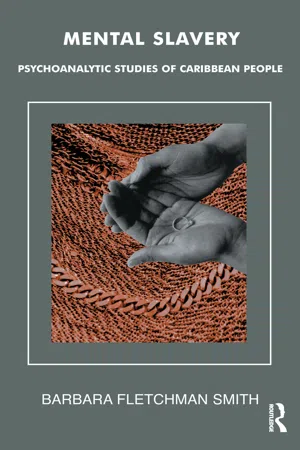
Mental Slavery is a unique and timely contribution to the field of trans-cultural psychoanalysis, casting light on an area previously neglected within mainstream psychoanalytic writing. The author examines the complex effects of the experience of slavery and its impact on generations of Caribbean people, with particular reference to families who have settled in the UK. She brings many subtle insights to a fascinating subject, drawing on her detailed knowledge of many Caribbean cultures, both past and present. Through vivid examples from her clinical practice, the author argues for a much wider perspective on the issues presented by Caribbean patients, and the role played in these by the historical past. Misunderstanding of Caribbean patients which, formerly, had been blamed on racist attitudes on the part of the therapist, is here revealed in a new light. Although the author does not deny that racist attitudes exist, throughout her book she presents a powerful case for a more discerning approach to both the negative and positive aspects of the Caribbean experience.
- 166 pages
- English
- ePUB (mobile friendly)
- Available on iOS & Android
eBook - ePub
About this book
Information
PART ONE
Historical and Theoretical
Chapter one
Slavery: The Historical Background
Before taking a look at the inside of patients of Caribbean origin, I think it would be appropriate to take a look outside, at the historical connections between Africans in the Caribbean, and the British.2
I have grouped together the different countries of the Caribbean, but in the full knowledge that they are very different from one another. To me their differences are less important than their similarities because the people of these countries—together with African-Americans—share a historical past.
The terms ‘British of Caribbean origin’, ‘African-Caribbean’, ‘Afro-British’, ‘Black British’, ‘Black English’, ‘Scots or Welsh of Caribbean origin’ are all used currently to describe the group of men and women upon which I wish to focus. The wide variety of definitions is part of a wider process of re-assembling identities, currently taking place in the post-empire, post-independence period. Indeed, ‘people of Caribbean origin’ also include the descendants of indentured labourers from Europe, Asia and elsewhere, and Caribbean people who migrated to the USA will have experiences in common with those who migrated to the UK. The majority of the population in most Caribbean countries, however, continues to be ethnic African.3 So although I am focusing upon people of African origin, I am aware that most people from the Caribbean are racially mixed to some degree. It is true to say that they are predominantly ethnically African, and their descendants in Britain are also viewed as such. In a climate in which racism thrives, one runs the risks of ‘singling out’ this group of people as a ‘problem’. However, this is a risk I am prepared to take. By damaging others, people also damage themselves, and I suspect that if I were to focus on the children of former slave-owners, then I would discover traumas there too. In the making of empires, it is inevitable that crimes will be committed.
People of Caribbean origin share a history that begins with slavery and indenture, but—of course—the history of the people of Africa extends back much further. The relationship between Europeans and their African neighbours—for it should be remembered that the two continents are geographically less than ten miles apart—is one of exploitation. The development of Europe was at the expense of Africa. This is despite the fact that, as human beings, we have the capacity to shape our history in a non-exploitative way.
Britain in the fourteenth century was poor in comparison with the rest of the world. It was this that drove its people outwards in pursuit of wealth. The culmination of the efforts of the heroes in English history—men such as Sir Francis Drake in the sixteenth century, for instance—was the establishment of plantation societies in the Americas and the Caribbean, by the beginning of the eighteenth century.
European involvement in the slave trade has to be set alongside Arab involvement, and African co-operation and resistance. When Egypt fell to the Arabs in AD 641, a gradual process of colonisation by Africans began. The Arabs, for centuries, imposed their Islamic religion from the north of the African continent downwards, replacing the dominant religions of Animism and Christianity. There were Christians in Africa long before the British ever went there. Many wars were fought, in which African slaves were taken, and Arabs were the instigators of these wars. Africans also indulged in the taking of slaves from other African states.
Both Europeans and Arabs used their religion as the justification of their actions—as the whole of mankind always has. However, if sub-Saharan Africans had been more willing to allow reforms within their societies, they might have been able to eradicate slavery within their own nations—and outside—much earlier. Yet equally, had they chosen instead to fight to the death in an attempt to halt the push of the Arabs and Europeans further and further into the continent, then they might have suffered a fate similar to that of the American Indians or Australian Aborigines. We will never know what might have happened otherwise, but it is interesting to speculate. Greed, hatred, and love are universal human attributes, each in more plentiful supply at a certain time than at other times. What is clear, however, is that as time went on the Europeans came to possess superior tools of war—due to the wealth created through continuation of the slave trade itself—and which they were very happy to put to use. It must be remembered, however, that the slave trade endured for hundreds of years.
The slave trade financed the ‘high culture’ of eighteenth century England, and provided the financial base for the industrialisation of the United Kingdom. To my knowledge, however, the existence of the slave trade features in the literature of the nineteenth century only in a heavily coded fashion. An example of this can be seen in the work of Charles Dickens—specifically, in the character Tom Gradgrind from the novel Hard Times (published 1853). Dickens was 41-years-old at the time he wrote this novel in which Tom, the Gradgrind family’s son and heir, ends up having to evade exposure as a thief by dressing as a ‘blackamoor’ (a European construction of an African) in a circus (Dickens 1982). This disguise might be read as an appropriate course of action to avoid detection. However, to me it reads instead as the author’s unconscious acknowledgement that the real thieves are not the ‘blackamoors’. I take the ‘blackamoor’ as representing black foreign people who lost land and freedom to the British. The circus people in the novel appear as a combined representation of the arts, the working classes, and the dispossessed in general. Dickens could have chosen a different disguise for Tom, but by putting him into the skin of ‘the other’ he attempts to put his audience also in the position of the ‘blackamoor’. Despite the lack of explicit references in nineteenth-century literature, Victorians were very aware of slaves and slavery, and thus were likely to respond strongly to the plight of Tom who—by adopting the ‘blackamoor’ disguise—simultaneously loses his own land and freedom. Dickens himself held deeply Christian values, which were mostly in direct opposition to the institutionally practised ‘Christianity’ in Victorian society.
By the time the Industrial Revolution was complete, the freedom of the slaves had become an option. The British Empire was by no means the only Empire built upon slavery, but it was the first from which there was no hope of gaining freedom with the passage of time. There was no way out except resistance. In the end it became too expensive for the British to maintain slavery, because of the continuous necessity to suppress perpetual revolts on the plantations. Also, industrialisation brought with it a need for markets for the goods being produced. Consequently, the slave trade lost its supremacy, and as the demand for slaves steadily decreased the supply itself could finally be abandoned.
Britain was the chief European country involved in the organisation of the slave trade. It conducted its operations from three main centres: the ports of London, Bristol and Liverpool. Indeed, the municipal development of Bristol and Liverpool was entirely dependent on slavery. In turn, the Caribbean plantation owners became extremely wealthy men, and used their money to buy power and influence in the British parliament and aristocracy. It was this power against which the black and white Abolitionists had to struggle, yet, even as the slave trade went into decline, the plantation owners and traders received huge sums of compensation for the loss of their livelihood.
The Abolitionist movement grew out of eighteenth-century Humanism. There were many decent British and African people who abhorred the trade in human lives, and who made its abolition their life-long task.4 In much the same way, today, there are decent people making history through their daily work towards racial justice and equality.
In the Caribbean, the abolition of slavery was succeeded by the importation of the indentured labour of Europeans (mainly Portuguese), East Indians, Chinese, Arabs, and others. Africans had a different relationship to the land from these new arrivals; many Africans could not wait to escape from the country altogether. At this time it was very difficult to obtain enough land of one’s own to make a living. Slavery thus passed through Abolition to Emancipation, and then into the era of Colonialism. Independence from Colonialism followed in the 1960s.
The people who arrived in the Caribbean after the Africans entered a society which already possessed an established Creole language. They had to learn how to speak both English and Creole. In the process, many of these non-English-speaking people lost their original languages. At the time of slavery, Caribbean society was rigidly structured, with the plantation owners at the top, and the people of mixed blood—from unions between Europeans and Africans—forming the next layer. Africans were the bottom layer of this society, the most numerous group. Among the Europeans in the British colonies there was also a split between land-owning, mostly English-speaking Protestants, and landless, largely non-English-speaking Roman Catholics. The latter, in time, acquired land.
From the mix produced by these processes emerged the modern Caribbean men and women, with practically no links to the original, indigenous Caribbeans. The bulk of the people were also officially disconnected from the African countries of their ancestors, until after Independence?. The Caribbean plan-tocracy retained their connection with Europe. Continued racial inter-mixing of the many different peoples has ensured that there are no ‘pure’ Africans descended from the original African slaves—that is, ‘pure’ as far as this term can ever have any meaning. African languages, beliefs and customs which had been transported to the Caribbean with the slaves were either lost completely, or have lain buried, waiting to surface. The customs of the different peoples have combined together over time, and have become transformed into a culture which is now uniquely ‘Caribbean’.
Many academics have taken on the challenge of exploring the roots of language, in order to attempt to reconnect with the past. Language itself is the mark of a specific culture. The Creole language developed over the centuries as an exclusively oral language, firstly between the slaves who originated from different nations and spoke various languages, and then between the slaves and their owners. The slaves were forbidden to speak their African languages amongst themselves purely as a means of controlling them.
Creole drew upon African as well as European languages. There are three different Creole languages spoken within the Caribbean. This is due to the way in which different European countries with their different languages ruled over the various countries in the region. The speaking of English (and also French and Spanish) in preference to Creole was viewed as the mark of education and class throughout Caribbean society for centuries. Along with the English language, English culture was also absorbed. Only in the second half of the twentieth century—the post-colonial period—have these societies become comfortable enough with themselves to claim Creole as an oral and a written language. Published writers from the region often use English, French or Spanish as well as Creole, and Creole-English dictionaries have since been published.
However, some ambivalence remains over claiming Creole as a fully distinct language in its own right—as might be imagined from the circumstances we have reviewed so far. It seems highly probable that psychological disturbance would have arisen in individuals forbidden to speak their own language, in slavery times. During the migration of Caribbean people this century a similar inhibition against using language might also have occurred, which would affect the capacity of some children to develop language and symbol formation. Most probably, this will have been associated with the occurrence of severely depressed states in the parents. It can easily be imagined how the failure of the processes of verbal self-expression must endanger a person’s mental health, especially if alternative modes of expression cannot be found. I suspect that this state of affairs has been partly responsible for a great deal of ill-health. The loss of familiar ways of communicating, and of loved ones with whom to communicate, was as bad as the loss of familiar foods and climate.
It is interesting to note that the children of Caribbean migrants, regardless of their country of origin, who live in the inner-city areas of the UK and USA, have developed languages of their own which they use to express their separateness and exclusivity. This can be viewed as an unconscious reclamation of something that was lost. However, when the language used by a person to express intimacy is not understood by outsiders, then serious problems will arise when professionals attempt to make meaningful contact with the individuals concerned. It is known that this process frequently occurs, and has fundamental implications for any form of inter-personal work in which words assume importance.
I have entered into these historical details because I think that history has fundamentally influenced the way people of European and African origin treat one another today, and also the way in which each regards themselves. Slavery severely traumatised people—to such an extent that it affected people’s capacity to procreate. Terror, perpetual fear, cruel abuse and gruelling work were the order of the day. Slave women frequently took control of their own fertility by killing their children, in order to prevent them from becoming slaves themselves. Following Emancipation and Independence, a population which was unable to rise in number during slavery began to swell dramatically once people felt in control of their own lives. The political significance of Emancipation and Independence was of great importance to people of African origin; it seemed inevitable that migration would become an appealing option.
Alongside migration, there is the legacy of the continuing struggle for equality as human beings. I very much doubt that the majority of British people have yet caught up with the significance of Emancipation, its potential for good. The loss of an Empire built upon slavery is something of which to be proud; however, it is not possible to feel this without a period of mourning. This—hopefully—will be worked through in much the same way as more personal matters need to be worked through, and is a process hindered by high levels of denial. For instance, it is a fact that the slave trade created the United States of America as we know it today. Many people do not know this. Some, of course, do not wish to know it. Similarly, schoolchildren, taken to visit Ironbridge in Shropshire, England—the birthplace of the Industrial Revolution—are not helped to make the connection between the rush to smelt iron and the slave trade. Nowadays much money is spent on promoting English heritage, but it does not include this particular bit of history. While this attitude persists, people of African origin are likely to be blamed for all sorts of imagined wrongs. It is, as yet, far from certain whether the nation can find a different way of being from that based on the notion of a ‘top’ and a ‘bottom’—which is the same as that on which slavery and colonialism was based. The European mind, evidently, is as much in need of Emancipation as the Caribbean mind. Attacks on migrants—whether on a personal or governmental level—are uncreative, but also a terrible waste of energy as people have migrated from the beginning of time, and will go on doing so, whenever they think there is the possibility of a better life elsewhere.
Africans have lived in Britain since Roman times, which—as we have already reminded ourselves—is not surprising, given the close proximity of the African and European continents, physically less than ten miles apart. From the fifteenth century onwards—and particularly during the reign of Elizabeth I (1558–1603)—much was recorded of their presence. Some Africans came directly to Britain as free men, and others as slaves. Children have—for centuries—been sent to Britain to be educated. Some Africans were brought as slaves directly from Africa, or from the Caribbean or America. It was not unusual for Africans to be seen in England throughout the seventeenth and eighteenth centuries. The practice of keeping slaves was largely undertaken abroad, in the new American colonies and the Caribbean. Indeed, slaves were vital to the establishment of these colonies and were regarded as status symbols by the English aristocracy, who were only too willing to have their portraits painted with their slaves in attendance. There seems to have been no general shame or guilt at this time attached to the chaining and collaring of human beings, yet there have—for centuries—been black and white voices in England raised in protest against this way of treating people.
During the twentieth century the British Empire began to dissolve, as a result of Independence movements and two world wars. At the same time there was a migration of people from the Caribbean and elsewhere to the UK and to North America. People migrated in the expectation of better lives; thus most were economic migrants, like the Europeans of the nineteenth century. At that time British and other European people had migrated to the Americas, the Caribbean, Africa, Australia, New Zealand and India. Nearly three million people left the UK between 1853 and 1880, to live overseas in the New World because—as the liberal historian Geoffrey Best put it—‘their country became incapable of offering them the means of living by their own labour’ (Best 1979: 147). These events are recorded in the paintings ‘The Last of England’ (1852–3) by Ford Madox Brown, and ‘The Emigrant’s Last Sight of Home’ (1858) by Richard Redgrave.5 Economic conditions in the Caribbean during the twentieth century had a similar effect on the people living there.
So far, I have attempted to sketch the connection between Africa, Britain and the Caribbean, and to trace the journey of Caribbean migrants to Britain. I am not concerned in the book with the issue of race relations as such—with how British people of one hue relate to those of another—although this will, necessarily, be somewhere in the background. Migration has consequences—both for those left behind, and for the countries in which migrants arrive. Migration to the very centre of what had been the British Empire, of people whose forebears had been enslaved in Africa and taken to the Caribbean, was evidently a very serious matter. Firstly, it involved the loss of important attachments to loved ones who might never be seen again. Secondly, it meant the breaking of traditional ties of loyalty to a culture. The disruption of personal ties disturbed the individual’s whole being, which sometimes took years to repair—or sometimes...
Table of contents
- Cover
- Title Page
- Copyright Page
- Dedication Page
- Acknowledgments
- Contents
- Introduction
- Part One: Historical and Theoretical
- Part Two: The Case Histories
- Notes
- Bibliography
- Index
Trusted by 375,005 students
Access to over 1.5 million titles for a fair monthly price.
Study more efficiently using our study tools.
Frequently asked questions
Yes, you can cancel anytime from the Subscription tab in your account settings on the Perlego website. Your subscription will stay active until the end of your current billing period. Learn how to cancel your subscription
No, books cannot be downloaded as external files, such as PDFs, for use outside of Perlego. However, you can download books within the Perlego app for offline reading on mobile or tablet. Learn how to download books offline
Perlego offers two plans: Essential and Complete
- Essential is ideal for learners and professionals who enjoy exploring a wide range of subjects. Access the Essential Library with 800,000+ trusted titles and best-sellers across business, personal growth, and the humanities. Includes unlimited reading time and Standard Read Aloud voice.
- Complete: Perfect for advanced learners and researchers needing full, unrestricted access. Unlock 1.5M+ books across hundreds of subjects, including academic and specialized titles. The Complete Plan also includes advanced features like Premium Read Aloud and Research Assistant.
We are an online textbook subscription service, where you can get access to an entire online library for less than the price of a single book per month. With over 1.5 million books across 990+ topics, we’ve got you covered! Learn about our mission
Look out for the read-aloud symbol on your next book to see if you can listen to it. The read-aloud tool reads text aloud for you, highlighting the text as it is being read. You can pause it, speed it up and slow it down. Learn more about Read Aloud
Yes! You can use the Perlego app on both iOS and Android devices to read anytime, anywhere — even offline. Perfect for commutes or when you’re on the go.
Please note we cannot support devices running on iOS 13 and Android 7 or earlier. Learn more about using the app
Please note we cannot support devices running on iOS 13 and Android 7 or earlier. Learn more about using the app
Yes, you can access Mental Slavery by Barbara Fletchman Smith in PDF and/or ePUB format, as well as other popular books in Psychology & History & Theory in Psychology. We have over 1.5 million books available in our catalogue for you to explore.