This book provides comprehensive information needed to assist with all aspects of designing, delivering, or evaluating transportation systems for use by older adults, and presents the necessary background on aging and human factors issues as well as practical guidelines needed to accommodate older adult transport users.
Features
Presents clear design guidance aimed at improving usability among older adults, a too often neglected but fast-growing segment of the transportation system population
Includes comprehensive coverage of transportation systems, including the notably important issue of older drivers, but also additional transportation forms including public transportation via bus and subway, air transport, rail, bicycle, and even pedestrians
Offers numerous examples throughout of best practices based on both the scientific literature and the content expertise of the authors
Discusses practical implications of incorporating the recommended design principles for both older adults and other transport system users
Provides useful background about normal age-related changes in sensory, cognitive, and physical abilities that impact older adults and how they interact with transportation systems
A 91-year-old motorist ran over two people Monday morning while backing out of a parking space at the Mar Vista Post Office parking lot off Grandview Boulevard, according to Los Angeles police. A 74-year-old woman struck by the SUV died at the scene and an 83-year-old man, believed to be the victim’s husband, was taken to a local hospital with serious injuries.
Argonaut Online,December 15, 2014
The incident occurred in broad daylight, at low speed, and yet tragically took the life of an unsuspecting pedestrian. Accounts like these are all too frequently in the news, even if they are not that common relative to the number of miles older adults drive. They catch the attention of media. Sometimes such incidents occur while the older driver is backing up, unable to see what is behind him or her. Other times they are due to the driver inadvertently hitting the gas pedal instead of the brake.
At the same time, there are news reports of older people voicing sentiments such as this: “‘You know what I’d do if I couldn’t drive?’ an older man barks from inside his home, with a nod to a living room recliner. ‘I’d go sit down right there in that chair and die…’” This quote was from an 80-year-old Detroit driver who was interviewed for a story about older drivers that aired on WZZM Channel 13 ABC on May 8, 2014.
Designing safe and effective means of meeting the mobility needs of older adults is a global imperative. For many companies it is not only the right thing to do, it will also be financially beneficial. Human factors design solutions for the personal automobile are one avenue for achieving this imperative by assisting the older driver. In general, the term older refers to anyone over the age of 65 years. However, the tremendous variability in the aging process means that any two individuals over age 65 are likely to be different in more ways than any two 20-year-olds. Despite the increased variability associated with age, general changes in sensory, perceptual, cognitive, and physical abilities tend to accompany advanced age and can lead to increased difficulty interacting with transportation interfaces.
Drivers over age 80 years are involved in more fatal crashes and are more likely to be at fault in fatal crashes than any other age group. Older pedestrians are more likely to be struck when crossing streets and navigating parking lots than their younger counterparts. However, the great variability among older adults means that strict cutoffs for things like driver’s licensure are both unethical and ineffective. Any given octogenarian driver may be safer behind the wheel than a random 46-year-old, and likely to be safer than the average 20-year-old male driver. The National Highway Traffic Safety Administration (NHTSA) currently focuses on what is known as the three D’s of traffic collisions (drunk, drugged, and dangerous). Young males are much more likely to engage in dangerous driving behaviors like speeding and passing in narrow gaps than their older counterparts. Providing in-vehicle adaptive speed control devices may assist older adults by off-loading part of the control aspect of the driving task while assisting young drivers with maintaining safe and legal speeds. In fact, we often see that design recommendations that improve safety for older adults improve safety for all. The few exceptions to these design guidelines are pointed out in subsequent chapters.
Further, improved design in domains such as roadway infrastructure and driver vehicle interfaces (DVIs) can have dramatic, immediate impact that is difficult to achieve through training and attempts to change well-established cultural safety norms among the millions of people involved. Technological advances are making driving and flying safer for all ages. As we discuss in the current volume, there are many design factors that can make transportation in all forms safer for people of all ages, and for older adults in particular.
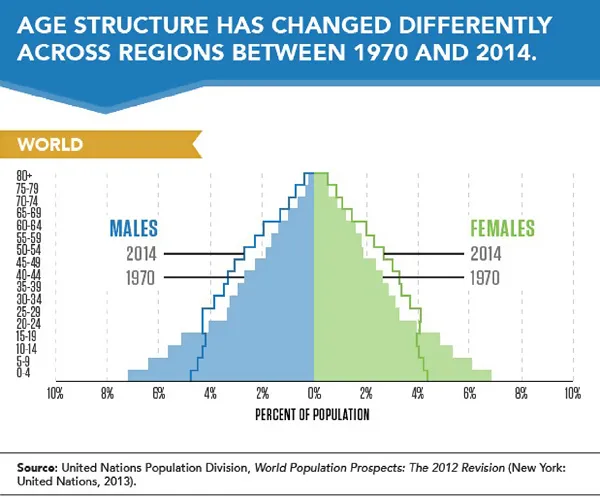
Population aging is a well-known reality in the United States and Europe. This demographic trend of population aging is expected to continue (Figure 1.1). The group referred to as the baby boomers (those born after World War II between 1946 and 1964) are reaching retirement age, but many are choosing not to retire for a variety of personal and economic reasons or are choosing to have “encore” or second careers after retiring from their first career. Today’s older adults are expecting to have more mobile lifestyles than their predecessors, regardless of whether or not they remain employed.
Figure 1.1 Population aging trends based on UN figures. (Used with permission from the Population Reference Bureau, Washington, DC, https://www.prb.org)
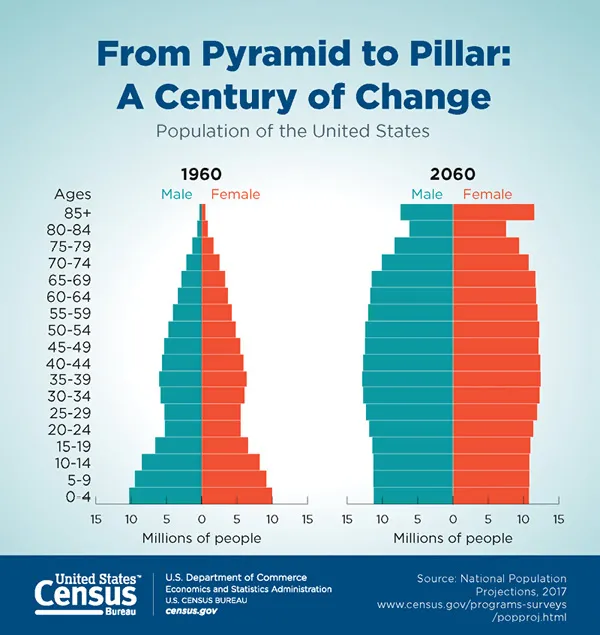
Data from the U.S. Census confirm this population aging trend by indicating that not only are the percentages of adults over 65 years of age increasing, people over the age of 85 are the fastest-growing segment of the population (Figure 1.2).
Figure 1.2 Percentage of U.S. adults over the age of 65 and 85 years.
Older adults today are more active, healthy, and technologically savvy than those of previous generations, and they live more mobile lifestyles. They rely on many modes of transportation to meet their needs. However, personal automobiles remain the most prevalent mode. The most recent data compiled by the U.S. Department of Transportation (2017) in its National Household Travel Survey indicate that 90% of all trips are taken by personal vehicle across all age groups over age 65 years. Designing transportation systems that effectively meet the needs of this fast-growing segment of the population is a global imperative. Providing design guidelines to accomplish this imperative is the aim of this book.
To illustrate the issues to be discussed in subsequent chapters, we begin by presenting two fictional personas in specific situations that highlight some of the strengths as well as some of the challenges and issues faced by older adults. Personas are archetypal or prototypical users and are frequently used to aid design as they facilitate a user-centered design approach. Later in the text, we refer back to these personas, as well as introduce new ones, and discuss lessons learned from working with older adults in person. These personas can illustrate how key design recommendations can be applied in a wide variety of transportation modes ranging from the personal automobile to air travel and other forms of public transportation.
Before we can improve transportation systems for older adults, we need to understand more about their general mobility, driving habits, and preferences for modes of transportation. In the remainder of this chapter we discuss important general characteristics of today’s older adults, how this demographic is changing, and how they choose to meet their transportation needs.
1.1 Population aging
Declining fertility rates and increasing life expectancies around the globe in many countries are resulting in a phenomenon that has come to be called global population aging. That term means that the median age of a population is rising. Populations in the United States, Europe, Australia, Asia, South America, and most other countries are aging. This trend has numerous ramifications for designers of transportation systems. A larger proportion of the consumer market will soon be over 65 years of age. Older adults will be a larger share of the drivers and purchasers of vehicles, airline tickets, bus passes, etc. Therefore, in addition to being a global imperative to maintain the safety of this growing proportion of the population, it will be financially prudent for the companies and suppliers of transportation systems to do so. It is worth getting to know more about the lifestyles and habits of this changing demographic.
1.2 Mobile but less active lifestyles
Older adults from most, if not all, developed countries are increasingly sedentary, and this less active lifestyle is accompanied by a greater risk of cardiovascular disease related to obesity, hypertension, and diabetes. These trends are particularly evident in North America, where over half of the U.S. population is currently considered overweight or obese. Only recently has the difficulty of losing weight been recognized, with only 15%–20% of obese people being successful in permanent weight loss. In light of the serious health consequences of obesity (e.g., diabetes, heart disease, sleep apnea, and dementia), there is a public health motivation to make it easier and safer for people to walk and bicycle safely.
At the same time, these older adults in the United States retire later than their predecessors. Further, a substantial number of people who do retire subsequently reenter the workforce within the next 2 years. According to a recent AARP study (Brown, 2003), only 40% of workers between the ages of 50 and 70 expect to quit working before age 70, and over 25% expect to keep working until age 80 or beyond. These workers will continue to rely on transportation services to get to and from work on a daily basis and will travel using a variety of means for both work and pleasure.
1.3 Lifestyle factors
Older adults generally have poorer health, less money, but more time than younger adults. Increasing numbers of adults in Western European countries and the United States live in single households. Today’s older adults are also more technologically savvy and less likely to see themselves as having any type of sensory, cognitive, or physical limitations relative to previous generations. This lack of insight into their actual abilities can sometimes create problems for older people who may attempt travel without being aware of the accommodations that their physical and cognitive limitations may require.
Today’s older adults, unlike previous generations, are also more likely to be living farther away from family and other support networks and thus have an even stronger desire for independent transportation. More than before, octogenarians are likely to travel to see their children and grandchildren and for entertainment and leisure.
1.4 Importance of mobility
Mobility in older people is very important for health, social inclusion, and quality of life. According to a 2010 U.S. Centers for Disease Control and Prevention (CDC) Report on Healthy Aging, impaired mobility is associated with a number of adverse outcomes including such health problems as cardiovascular disease and depression. A number of large prospective studies in Europe and the United States have demonstrated that social isolation (based on contact with friends, family, and civic participation) increases all-cause mortality with a magnitude similar to widely recognized risks such as smoking and alcohol consumption. Underscoring the importance of this global issue, the CDC’s Director of Unintentional Injuries Division, Grant Baldwin, spoke before the Special Committee on Aging of the U.S. Senate to discuss the importance of mobility for the health and safety of older adults, in particular. A portion of Baldwin’s address spoke specifically to the importance of mobility:
Mobility – whether by car, foot, bicycle, public transit, or other transportation options, such as ride sharing, shuttles, or volunteer driver services – enables older adults to remain independent, active and socially connected. Mobility concurrently helps older adults obtain needed health care and preventive care services, and access other health-promoting goods and services. Ease of mobility also may enable older adults to pursue volunteer or paid work opportunities, further connecting them to communities as well.
(Baldwin, 2010, pp. 3–4)
In addition, the opportunity to walk to a destination, or co...
Table of contents
Cover
Half Title
Series Page
Title Page
Copyright Page
Dedication
Contents
Preface
Authors
Chapter 1: Introduction and scope
Chapter 2: Mobility and quality of life
Chapter 3: Sensory, cognitive, and physical challenges of aging specific to transportation
Chapter 4: Older adults on the road
Chapter 5: Transportation infrastructure
Chapter 6: Driver vehicle interfaces and older adults
Chapter 7: Older pedestrians and cyclists
Chapter 8: Design of older adult transportation training programs
Chapter 9: Alternative forms of transportation
Chapter 10: Designing aviation travel services for older passengers
Chapter 11: Automated vehicle technologies and older adults
Chapter 12: Summary, synthesis, and conclusions
References
Index
Trusted by 375,005 students
Access to over 1.5 million titles for a fair monthly price.
Study more efficiently using our study tools.
Frequently asked questions
Yes, you can cancel anytime from the Subscription tab in your account settings on the Perlego website. Your subscription will stay active until the end of your current billing period. Learn how to cancel your subscription
No, books cannot be downloaded as external files, such as PDFs, for use outside of Perlego. However, you can download books within the Perlego app for offline reading on mobile or tablet. Learn how to download books offline
Perlego offers two plans: Essential and Complete
Essential is ideal for learners and professionals who enjoy exploring a wide range of subjects. Access the Essential Library with 800,000+ trusted titles and best-sellers across business, personal growth, and the humanities. Includes unlimited reading time and Standard Read Aloud voice.
Complete: Perfect for advanced learners and researchers needing full, unrestricted access. Unlock 1.5M+ books across hundreds of subjects, including academic and specialized titles. The Complete Plan also includes advanced features like Premium Read Aloud and Research Assistant.
Both plans are available with monthly, semester, or annual billing cycles.
We are an online textbook subscription service, where you can get access to an entire online library for less than the price of a single book per month. With over 1.5 million books across 990+ topics, we’ve got you covered! Learn about our mission
Look out for the read-aloud symbol on your next book to see if you can listen to it. The read-aloud tool reads text aloud for you, highlighting the text as it is being read. You can pause it, speed it up and slow it down. Learn more about Read Aloud
Yes! You can use the Perlego app on both iOS and Android devices to read anytime, anywhere — even offline. Perfect for commutes or when you’re on the go. Please note we cannot support devices running on iOS 13 and Android 7 or earlier. Learn more about using the app
Yes, you can access Designing Transportation Systems for Older Adults by Carryl L. Baldwin,Bridget A. Lewis,Pamela M. Greenwood in PDF and/or ePUB format, as well as other popular books in Technology & Engineering & Discrimination & Race Relations. We have over 1.5 million books available in our catalogue for you to explore.